
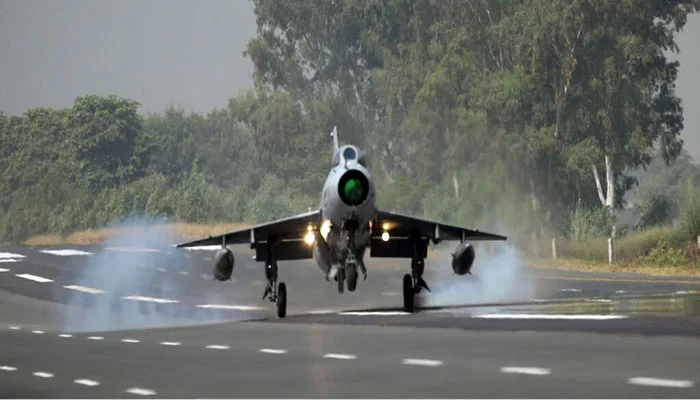
[A PAF (ex-Chinese) F-7P taking off from possibly the Lahore-Islamabad motorway]
It is despairing to hear and see a string of former generals, RAW, IB officials and the like, prodded by television hosts, daily emitting a lot of nonsense and hot air about what the Indian military may be planning to do, or should do, without anybody coming up with any definite ideas of how the Indian military should proceed. The contemplated Indian retaliation is, of course, for the heinous killings of domestic tourists on the Baisaran meadow in Pahalgam April 22 by terrorists from the Lashkar-e-Tayyaba (LeT) and Jaish-e-Mohammad (JeM) groups operating under a newly created and secular sounding nom de guerre — The Resistance Front (TRF).
The situation reminds me of the competitive “yellow journalism” of the mid-1890s one has read about, practised by two American media barons of that time — William Randoph Hearst running the New York Journal and Joseph Pulitzer the New York World, each trying to out-do the other with sensational headlines and coverage of the Cuban rebellion against Spanish colonial rule, that eventually prompted US President William McKinley to intervene in Cuba. The story goes that Hearst hired a famous illustrator, Frederick Remington, to provide sketches of the action in Cuba. Remington reached the island state during a leantime and wired back that nothing much was happening in Havana, only to have Hearst famously instruct him to stay put, saying “You furnish the pictures, I’ll furnish the war”!
Whatever any one says everyone, including China and the US, wants a fight and the situation is being media primed to deliver it, if only to see what Modi will do. The irony, of course, is that Modi’s rhetoric about “This is not an age for war” that he freely ladled out to Russia and Ukraine, Israel and Palestinians, has come back to bite him. For too long Indian leaders have gotten away with moralising about war only to have war or threat of war on our borders reveal them as poseurs. Jawaharlal Nehru got his comeuppance in the 1962 War. It remains to be seen if Pahalgam will be a climacteric for Modi.
Except, a lot of time has been wasted by the PM and the MEA trying to drum up international support for prospective Indian retaliatory actions which, by the way, has not been forthcoming. As reported in the media, the Indian government failed to insert a bare mention of “Pahalgam” in the UN security council resolution. It shows up the meagre returns on Modi’s activist diplomacy.
India does not need anybody’s permission or support to retaliate harshly against Pakistan for its asymmetric terrorist warfare undermining national security. Get on with planning and successfully executing punitive military actions to capture the Haji Pir Salient and Skardu (described below in broad brush terms) and don’t stop until these geostrategic goals are achieved — even in the face of international opposition. The trouble is India has never shown the spine to stand up for itself and its interests.
The Indian media is not actively promoting war, it is true, but is doing the next worst thing — speculating inanely about what India may be planning to do. Something is bound to occur because, well, Prime Minister Narendra Modi is caught between — in the circumstances — his moderate rhetoric, “India will identify, track, and punish every terrorist, and their backers” and his more bombastic, almost Trumpian-sounding but inherently vaporous threat, of visiting something “unimaginable” upon Pakistan. Rising to the bait, Bilawal Bhutto, following in his grandfather’s footsteps, promised a river of blood should India deny his country the Indus waters — slightly scaled down rhetoric, I suppose, compared to then Foreign Minister Zulfikar Ali Bhutto’s thundering on about a “thousand year war” with “Hindu India” at the UN in the wake of the 1965 War.
General Asim Munir, Pak COAS, has suddenly gone silent after his incendiary speech, in the Zulfikar vein, to well-heeled nonresident Pakistanis (NRPs) last week at an event in Islamabad — a counterpart of the annual Indian jamboree — “Jan Pravasi divas” except with anti-Hindu/anti-India venom, befitting a progeny of a backwoods mullah from UP who ventured a hijr across the Radcliffe Line. There were copious quotations from Koran — which apparently Munir is well versed in. The better educated among the NRPs sitting on sofas were plainly bemused, some of them even managed to look appalled, by their slightly unhinged-sounding army chief holding forth in recognizably “butlerish” English.
But there was more drama in New Delhi yesterday when Modi, in a meeting with the armed services chiefs of staff did something the latter did not expect. Cleverly, he not only shifted the onus and responsibility of choosing an appropriate retaliatory response for Pahalgam on to their professional shoulders — a decision that rightly is in the political domain and for him and his cabinet alone to make, but also of its success or failure.
Apparently, the TV cameras were allowed into the room after the PM had authorised the military brass to do what they think best. Because, the CDS and services chiefs looked sort of ashen, perhaps, because they suddenly found their metaphorical plates piled high with too much “political” stuff, besides having to alight on a set of significant military actions. It is the proverbial hot potato a politically adept PM has tossed to them.
No matter what happens or does not happen by way of the usual slow to get started Indian retaliatory reaction and Pakistani riposte, Modi wins (in terms of domestic politics). He can point to the armed services chiefs being afforded the freedom to choose whatever military actions they thought would have impact; should they succeed, he will be praised for respecting the military and doing the right thing in leaving it to the professionals to garner success. Should the chiefs fail in their choice of telling action, or worse there are operational snafus and failure looms, or still worse — an Abhinandan sort of embarrassment recurs except this time there’s no return of pilot(s), the CDS and the service chiefs will get hung by their lanyards. But Modi will be in the clear, even if he is met with derision and, internationally, loses face.
Our chiefs of staff and military commanders, the great Sagat Singh (as GOC 17 Mountain Division beating the Chinese PLA into submission in 1967 and retaining the Nathu La Pass, and as IV Corps commander helilifting his units across the Meghna River to ensure the “surrender in Dacca” in 1971) aside, have been conspicuously hamhanded in conceiving and conducting actual offensive operations. To wit, the failed 2019 Balakot aerial strike misorganised by IAF. It will be interesting to see what the CDS and the armed Services chiefs come up with this time that will have a salutary effect on the pesky but professional Pakistan army, considering they are working with Modi’s carte blanche.
Assuming all the commotion created by the two sides has not dissipated the tension, and the situation is being propelled towards some kind of reckoning, there’s consensus at least that India cannot any longer be subjected periodically to excesses by Pakistan-sponsored terrorists, that this cycle has to be broken, and a price imposed on Pakistan.
Unfortunately, the less visible option Modi would have liked to chose is what he voiced — identifying, tracking, and punishing the terrorists, and their backers, along the lines of apprehending Tahawwur Rana. That will take a few years. This is so because the Indian government has gotten into a bad habit of reflexively bending its knee to US, China, any big power. And because US President Donald Trump, who says he is “running the world”, declares that India and Pakistan would resolve the tensions in their relations amicably and without ruction, and also because US Vice President-cum-India’s damaad, JD Vance, has urged a “responsible solution”. OK, then!
But the Indian military chiefs have been hoist by Modi with the popular demand for retribution. Because holding the Indus Water Treaty “in abeyance” means nothing. Abeyance is not abrogation. It merely means in practical terms that India will be more forceful, first, in exploiting the three eastern rivers — Ravi, Beas and Sutlej, before turning its sights on the three western Rivers — the Indus and its two tributaries — Chenab and Jhelum. So, denying Pakistanis even “a drop” of any of these waters is not a practical proposition in the here and now, and cannot be engineered out of thin air in the near or even mid-term. Constructing the dam infrastructure and system of subsidiary dams, etc on the eastern rivers to divert them fully to flow through India — assuming it is at all, practicable, will take India some two decades to realise. In all this time, the western river waters will be available to Pakistan. So, that is hot air and gas, and won’t silence the Indian public baying for blood.
Many militarymen have taken to writing, and most of them end up waffling, having little to offer. For instance, take the former army chief General MM Naravane. The title of his piece — “Pahalgam attack deserves retaliation, India can borrow from US, Israel playbook” (https://theprint.in/opinion/pahalgam-attack-deserves-retaliation-india-can-borrow-from-us-israel-playbook/2600084/) promised more than the article delivered. “Let [Pakistanis] be on tenterhooks for a while till they start jumping at shadows”, he advised. “Meanwhile, we must build up global support through political, diplomatic and military channels of communication, for our retaliatory measures for when (not if) it happens, which could be in multiple domains, both kinetic and non-kinetic. It is time for India to bare its fangs and not fall prey to calls for restraint, or third-party assurances. India can always borrow from the US or Israeli playbook and draw support from international law which allows for such responses.” There was no elaboration on what aspects of the Israeli and US “playbook” Naravane wishes the Indian armed forces to replicate. In short, hot air!
Lt General HS Panag (Retd), the former Northern Army commander, is more no-nonsense in his analysis and recommendations. So, I was surprised that he set no definite goals for the incursion he recomends across the LOC (https://theprint.in/opinion/dont-act-hastily-keep-pakistan-on-the-edge-then-strike-decisively-repeatedly/2600446/). Like Naravane, he is against India “hastily blowing the war bugle”. Fine, India is doing just that, taking its time. Next, Panag suggests prosecution of “a short and intense limited war below the nuclear threshold [to] be exercised preemptively when the adversary least expects it” with the aim of pushing back the LOC “0-15 km to threaten strategic objectives before nuclear weapons come into play [and for] All launch pads used for facilitating infiltration [to] be captured.” This, he argues, “would force Pakistan to sue for peace as the China-Pakistan Economic Corridor would come under threat.”
Good he mentioned the “0-15 km” depth to which he’d like Indian forces to penetrate into Pakistan-occupied Kashmir. Considering that almost all of Pakistan army’s cantonments and concentration areas are near the international border and the LOC, debouching from them will be easier for Pakistani army units to affect than for Indian army formations which have to travel longer distances with their trains of equipment. Panag, apparently, just wants an advance across the entire LOC front with no specific purpose in mind. In the event, instead of a “limited war” we may have a replay of the 2002 disaster — Operation Parakram, with all the eyeballing ending in a bored mutual withdrawal after Vajpayee called it a day. The worst that can happen with Panag’s sketch of a plan is the Indian army will be stuck at the Zero end of the “0-15km” depth he plans to occupy! So, no that won’t do.
Pravin Sawhney, a former Major (Artillery), who publishes a defence monthly, contends problematically that the Pakistan military (1) “will outmatch Indian military in a war by a convincingly huge margin”, (2) “has much stronger strategic level which directly impacts the operational level of war”, (3) has the battlefield edge owing to the Chinese Beidou satellite constellation it relies on in cyber warfare and in munition guidance and, more generally, in electronic warfare, air defence, drones, and owing to induction of certain Artificial Intel systems, courtesy CENTIAC (Centre of Artificial Intelligence and Computing) under the Pak Air Force, which also enjoys a better pilot to aircraft ratio.
Actually, by my assessment, the only real military edge Pakistan enjoys is in the quality of its fighter pilots. This has historically been the case.
The hot-headed Pakistanis have afforded us strategic opportunity. Time to exploit it. Reacting to India’s changed stance on the Indus water treaty, Islamabad announced a “suspension” of the 1972 Simla Accord, rendering the Line of Control (LOC) in J&K a live ceasefire line that can be changed by either side using military means to advantage itself. In this context, does it not make sense for the Indian army to cross it to achieve certain specific aims?
The first thing to do is to put the Indian army’s holding formations on alert along the international border from Gujarat to Gurdaspur to threaten imminent action at anytime anywhere across it.
Having thus nailed the Pakistan army to static defence and inviting it to risk moving additional units to the LOC, the Indian army can take the Haji Pir salient last captured by Indian 1 Para in the 1965 War but returned to Pakistan for Chhamb that the Indian army lost to Pakistani forces (and lost it again in the 1971 War, for good).
The Haji Pir Salient (HPS) is a fat thumb sticking into India, and integrating it into the Indian J&K is eminently doable. There are only so many defensive forces the Pakistan army can push into the salient. Engaging them from three sides, with Special Forces pinching off the salient on the Uri-Poonch Line with this line quickly reinforced and firmed up with induction of Indian forces, will compel the Pakistani forces inside the salient to fight, to fight to get out of the encirclement, or to face destruction in detail. Remember any territory lost across a ceasefire line remains lost. HPS could be a cauldron, a killing field. An Indian Haji Pir would at once rationalise that part of the border and cutoff the easy south-of-Pir Panjal route used by ISI to infiltrate its jihadis into the Valley, as they did the LeT/JeM cadre into Pahalgam.
A similar lightning foray can be made in the far north to take Skardu — HQ, Forces Command, Northern Areas, Pakistan army some 40 kms across the LOC. Skardu in Indian hands will rationalise the line of control to the Saltoro Muztagh and India’s Siachin Glacier, and weaken a Sino-Pakistani linkup in the area proximal to the Shaksgam Valley gifted by Ayub Khan to China.
Hard geographic-geostrategic objectives-endpoints have to be articulated for any operations the Indian military undertakes; just advancing on a broad front across the LOC as Panag recommends ill-serves the cause Modi has set the Indian armed services. Capture of Haji Pir and Skardu are the sorts of consequential actions the military brass tasked with doing something of lasting and visible effect, should prioritise.
By the way, there’s not a spitball’s chance in hell that either or both of these operations will trip the nuclear wire primarily because it is disputed territory across a ceasefire line. Secondly because Pakistan becomes extinct in an all-out N-war. And thirdly, because the pampered Pakistan army officer cadres have too much to lose and cannot afford such a nuclear exchange, all their threats being so much hollow posturing that Western thinktanks and their ilk inject with credibility to advance American interests in South Asia.
But, there are two things, the Modi government and the Indian military simply cannot allow to happen once the action starts. Firstly, India should under no circumstances succumb to pressure from Washington, Beijing, UN or anybody else and stop its operations short of taking Haji Pir and Skardu and otherwise substantively altering the Line of Control. It is this LOC alteration that will have a permanent effect on GHQ, Rawalpindi, and profoundly reorder its thinking, outlook and approach to J&K. Asim Munir and fellow-believers can keep rehashing the “Two Nation Theory” in the aftermath of Haji Pir and Skardu in Indian hands, should the General survive such Indian successes.
The fact is, after suspending the 1972 Simla Accord, Pakistan is in no position to stop India from hugely changing the LOC!


 Security Wise
@BharatKarnad
professor a little bit correction the cover image of the essay it is mig21 not jf17
Pakistanis are well aware that Skardu can be a possible target they have started deploying fighter jets too
https://timesofindia.indiatimes.com/videos/toi-original/pak-media-paf-deploys-fighter-jets-in-skardu-in-occupied-gilgit-baltistan-amid-tensions-with-india/videoshow/120728982.cms
certainly haji pir can be a big moral and geostrategic victory for the nation. But can Pakistani tanks and Armour pose a serious threat to Jammu and pathankot from the Akhnoor dagger if we were to go for haji pir.
An excellent strategic analysis of the present situation. Is anybody listening in the military circles?
India’s political masters are only capable of lecturing others in the world stage … “this is not the era of war ….” !
Professor, I have read somewhere in the past military documents, that India’s northern commanders in the 1971 war wanted another forty-eight hours to continue their mission before declaring ceasefire to enable them capturing Skardu without a fight. But for some unknown reasons their masters in Delhi ignored them.
Is that true?
Sankar@ — don’t know about Skardu & 71 War, but both the US and Soviet Union pressured Indira G to terminate ops after success in east Pak.
Nothing will happen I’m confident in the incompetence of the government, and its priorities lie elsewhere, like the caste census. India will never become a great power; as you said, it will remain an inward-looking, third-world socialist republic.
Systems like this will always promote safe, incompetent generals. They lack the confidence to offer real solutions because doing so would mean taking responsibility and the current system punishes that.
General Harbaksh Singh was an anomaly.
Lt Gen Sagat Singh, tho’ Harbaksh was a damn good leader as well.
Dang! This is better than sending Paras for a Surgical Strike or the IAF payloads decimating some camps. Can India hold on to these territories once captured? If so, this a sucker punch that will reverberate for ages to come. Good one!
Aircraft depicted is a MiG-21 Fishbed, not a PAF JF-17.
You may be right. Didn’t pay attention. Pasted it from a Pakistani newspaper story and assumed it was a PAF aircraft!
Phenomenal as usual
My analysis stands that Asim munir aspires to be a dictator and even if army wins or lose the conflict he will win the Dictatorship and stronghold the rule over Pakistan suffering from multiple insurgencies and public distrust.
2 . In Kargil, after ceasefire instead of backing pakis started grouping equipments in batalik sector which resulted in IA assaulting and capturing the heights, Interestingly NBC suites were found in possession of paki troops which indicates towards possible nuclear usage plan which was later dropped by Pakistan army
similarly in Abhinandan case , indians wanted to use SSM missile with warhead,
these two scenarios envision that tactical nuclear usage below 1-2 kt is acceptable to these dumbfucks (leadership) who don’t understand difference between tactical and strategic usage. Usage of nuclear in sustained conflict doesn’t seem out of question
3. Pakistan may suffer annihilation, but Muslims will survive. There is only one India. I shall wipe out Hinduism from the face of the earth.”. – Zia ul haq
this statement sums up Pakistan army, these small attacks are nothing but part of positive feedback loop wherein terror attack happens hate for muslims increase and more radical hindu leader is demanded, once atal bihari was seen as hardline hindus then came modi who is now seen as softie with Yogi Adityanath next in line for leadership which will cause ripples in social fabric and aggravate the situation .
Islamic conquest of India has been going for hundreds of years first we lost our diverse pagan worshipping culture to this homogeneous Hinduism practised today that seems to move on path of Abrahamic religion with one selected book and code-fication of rituals taking place by polity . These sitution only cause hatred in people and distrust among them .
Shivam@ — No need to talk of 1-2KT N-weapon use when India has comprehensive conventional mil superiority with Pakistan
professor, the balakot strikes were more even handed as India did not have advanced air to air and air to ground communication links and a less capable R77 BVR missile. One only hopes that its military capabilities are superior now (it has fixed the two issues highlighted).
As to what the Indian military does, let’s see what happens. Your ideas about Skardu and Haji Pir sound appealing.
A more incisive set of strategic ideas than those emanating from assorted retired generals on television, who are as much known for their emissions of hot air as their luxuriant moustaches. Perhaps, it has dawned on the policymakers that India doesn’t have the same level of war-making impunity as enjoyed by Israel, seemingly our latest paragon, let alone by the mighty hegemon. The ulterior reason the crucial decision to cross the Rubicon has been delegated to the military-men is the risk of future ICC prosecution if things were to go appallingly wrong in the tit-for-tat escalation ladder.
Indian army comprises of two main sections; the retired ones are living their lives in luxury due to their fat pensions. They keep appearing on TV debates for war rhetoric.
The serving ones have only one aim, to retire like their predecessors and enjoy a good life. They don’t want to get into any war. National interest be damned. They are only bothered about themselves.
So forget any meaningful action from this bunch.
Dr.Karnad, many channels even spoke of a naval blockade. Doable ?
Soham@ — Doable, but iffier.
Email from Dr V Siddhartha, former Science Adviser to Defence Minister
V Siddhartha
Wed, 30 Apr at 7:33 pm
…. the catch with your plan — even if successful — is that it will leave us with more destitute M to look after.
Why do we want any more M?
So, this is my plan. Tell all phirangis who are urging “restraint” that we will refrain from kinetic and invasive LoC cross, if PAKI proposes (i.e. is forced to propose — even if via Saudi et. al. ) — that the LoC be made — formally — the border, and sign NPT.
The advantages are obvious. No more M. in K. A permanently restive PoK population that can be fed by us to conduct sabotage in Paki Punjab and elsewhere in NWFP. International accolades for Modi, an even chance for a Nobel. “we took the advice from China — the best victory is the one that is obtained without fighting”
VS
That stupid kamzaat should worry about the ballooning number of destitute H, which his wretched bigoted society, of which he seems a stellar role model, is eminently unable to handle in every way. He also seems like someone who would advise his defense minister to perform a yagna to soundly beat the nation’s enemies, no doubt a most scientifically sound advice according to his perspective.
The biggest problem we have is the lack of ambition. Spanish, during Reconquista, did not limit themselves to conquering few hills or valleys but total eradication of Moors – this expansive ambitious mindset is what led to their drive towards world exploration.
In a democracy such ambitions are stifled. BJP, Therefore, should change the paradigm and adopt Chinese Communist System, get our house in order and, eventually, takeover South Asia.
We should aspire to a progressive South Asia governed by a martial-technocracy, with a population of 500 million—100% of whom are H—and a culture and biology that are continuously evolving and refining.
@ Ranveer , BJP has already become a CCP type party. Most RSS/BJP leaders like the communists in China are staunch atheists at heart who care only for power like their supreme leaders. All these loud slogans of “Jai Shri Ram” are nothing but yelps to hide their vaccuous type Atheism at heart.
@typhoonmaximum254b0f9a4f
The problem with BJP/RSS is not atheism –which is a part of Hinduismos– but gerontocracy and gynocracy; their desire for approval and validation from Whites, M and H-servants; their unwillingness to understand and implement the Chinese System; their inability to understand the need for depopulation and selective multiplication; their lack of urgency etc..
Spanish retook Spain gradually not all at once. Savarkar, despite his realism, did not see acquiring PK as a necessity. Even the Marathas limit themselves to east of sutlej.
BJP does not have the guts to become the CCP, it’d require immense testicular fortitude to transform India into the Chinese System. Modi&co are peasants not martial rulers.
@Vikas
Savarkar was a liberal. He’s disliked by the M-right & H-servants because he, briefly, pointed at the nature of M. His conception of Hinduness is liberal and, therefore, underestimates the imcompatibility of H&M.
Marathas considered kandahar and Kabul as the boundary of Hindustan.
https://threadreaderapp.com/thread/1258463128867598336.html?utm_source=chatgpt.com
here is another one by the French envoy St.Lubin in 1783: https://pbs.twimg.com/media/Gpr7-k_XAAANHn-.png?name=orig
https://pbs.twimg.com/media/Gpr9HnhWUAEL0qN.png?name=orig
We have roughly 10 years to get our house in order, before we’re forced into a humiliation ritual of signing subsidiary treaty with either China or US.
Chinese Model is the only way out of our predicament. Everything else is a hollow rhetoric and meaningless posturing.
You are capable of doing… Ghanta.
Just see the societies Ms have fashioned for themselves from Malaysia to Turkey.
They may not be in the first world, but they run circles round what you have done on an overall societal level.
So, don’t throw silly crumbs like rocket to the moon, etc.
Mr Mister@ — Malaysia is what it is because of Chinese and Indian enterprise, not because of the peacefuls. Turkey is what it is because Kemal Pasha and successors suppressed its peacefuls after the humiliation of WW 1. So, don’t throw silly crumbs like Malaysia and Turkey, etc.
Incredibly ambitious. First step towards it is to create our own Monroe doctrine. We also need to step up covert ops in adversary nations. Japan needs to be made sovereign again. A militarised Japan is in itself a deterrence for us against China.
Dr Karnad, Some commentators are suggesting the current wait-and-watch game is better instead of outright attack as it is bleeding the pakistani army to stage their armies in the border areas. Some are estimating it to be 10,000 crore PKR/day. Do you think it is a reasonable approach ?
It is if there’s action at the end of it.
Email on a pertinent subject from Adarsh Pandey, an UPSC aspirant
Fri, 2 May at 3:21 am
Dear Professor Karnad,
I hope this message finds you in good health and high spirits.
I recently found myself grappling with a deeply unsettling query that has since become a persistent source of mental disquiet: How is Pakistan currently financing its covert operations and influence campaigns, both regionally and beyond? This question has troubled my sleep, and I feel compelled to seek clarity from someone of your intellectual stature and strategic insight.
While narcotics trafficking often emerges as the primary suspect in such discussions, the complexities of Pakistan’s evolving relationship with the Taliban regime in Afghanistan, coupled with increased U.S. vigilance in the region, suggest that this channel may no longer be as reliable or scalable as before.
An alternative—and perhaps more insidious—possibility seems to present itself: the systematic exploitation of cyber-enabled financial crimes and online scams. Might this be a significant, yet under-acknowledged, revenue stream for the Pakistani deep state?
If so, could a concentrated international or regional campaign—comprising both physical and economic cyber operations—serve to critically disrupt these funding arteries of this terrorist state.
In the unfortunate scenario that institutional responses are constrained by political or diplomatic considerations, I humbly ask: how might a determined and conscientious civilian pursue action in this domain? I would be profoundly grateful if you would consider guiding this line of inquiry, either as a subject worthy of broader academic or strategic reflection, or as a personal compass for individuals eager to make meaningful contributions to national and regional security.
Thank you for your time and attention. I deeply appreciate your consideration of this concern and look forward to any guidance you may be willing to offer.
Warm regards,
Adarsh@ — Yours is a very well articulated comcerm To be honest, I have not given this financial aspect much thought even though it is terribly important. I’d, however, point you to the activities of what I have called the “Rogue triad” of China, Pakistan, North Korea. North Korea, in particular with Chinese assistance, has perfected cybercrime as massive revenue source. It has also been the conduit to Pakistan of Chinese missile tech, etc. So, somthing to think about.
Email from Air Marshal Harish Masand, VrC (Retd)
Harish Masand
Thu, 1 May at 10:12 pm
Well said, Bharat.
(The picture, incidentally, is of the Chinese F-7P)
Thanks, Harish. The pic text corrected
@bharatkarnad Going by media reports Skardu and Gwadar are the first assets which Pakistan has tried to secure by placing F16s there. They after all matter to China as much as to Pakistan. This crisis has surely brought home the problem of the indo us nuke deal which has limited India to a middle rate nuclear power leaving our leaders vulnerable to Chinese pressure. Isn’t there a PLA presence in Gilgit Baltistan? While Skardu is of immense utility what is possibility of Indian leadership risking doing anything which will draw China’s ire. As far as international support is concerne. We have got no clear support. Only voiced of restraint.
May be it’s time for voices inside India to call for dumping the nuke deal and resume testing to send China a message finally.
Advocated against the N-deal from when it was being negotiated by Jaishankar some 10 years ago. Now we are facing the consequences that were foretold.
@BharatKarnad
Professor what stopped pm Narasimha Rao from testing the nuclear bomb in 1990-1995 itself?
https://theprint.in/walk-the-talk/this-secret-will-perish-with-me-when-narasimha-rao-was-asked-if-india-delayed-nuclear-test/1961746/
Vajpayee said that, in May 1996, a few days after he had succeeded Rao as prime minister, Rao told him that the bomb was ready and he can go ahead with it
What prompted his decision to test in December 1995? Why did he change his mind? Was it US pressure or something altogether more mysterious? Why did he pass on the baton to Vajpayee six months later?
The journalist Shekhar Gupta asked Rao these questions months before he died. The former prime minister patted his belly. “Arrey, bhai, let some secrets go with me to my chita [funeral pyre].”
Now i think we can know the real reason
would love to know your opinion as always
US pressure
Dear Dr Karnad , do you believe that Pakistan is capable of severely damaging our naval assets near Karachi by using Chinese missiles like Dongfang and Turkish drones like Bayrakhtar ?
Indian subs in the past have been in danger after detection by Pak ASW. And yes, Indian warships, like any surface combatants, are vulnerable to mssiles.
@BharatKarnad
Also to add sir
can INS Vikrant(which was supposedly heading to karachi last week) really pose a threat to pakistan’s economy and Karachi
or it can be taken out by cruise missiles
my point is do we need a aircraft carrier strike group against Punny Pakistan in such scenarios
No, no need for carrier ops. Refer my books and writings on the vulnerability of carriers and large ships to cruise and antiship Chinese ballistic missiles
Will Israel have any interest in breaking Sistan-Balochistan from Iran? If yes, the Baloch of Pakistan should first try to carve out a part of Iranian territory and establish an operational base.
If this ever materializes, Pakistan can expect Indian mridangam from both east and west.
No. Israeli interest is solely in keeping Iran below N-weapon threshold.
Well sir in a recent Youtube video Pakistani Ambassdor Abdul Basit says that if India blockades Pakistani shipment in the arabian sea then Pakistan would have to start negotiating and talking to iran for their oil and fuel supplies
is this practical or just a pipe dream from Mr basit side
Iran-Pak oil/gas pipeline has been on the anvil for years. But it
becomes profitable only if India is the terminus offtaking the bulk
of Iranian energy
I agree with Girish on this point Dr Karnad that Israel would love Iran to break up as it is currently trying to dismantle Syria. However what remains to be seen is whether Israel has the capability to do so. Israeli efforts to balkanize Syria so far is being resisted by the regional countries like the Saudi, Qatar, Iran and Turks. And Israel in order to divide Syria into statelets for Kurds and Druz has to continue to mobilize her already war weary population. This is tremendously increasing Israeli sovereign debt while gutting Israeli public sectors like education and fire fighters. Remember, last week Israel was struggling to douse forest fires across Jerusalem that forced it to cancel independence day celebrations and call for help from the European partners. Today public teachers across Israel are boycotting classes due to salary cuts. To conclude, both Israel and India have strong intentions to become great powers and reshape their regions in their own images however as things stand, they seriously lack capabilities to fulfill their intentions and are dependent upon predatory foreign benefactors such as the US
Except restricting an independent Kurdistan w/o including Kurdish parts of Turkey won’t do.
But Turkey won’t budge and that matters because NATO cannot do w/o Turkey (and the control of the Dardanelles and the Black Sea)!
Training the Baloch in warfare will be paying back Iran in the same coin as using proxies like Hezbollah, Hamas and Houthis to keep Israel in eternal state of war. Strike at Israel. Help create Gedrosia and end Iran’s low-cost war forever.
BTW, Iran has plans to move its capital to Chabahar, which makes strategic sense. But for now, they don’t have the resources for a new capital. If and when this materializes, it will mostly shut the window of opportunity on Israel.
Girish on this point I agree with you that Israel would love Iran to break up as it is currently trying to dismantle Syria. However what remains to be seen is whether Israel has the capability to do so. Remember the word CAPABILITIES. Israeli efforts to balkanize Syria so far is being resisted by the regional countries like the Saudi, Qatar, Iran and Turks. And Israel in order to divide Syria into statelets for Kurds and Druz has to continue to mobilize her already war weary population. This is tremendously increasing Israeli sovereign debt (from around 60 % in 2023 to about 70 % now ) while gutting Israeli public sectors like education and fire fighters. Remember, last week Israel was struggling to douse forest fires across Jerusalem that forced it to cancel independence day celebrations and call for help from the European partners. Today public teachers across Israel are boycotting classes due to salary cuts. To conclude, both Israel and India have strong intentions to become great powers and reshape their regions in their own images however as things stand, they seriously lack capabilities to fulfill their intentions and are dependent upon predatory foreign benefactors such as the US. Ever since , October 7 2023, Israeli dependence upon the US has increased manifold for money, arms as well as diplomatic support. I believe secretly the US is happy to see the Israelis to continue their war efforts and get into an unbearable debt trap burden , giving the US the power to dictate and manipulate Israel like US does to once great European powers like UK France or Germany.
@Aditya Mishra, Technically, Pakistan can easily transport all their energy from Iran if and it is a big if that India is able to choke the Karachi port. Already there are plenty of smuggling networks present from Quetta to Lahore that smuggle Iranian fuel from Balochistan to the Punjabi heartlands and almost all of these networks are dominated by the Pakistani military. So what Pakistan needs to do is just authorize this illegal smuggling trade. Remember there is already a energy pipeline from Iran that just stops at the Pakistani border and Pakistan has both the technical capabilities as well as the practical intent to operationalized this. The problem lies in the external front. Will Pakistan’s foreign benefactors such as the US, Saudi and UAE allow this to happen ? This is something one doesn’t know for sure. The Saudis, thanks to the Chinese meditation are enjoying better relationships with Iran so they may not be too petrubed. As per the US is concerned, at this moment they are distracted with a lot of issues at present and may not be bothered too much. One additional point here is that if Pakistan makes the bold step of importing Iranian energy, the insurgency in Balochistan may ebb and curtail since flourishing border trade may mainstream some of the these Baloch insurgents into becoming stakeholders in an Iranian Pakistani joint border trade venture. So to conclude, Pakistan has the technical capabilities to import energy from Iran but external pressure may play a part in influencing this.
@BharatKarnad
Haji Pir is no doubt symbolically significant, and Skardu even more so, but both sit in some of the most unforgiving terrain in the Indian subcontinent. Any real push there would demand weeks of sustained logistical buildup – supplies, artillery movement, air cover coordination – all under constant surveillance and likely interdiction by Pakistan. Skardu especially is too deep inside Gilgit-Baltistan to be a feasible objective without committing to a full-scale war, something the Indian establishment is clearly not aiming for by the looks of it. We’d be looking at a multi-division operation over mountainous terrain, with long and exposed supply lines, and no guarantee of strategic surprise.
There is no conventional road from India to Skardu, any assault would entail crossing high passes from the Nubra or Dras sectors or conducting a large-scale airlift. Pakistani forces in the region include acclimatized mountain infantry and local militias, backed by artillery. The terrain south of Skardu is dominated by 5,000–6,000 m peaks, where thin air and extreme weather are constant factors. In practice, India has never attempted a major offensive into Baltistan since 1948. A modern landing or assault near Skardu would require an unprecedented logistical effort likely involving airdrop-supported glacier crossings and would risk isolating Indian troops on three fronts (east, south, and west). On top of that, any movement near Skardu could draw Chinese scrutiny, given that PLA forces are positioned just across the border in the Shaksgam Valley. ( No disrespect to the Indian armed forces but do you really think they are competent enough to pull this off? )
Also, holding either Haji Pir or Skardu post-capture isn’t a minor detail it would require a sustained troop presence and heavy fortification under constant threat of Pakistani counteroffensives. This isn’t a clean, punitive strike, it’s a drawn-out, resource-intensive campaign with uncertain returns and significant political costs. Frankly, I don’t think the Indian public or policymakers have the appetite for that kind of commitment. And in all honesty I don’t think Indian special forces are good enough to conduct operations there without heavy casualties. In 2023, the estimated kill to death ratio was ~2.6:1.
The strategic logic is understandable, but it would be an operational disaster- even for the Americans or the British, who are among the most capable fighting forces in the world.
Bisht@ — All you say is true. Even so, Haji Pir is very doable.HP capture is for keeps, and so deployment of a large force in the salient is par for the course and would, in fact, be easier to maintain than the forces presently arrayed around the salient. Without a logistic buildup, less so Skardu. Indeed, in a discussion, a recent corps commander in that region rated Skardu as doable as well.
Godi media is indulging in full drama to fool the masses;
Example- This so called air raid siren warning scheduled to be held tomorrow. I am yet to see any civilian bunker in any part of India. Where do you expect the people to go?
Army is reluctant to fight any war and Modi has lost his self proclaimed ‘macho man’ image.
India attacked pakistan today. You must be happy now with the war mongering!
I am far from a warmonger as regards Pakistan, and have long advocated coopting the Pak elite
to build lasting bridges. But not reacting to Pak provocations is to incentivise a small
militant section of that society into becoming insufferable.
@BharatKarnad
bahawalpur,muridke and muzzafarabad(all headquarters of the terror groups Let,Jem,Hum) were choosen as the main targets for the missile and bomb strikes conducted midnight on 7th may
can you write a blog on this professor like you wrote after balakot
unforgiving terrain, impossible, we need 1:5 force ratio, ie what we hear when it comes to PoK. Then how rag tag Pak tribal army so easily captured the entire PoK including GB? in such a swift campaign? May it was free for all open border without any army from J & K king.
Defender may have insurmountable advantage in mountain warfare.
My be we should deploy long-range stealth armed drones 1st to destroy enemy defense line, forward posts, bunkers, ammunition depots, back-end logistic supply lines.
Our ground forces move only in the end for mop up operations and set up our own defense line and fortification.
Was not the capture of Siachin glacier more challenging than GB & Hazi Pir Pass