
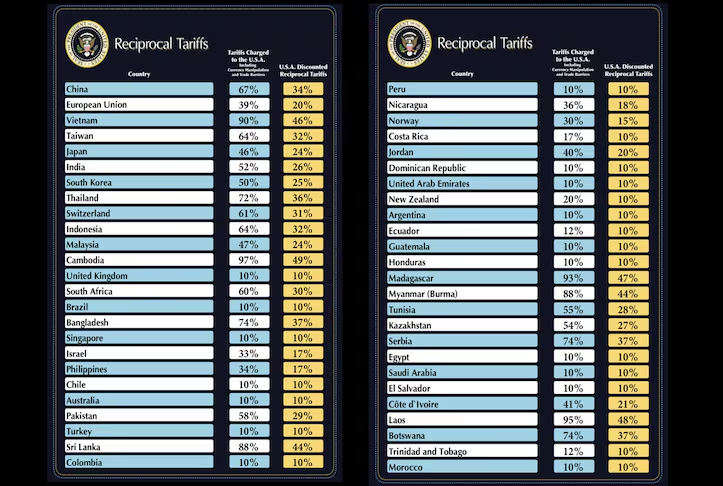
[Trump’s tariffs and counter-tariffs chart]
Sure enough, US President Donald Trump did what he promised he’d do — upset everyone’s economic applecart, including America’s. His “reciprocal tariffs” across the board on every country trading with the US makes no economic sense. But he is delusional enough to believe that disrupting the world trading order will somehow find America at the top at the end of a period of turmoil that he has loosed on the world. All the US Treasury Secretary had to say (to CNN) was that, instead of instantly retaliating, the affected countries should “take a deep breath” and do nothing, certainly “not escalate” by imposing more tariffs on American goods and commodities.
In one sense, it may be seen as the last gasp of a creaky old great power making its exit with a bang!
Charged by the Trump Administration of imposing an average tariff of 52%, the counter US tariff on India is 26%. China’s figures in the same categories are 67% and 34% over and above the 10% already imposed on Chinese exports to the US. America’s Asian partners are not spared. Japan’s 46% tariff rate draws 24% tariff; and corresponding figures for Israel are 33% and 17%, South Korea’s 50% and 25%, and Taiwan’s 64% and 32%. It proves, what I wrote in a post a few months back, that Trump is no one’s buddy and America is no one’s friend.
Taiwan is almost equated with China for tariff punishment, which is curious considering US Defence Secretary Pete Hegseth said in a ‘secret memo’ to the Pentagon brass disclosed by the Washington Post, that preventing Chinese takeover of Taiwan was the priority even if this means “assuming risk” in Europe. This last premise owes much to Trump’s pally relationship with President Vladimir Putin and his willingness to throw Ukraine overboard if that secures — and this plays on Kremlin’s historic apprehensions about China — a US-Russian entente to stop China — perceived as the more onerous threat to both the US and Europe.
Actually, such a concert serves India’s strategic purposes well, and New Delhi should stoke this policy tendency in Washington and Moscow as much as it can. With the US and Russia militarily stretching China in the east and the west on the Eurasian landmass, Southern Asia and the subcontinent will get less attention from the PLA, which’s in India’s national interest.
Yes, but what about Taiwan? With extortionist tariffs, whether intended or not, crippling the Taiwanese industry and economy, Trump has happily ensured, writes ‘Typhoonmax’ — a reader of this blog in response to the previous post, that China need never “invade Taiwan i.e. [Trump’s] tariffs will probably encourage the Taiwanese to cut a Hong Kong style ‘one China two systems’ type reunification deal with Mr Xi.” Exactly right, and the Goumindang (KMT) opposition party of the late Generalissimo Chiangkaishek that for a very long time ran the “nationalist” government in Taipei, may facilitate such a transition because, well, it too claims Taiwan is part of China it hopes to once again rule!
Such a denouement would be bad for India, because strategically, this’d permit Beijing the luxury of taking its eye off Taipei and redeploy its military forces now massed on the Fujian coast, to its “Western theatre” — Tibet and Xinjiang where Chinese strategists espy the most potent threats not just from India, owing to the disputed border, but also from Tibetan and Uyghur (in Xinjiang) secessionist sentiments and from the spread of Islamic terrorism.
The insurmountable problem for India — no great revelation this — is the phenomenal rise of China. Any visitor to China — and I have visited that country several times, cannot but be astounded by its spectacular and visible economic and technological growth. Shanghai is an obvious showcase for everything that’s gone right for China. Looking at Pudong from the Embankment in Shanghai is verily to see the future. Haven’t been there — but Thomas Friedman in the New York Times column, has talked up the newly constructed Huawei campus in Pudong as the centre of technological advances for the world.
Experts who have studied China’s rocketing rise attribute it to the Communist rulers from the beginning investing in STEM disciplines — science, technology, engineering, mathematics primary school level up, when Jawaharlal Nehru was building the “new temples” of India — the Bhakra Nangal Dam, etc. but in the education sector, the IITs and IIMs that have produced the feedstock for the US and West European economies — providing efficient engineers and managers for their burgeoning post-World War Two economies. It was a lovely fit. But Nehru paid no attention to primary schools in the countryside and in the cities and to raising the quality of education provided. So these “schools” other than remunerating the “teachers” who pocketed their pay and went home, offered such absymally bad education, virtually no formal education, they became assembly lines for producing rank illiterates, who joined mofussil “colleges” and graduated in illiteracy, and then hankered for sarkari jobs, and once in them lowered the quality of governance! It was, in effect, an unvirtuous cycle of scam sustained on public monies. But surely, Nehru did not intend all this to happen. But in a manner of speaking, he did encourage precisely the seeding of the urban talent pool groomed in IITs/IIMs for technology serfdom, different only in degrees from the indentured labourers from eastern UP, Bihar, and Tamil Nadu the British colonial government shipped off to run England’s lucrative plantation economies in the Indian Ocean (Sri Lanka, Mauritius, Seychelles) in the Pacific (Fiji) and in the Caribbean (Trinidad and Tobago). It made the Indian state and society incapable of technology creation and innovation on mass scale. Upskilling this sea of illiterates to service an AI-laced technological future is plainly beyond the Indian state’s capacity. What happens now? Who knows!
But sticking with the coolie stream seems to be still a policy priority. Look at the disproportionate political-diplomatic capital expended by the Modi regime in opening the H1B visa (and equivalent) route for swarms of would be IT coolies! The fact is IITs and IIMs have not produced technology inventors and innovators. All that the great software factories of Bengaluru and Cyberabad — Infosys, Wipro, TCS, et al, make money out of is by writing code — their bread and butter — which is glorified coolie job, that is now being done better and immeasurably faster by Artificial Intelligence. May be Indian engineers will become skilled in wielding the AI to, what else, get work abroad.
But the troubling and worrying question is this: Is there any original software written in India? The minister in-charge realised this only a couple of days back that there’s none! Even more where’s a ‘Deepseek’ kind of revolutionary technological invention? China seems to have these inventors and innovators coming out in droves. They are adding high-octane fuel to the already astounding pace of progress by that country. India is near zero in this realm of technology creation what with a bureaucracy-heavy state system configured to squelch innovation and technolgical advancement. For all the rhetoric — look at the state of tech MSMEs in India. And then look at the prime tech entity in govt sector — DRDO, the screwdrivering specialists, and one begins to appreciate how badly off the country really is in this sphere! Clearly, the necessary technology creation/innovation ecosystem is absent in India. But, how is it that the even more, bureaucracy-wise, turgid “state socialism with capitalist characteristics” ideology and system in China is now the source of endless and astonishing new technologies?
It may be because, as I have repeatedly mentioned on this blog over the years, Indian culture. It has refined the science of abstraction — most famously in conceiving the mathematical symbol “zero” and the decimal system. Great kings and empires in India, however, created no monuments of practical use. There was no tradition of science application. The zero and the decimals did not fetch the natives of this land engineering advances. It had to go via the Arabs to Greece and to spread to rest of Europe for its engineering possibilities to be actualised.
The Chinese culture on the other hand was high on the applications of knowledge — they invented just about anything one can think of — paper, paper money, gun powder, seisomograph, wheelbarrow, compass — oh-look up Wikipedia! And the merit-based civil service — the Mandarinate! Ruling dynasties were known by the massive public works they constructed — the Great Wall started in the 7th Century BC and built over the next 2,000 years — think of it!, the Grand Canal on the Yangtze River and associated system interlinking rivers, the oldest of these dating back to the 5th Century BC! Indian kings and that lot left behind nothing to remember them by — oh, sure, Taj Mahal, what good did that do for the people? In fact, the only enduring public work one can think of by an Indian ruler is what’s come to be known as the Grand Trunk Road built by Sher Shah Suri in the 16th Century, connecting Kabul to Bengal.
There’s a reason Indians are culturally attuned to not being good at creating anything practical from the knowledge they have — the caste system, which looks down upon those who work with their hands. I remember Sam Pitroda telling me in the late 1980s that he hails from a family of carpenters — work that won his father no respect. He somehow made it to America where working with his hands he designed electronic switching systems and got patents that made him rich! So culture, in effect, has been an obstacle to modernity, to the establishment of a flourishing industrial sector even. Of course, the caste restrictions are breaking down, and it is a good thing too, but not fast enough to make a difference. The other aspect encouraged by the British was to make servants of Indians who for a small but regular pay would do anthing for the firangi, serve anyone for a consideration! The Raj turned Indians into servitors, yes, and also dependents with the state portrayed as maibaap. Hence arose a nation of servile babus, from the ICS at the top to everyone down to the lowliest sweeper — who looked for security in his regular monthly pay. This was also the main reason for the military labour in the Mughal times shifting over to serving the East India Company and later the British Indian Army. There was nothing ‘martial’ about any of it.
China was never weighed down by such cultural impedimenta. It however needed a Communist apparatchik to release the brakes on the people’s aspirations — and this the great helmsman, Chairman Dengxiaoping, did with some common sense directives to unshackle the Chinese genius for craftsmanship and commerce, and build up the economy that way. Of course, he had America helping out by opening up its market and transferring military tech to firm up the PLA — all this as part of the Cold War game of turning the power balance against the Soviet Union. In the sheer mass and the drudgery of the Communist system in China, Deng’s successors still found that the country needed to catch up with the tech front rankers. So, the next thing they did was fast-forward the process by simply getting the very best brains from all over the world via its “Thousand Talents” programme which has spawned its adjunct — “Thousand Young Talents” programme for Chinese youth which is now advancing the economy with technology inventions and innovations.
And here’s India, which has yet to find its Deng.
I may have mentioned this but one of the pioneer theorists of quantum computing and one of the really heavyweight algorithm writers who once worked in our nuclear programme and then in the soul-crushing confines of CDAC (Centre for Development of Advanced Computing), Indore, took up the offer from an elite Chinese University after he failed to find Rs 3 crores here at home to set up a centre for algorithm writing. Mind you, he approached, I know, everybody from the highest in the govt and IT industry but got nothing from them except hot air and pat on the back. The Chinese so valued him, he was given his own newly established centre to run manned by the best and the brightest among Chinese STEM students for him to train. His annual remuneration package? $1 million (in hard currency) as virtually pocket money + beautiful house in the elite part of town + expenses! This was some 10 years ago. He may be making multiples of that money now and has the satisfaction of seeing his work manifested in high-tech devices and technologies. May be it is coincidence, but it is after he shifted there that China launched the first operational quantum tech satellite in the world!
But, I digress!
Sure, there’s no comparison between India and China. Each country has had to work through its set of problems. The Indian government works on the principle that there’s all the time in the world to do things, the slower, more evolutionary, the better — a legacy of the Indian freedom movement leaders being mostly lawyers working the margins of legal minutiae and comfortable with the system the British left behind that produced more paper than good decisions or good governance. In China, the revolutionaries with their peasant vigour uprooted the old system more thoroughly, and gave themselves a chance.
Realistically speaking, India is no match for China economically and technologically, and will never be because there’s no hint of radical reforms animated by an Elon Musk-ian type of “move fast, break things”-approach to making over the government and the improbably sluggish Indian system generally. So, besides hoping for a fruition of the Russian-US nexus strategically to contain China, is there anything India can do to brighten its prospects at a time when Trump — whom Modi painted as his good friend, has dumped on India? The Modi government, as has been suggested, can ease the entry of Chinese companies — the tech leaders in their fields — to set up factories in India with Indian investors, and repatriate profits but with the proviso that inside of 3-5 years all the components that go into the product lines would be manufactured here.
But economic cooperation should be no reason not to try and do China in, in terms of aiding and abetting two causes — those of a “Free Tibet” and of an independent Uyghur East Turkestan Movement, and in strategic military field by proliferating Brahmos supersonic cruise missiles to Southeast Asian countries and Agni SRBMs and MRBMs at “friendship prices” along with any other Indian produced military hardware, excluding nothing. That’s what secret understandings between states are for!
The greatest flaw in the Indian institutional strategic mindset is that it is not strategic, because it is too set along linear lines. If India trades with China, it cannot also undermine it in various military ways, etc. China believes in just the reverse– that good economic relations is no excuse for not screwing the adversary in every other respect. The twain don’t meet, and is the reason why the Indian government learns nothing and the country is supine, keeps getting it in the neck everytime.
One other lesson the Indian government refuses to learn. Trump has done India a favour by proving once again that he doesn’t care for India any more than he worries about — name any country, Uruguay! But the tariffs have done us one big favour — it is showing the way for Modi to “free marketise” Indian agriculture — get the Indian State out of the farmer’s life and business, scrap the minimum purchase price for agricultural produce, etc., and he can blame America for holding India’s feet to the fire! Once they become competitive, these same wealthy farmers (from Punjab and Haryana) who sit on well-fed dharnas at the slightest pretext and are as far removed from the subsistence agriculturists all over the country, as China is technologically from India, will thank Modiji for allowing them to find markets in the far corners of the world. This is potentially the only gain!
But, much worse, may be in the offing. Trump may cajole or coerce Modi into buying high-priced, ridiculously useless military hardware, like F-35 combat aircraft. Buying more C-130s/P8Is/C-17s is one thing. The Modi government, which made a humungous mistake by buying Rafale, will compound it many times over if it goes in for the F35 — it will be 100s of billion of dollars (in life time cost) down the gutter. It will, mark my words, spell the end of the indigenous Tejas programme — 1A, Mk 2, AMCA, the end of the IAF as a serious force, and of India as an independent and sovereign variable in the global balance of power system.


 Security Wise
“Dernier cri” of a sliding hegemon. India should now gauge the consequences of tethering its ship of state to the proverbial Titanic. After this, under no circumstances, should the Modi govt kowtow to further American demands nor open agriculture and dairy markets to impoverish the farmers and dairy-workers.
i think you need to explain Dollar role here as well . Since years ,US is printing dollar endlessly and getting whatever they want from world(due to reserve currency status). inflations has been passed to other nations because of endless printing. Same dollar used for implementation of 2 buckets theory all over world . Due to this over printing they are already reaching redline and dedolaziaztion must happen to save US from huge depth. Once manufactoring moves to US they need to reduce dollar rate in order to make their product affordable to other countries. And If this doesnt happen China will take controll of all US security and defence infra(as parts comes from china). Due to all this most of DS tool kits are already started establishing their offices in India.
Amongst all the doom and gloom, here is an optimistic theory. The Trump Tariffs have the following purposes. 1. To raise some revenue for the federal government. 2. To force countries with large trade imbalances to invest/buy American. 3. To provide incentives to American companies to invest in the US. 4. China will be singled out with higher tariffs at the end.
People forget a few things. It was the Smoot-Hawley Tariff Act (1930) that deepened the global recession. But it was the Reciprocal Trade Agreements Act (1934) that allowed the US president to cut deals with countries that was the start of the end of the depression.
This is about cutting deals – that is what Trump likes to do and claim victory! The objective here is addressing the imbalance and investments for the working class – his vote bank. Except for China and that too only due to pride and not power, none of the other countries have the hard economic, let alone military power to retaliate.
I expect deals galore and loads of volatility and rewards for the brave, who can invest in these times!
Shaurya@- I do not agree with you on this that countries other than China do not have options for retaliation. Europe can close down US cloud capitalists by taxing them to extinction as Yenis Verufakis says. Remember US has a huge service export surplus with that region. Most prominent US commentators are hinting at this. Japan , Korea and Taiwan can suddenly do a FTA with China. Japanese and the Koreans are already talking with the Chinese about this. I am also not so sure about the transfer of technology to the US. The Taiwanese sent one chip plant in the US but they have ensured that the plant doesn’t work with American labor.
Shaurya@ – You are living in La-La land. Seems you have swallowed the Trump narrative hook, line and sinker without exercising any of your grey cells.
Professor,
I have read very few articles that actually analyse the impact of tariffs on the U.S. economy. Most of the articles I have read are superficial and do not examine the impact in detail.
However, there was an article in Foreign Affairs a couple of months back which did analyse the issue in some detail. The key issue on tariffs is the difference in the nature of the U.S. economy in the 2020s versus the 1920s.
In the 1920s, the U.S. was a manufacturing powerhouse and was exporting goods to the world. So when it raised tariffs, it hurt its own economy by thinning out manufacturing and causing he Great Depression. However, now China is the manufacturing powerhouse. Raising tariffs on China will hurt China more than the U.S. In fact, just like the U.S., the impact on India may also be limited, as India does not do too much manufacturing. I found the article compelling. However, I must say that I do not understand the complexities of the issue well enough to judge what will happen.
There is anecdotal evidence from 2018 that tariffs on China did not hurt the U.S. economy as much as discussed. I’m hearing similar voices from Tom Lee, a respected stock market analyst on CNBC, now. Yet, the major banks are saying that the probability of a U.S. recession has gone up to 40-50%. So perhaps we have to wait and see what happens.
If reciprocal tariffs lead to a reduction on tariffs in an FTA, it will force inefficient Indian industries to become competitive. As in defence, Indian business does not reform unless there is a crisis. There is no investment in R&D – that is why I’m pessimistic about private players in India transforming he Indian defence landscape.
I watched a clip of Jeff Bezos describing why the U.S. innovates so much and is successful in creating transformational businesses. He said, 80% of the reason was the availability of risk capital. If Indian businesses don’t invest on their own businesses, who is going to make the risky bets that can transform Indian industry? Not going to happen. Therefore, one must keep expectations low with India, and hope competitors lose strength by making poor decisions for India to gain relative power. Otherwise, India will forever remain a country with potential.
So his socialist rhetoric aside, Chacha Nehru was a snob. And his family’s courtiers in the Intellectual class are covering it up.
Sir, do you see any scope for improvement wrt bureaucracy, military, MEA ? Politicians are useless so exempting them.
With the kind of intellectuals & bureaucrats we have, revolutionary change through the system seems impossible.
Only an event like the Turkish/French/Russian revolution will save India ?
Yenis Verufakis makes very clear that Trump’s ultimate plan is to shift high-tech manufacturing from the rest of the world US. Germany, France, Japan, Korea, Taiwan are in this category. It doesn’t make sense for these countries to allow shifting of their high-tech industries to the US and jeopardize their future generations. It will be better for them to de-risk and de-couple their markets from the US and build better relationships with the Chinese as US is not trustworthy.
Email from Dr V Siddhartha, former Science adviser to defence minister
V Siddhartha
Thu, 3 Apr at 9:20 pm
Re: ‘… and of India as an independent and sovereign variable in the global balance of power system.”
Why should it be, if it could be, which it — according to your lamentations foregoing — it cannot be, anyway?
VS
One thing we need to do as a nation against these Trump tariffs and that is pull down the rupee against Dollar. Unless Rupee crosses 90-95 in the next six months, our IT software services behemoths will be going out of business soon. Chinese Yuan is already down slightly to offset the Trump Tariffs. Let’s see what happens to the Rupee. The only problem with an weakening rupee is then that we reach 5 trillion USD economy maybe 3-5 years later.
Dear Dr Karnad, First of all thanks to you for mentioning my viewpoint on Taiwan with regards to the Trump tariffs. “Ultimately, the strength of these alliances depends on whether the Trump administration views them as long-term bulwarks against China’s rise in the region or merely vassals that can be extorted for financial gain.” I am referring to the above in quotes from an article in Asia Times about how Trump sees the US long term alliance partners in Asia like Japan, Taiwan and S. Korea. What Trump wants from them in the long run are two things. Number one, convert their holds on the US government debts into very long term (100 years according to Verufakis) debt so that the US don’t need to pay them in a hurry. Number two, pressure the allies to transfer their complete high tech ecosystems to the US. I believe India is also viewed on these same lines. We will be required to continue to invest in costly American bondoogles like F-35 etc. and expected to shift some IT jobs from places like Bangalore back to the US. How will Modiji react ? I don’t know but after being in power for 11 years , I feel Modiji alongside mr Jayashankar and Mr Doval are feeling safe secure and status quo.
Hello Dr Karnad. Is the theorist referred to in the article Dr Arun k.Pati ?
No. But did Dr Pati rise to the Chinese bait?
Well he should leave this 3rd world country. What’s in it for him anyways; there is also a chance some moron will kill him for parking issue. Third world country who can’t even build roads, is incapable of addressing basic civics issues. Even Africa is better than us. Does anyone hold these babus — one exam wonders, accountable? The citizen should know their rights and not crawl in front of these govt officers.
Random thoughts:
China has imposed 34 percent tariffs on US goods. The only thing we need to observe now is whether China devalue Yuan again. Once China does so, the impact of tariffs will be nullified. Other Asian nations will also then follow China’s example to devalue their currencies so that China doesn’t take over their export market share. Meanwhile, South Korean pro-US president has been impeached by their constitutional court. A snap election will follow soon and with anti-US sentiments prevalent, the pro-China candidate may win. In that case, China will be closer to win both in Korea and Taiwan. All thanks to Mr Trump and his tariffs.
Blaming everything on caste system is a lame excuse.Every country had hierarchical systems like caste Japan,South Korea.
Americans had a bloody slave history.
If after 70 years of reservations, scholarships if India is not developed than the bahujans who are in majority and vote politicians based on caste have to take responsibility.If caste is their priority over civics issues, education, Excessive power in hands of babus who have throttled business in India and killed it’s animal spirit than who is to blame.You get the politicians you choose if people don’t have aspirations or ambition than who is to blame.If you aim for pass class you will end up flunking your exams
Out politicians are dumber than politicians from US. US politician don’t delegate policy-making to babus their laws are not vague giving room for “interpretation” .Babus deliberately draft vague laws which gives them a lot of power.It let’s them enjoy power without accountability.Our politicians are only focused on next freebies schemes by which they can win election.Is this democracy?
US babus execute the agenda set by politician and if it fails citizens hold the politician accountable. India is not a democracy but babucracy, even mobocracy, where vested group rights are superior to individual rights. No other country in the world has this discriminatory kind of reservation policy. India was woke from its conceptions what did it achieve?
Even now the mentality of Indian policymakers is that US will save us.We should have service economy do this morons know the service economy will massively be disrupted by AI yeah but who cares this babus and elites have no skin in the game as their children study and most likely will settle abroad and they can exploit India like British used to do.They will just tax the aspirational middle class more and play caste politics.
It will only get worse from here when the likes of Tejaswi Yadav will be in policy making, whose solution to every problem is more reservation more govt control.
Such morons think wearing Burberry tshirts will make them equivalent of their western counterparts.
Even to copy something you need certain degree of intellect which our politicians and babus lack. Its the middleclass who had the ambition and desire to see India become superpower the aspirational class who have been taxed, hounded by babus
Caste is not responsible for all ills. But, it is, as I maintain, the reason for the corpus of mostly abstract Indian knowledge not being converted into applications with everyday utility, into engineered devices.
@bharatkarnad kindly read Dr C K Raju and books published by Infinity Foundation (Rajeev Malhotra) on History of Indian Science and Technology. Several examples of application of tech exist in metallurgy, sea navigation, public civic works etc exist.
http://www.indianscience.org/index.html
Email from Air Marshal Vinod Kumar Verma (Retd)
vinod kumar verma
Sat, 5 Apr at 9:10 am
Good one
Professor,
Regarding two points you make – last gasp of a declining power and ‘coolie’ work – you are wrong on both fronts. The American innovation engine is still alive and kicking. While the tariff wars will create a period of uncertainty, DOGE is trying to fix bloated spending and cash position of American companies is strong. Also, every region except India is also declining economically. So relatively, the US is not doing so badly.
Secondly, Indian IT service companies no longer do only coolie type work. They have moved up the value chain and are doing more product development and engineering work for many U.S. corporations. In addition, many data science and engineering Indian companies are also spending much on R&D unlike the rest of Indian industry. So to characterise their work as coolie work is the results of an ignorant mind set.
Amit@ — The point I was trying to make is that the bulk work of these companies is still code writing. Sure there’s some product development, but the tech benefits and profits from the original design and R&D work done in the 1,900 GCCs, etc. accrue to the American/European parent companies and hence to the US and West European states. So, how’s that different from the monetary or other value of his work profiting, not the indentured labourer personally but his owner?
True that the MNCs benefit. But this is how Indians are getting trained and eventually will build an eco system in India that adds value. Also, there are some new AI/ML service providers that do good work for many US and European clients and these companies are doing cutting edge work as many U.S. clients are way behind the curve of this technology adoption. So for certain fields in tech, Indian companies are doing good work, but it’s early days. However, in general Indian companies do not innovate much.
Eventually, to paraphrase Keynes, we are all dead.
You are absolutely correct in using the said word, disparaging and history-laden as it may be. That is what the bulk of Indian techies do, not to speak of call-centre employees and hospitality workers. BTW, the Keynes quote goes: “In the long term we are all dead”.
Professor,
The reality of India is hard to characterise. India does not do large scale innovation, but adopts innovative technologies to innovate on micro scale services. The UPI and the Aadhaar are a couple of large scale innovations that have transformed service delivery in India. From paying maids and cooks, to groceries, medical and other services is very easy in India compared to other countries. Indian IT firms are also doing more value added services in the West – definitely not coolie type work.
Indian manufacturing is also good when technology comes from outside. I have seen it first hand in the battery space. But the tech for that came from outside.
There are services offered in India that are not available in the West. Home blood tests, home camera installs, property management services, cooking services, etc. All make life convenient. So there is innovation happening in providing all kinds of services.
The type of capitalistic innovation in the U.S. is large scale frontier edge innovation. Billionaire making innovation. It’s different. India absorbs these technologies to provide innovative services on it. WhatsApp was created in the U.S., but making payments using QR codes on WhatsApp by businesses is uniquely Indian. There are other examples.
So it’s hard to put your finger on the pulse. Clearly, ore needs to be done, but there is also much that is being done.
Amit@ — Micro-application and indigenising of imported tech is fine. But after 20 years of reform, one would have expected India to have created the base for big tech creation and innovation. As Meiji Japan did, post-War S Korea and Japan did. And these were government driven and incentivised. That’s not happened here and there are no signs of any of it happening — and there’s my peeve.
Professor,
One cannot but agree on the slow pace of change in India. However, if you look for comparisons, there is really no comparison for a country like India. A billion plus people with 29 state governments who don’t necessarily have to follow what the central government wants.
If you look at Japan, Russia, France, UK, Germany, U.S. etc. they all took over a 100 years to industrialise and reach high per capita numbers. And all of them were much smaller and more homogenous countries.
No excuse for India, but labor laws, land laws, judicial and police reforms are still required in India. The bureaucracy has also to be tamed. Who will fix these and in how much time remains to be seen.
But the tariff wars offer India an opportunity to get a leg up on China. Indian tariffs are lower and mfg could still move to India. There could also be more European investments into India. So possibilities exist.
But, this is a decades long game for India. There are too many problems to solve here.
Dr Karnad , I believe you have a skewed / obscurantist understanding of Indian History Indian Culture and even Chinese History .
You said Indian’s or Indian Civilization has created nothing of practical value or no engineering marvel to the similar size as their Chinese parts. I would like to point you to the Well planned cities of The Indus Valley Civillization with their grid-planned urban layout , Advanced Drainage Systems , Granaries , Dockyards ,etc constructed with keeping in mind sanitation, commerce, and urban functionality.
Isn’t this application of knowledge ? You may dismiss this as an isolated “anomaly” .Fine , Lets talk about the only Indian example of “enduring public work by an Indian King”. The Grand Trunk Road or as originally called Rajya-Uttarapatha or Uttarapatha , was constructed by “Chandragupta Maurya” to connecte his capital city of Pataliputra to Ordestana which is Present day Bala Hissar – Kabul. We know from “Indica” by Megasthenes , that there was a dedicated department , which was responsible repairing roads , constructing canals and other such amenities that would have aided the travellers who walked on Uttarapatha. The Most fascinating aspect of all this was that the roads were elevated and there were towers constructed every 10 “stadias” . But according to you or your Sources, Sher Shah Suri got a 4,000 km long highway constructed in 16th Century within 5 years !
But I digress.
Maybe Indians were too busy fooling around with 0 , and not create Maritime Empires Like the Cholas and Continental empire like one created by Laladitya Muktapida .
Then clearly we should learn a thing a two from our Chinese counterparts on “applications of knowledge”. Clearly they Chinese were applying knowledge in full force , when they were ran over by the Mongols , first by Chengez Khan and then were ruled by them for nearly a century. Certainly Chinese had figured out nearly all the domains of human knowledge , but alas they were once again conquered by a foreign race of people who use to run around on horsebacks ! These Manchus ruled over China for nearly 3 centuries. Such humiliating is the Foreign Manchu Rule Of China for the average Chinaman , that they resort to calling “Manchu” , one of their own people. Its like Indian’s Calling the British “distant cousins”. When this was not enough , Chinese got again invaded this time by their little brother, the Japanese. When the Chinese are not getting killed by foreigners , they resort to killing each other as it was seen in the bloody uprisings and rebellions of the early 19th Century. After all this a radicalised librarian funded by China’s Arch nemesis, ends up “liberating China” in 1949. This self deluded librarian , did exactly as you said “In ..uprooted the old system more thoroughly, and gave themselves(Chinese) a chance”. He uprooted the system so throughly using his well crafted policy ideas like Great Leap Forwards and Cultural Revolution , that he ended up killing nearly 40 million citizens of his own country. The fact that these peasant Communist Leaders(in which Deng is also included) with whom you are so enamoured by ending up killing more citizens than any any war, famine ,natural calamity or rebellion could is definitely an “application of knowledge” Chinese have mastered throughly. Such is the Rich Legacy of China .
You also mentioned China started investing in STEM disciplines quite early . That could be the reason , why Chinese are so attuned in stealing science and technology from western countries by having spies masquerade as Students and Researchers. Certainly we should ape this Sinic culture and not the Ugly India Culture of innovation and Ingenuity as pioneered by Jagdish Chandra Bose , Satyendranath Bose , Meghnad Saha, Homi Bhabha , etc , all whom btw made discoveries which are TANGIBLE ,APPLICATION BASED KNOWLEDGE. Its seems Dr Karnad your knowledge of Modern India Science and its pioneers is spotty at best and ignorant at worst.
But I digress.
It is quite insightful to know that you visited China mutiple times as part of track – two dialogues , as a research fellow, etc and may have felt like a “village yoke ” in such a dizzing environment of tall buildings made up of glass and steel.But I would like to bring to you notice , what you did not saw. You did not saw the shacks and shanties of the labourers and workers who keep the City Spick and Span. You didn’t know observe their children attending the city schools. You did not saw the old parents of those labourers getting the treatment that they required from government hospitals. All of this because of The Hukou System . While you are actively measuring the rate of breaking down of caste according to a set of metrics that only you are aware off, you seem to blissfully unaware of how a State- Sponsored Caste System is practised in China in the form of Hukou System.Because of this system , these labourers don’t have access to proper housing, sanitation, education for their children , access to government hospitals and other such myriad of other such government benefits which their urban counterparts have access to. This is the kind of “application of knowledge” Indians should study and implement in India , according to you.
It also quite heartening to know about your association with Mr Satyanarayan Gangaram(Sam) Pitroda ,who got out of India in the 80s because of India’s” Caste Problem”. “..So culture, in effect, has been an obstacle to modernity,..” , So clearly Sam Pitroda learned a lot in the land of Uncle Sam. The Next time you correspond with Mr Pitroda , Can you please ask him did he learn the art of land grabbing properties in Karnataka and abusing North Eastern and South Indian in America as well . If that is so ,then clearly along with China , why now have have to add USA , as places from where Indian’s have to learn from. Talking of Karnataka , Dr Karnad , I believe you are from Karnataka as well . So Had India aped China and implemented a Hukou Style System , It would have been near difficult for you to live where are living now, somewhere in Delhi-NCR.Small cheers for those snobby lawyers who wrote our constitution ?
But I digress.
You talked about The CDAC,Indore Quantum Physicist who left India for a better Opportunity in China. Quite tragic Indeed, but is that the case with just India or almost all countries. There are countless Field Medalists and Nobel Laureates from Western Countries who have shifted their labs to other countries including China due to inadequate funding and support. Likewise China also loses talented Individuals who have scientific/analytical bent of mind. Offcourse , Nobody in China talks about this , but one see a small glimpse of this in the number of Chinese who forego there Chinese passport every year. Far Far more Chinese forego their citizenship than Indians do.But Indian are the less nationalist , right ?
You may have unintentionally (or intentionally) may painted the Quantum Computing Scenario as doom and gloom. Sure India has Shortcomings , but it is actively trying to over come them. Dr. A. Pati arguably one of the finest Quantum Computer Scientist , has not ran off to some country. He is head of R & D at an Indian Quantum Computing Company . This company is actively negotiating deals with foreign countries in the gulf and helping India earn foreign exchange in a bleeding edge sector.I don’t think similar Chinese Companies are doing these , but again you are more well informed of such matters .
I have laid bare your contradictions , fallacies as well as your skewed , contradictory logic. It is quite troubling to note that you have started to project your frustrations or what you see as inadequacies in the current political dispensation at the Centre , onto the Country at Large. Hope my small comment , provides a small mirror to you
Warm Regards
Samudragupta.
The absolute lust for power, a defining characterstic of the West, drives men to achieve mastery over their surroundings and, subsequently, to explore, conquer and rule others. The continuous refinement of technology, culture and humans is an outgrowth of that very lust. For far too long we’ve eschewed excellence(biological) in favor of egalitarian slave-morality. As a result, large swathes of Indian biomass is non-martial, low IQ and unaesthetic– lacking any sense of higher purpose and drive for excellence.
A Dengian BJP could set us on a right track by adopting the Chinese system and doing(quietly) the following:
(1) Depopulation – Capping population at 300-400 mil.
(2) Selective Multiplication based on: Martial prowess, high IQ and aesthetics.
(3) Massive gov R&D funding for University, labs and private sector.
(4) Help critical high-tech(A.I, biotech, microchips, quantum comp, robotics, electronics, battery, Fusion reactor etc.).
(5)Design and manufacture every electronics product here.
(6) Establish digital sovereignty: ban all foreign social media companies and create domestic alternatives.
(7) Skillfully, strategically and quietly absorb South Asia– territory not the people, depopulate the people.
(8) De-desertify South Asia.
Ranveer@ — Revolutionary changes require remarkable individuals–almost superhuman figures whose influences alter the course of societies and nations. No one in the Indian political/cultural or military sphere would even want to attempt to solve structural issues in our polity. Elites have no skin in the game, their progeny studies and settles abroad. Reservation, “desertification” and overpopulation have been dragging us down and no one wants to make hard choices. The most optimistic projection of India’s future is that we’ll remain an unambitious Third World state, with a comically contemptible sense of self-importance. Remember, we got independence bacause Russians and Americans wanted to replace British/European Empires with that of their own, not because we overthrew the occupiers.
Sahil@ — You nailed it man. 100% true state of affairs and it will continue like this.
After reading this awesome composition. I am reminded of a song from one of Gurudutt’s movies; “Jinhaeyy naaz haii Hind paeyy wohh kanhaa haii….”
https://www.indiatoday.in/opinion/story/piyush-goyal-battle-startups-engage-in-just-to-survive-indian-ecosystem-murtaza-amin-x-post-it-burhanpur-mp-2704852-2025-04-06#?utm_source=Story_hp&utm_medium=Story&utm_campaign=home_Story
We are paying the price for voting the Islamic Khangress in 1947 and our previous generations did this to us and ruined our future by continuously electing khangress till as early as 2010 . It is too late now !!!!
1947 would have been the perfect turning point for us since the whole world was busy but we allowed the khangress free rein then and do it today as well. BJP may be in power but it is the khangress that rules through the corrupt socialist dravido khangressi sc/st/obc reserved unemployable low iq bureaucracy, judiciary, ngo and other institutions that stay permanent
@Amnonymous- Bhakt from BJP’s WhatsApp University spotted. Your beloved Modi is in power since the last 11 years. What stopped him from breaking down the existing system and usher in revolutionary changes?
Precisely the question I have been asking!
What bemuses me, despite all the self-regarding chest-beating of the past 11 years and the touting of catchy slogans like “Make in India”, is that the country has not developed competitive indigenous weapon systems and still therefore has got to rely on imports. How has Turkey, of all places (!), become a world leader in advance drone technology; Iran in missiles; even a puny Yemen in various offensive systems? Prof Karnad, you are entirely on point here, notwithstanding the contentions of various bhakt elements with grandiose names like Samudragupta, which your column has an unfailing propensity to attract.
https://www.indiatoday.in/world/story/donald-trump-tariffs-effect-vietnam-taiwan-indonesia-china-india-2705140-2025-04-07
A passage from the above;
Vietnam was the first off the block to slash its tariffs on US imports to zero after the US imposed a hefty 46% duty on goods from the Southeast Asian nation.
Mr. Karnad you think Vietnam is a land of brave hearts. Wake up and smell the coffee. All Vietnamese companies exporting to US and other countries are owned by the Chinese. Vietnam cannot fight any war now.
Does anyone has any idea about this character, Sudhendra Kulkarni. He is traveling to China frequently and giving childish comments and statements about how India and China are such great friends. I guess he is being secretly sponsored by Modi.
Professor Karnad, after that masterful reply to Jai Shankar you have managed to write another great piece. Thanks for this. I’ll read it a couple of times more and recommend it to my friends.
After I talked about it here, you seem to have quickly gone through William Dalrymple’s ‘The Golden Road’. That reference to zero and decimal system and how it travelled through Arabs and Greeks eventually to Europeans made me think so. But you have given a counterpoint to Dalrymple by dwelling on where Chinese excelled i.e. practical applications of abstractions indulged in by Indians. It was new for me.
I thoroughly agree with you on your observations on India’s education system. And lastly I’ll recommend another book to you which I’m reading now, Ruchir Sharma’s ‘What Went Wrong with Capitalism’. It analyses from 1930s to 2020s what went wrong with America’s economy and decision making including the role of various presidents and federal Bank. While I have always been in awe of your language, I also equally admire Ruchir Sharma’s grasp of economic issues.
Got Dalrymple’s book, not read it yet. But 0 and decimals is old hat.
Yes; we lack strategic perspective .
ship – Building – Both Merchant Navy and Naval assets
Need: A large coast line ; Oil needs to be brought in from Middle East countries.
Our Product exports needed to be exported.
But, we have not even started planning for building Big ships;
Construction involves Engineering, locally produced steel , large labour pool both technical and non technical, Standardisation , Building large engines ( thanks Cummins and Kirloskar ) , electrical installations, usage of standardisation bureaus.
But we did. Kattupalli of L &T became Kattupalli of Adani ( Adani is a absentee land-lord ) . He does not know ship building takes 3/5 years ; it is not a trading item.
Usage of ports, Marine pilots, Crew of all denomination
Lack of strategy is in built in us.
But , when we need meddling commission we can use the same strategic thinking.
India is preparing for hosting 2036 olympics.
And Gujarat is the preferred location ( what Gujarat has to do with sports is another matter, other than cards) and not Haryana or Orissa or NE states for archery.
To make all the land deals, we have appointed a Guj as a sports minister.
That speaks for itself.
https://xcancel.com/chamath/status/1909262141519245667#m
Trump lets tariff reactions play out for a few weeks. Sees the trend of capitulations and is emboldened to keep going. He fields offers from everyone. Negotiates with no one.
Then brings everyone to MaL in a month or two and puts an offer on the table: Bretton Woods 2.0. It’s simpler and more effective to have one Grand Bargain than negotiate piecemeal with 80 countries+.
I am focused on figuring out what terms matter most for the MaL Accords. I have a few in mind which are obvious and would kingmake the US.
I don’t buy this whole “end of US hegemony”. This is the moment to go for the jugular and establish world order around America.“
Americans also will have to resell the $26 trillion of short-term debt that is going to mature in few years. One part of Grand Bargain seems to be to force others to buy that debt at long-term with low interest rates.
@Ranveer
“large swathes of Indian biomass is non-martial, low IQ and unaesthetic– lacking any sense of higher purpose and drive for excellence.”
@Sahil
“The most optimistic projection of India’s future is that we’ll remain an unambitious Third World state, with a comically contemptible sense of self-importance.”
Most Indians have no understanding of what it takes to acquire power. They are blissfully unaware of larger geopolitics and how it affects them. Our elections are fought on only two issues (1) For M, it’s about securing eventual religious domination and freebies. (2) For H, it’s about endless caste tribalism and freebies. Industrialisation, R&D and innovation has no constituency.
One economist bluntly told me that just as Africans will never achieve the same level of prosperity as Ashknazi jews, so, too, most Indians will not get far away from their current station in life. Most Indians, he said, are much closer to Africans in their intellectual capacity than we would like to admit.
Whenever people start yapping about confronting China i show them videos of Chinese cities, infrastructure, universities and technology. The democracy-addled Indians are going to get such a shock in future after seeing the progress of communist China that they’re going to get PTSD. David P. Goldman, one of the few scholar who has a sober and realistic understanding of Chinese power, has pretty much implied that we’re entering into a China-led/shaped world order.
Professor, the world is getting to see what a maverick can do. You wanted one in India, but got one in the U.S. Still, you get a taste of what this looks like. Such a model does not work for a country like India. In fact, one could argue that Xi JinPing is kind of a maverick in China. He is likely to bring China crashing down!
Amit@ — You miss the point. Big countries are the only ones that can afford to act mavericky and bend the world to their interests. The US and China can, so can India. It is precisely the play safe, risk averse attitude that’s been our government’s undoing.
Professor, the Modi Govt. did demonetisation, without much thought or care. Did not turn out so well. Tried land reforms and labor law reforms without much consensus building, and both failed.
The fact is making large scale change is difficult. Xi JinPing has tried it in China and is failing. Somewhat smaller scale attempt in India, and it kind of failed. Trump is trying it on a massive scale – let’s see what happens, but the odds of success are low. But the odds of great power conflict are high.
In the corporate world, it’s rare to see shock and awe – risky ventures always start out as pilot projects before scaling.
Maverick behaviour leaves too much to chance. No one can guide the outcomes as there are too many variables and too many unknowns. I haven’t done a data based assessment of which strategy might produce better results. I’m hoping Trump succeeds against China, but it’s so much based on chance.
there is a news that circulated by The Print which is IAF would go for rafale in mrfa . Does that hold any significance provided that Russia offers us su57. Would’nt such thing be suicidal.
Rafale as MRFA — predictable. (Read the previous post)
Professor, You’re overestimating India’s strength. Hillary Clinton was intemperate enough to blurt out the truth about us. Even Piyush Goyal pretty much implied that we–unlike EU, Japan and China–have no leverage over the American Empire. Besides pharma, we don’t have much to offer and even that is dubious–as the precursor chemicals are imported from China.
China was smart enough to implement Perestroika while resisting–with all the might and cunning–Glasnost. however, We, to seek validation of the West, have been implementing an alien system of governance that does not fit our geographic context and has not led to prosperity, and is unlikely to yield positive outcomes moving forward.
The real adversary we face is our system, even more so than the challenges posed by China or America.
The over-bureaucratised system of govt we have is the problem — my central theme over the last 40 years!
But we have geographic location and manpower (for whatever that’s worth) and, most importantly in economic relations, ACCESS to the biggest market in the world — no small leverages!
Professor, bureaucracy is merely a node in the larger unworkable system of governance–democracy. No politician is running on “Ladla Scientist Yojana” or “Har Ghar Laboratory Yojana”. Chinese, in contrast, have been running on those very foundational blocks of modern civilization.
Moreover, our manpower, far from being an asset, is the biggest liability for whose upkeep we will be shelling out money in perpetuity.
In geo-economics the leverage lies with the technologically advance producers, not with the third-world consumers.
Biggest market in the world hahaha what a joke. Modi government is proudly proclaiming Crores of citizens who live on dole of few Kgs of rice and wheat every month.
This segment doesn’t has any spending power and are a huge demographic liability furthermore starting any business in India is a nightmare even for Indians forget foreigners
The market — the 330+ million with consumerist tendencies, not the 700, alas, who survive on the margins
Professor, Those 300 million consumers can easily be outflanked in any negotiation by the technologically advance powers(China or West). The upper crust will be all to happy to do the bidding of the West, which will be their eventual residence any way; and those who can not eject out of this “democracy” will be paying taxes(or inflation) for the upkeep of billion+, and still growing, inutile masses. As the number of productive individuals shrinks and the unproductive rises, this system is going to crumble.
I also think that the U.S. will go after China and try to defeat it, as it is the only peer competitor to them. More so because the Chinese are equally belligerent. Trump has initiated a direct economic attack on China. Where this leads us is unknown. While the U.S. thinks that if it defeats China like the USSR, it will come out on top even stronger like in the past, there is also the possibility that it will weaken in the process. India should hunker down and quietly enhance its economic and military capabilities, and watch the Eagle and the Dragon battle from the sidelines. For all its problems, there is also the possibility that its relative power increases as others fall.
There is an analogy of the erstwhile Great Powers UK and Germany duking it out for dominance in 1914. Meanwhile US took advantage of the reduced status of both countries to emerge as a Great Power itself. One wonders if India will be in a similar situation after this US-China tussle/war.
Actually, the friendly handover of great power from Britain to the fellow Anglosaxon US happened with the acquisition of the globe-girdling “White Fleet” by the latter in the 1890s. If interested, read ‘The Weary Titan’ by Aaron Friedberg, chapter 4
A must read for Modi supporters —
https://www.indiatoday.in/business/story/make-in-india-investor-shankar-sharma-mumbai-slum-visit-china-manufacturing-reaction-x-2708599-2025-04-14
Dear Dr Karnad, as I said the Tramp tariffs are having the unintended effect of helping China cement an alliance with even hostile countries such as Vietnam and even Japan. Notice how the Japanese are selling their US treasury bonds non-stop! What China wants is the further strengthened RCEP whereby China’s exports will find a new home replacing the unpredictable US. China also wants to push the use of RMB and digital Yuan to replace the Dollar, eventually for these countries. So what are India’s options now in the face of a RCEP type regional system with China at the core ?