
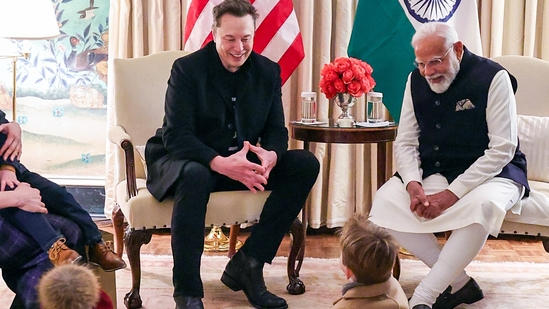
[Family meet in the White House, or serious business?]
The Indian Prime Minister’s “working visit” with Donald Trump went off script in a major way now and again. As expected, Narendra Modi was publicly manhandled. In a bid to embarrass the visitor, Trump gleefully related to the media the Indian leader’s discomfitted reaction — “No, no, I don’t like that” — when told by the US President he would tariff Indian exports out of the American market if New Delhi failed to comply with his wishes, and made sure Modi would lump it. Whether he was adequately advised by S Jaishankar and his MEA on how to tackle Trump or not, the PM hoped to revive a measure of bonhomie from past years to help redirect the punitive threats. That went for a six and some!
Trump also pushed the F-35 as the priority defence item to peddle despite the lack of any serious Indian interest in it. After all, the Service’s procurement strategy was plain enough to all. Once the 36 Rafale buy went through, it was viewed as the gateway for more Rafales filling the 126 MRFA (multi role fight aircraft) requirement, making the F-35 redundant. Still many senior airmen nurse the view that 2-5 squadrons of F-35 can serve as sort of a bridging solution until the local advanced medium combat aircraft (AMCA) , which reportedly is at the “metal cutting stage”, becomes available a decade or so from now.
Those who instinctively go ga ga at the remotest possibility of Western, particulaly, American military hardware in Indian colours and that includes all of the Indian press, TV, and social media, should acquaint themselves with just how much of a costly headache the F-35 is proving to be for the US Air Force (and for the 19 other air forces) flying it, and why. They could read, for instance, the April 14, 2024, report on this aircraft by the US Government Accountability Office (GAO). Stealth — it’s prime attribute is not a problem. But everything else (propulsion system, cooling system, thermal management system, spares availability, etc.) apparently is!
The US GAO Report concludes that “The F-35 fleet is not meeting most of its performance goals, including those for availability and for reliability and maintainability, according to DOD and contractor data. We have reported on the performance of the F-35 fleet, especially aircraft availability, across several GAO reports. We have consistently found that the F35 fleet is not meeting its availability goals, which are measured by mission capable rates (i.e., the percentage of time the aircraft can perform one of its tasked missions), despite increasing projected costs.”
With just about anything that can go wrong regularly going wrong with it, this plane spends more time in the hangar than in the sky. Moreover, to-date some eleven F-35s have gone down in malfunction-related accidents worldwide. The F-35, in short is, if not a dud, than far less of an operational asset it was expected to be. By the way, with a price tag of $110 million, the plane currently costs nearly $40,000 per hour (twice as expensive as the Rafale) to fly, and $6.8 million annually to “operate and sustain” (as calculated by the USAF for reduced flight hours!).
So far, over a trillion US dollars have been invested by the US government into the F-35 programme, making this aircraft the costliest that America has ever produced with no end to the rising sustenance costs. That’s an awful lot of money and is the reason why Trump is determined to flog it to friendly foreign countries to recover some of the sunk cost. But cost-benefit and cost-effectiveness are not Trump’s concerns. He cares only to rack up a sale for the US defence industry. Made aware of the IAF’s reputation for preferring over-priced foreign armaments and of the Indian government’s policy of using arms purchases to improve bilateral relations, Modi was an easy mark. Trump teed up the India sale and tried to force Modi’s hand with a public announcement of the offer of the plane during the latter’s visit. It will be a disaster if this aircraft is allowed into the country’s fighter fleet. But should that somehow happen, the IAF chief of the day will have to carry the can, and have a lot of explaining to do.
On to “Muska chaska”. [To give credit where it is due, this phrase tripped off the tongue of my friend, Dr V Siddhartha, Principal Scientific Adviser to the Government of India, 2009-2010, and irrepressible wit!]
Yes, folks, we are getting the Tesla EVs, likely imported China-produced kits — the unkindest cut — from which the vehicles will be assembled here. Modi can mitigate the effects by tasking the defence public sector units that have done little else but screwdriver this and that for 60 years, to do the same with the Tesla. It will leave the better managed, more energetic, private sector defence industry to do the heavy lifting for a change, and prove how much better they are at innovating advanced technology and manufacturing military hardware of every description. Musk angled for Indian-assembled Tesla cars enjoying tax and other concessions the Indian government reserves for foreign companies investing in more complete manufacture of their products in the country! And that may have been the point of Musk’s motivation for meeting with Modi in the White House with Elon’s numerous children in attendance.
Modi’s intent was more obvious — it doesn’t hurt to do favours for the Number 2 in Washington or, as he is referred in some circles “co-President” — a word coined to get the Donald’s hackles up, and speed up a divorce between two ego-boosted persons which everybody expects will occur sooner rather than later. The terms Musk sought are not that big a thing. But if Modi and his advisers expected that pacifying Elon would help moderate Trump’s position on retaliatory tariffs, etc. that hope was short lived.
In fact, Trump followed up his meeting with Modi by doing something more gratuitous — deliberately roiling the political waters for Modi by publicly ranting about the misuse of the taxpayer’s money and holding up the $18-$21 million USAID grant to India to increase Indian voter participation as evidence of US government waste. Except, this sum turned out actually to be assistance to Bangladesh — something Trump was surely briefed about before he created trouble for Modi. Trump, moreover, did not budge an iota on the counter tariffs issue, but put the Modi regime under the pump. If Modi ever thought Trump gave a damn for him, for India, or for Indian interests, he should have been disabused of it by now.
The result was that a pressured Prime Minister did what he should have done immediately and on his own after he was elected in 2014 to implement his election promise — “less government, more governance”, announced the convening of a Deregulation Commission. The problem is such a Commission presided over very likely by some retired finance ministry babu will do little of any consequence in deregulating the economic landscape and leave the country exactly where it is now where the old system of interminable decisionmaking and graft still prevails and the system will only slouch towards genuine and farreaching improvement in the “ease of doing business” area.
Trump’s threats also prompted more urgent action by the Modi dispensation. A Committee was convened to ascertain from all ministries the list of things they allowed imports of, how much of it was of US origin, and what concessions to offer to Washington in terms of goods, like Bourbon whiskey and Harley Davidson motorcycles, where tariffs could be safely reduced with minimal hurt to local industry and agriculture. Such measures won’t satisfy Trump though, who is demanding virtually open access to US agricultural and dairy products to the Indian market — a political time bomb for Modi because of its domestic economic repercussions at the grassroots level.
Worse, Samsung, Motorola, and other topline manufacturers who switched to producing smart phones, automotive parts and ancillaries, and other quality goods in India for export to the American market after Washington’s nudging them to “friend shore” their production and supply chains as alternative to China, now find themselves up a creek, their products attracting the Trump tariff. The fact is Trump has said he’d rather transnational companies that produce all the stuff they sell to Americans to relocate to the US and make them in America and, in the process, increase jobs in the US and government revenue.
It puts Modi and India between a rock and a hard place, as it does a number of other countries, most notably South Korea and Thailand that are in the same rocky tariff boat. It reminds everybody — as Ukraine and the NATO European states are discovering in another context, the wisdom in the famous Kissingerism that it is dangerous to be America’s enemy, but fatal to be America’s friend!
But, this is exactly the path Modi has taken over the last 10 years — believing that playing by American rules, closing in with Washington, will gain for India a vantage point in global politics and economy it cannot otherwise secure. But, it is for a reason that Europe and the most powerful state in it, Germany, after nearly 75 years of US tutelage, wants out. The victor in recent German elections, Friedrich Merz, of the right-of-centre Christian Democratic Union party, has called for “independence” from America — think of that! — as his foreign policy priority. It is in this context that it was good to have a former ambassador in Moscow, DB Venkatesh Varma, actually ask in an op-ed for something I have been advocating for a long time — to stop India’s slide towards US proxy status, reminding his readers that “proxies always end up as the doormats of history”.
It is astonishing to witness how easy it has been for Washington to drive New Delhi’s foreign policy and economic agendas, and to see just how pliable Modi is and his sidekick, Jaishankar, always was. The proof of this was in Modi’s unwillingness to go toe to toe with Trump and exercise the leverage this country has. The PM could have told Trump in the clearest language possible that it is America that CANNOT do without India’s strategic location and helpful policies to militarily contain China in Asia, which may or may not be the US objective, and that US, Europe, and the rest of the world will have to EARN their access to the vast Indian market that will soon outstrip the Chinese market in potential customers, but he did not. Myopically, such market access is being given away to the US, UK, et al, by the Commerce Minister Piyush Goel for few substantive returns.
Then again, there’s no telling when Trump will cut a deal with Xi Jinping for a G2 kind of arrangement for America and China to rule the world. Indications of this happening is why I have argued for reversing the trend in the last few years of weakening India-Russia ties per US dictates, because of Moscow’s inherent fear of a revanchist and powerful China reclaiming all territory east of the Lena River in Siberia.
Instead, we saw a disconcerted Modi and Jaishankar returning from Washington, doing things Trump bid them do. President Volodymyr Zelensky may have overestimated Ukraine’s strength and staying power in warring against Russia but at least he stood his ground and won the world’s respect, however hopeless the task of protecting his country’s territorial sovereignty may have been from the beginning. But Modi is erring seriously in underestimating India’s strategic and economic value, and his habit of reflexively kowtowing to US, Russia and China, is disturbing and will end up selling India short.


 Security Wise
Professor, while the optics of Modi’s visit did indicate Trump had the upper hand, Modi did say that just like American will put its interests first, India will do the same. So my take on the visit and the press conference after the talks was that this is the classic Indian response. Never say no, but never get to yes either. So I doubt the F35 deal will happen.
However, with the U.S. making serious effort to patch up with Russia, it does a couple of things. Makes a China nervous as it will be isolated, and gives Russia more options. The Chinese response could be to patch up with India. Structurally, China and the U.S. will never patch up, despite the rhetoric. They are the big 2, and are natural competitors/adversaries. Russia now becomes the swing state between the U.S. and China, and India will be the swing state between the U.S. and China. It just makes for more complex dynamics.
u.s.a. = union of saoodi amrika is more interested in a roosee collapse to retain its full control on entire oil and gas business of the whole world.
cheen never nervous like anglo-saxon race. cheen is least interested in competing with u.s.a. where it sells its stuff and buys its oil from. cheen is least interested in patching up with india. cheen is more interested in exploiting the weak position of india in current change of winds via east pork-i-stan and west pork-i-stan.
roosee are not idiots to engage and embrace the vile anglo-saxon race of amrikees and breets and germs.
saoodi is a key player as amrikee and roosee meeting happened in reeaadh and not in ankara. saoodi will play footsie with trump and hit with big bats on his buttocks if he even touches gaza with even a very long pole.
moo-laa moh-mad moo-dee likes and enjoys that taste of qatar ka batar more than desighee, you see.
so what does that tell you about “complex dynamics”?
@BharatKarnad
after reading this i went back to a 2019 article and there you said this 6 years ago.
“S. Jaishankar , the former Foreign Secretary and virtually Washington’s Man in Delhi in the Union cabinet, is to, in fact, make India a full-fledged American “ally” — a label used by US President Donald Trump just yesterday”
Washington’s man is the most accurate word that can be used to describe Jaishankar
it is only these teenagers who have raised him to the pedestal
i wish instead of Jaishankar policy makers like you were part of the cabinet and decision making groups.
Email from Dr V Siddhartha
To:bharat karnad
Tue, 25 Feb at 1:28 pm
With an embarrassed grin, allow me to point you to also this:
“Its multi-role design, although helpful for foreign sales, means it does not perform any one role as well as other aircraft in the U.S. inventory.”
https://armscontrolcenter.org/f-35-joint-strike-fighter-costs-challenges/
VS
Sir, I have gone through 18 pages of the US Government Accountability Office (GAO) 2024 report on the F-35 and found no demons as such there. Of course these reports aim at a certain ideal and when you are dealing with as superlative a technology as F-35 is, ideal is difficult to attain. Involvement of big money and marooned as they are from actual problems faced by the jet, these reports are hypercritical of jets’ performance parameters and preachy about cutting costs wherever they possibly can.
Nevertheless, some figures will be illuminating. As per GAO report the full mission availability rate of F-35 in 2020 was 71.4 percent and in 2023 was 51.9 percent. Compare this with other 4 and 4.5 generation aircraft.
Mission serviceability of Rafale in French Air Force hit 48.5 percent
That of the Su-30 MKI with the Indian Air Force before 2014 was 48 percent which they claimed to raise to 60 percent in recent years.
And Indian Navy – that is always carping about HAL products, not without substance though – imported Mig-29K jets has ranged from 21.30 percent to 47.14 percent !!!
F-35 is a jet that in 2017 Red Flag exercise scored 15 kills of F-16 against one F-35 felled. That is what made me say that 40 F-35 can wipe out whole Pakistan Air Force. Not without firm ground underneath. Just the mention of Trump offering F-35 to India had Pakistan Major General Zahid Mahmood (R) wet his pants a week ago and crib about the potential strategic balance shift in favour of India.
I’m not denying such a fighter will come with some compromises. As GAO report elaborates, to operate F-35A within their annual budget USAF has decided to fly it for 186 hours per year instead of previously held 230 hours. But one wonders just how many hours Migs fly in a year.
The projected sustainment cost of the American F-35 fleet over their lifetime has risen from 1.1 trillion dollars in 2018 to 1.58 trillion dollars in 2024. One reason for increase in the cost estimates is the extension of the service life of the aircraft from 2077 (in 2018) to 2088 (in 2024). Spare a marvel at their longevity ! A 0.0001 m2 RCS jet that will be relevant even 6 and half decades hence.
Further, the Engine modernization effort is in full swing to upgrade the engine and thermal management system, to reduce sustainment cost, improve engine life and enable future F-35 capabilities to make it even more incisive.
In 2018 DOD spent 2.2 billion dollars as sustainment cost on 220 jets which rose to 4.7 billion dollars for 520 jets in 2024. If you will calculate, the sustainment cost per jet has slightly fallen with time.
And not the least, “As of August 2023 the programme was meeting or close to meeting 17 of its 24 reliability and maintainability goals, which are aimed at ensuring that the aircraft will be available for operations as opposed to out-of-service for maintenance.”
This much from GAO report.
Still I would say F-35 is not an alternative for AMCA. Spares and their timely shipment could be a problem in an imported jet, which we might face to a lesser degree in case of an indigenous jet. But India has a history of spares problems with Russian aircraft also.
And F-35 is a very sophisticated aircraft. If we have to adopt the same practices as are common on the HAL shop floor that nuts and rivets are floundering around, shavings of drilled holes are left unattended, then we better not touch the F-35 even with a barge pole.
But don’t you think fiddling with a true blue stealth aircraft can introduce new practices, new equipment and machinery and new culture in our industries and among our engineers that will benefit our indigenous 5th gen fighter aircraft programme immensely ? Another question is do we have the necessary infrastructure such as common datalinks that will make the F-35 talk with other aircraft and weapon systems on the ground ? All this will have to be dispassionately considered before we take a call on F-35. And won’t we have to develop that infrastructure when we ply AMCA also ?
gagandeep@ — Evolving procedures and protocols for a stealth AMCA will happen naturally within the IAF context and culture. F-35 is optimised for US conditions and template of operations, and will feature suboptimally in the Indian orbat at unaffordly great expense.
war is not fought with fetish for toys.
@BharatKarnad
A little bit off topic from this discussion professor but please
I was just reading Nuclear weapons and Indian security(2002) for the second time. I am really curious to now that do we have something like the “Dead-hand system” that the Russians have with them.
Like if an adversary launches a massive barrage of nuclear missiles(worst case doomsday scenario) and takes out our leadership , command and control , airbases and cities and then these ground based computers that detect nuclear weapons falling on a territory that detects nuclear radioactivity and pressure sensors examine the environment and then considering the fact that high command has been already taken out by the adversary the system hands over control to any alive authorized senior officer or takes control itself and then it launches massive retaliatory strikes with whatever left out weapons. No matter what a follow up strike will come even if the leadership and assets stand decapitated.
I know you have researched so much about the Indian nuclear weapons Programme and this 2002 book tells that. So if you could tell that whether we have such a weapon system or not?
Would love to know your opinion.
No, India does not have a ‘doomsday’ policy and mechanism. But there is a line of succession for launch authority.
Professor, from what I’m reading the RCS of the Su57 is 0.1-1 m2. That’s worse than a Tejas Mk2. Don’t know how that qualifies as a stealth aircraft! My take then, India should ditch the F35 and Su57 and get the Tejas Mk2 going apart from the Mk1A. And Focus on developing the AMCA. That will be faster than buying from outside. With Trump in the White House, hopefully the 404 and 414 engines are delivered on time. And the Kaveri really needs to be developed fast. Very unlikely imports will be made as they are time consuming. Probably more time than developing India’s own aircraft’s and engines.
$21 million were for India. Moreover, USAID, a CIA front, has spent 2.9 billion for last two decades in India. Are we really that naive to believe it wasn’t use for capacity building? Given how hand in gloves were the narratives and ‘permission structures’ in the last decade against BJP. Is it any surprise that the beneficiaries/collaborators are denying/obfuscating it?
https://www.opindia.com/2025/02/indian-express-misleading-fact-check-election-interference-india-rajdeep-sardesai-mohammed-zubair-amplifies-details/
Dear Sir, India should never go for F-35 as you rightly said. Trump is pressurizing Modi to buy more US products,retaliatory tariff threat and raising other trade related issues.
This is not just limited to India, he is putting max pressure on EU and other allies as well. Trump being a businessman see everything interns of profit and loss. He wants to expand Us territory, he wants rare earth minerals from Ukraine,third term as president for himself by whatever means.
Only way to counter China is to grow the capability of India in every field which is a mammoth task and can easily take many decades if we go on right path. Chinese cannot be contained by other means. Expecting US will help India to counter Chinese threat is not realistic.
Professor,
here is an article that shows which Sarkar is cutting its tarkari and which one is growing it! What you wanted India is happening in the U.S.
https://theprint.in/national-interest/minimum-trump-maximum-modi-us-is-gutting-bureaucracy-india-is-turbocharging-it/2517592/
Now it’s too early to say whether Trump will be successful, it my heart is with his policies! Never thought I’d say that but he is trying to do the right things. If he is even half successful, he will end up changing global order.
Professor, these two videos of a former State Dept. employee reveals the control mechanisms of neo-colonialism and the information control needed for its functioning. Imagine the kind of infrastructure must have been built by them here.
After Zelensky was verbally thrashed in the public by Trump and his minion J.D Vance , it is a stark reminder why Ukraine shouldn’t have given up it nuclear arsenal(3rd largest in the world at that point of time) in exchange for security assurances as part of Budapest Agreement.For India ,it is important the we build up our nuclear arsenal to China’s level and hence restart Nuclear Testing.Therefore making the Indo-US Nuclear Deal of 2008 of null and void similar to how US and Russia made the Budapest Agreement null and void.
@foodometry
but the common reply from pacifist lobby is that if we start nuclear testing we will get sanctioned to hell and all those dreams of becoming a top 3 economy will never become possible again.
what is your thinking on this?
Nuclear Testing will help us increase our nuclear arsenal from 160 to 170 warheads to nearly 500 – 550 warheads which what China has currently , hence establishing effective strategic deterrence against China and help reduce the psychological asymmetry between India and China. This helps us in negotiation leverage in bilateral relations and increase our international standing. Furthermore , Nuclear Testing will also help us perfect our Hydrogen Bomb(which turned out be a “dud” in the Op Shakti testings of 1998) and make the 2008 Indo-US Civil Nuclear Deal null and void. This deal has put a cap/limit on our nuclear capabilities even though there are no such similar caps on our primary strategic threat i.e China !!
Many of these sanctions , which our Bovine Pacifist Lobby members spent countless sleepless nights thinking may not come to fructify because of the Order of Magnitude of the Indo-US economic relations . Indo-US trade is nearly 180 billion dollars and supports the livelihood of nearly a million US citizens. Hence if US ever implements these economic embargoes , it would naturally damage the American Economy as well. It is similar to how the American policy of “de-linking ” with China is just a policy rhetoric and nothing more because of the deep economic inter-linkages. Even if we suppose that US ends up implementing the harshest sanctions on India (which it normally reserves for Cuba, North Korea and Iran), Nuclear Testing would fetch us more strategic benefits than any economic loss that we face due to these embargoes. Sooner or later, the Americans would need to come on terms with the new regional and international dynamics vis-a-vis India and hence set the stage for a complete overhaul of Indo-US ties.
@foodmetry
Whatever the yield was from the dud TN device in 1998, be it 10% or 15%, it was still tested.
And the second iteration from BARC should have fixed all this.
So India possessing a 200-200kt device is more close to reality than what you are suggesting.
Spot on as usual. He not only conceded the “game” to Trump, but the “set and match” as well. This highlights the need for a PM who has the necessary backbone, intellect and fluency in English to give it back in equal measure. Regrettably, there aren’t any such on the political scene, post-Indira Gandhi.
@BharatKarnad
after seeing the recent public humiliation of Zelensky by trump and JD i am fully convinced now that nuclear weapons are the decisive weapons in warfare they decide the fate of your country
americans are violating every treaty every agreement and looking after their own interest time for us to trash the 2008 deal but i don’t expect someone like jaishankar will do it
@BharatKarnad
one of your main policy recommendations was that we need a few warheads in megaton range in our arsenal. China maintains nearly 2-3 dozens warheads (maybe even more) exclusively in the 1,3.3,4,5megaton range all these are stored and hidden in mountain tunnels
now sir on many occassions you say that the standard weapon issue of china is 3.3 megaton which is not true
first a little bit about chinese warheads(on the basis of open source data that i read)
506(codename): The 506 warhead is a relatively old warhead, developed in the 1970s. It has a total yield of 4.4Mt and weights around 3 tons. These warheads were designed to be fitted on the DF-5 ICBMs, and their high yield compensates the DF-5’s low accuracy majority of them are about to be retired(and you refer to these as standard issue of the chinese)
535 warheads (codename): The current workhorse of Chinese nuclear forces. These warheads have a yield of 650kt and can be fitted on DF-31s (single warhead) or DF-5s (MIRV). The weight varies from 480kg (early variant) to 360kg (late 2010s). The physics package of all variants are the same, but new light weight RVs and heatshields have been fitted on the newer warheads in an effort to save weight and space.(The actual standard chinese weapon )
575/5XX/”Shadow”: A lightweight 150kt warhead. Uses HEU tamper to improve efficiency and the weight is around 180kg (2010s). 6 “shadow” warheads can be fitted on a single DF-41. It may also be fitted on cruise missiles if needed.(Latest chinese warhead)
now as i see it Chinese developed these megaton range warhead to prevent any American or soviet intervention in south China sea or near its northern borders. Mainly against the US Navy
second these megaton weapons can be used during decapitation counterforce strike a accurate missile with a megaton warhead can destroy even the most hardened target a critical command control or a big bunker
any adversary will think multiple times before messing with a megaton armed country because the of the sheer amount of destruction that these can wreck will be unacceptable for the interventionist
is that the same logic that you have with India that too prevent any intervention from any hegemonic power(mainly America as you mention in nuclear weapons and Indian security) and that is why you recommend a entire gamut of armoury from low yield to very high yield
please correct me if i am wrong
Standard issue on early DF IRBMs and ICBMs. You got the logic right but failed to mention that megatonnage has its own pyschological impact that lesser yield weapons do not pack. And that’s the whole point, I have all along stressed.
@BharatKarnad
Sorry missed that one out off course the psychological effect has it’s own significance i am quite sure that god forbid but if a megaton is incoming on Delhi the GOI will be paralyzed just by seeing and hearing this news as always they loose there nerves in crisis.
Now to the Pakistani scenario i know the chances of a limited nuclear exchange between India and Pakistan is almost nil considering the exchange ratio but if the Pakistanis are able to hit a invading Indian Armoured column with 0.5kt nuclear nasr rockets what is the most logical realist response of India you see in such a case.
Certainly blowing off Lahore or Karachi makes no sense at all and it increases the risk of a counterstrike on a Indian city
if you were to write the nuclear doctrine again what response options would you put in such a scenario
also the massive retaliation is not at all logical considering thermonuclear weapons are a prerequisite of massive retaliation
would like to know your answer professor
@bharatkarnad After seeing the way Ukraine is being dumped under the Trump administration and the way both the limits and effect of nuclear deterrence is playing out in the Ukraine war; it becomes clear that only nuclear armed countries, which also have strong economy are truly sovereign. Given this fact as you have advocated without sufficient nuclear deterrence India is going to remain a Middle power not really a great power. Under what circumstances do you thing India will either proactively or reactive resume nuclear testing. For instance is India looking to achieve a certain target in terms of economic growth or a convention weapon production capacity with cooperation with West before it dumps the indo us nuclear deal?Or do you think being pressured by some geo political events will force India to resume testing?
@Prof Karnad.
I think you are getting it wrong here. The prescription is for thermonuclear Agni-4, Agni-5,Agni-5D with 250kt – 500kt.
Along with it is the need for increasing numbers in missile deployments, from 900 to 1000.
And not an old mega-tonne science experiment.
Lets just hope BARC’s simulation built device will fill that prescription and go upto 200kt.
But a question for you – do we know if the supposed “200 kt TN device” has been deployed yet?
In June 2020, the Indian military violated the previous consensus and trespassed the Line of Actual Control and built tents. Out of respect to previous agreements and rituals, Qi, regimental commander of the Chinese military, went to negotiate with a few soldiers. However, the Indian military showed no sincerity and had already deployed more soldiers in an attempt to force the Chinese soldiers to concede, CCTV reported in February 2021.
When facing more Indian soldiers appearing from nearby mountains, while reproaching the Indian military for destroying the agreement, Qi organized Chinese soldiers to move into combat formations and engage in any confrontation, according to the CCTV’s report.
The Indian military then started to attack the Chinese soldiers by using steel tubes and cudgels and throwing stones. Qi was under heavy attack and sustained a serious head injury, the CCTV’s report said.
https://www.globaltimes.cn/page/202503/1329381.shtml
The Chinese have completely altered the course of events regarding their clash with the Indian army during mid 2020 as I have depicted in my previous post.
This one is the best report till date about what really happened:;
https://theklaxon.com.au/home-china-india-clash-death-58xj7/