
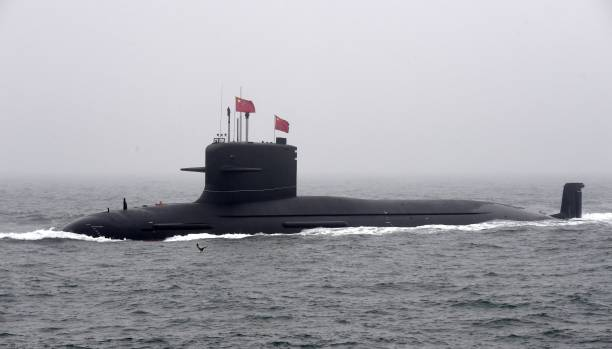
[Chinese N-powered attack submarine — 093 Shang class]
Couple of days ago, Prime Minister Narendra Modi, in a justly celebratory mood, commissioned three warships in Mumbai — INS Surat (4th and the last of the Project 15B) stealth missile destoyer, INS Nilgiri (Project 17A) multi-purpose stealth frigate, and INS Vaghsheer (last of the Kalvari-class, Scorpene) diesel submarine. Making a show of it was to sort of match, optics-wise, the enormous splash China made Dec 26, when it flew two entirely new stealth aircraft — the revolutionary, tailless, all wing, 3-engined J-36 that was, as intended, a gut punch to the US Air Force, which prides itself as being in the forefront of aerial combat tech, and the more conventionally designed lambda-wing J-50. And earlier, the Chinese had inducted the CH-7 long endurance armed drone even as the Adani Drishti-10 MALE (medium altitude long endurance) drone, a variant of the Israeli Elbit company’s Hermes 900, tumbled into the sea on its first flight off Porbandar.
Militarily pitting India against China even on paper is a one-sided game. In practice, as the army’s run-ins with the PLA on the LAC have shown, it is even more so because the Indian military lacks the ability to strategically surprise its adversaries. The Indian government in the national security field and the Indian armed forces are so predictable in thir actions, reactions, in their choice of armaments and weapons platforms, in their tactics and strategy, and so keyed to looking good, making a grand impression with pricey armaments, rather than building a cost-effective and efficient military, that even a mangy state like Pakistan has the gumption to challenge India and get away with it. In a sustained war with China, the outcome would be, well, shattering. Senior military officers agree with this assessment but won’t say it.
Weapons are the hard edge of any confrontation and the armaments a nation equips its military with tells a lot about the government, of course, but also the strategic quality of its armed forces. Case in point: The low quality Indian low yield fission based nuclear deterrent that succeeds more in self-deterring the government from flexing that particular muscle than dissuading the enemy! Contrasting case: China. In 1956, when Khruschev offered to permanently deploy Russian submarines carrying nuclear warheaded rockets in Shanghai, Maozedong’s response was, fine, but whose finger, he wondered, would be on the trigger! That sort of forward and offensive logic has permeated Chinese security thinking always, and led to the Mao regime initiating the project to produce nuclear-powered submarines alongside the programme to develop the Dong Feng family of strategic missiles headed by the prioritised intercontinental range ballistic missile able to reach the arch-enemy US’ heartland. India’s integrated guided missile project under APJ Abdul Kalam begun some 30 years later, in the 1980s, prioritised 150 km short range missiles (Prithvi)! So much for India’s “strategic” mindset — start small, stay small!!
The Indian government is once again on the cusp of a critical decision. Limited resources mean, it has to choose between approving large (60,000 ton) aircraft carriers with the navy pushing for nuclear propulsion, or six nuclear powered attack submarines (SSNs); the same 90MW miniature nuclear power plant driving the SSBNs is expected to power the SSNs and the proposed carrier. The larger carrier, if approved, will be built by the Cochin Shipyard that produced the IC-1, the new Vikrant, is in the process of building the second carrier (IC-2), and will be able majorly to refit (when it comes due) Vikramaditya (ex-Russian Gorshkov) to extend its life by 10 years.
The construction of a new class of boats — the SSNs, will be undertaken by the submarine manufacturing complex at Vizag headed by the navy and the private sector industrial giant, Larsen & Toubro, experienced in manufacturing the Arihant and Arighaat nuclear powered ballistic missile-firing submarines — SSBNs, with the third, Aridhaman, presently undergoing sea trials. For L&T to put together the SSN will be merely to extend its product line! So production is not the issue.
What is at issue, however, is the naval brass pushing for the carrier at the expense of the SSN. The carrier vs submarine is an old tussle within major navies, and has been resolved only in terms of both the carrier and submarine programmes being funded by the two countries with apparently the financial resources to spare — the US and China. But that option is unavailable to India.
A former CNS, Admiral Sunil Lanba summed up the attributes of the two types of vessels, fairly: “An aircraft carrier gains its strength from being visible, the submarine from being invisible. The carrier can show the flag, make a nation’s presence known, act as a show of force, or display support via a friendly visit. The submarine, on the other hand, is discreet. It can be quietly dispatched to keep an eye on things or it can apply pressure without being overt. This stealth allows a submarine to put a massive amount of uncertainty into the mind of an enemy.” (See his “Indian Navy Submarine Force – Way Ahead”, SP’s Naval Forces, Issue 3, 2022, https://www.spsnavalforces.com/story/?id=808&h=Indian-Navy-Submarine-Force-Way-Ahead )
The finest sailor-scholar the navy has produced, Rear Admiral KR ‘Raja’ Menon, a submariner who retired as Assistant Chief of Naval Staff (Operations) has been in the forefront in navy circles opposing the carrier. His argument that makes ample sense is this: Does the navy want a couple of very large ships or afford many more smaller warships, because the more the capital ships in the fleet the bigger the country’s sea presence in the vast expanse of the Indian Ocean. And that, the Indian navy has to be seen on the waters, and that counts for more than a single carrier with its escort flotilla steaming here and there, perhaps, making an impression whereever it goes exercising “sea control”, but leaving the rest of the ocean bare of Indian warships. It is an argument bolstered by the fact that for the cost of a single carrier with its combat aircraft complement, the navy can have 3-4 missile destroyers/frigates.
I restated Menon’s case against the aircraft carrier in my 2015 book — Why India Is Not a Great Power (Yet), and added two other factors. The first one was its immense vulnerability to supersonic cruise missiles like the Brahmos that the Chinese Navy has, and which technology has been transferred to Pakistan, so soon PN will have the Babar cruise missile in numbers. I did not then reckon — because the technology had not matured, with aerial/underwater drones and drone swarms that now pose the greatest threat to big warships, with aircraft carriers being manifestly the proverbial “sitting ducks”. The second argument I made — to augment Raja Menon’s point, was that for a relatively small navy, the force fraction dedicated to protecting the aircraft carrier at sea, would strip away what sea presence the Indian Navy would otherwise be able to muster. It is also worth bearing in mind that India has 50 capital ships (carriers, frigates, destroyers, submarines, mine sweepers, corvettes) in a fleet of 150 ships, China has some 140 capital ships in a fleet totalling some 360-odd ships!
The carrier-wallahs have not been able to offer convincing refutation of these anti-aircraft carrier theses and their utility to the navy and the nation at this point in time when resource scarcity stares the country in the face. But what they have been able to do, because several naval aviators have been naval chiefs, is to successfully institutionalise the carrier outlook in the Indian navy, even as no submariner to-date has risen to the top post to promote, preserve and protect the submarine arm. The value of the submarine is thus under-rated and the arm gets the short shrift in Nausena Bhavan. Not only are submarines less visible, so it seems are the submariners running these deadly weapons platforms because there are not many of them in the top ranks of naval leadership. And over the years that has led to the submarine’s derogation in the government’s approach and policy.
The aircraft carrier vs submarine debate toggled up to a higher gear ever since the “30-year (2000-2030) submarine building plan” was mooted in the mid-90s by the head of the submarine directorate, Rear Admiral AK Singh (later Vice Admiral, and FOCINC, Eastern Command) and okayed by the then naval chief, Admiral Vishnu Bhagwat, and the Vajpayee government. The modified version of the plan was for 18 diesel submarines (Project 75 and Project 75I) and 6 SSNs. The last of the six Project75 Scorpenes was just delivered by the Mazgaon Shipyard Ltd. Like the other defence public sector units, MSL is a money guzzler with the unenviable record of routinely clocking 20 year delays in delivery that upended the 30-year plan, until now when there’s money enough for SSNs or for carriers, not for both.
All things considered, the submarine is a better bet. An SSN is better still, because it is more potent, silent and lethal and, once out of the harbour, can remain on patrol for quite literally ever, but in practical terms, 3 months at a time — max endurance for a crew before it needs replacing with a new team — the only reason for the boat to touch shore. Nuclear power, moreover, endows the submarine with tremendous closing speeds (40 knots) to effectively shadow and kill Chinese aircraft carriers of the Liaoning-class or even the latest, 60,000 tonner, Fujian-class capable of of 30 knots speed, and thereafter to scoot.
It is a good thing that the commonsense virtues of the nuclear hunter-killer submarine are being appreciated by many within the Integrated Defence Staff under General Anil Chauhan and that matters. Because it is IDS that is tasked with inter se prioritisation of procurement programmes between the armed services, and between the combat arms within the armed services. India will have two light carriers, sufficient to show flag in peacetime, and stay safely quartered during wars! What is desperately needed are sharp naval teeth to tear into China’s globe-girdling pretensions, and that’s where a fleet of SSNs lurking in the approaches to the Malacca, Lombok and Sunda Straits, will ensure the Liaonings and the Fujians remain east of these narrows, and out of India’s and the Indian navy’s way. And further, that the Chinese trade, in the crosshairs of Indian submarines, generally, will remain for ever hostage to Beijing’s good behaviour.
And keeping PLAN out of the Indian Ocean can be touted to Washington as India’s seminal contribution to the Quad. Important because the US is frustrated with New Delhi doing so little to put military pressure on China — the principal aim of the Quad. An angry Trump has demanded allies and partners do more. India is unlikely to be exempted from such asks, nothwithstanding the good memories from the twinned “Howdy, Modi!”-“Namaste, Trump” events the reinstalled President may recall. The Indian Navy is not, after all, there principally to rescue Tsunami victims and sealift Indian labourers stranded in distant war-torn countries — a distinctly tertiary activity that foolish Indian politicians gush on about as if Indian naval forces are some kind charitable org, like Red Cross!
Many of us are waiting with bated breath for the decision of the Cabinet Committee on Security to come down. But many more, especially war planners in China’s Central Military Commission and in PLA Navy’s Southern Fleet HQrs on Sanya base in Hainan Island, will be curious to see which way the Indian worm turns.
The Government of India so lacks strategic sense, and makes grievously wrong military procurement choices so often, no one should be surprised if they screw it up again.


 Security Wise
Professor,
I’m no naval expert, and only read various opinions on this issue to learn. You make compelling arguments in favour of submarines. I’ve read also that India’s island chains can be used as stationary aircraft carriers on the east and west IOR. But regarding funding, I feel like India can easily afford $100B per year budgets. And more very soon! So I wonder why funding is considered such an issue. There seems to be a reluctance to spend urgently on defence.
Other arguments I’ve Read in favour of carriers – why do the U.S. and China continue to build new and more expensive ones if they are so vulnerable? The Dong Feng21 is an overhyped ballistic carrier killer – its ballistic, and cannot target a moving ship, Which Requires a low CEP easily, and which also requires advanced GPS capability and ground tracking capabilities, which China lacks. A lot of Chinese weapon systems are overhyped by Indian analysts. I doubt many of these analyses.
There was also a 2006 US study which Demonstrated small subs as a critical threat to aircraft carriers. But after that, the U.S. has further built the Ford class of carriers, much bigger and lethal than the Nimitz. I’ve not read anywhere about drones being carrier killers. And laser weapons are fast being developed against them. So I’m still not sure which way to lean.
But I think funding is not as big an issue that it is being made out to be.
Regarding your other comments on India’s missile programs – they are not relevant anymore – your comments are belittling and unfair. India’s missile arsenal is formidable and has better CEPs than Chinese missiles. Numbers wise also, India is reasonable. And the 150-500 km Prithvis and Pralays are exactly what are needed for interdiction in the Himalayas and for Pakistan. As for drone crashes, again, does not mean Adani drones are crap. The number of crashes that the USAF has borne in the Apache, Osprey, F35 and other programs and still persisted to hone their weapon systems, is a lesson for India.
In summary, I think India can do both carriers and subs. That should not be the reason to stop one program over the other.
Dear Sir, what is your take on Trump threatening even NATO allies like Canada for merger with US , Denmark to sell Greenland to US, pressurizing Panama to give the Canal to US.
Is this just to divert his MAGA followers as he may fail in fulfilling poll promises or pressure tactics to keep allies spending more for NATO or he is really serious in annexing these territories?
If US can annex why India cant ask Nepal, Bhutan for merger as Indian states and annex parts of Bangladesh, Pok giving the same excuse US is giving for annexation of new territories.
With so called friend Trump back to the office, Do you think India is ready to play US game against China risking another border tension with China.
Who cares what Trump does vis a vis Greenland, Panama, etc. except it sets a precedent.
Before we think of annexing parts of this, portions of that, may be, we should see if we
can run our own country better.
Dear Sir, my only point is most of our neighbors are becoming Chinese or US proxies harming India.This is the same reason Putin invaded Ukraine, why cant we do it when US,Russia are doing the same.There may be some sanctions which will harm economy for sometime but eventually we will come out of it.
I get it. But can we, say, pull off detaching the Chakma Hill Tracts from Bangladesh to widen the “Siliguri Corridor”?
@Deepak,
As long as we remain democratic, neither the internal governance nor the external strategy will improve. We can’t replicate other Powers because we have no power, neither can we absorb other nations due to the complete disorder in our own. The absorption of our neighbours will require delicate, disciplined, strategic and quiet hands. The election-winners(non-leaders, peasants) are incapable of multidecade work required to achieve this goal. These polities had be depopulated, defanged and degraded before they can be absorbed, and that’s a long-term work.
Democracy is our biggest enemy; a system of governance which exists for the maintenance and perpetuation of lower life, as opposed to the selection and cultivation of higher life.
Dear Sir,great analysis by you. We need to prioritize SSNs over carriers. Please take this view to the people who take decisions in the government.
what about SSBN’s. We are still far away from K6 which can target any Chinese city from safe waters near India. There is some news which tells US wont allow India to develop missile range beyond Agni 5 which is sufficient to target any city in China. We are not sure if true ICBM with 10K plus Km range can ever be tested even if developed due to pressure from US as this 10K plus missile target would be US only. It is best to develop submarine based ICBM giving the reason of targeting China from safe Indian waters without making West fearing ICBM. What is your take on this Sir.
Hello,
Whilst I acknowledge your article and your views, I dont necessarily agree with all. You tend to have a bias against anything that the Indian military does!
Rather, your analysis is fair and balanced which it is not! Where do you even mention the Indian Navy Marcos being airdropped a 1000 nautical miles, successfully rescuing MV Ruen of 30 pirates? The Chinese Navy was nowhere to be seen! A bit of balance would certainly go a long way in improving the credibilty of your analysis/opinion.
NDA@ –I am not “biased” against the military, but I am critical of flawed decisions, plans, policies, strategies, pertaining to national security, and that’s a difference worth noting.
Hello Bharat: If absolute dollars is the only issue, I hope we can continue to build at least one carrier for each decade indigenously so that skills and design expertise to do so can me sustained and improved with iterative cycles. A better approach would be to leapfrog and include nuclear propulsion, electric motors and electro magentic catapults. Will delay the induction of carriers by including such technologies but hopefully SSN’s will provide some insurance to protect our lake.
Professor Karnad you amuse a great deal. I couldn’t control my laughter when I read
“That sort of forward and offensive logic has permeated Chinese security thinking always, and led to the Mao regime initiating the project to produce nuclear-powered submarines alongside the programme to develop the Dong Feng family of strategic missiles headed by the prioritised intercontinental range ballistic missile able to reach the arch-enemy US’ heartland. India’s integrated guided missile project under APJ Abdul Kalam begun some 30 years later, in the 1980s, prioritised 150 km short range missiles (Prithvi)! So much for India’s “strategic” mindset — start small, stay small!! ”
And then “India will have two light carriers, sufficient to show flag in peacetime, and stay safely quartered during wars!”
Pure sarcasm.! That I’ve been unable to master because I haven’t had the opportunity to rub shoulders with high and mighty in India and the US.
Rest your arguments are valid. SSNs over Aircraft Carriers any day, if you are unable to have both especially when there have been no extraordinarily high raises in annual defence budget than what Congress used to do. Though I have also heard that actual defence spending exceeds than what is actually planned. But if that is the case, it is also pointed out that Chinese defence spending in actual impact – considering they spend in Yuan not in US Dollars – approximates 700 billion US dollars. That would be case with indigenous defence procurements in Rupees too. (As an example if a monthly magazine in India costs 100 Rupees, an equivalent magazine in USA will cost 40 dollars not a little over 1 dollar)
I also seem to agree with @Amit that India has been working to augment its missile capability though in numbers we fall significantly short of China. And you require numbers other than the capability to replace them during war, if Russia-Ukraine war has shown us anything.
As a parting shot, I think India will go for 3rd carrier as well as submarines though they will stretch the procurement to 20 years (after initially beating their breasts that they will achieve it by 2035), a slack we should get used to by now.
Email from Dr V Siddhartha, former Secretary, Science Advisory Committee to the Prime Minister
V Siddhartha
Thu, 16 Jan at 6:43 pm
C’mon. Bharat. Why are Flag Officers Commanding [East/West/South]-ern Fleet called that? They need a visible, show-off Carrier man. Have you ever heard of a “Flag-Cannot-be-Unfurled-Underwater Officer Commanding Submarine Fleet” ?
VS
Email from Admiral Arun Prakash, former Chief of the Naval Staff and Chairman, Chiefs of Staff Committee
ARUN P
Sat, 18 Jan at 10:01 am
Dear Bharat,
Thank you for your latest post — “SSN or aircraft carrier — the right choice!” on Security Wise blog (at http://www.bharatkarnad.com).
While I do not intend to join issue with you, on this interesting but complex issue, I need to point out
two factual inaccuracies which seem to have crept into your screed, and must not be left un-corrected.
Firstly, either you have not been following RAdm Raja Menon’s writings, or you have misquoted him deliberately. Far from being ” in the forefront in navy circles opposing the carrier”, to the great surprise of many of us, he has been the most vociferous supporter of (large) aircraft carrier(s) for the IN. Please read his article pasted below, as well as another one of 12 Feb 2024 (url attached) on this subject.
Secondly, your statement, “even as no submariner to-date has risen to the top post to promote, preserve and protect the submarine arm” is again factually incorrect. Admiral VS Shekhawat, a submariner, was CNS from 1993 to 1996. While at any given time there are at least 3-4 Flag Officer of the submarine specialisation in service, every CNS does his best to “preserve and protect” the interests of the Navy in all three dimensions of maritime warfare!!!
Regards,
Arun Prakash
How the Indian Navy can secure its sea lanes
Sat, 18 Jan at 11:04 am
My dear Admiral,
My bad on Admiral Shekhawat — how could I have forgotten? He was my colleague in the first NSAB!
As regards Raja Menon’s views — they have apparently changed some from when I talked with him
for my 2015 book — Why India is Not a Great Power (Yet). He was then for enlarging sea presence with
larger numbers of frigates and missile destroyers — a case he made, which I believe in. Obviously, if IN is
to get more frigates and destroyers it will be at the expense of something. It can’t be at the cost of the
sea denial element — the submarine force. That leaves the carrier as a tradeoff.
Raja’s more recent op-ed also had the sea presence aim furthered but by aircraft carriers. Considering the
relatively small size of our fleet of capital ships, a 60,000 ton carrier will be an even bigger drag, requiring a
still bigger force fraction deployed for its protection. If the navy gets 3 carriers and 2 are on station, and given
the number of ships at any moment in time in repair/refit, etc., that would drastically cut ships available for
sea presence.
I am not unmindful of the value of aircraft carriers. But, realistically, as platforms they are long past their prime and too
vulnerable to underwater drones/swarms and whatever other advanced ordnance that may be coming down the pike
— the naval currency of the future, to lessen my doubts.
warmest,
Bharat
Email from Admiral Arun Prakash:
ARUN P
Sun, 19 Jan at 9:13 am
Dear Bharat,
Thanks for your response.
However, this article has conveyed incorrect information to your vast following. Propriety, as well as your own credibility require that you
set things right with them.
Regards,
Arun Prakash
bharat karnad
From:
Sun, 19 Jan at 10:49 am
My dear Admiral,
I would happily set things right had I, in fact, conveyed “incorrect information” and “misquoted [Raja Menon] deliberately”.
I reiterate that Rear Admiral Raja Menon’s views on the subject were from when I talked with him for my 2015 book as I clearly
mentioned in the Blog post. It is obvious from the article circulated by you that Raja has subsequently changed
his mind, but I have not. So, there’s no issue of credibility.
warmest,
Bharat
Professor, more than taking potshots at the EAM, who is actually doing a fantastic job in his current role, you should be taking aim the Defence Minister, who is the personification of mediocrity in India. Decisions like Aircraft carriers or subs, jet engine development, indigenous aircraft manufacture etc. require strong leadership which is sorely lacking. The current DM, is unfortunately a perfect example of the majority in India. Aim your sights there Professor. That’s where change is required!
sir,
You have selectively quoted naval officers, out of teh context they may have quoted in. SSNs and Carriers perform different missions, have diferent capabilties with perhaps some small overlap.
The punch and power and area domination of a carrier battle group (remember they are escorted by a couple of attack ssn’s) is unmattched in todays strategic or tactical or political power play …
why do you think every navy worth its salt has a carrier …
just draw up a couple of scenarios and judge for yourself …
its never one or the the other ….unless you want to be defensive brown water navy …a few snns might give you soem respite..even then until they too are hunted down …
good luck!!!
The US Navy, the foremost user and proponent of the aircraft carrier, is rethinking its credibility. That should give all of us pause for thought.
Professor, by law the U.S. navy is required to have 11 carriers. There is a debate going on whether they are too vulnerable. But I’ve not read that they will stop making carriers. Even Prof. Sarah Payne, Naval War College strategy professor, says she is unqualified to comment much on this issue. But one thing is clear – carriers have great utility during peace time, which is most of the time. And as India’s maritime trade grows, this could be useful. Additionally, carriers can be potent against non peer powers, which is still valuable. The threat from drone swarms could be potentially addressed through laser weapons. But hypersonics is a question mark. However, hypersonics will need a low CEP and an ability to hit moving targets like carriers.
No one questions the utility of aircraft carriers in peacetime. And as I say in my post, 2 of these light carriers are sufficient. But we don’t need a 3rd and that’s the issue.
Professor, I’m certainly not an expert on the topic, but I find this issue interesting to analyse based on Indian military history and the evolving arc of oceanic commerce. India has for most of its history been a continental power – kingdoms fought with each other mostly On land, and the northwest and northeast apart from the plains and the peninsula had various kingdoms fighting each other just like European continental powers. Only the Cholas were a maritime power of note and because of it they expanded all over south east Asia.
With Indian exports expected to rise to $2T within a decade, there likely has never been a time in its history when 50% of its gdp (assuming $3T imports and a $10T gdp in ten years), is based mostly on oceanic trade. On top of that we have a weak state on its northwest, the traditional geography for continental clashes, and the Himalayan front with China, which can be handled by a rocket force, Air Force and a smaller land army. Therefore, India’s need to be a maritime power is greater than ever before!
So I can understand the strategic logic in Admiral Raja Menon’s comments about maritime power being more important going forward. Look at the oceanic trade routes India is working on – I2U2, Chennai Vladivostok corridor, the Arctic sea route, and of course the Indo Pacific. India’s trade routes will require power projection all the way from the Mediterranean (maybe the eastern Atlantic too) to the Western Pacific. So, while a couple of years back, I tended to agree more with your hypothesis (and also General Rawat’s), I’m leaning more towards investing more in Indian naval power, and that includes both aircraft carriers and subs. It will be required for power projection across two maybe three oceans. Frankly, I think it will require more than three aircraft carriers. India has limited experience being a continental and maritime military power – at least since Mughal times. So it will be interesting to see how it transitions into being one.
I think ur effort finally coming to fruition as GOVT is more inclined to SSBN
https://theprint.in/defence/indian-navy-drops-plans-of-third-aircraft-carrier-second-iac-will-replace-vikramaditya/2477397/
What I found surprising about Rear Admiral. Raja Menon’s view was the trade off in investment and to focus on the seas instead of the land border. While the oceans are important, control of it is transient, porous and subject to international forces and law. Any incursions on the land border can be permanent. So in my mind cannot make this tradeoff in investment. The truth of the matter is we seem to have lost this battle for power dominance with China, at least for our generation. Fighting for the next one is the only option and increasingly so with partners through overt, covert and strategic means.
Dear Dr Karnad , I would love to know your expert views on the geopolitical impact in the North East of the recent Chinese dam in Tibet.
yes sir we need ur views on planned Chinese dam on river Brahmaputra..
Professor,
National power depends on economic size and looks like both China and the U.S. are deceiving the world about the size of their economies. There have been several studies done to estimate the true size of the Chinese economy and population size, which puts it at between $6-$10T, I.e., 50-33% of its stated size. However, from what I’m seeing from some analysts is that the U.S. also is playing this game to counter China. Its growth rate in the last decade and this one has always been between 2-3 %, but it has more than doubled its size in 14 years, which implies a much higher growth rate. So the actual size of the U.S. economy could also be much lower. This has serious implications for great power security competitions and Indian think tanks should be doing some independent thinking on this topic to decipher the trajectory of relationships and world order.
if this analysis of economic size is true, then the U.S. will actually need India even with a weakened China to counter it. Both India and the U.S. share China as their primary threat, and therefore are natural partners. India and Russia do not share a common threat and therefore this relationship will decline. Russia and China share a common enemy in the U.S., and this relationship will strengthen. All other rhetoric is just that. This is the direction of future great power competition. Just my two cents. This also means that India has to step up its naval power for increased burden sharing in the Indo Pacific and elsewhere.
Rather than investing in these costly white elephants(Rafale, AC), we should allocate our scarce resources toward turbofan, microchip, nanotechnology, biotechnology, AI and battery(sodium-ion batteries in perticular). It’ll have much bigger returns in the long run. Whereas the AC will, no doubt, contain foreign subsystems. Negating the main purpose of building it domestically –creation of R&D ecosystem.
We should build AUVs, lay underwater detection sensors and cables throughout Indian ocean and its entry points. AI enabled AUV, USV and UAV will dominate the future of war.
I think the Indian government should focus on building more frigates and destroyers. There is a need for specialized destroyers and frigates like Air defence destroyers and frigates and anti submarine warfare frigates. Such vessels are vital to form a carrier battle group. If India decides to go for an aircraft carrier without sufficient frigates and destroyers to form a protective bubble around the carrier then the carrier will be a sitting duck. Someone needs to tell the navy to build more powerful frigates and destroyers with more missiles, Indian warships are lightly armed than their Chinese, Japanese and Korean counterparts.
Email from Capt. Jawahar Bhagwat (retd.), ex-CO SSBN.
Mon, 27 Jan at 1:18 pm
Dear Sir,
Pse read page 12 of my article from 2023. Still relevant.
“The Indian Navy fails to understand the significance of this, and its role in supporting the nation’s policy of having the most credible survivable deterrent. Moreover, the Indian Navy’s obsession with aircraft carriers and its quest for a third aircraft carrier may be affecting the indigenous SSN project that has been in the pipeline due to a lack of CCS approval (Bhagwat 2020a, Unnithan 2021a, Unnithan 2021c, Bhagwat 2022). However, contradictory reports state that funding was accorded for the initial design phase, and the project has commenced the detailed design stage (IDN 2023). Analysis of detailed study of Western study of Soviet tactics reveals that SSNs are offensive platforms for interdicting shore targets and carrier formations, and also used for protecting a SSBN unable to be deployed in bastion defence (Vego 1983). Classical roles adopted by a relatively inferior naval power. Here it is important to note that the USA who has always been the preeminent naval power with a numerical advantage (currently 53 SSNs) could and can afford to keep one SSN in each of its strike groups, something that the Soviet Union never did. Of course, it must be remembered that it started building aircraft carriers only in the 1970s after it had built up all elements of its naval power, more for prestige rather than any real value. Like AUKUS, it seems that this program also may fructify only by mid-century.” Please read a USNIP article from 1960 that is still relevant for the basic operating principles of a SSN. It was written in an age where hypersonic missiles and satellite surveillance technology that make carriers so vulnerable today did not exist.
Please see my article from 2020 regarding the same topic. We need a SSN based on the same platform design for economies of scale and optimal utilisation of the technologies that we have developed. We must attain the basic SSN with indigenous technology first. Following the maturing of our reactor and platform design after three platforms (SSNs) and the ongoing Arihant class by 2040+ we may consider building a larger one. As per media reports, the second of the Arihant class was commissioned in 2024 eight years after Arihant. Unfortunately, some would like to derail the SSN program by stating that a bigger boat is required now.
Regards,
Jawahar
———- Forwarded message ———
From: Jawahar Bhagwat
Date: Thu, 23 Jan 2025 at 08:40
Subject: Fwd: The SSN Vs Carrier debate
To: bharat karnad
Dear Sir,
Greetings!
With all due respect both the concerned individuals are so out of touch with reality.
The US deployment (or rather evasion tactics) of carriers in the Red Sea referred to in my one of my article is just one example.
The latest reference:
https://english.news.cn/20250110/92db773b068e4604b859a0cb9dc5fc18/c.html
The inability of the USA and the EU to provide safe passage to merchant ships is proof of the lack of credibility of the claims of these individuals regarding an aircraft carrier. Just the usual spin so as to build up the Navy, and in particular the carrier wing. In the process waste taxpayer’s money.
None of them can explain why unlike China India cannot build an aircraft carrier on its own steam despite operating one since the 1960s.
Adm Menon wrote in his book in the 1990s in one of his lucid moments, and thereafter has been advocating corporate interests. Adm. Prakash is promoting French assistance for the third aircraft carrier. Do they even know that we don’t have fuel for our subs, leave alone a N aircraft carrier. Or, is it deliberate to stymie the 3rd leg of the triad like the base near Vizag and personnel policies. What about atmanirbharta??? Any of the nations involved could pull the plug on our SSBN program.
You may like to speak to Adm KN Sushil and RK Sharma regarding the statement “looking after the interests of all the three branches of the Navy”.
Regards,
Jawahar
———- Forwarded message ———
От: ARUN P
Date: ср, 22 янв. 2025 г., 16:32
Subject: The SSN Vs Carrier debate
To: Admiral Arun Prakash
For those interested in the SSN Vs carrier debate initiated by Dr Bharat Karnad’s mail,
placed below is an article of 21 Jan 2025, by RAdm Raja Menon, titled:
“Decoding the Aircraft Carrier and Nuclear Attack Submarine Controversy”.
Decoding the Aircraft Carrier and Nuclear Attack Submarine Controversy
Raja Menon
21/Jan/2025
5 min read
The Indian Ocean cannot be dominated or controlled by ANY platform other than a large carrier of not less than 80,000 tonne.
In the Indian Navy’s brilliant attempt to make India a regional power by 2050, an unfortunate controversy seems to be in the making – whether to prioritise building aircraft carriers or nuclear attack submarines.
These are actually two platforms that are non- competing. Meant entirely to fulfil different purposes, both are integral components of maritime power. The cabinet committee on Security, which gives approval to undertake these expensive projects, would naturally keep the available budget in mind and therefore prioritise.
However, the building time in India for either platform is around eight years, and the capital cost amortised over this period should not be alarming. This is particularly because as this author has written earlier, we are working on a projected GDP growth to anything between $ 19 trillion and $ 30 trillion in 2050. Even taking the lower figure, the naval budget in 2050, would be $ 80 billion, at 20% allocation of the Defence budget to the Navy.
The aircraft carrier vs submarine debate
A misconceived idea which often intrudes in this debate is that a large platform like the aircraft carrier is too vulnerable in today’s warfare, and therefore, the submarine is the preferred alternative. This belief stems from a fallacious method of threat analysis, which if done correctly involves a three stage process.
The first is a one-on-one comparison, the second, the role of secondary factors, and lastly, and most importantly, a scenario analysis. To illustrate; if we placed a soldier in a trench equipped with a machine gun, and asked another platoon of soldiers to charge and take over the trench, the result would be high casualties.
The immediate conclusion would be that the human body is too vulnerable, and therefore the day of the infantry is over. This would be a catastrophic error. Firstly, the infantry is part of an all arms offensive, involving artillery, tanks, smoke and air power, which when used simultaneously would result in a different outcome. Secondly, the infantry is indispensable to achieving victory in war, which needs occupying and holding ground, as the ultimate achievements .
The aircraft carrier vulnerability theory arises from structured naval exercises conducted by all countries in peacetime, when to avoid wasting time, two forces are pitched against each other to ensure that an encounter takes place. In such artificial conditions, the submarine using the thermal layers in the sea to its advantage always comes out smelling of roses and victory.
Why Indian ocean cannot be dominated without large carriers
The reality may be different. The Indian ocean, which the Indian Navy seeks to dominate by 2050 is 6,000 miles by 4,700 miles. This vast expanse of water cannot be dominated or controlled by ANY platform other than a large carrier of not less than 80,000 tonne. The size is specified because only such a carrier can field three squadrons of fighter- ground-attack, and a flight of air early warning aircraft. The three squadrons, to overwhelm the ability of air forces of most countries to operate over the sea, and the AEW aircraft to give information dominance.
The most lucid exposition of what the aircraft carrier does is by Admiral Paparo, the C-in-C of the Indo-Pacific Command, in an interview on YouTube. Entrusted by the US government with taking on China in the West Pacific, Admiral Paparo enlikens air dominance to the infantry of the oceans, ‘occupying’ the surface upto a 1,00,000 feet, supplemented by underwater and space domination.
Modern aircraft carriers are escorted by destroyers with vertical launch cells, for land attack missiles, ballistic missile defence, anti-surface and anti-submarine launch weapons. The carrier’s destroyer screen is therefore, by itself, a potent offensive weapon capable of attacking drone launching sites.
The People’s Liberation Army Navy (PLAN) is currently building the type 55 destroyer, to escort their aircraft carriers, fitted with 112 vertical launch cells, to similarly fire ballistic missile defence and the CJ10 land attack cruise missile. The Indian Navy is also currently building the project 18 class destroyer which will have 144 vertical launch cells for firing missiles in three dimensions.
The nuclear attack submarine
The nuclear attack submarine has a totally different history and follows another narrative. Initially built by the US navy to hunt Soviet ballistic missile submarines picked up by sea bottom based sound sensors in the Greenland-Iceland-UK gap, the SSN went on to carry land attack missiles. They performed a vital role in attacking opposing C3I sites prior to a land invasion.
The Soviets and later the Russians use the SSNs to challenge the US’s surface warfare hegemony, particularly their aircraft carrier, and historically carried powerful anti-ship missiles. Nuclear attack submarines are potent and powerful sea denial weapons platforms, but cannot achieve sea control, which navies traditionally aspire to, following a Mahanian strategy. Currently, most US carriers have an escorting nuclear attack submarine in their screen.
At present, the Indian Navy has an approval to go ahead with the nuclear attack submarine programme, but is yet to start plans to build its third aircraft carrier. An 80,000 tonne carrier, built in India is estimated to cost about Rs, 40,000 crores. This estimate is based on the Rs. 20,000 crores that the Vikrant amounted to, the $ 4.5 billion that the Queen Elizabeth amounted to in the UK for a 60,000 tonne carrier, and the lower building costs in India.
According to open literature, the SSN costs for the first two is Rs. 20,000 crore each, or roughly $ 2.5 billion. It would appear that the yearly budgeted cost for both programmes are within the amounts that the Navy will be allotted, especially in the later years. The Indian maritime strategy, currently being written by Naval Headquarters will have to factor in the blistering pace of Chinese warship building, the imperative of dominating the Indian ocean, along with challenging the PLAN in the Malacca Straits. All these imperatives require for large carrier and the nuclear attack submarine.
Rear Admiral Raja Menon is the author of the highly regarded Maritime Strategy and Continental Wars.
Admiral Arun Prakash (Retd)
@Captain Bhagwat, thanks for sharing your thoughts and commentary from Adm. Menon. But after reading the content, I’m still unclear why aircraft carriers are Not recommended. And where is Adm. Menon not advocating for SSNs? He wants both. There is also the question of why the U.S. and China are building more aircraft carriers – are they wasting tax payers’ money? Are you suggesting to delay aircraft carrier builds to focus on an SSN fleet first?
I subscribe to the view of the former US Secretary of State Rumsfeld, that there are “unknown unknowns” in the domain of warfare, and hence there could be nothing as a ” right choice” implied by the title here.
And this is even more valid for naval warfare in contrast to land or air wars due to constraints imposed by science and technology, a serious matter missing in the presentations here by the respected uniformed officers as well as others in the military context. Both carriers and submarines have their own strength and weakness depending on how the navy admirals will be planning their wars.
The real technological obstructions are due to the sea water. Under water signal propagation is a pandora’s box for military hardware to perform. There is a huge obstacle of “noise” for sonar to work. Submarines cause unknown noise not to mention big Doppler shifts in the received signals which is a headache for the technology. And nuclear submarines are real rogues due to their reactor noise which give out their presence. True they can remain much longer submerged than the conventional ones, but still they have to surface from time to time for satellite communication which is spotted above water making them vulnerables.
Carriers are exposed to air and missile attacks, but they are essential for power projections. Due to their real estate in contrast to other surface vessels, they are loaded with excellent modern air-defence countermeasures which could by hard for hypersonic missiles to overcome since they are moving targets. Naval air arm is vital for submarine hunting as the literature says. Carriers are ideally suited to launch under-water drones which extend their effectiveness in war.
In sum, there are many other issues technical or otherwise in naval wars which boil down to “you do not know what you do not know” for the Admirals. This would mean it must be left to the navy’s hierarchy to decide their arsenal. After all, the navy will fight the war. I guess, the technology of underwater drones can throw a spanner here.
Professor, have you read this very curious and interesting article about the Congress Party and its raison d’etre :
https://www.indiatoday.in/india-today-insight/story/as-congress-settles-in-new-hq-how-its-parent-party-came-into-being-in-1885-2665752-2025-01-16
“ This inspired the civil servant and botanist Allan Octavian Hume to launch the Indian National Congress as a sort of safety valve for the Indians. The organisation was also meant to serve as a link between the colonials and the colonised. When he was posted in Uttar Pradesh, Hume was a first-hand witness of the 1857 war of independence.”
History of the Congress Party — old hat.
amendment to civil nuclear law means permitting US companies to build their reactors which would lead killing our indigenous ones.
@BharatKarnad
professor I just completed nuclear weapons and Indian security 2002 and a scenario came into my mind maybe if you could clear this
suppose there is a Country “A” and a Country “B”. Considering both have equivalent nuclear forces in terms of warheads and yields . “A” strikes first and hits 5 major metropolitan and industrial cities and Targets in Country “B”. Now what will be the most logical and practical response of B will they too hit 5 similar targets or will try to take out atleast 20 targets in Country “A”.Basically what will be the level of retaliation will it be a controlled one or overwhelming
And now considering A has superior force in terms of number and yield while B is inferior now what will be the retaliation level of B
i truly feel that the Indian doctrine of massive retaliation won’t work
If you could clear this.Thank you
IT’d be irrational/foolish for B with inferior weapons numbers to start an affray.
yaa and we all know that B is india and A is china
Dear Sir,
Found this article today. Seems you are being heard ! Is it true then that we shall be having more subs instead of carriers now ?
Indian Navy drops plans of third aircraft carrier, second IAC will replace Vikramaditya
Hopefully, yes.
@BharatKarnad
it feels good that many of your policy recommendations are being implemented and heard the navy wants to focus more on submarines rather then the white elephant aircraft carrier
hope to see your most important recommendation a credible proven tested thermonuclear arsenal by the end of this decade or 2035
Dear Dr Karnad, Your suggestion of India conquering Chakma hill tract and widening the “Chicken’s neck” corridor is interesting and creative except the fact that this said region is not adjacent to the Siliguri corridor and in fact this region borders Myanmar. The region of Bangladesh that is actually adjacent to the Siliguri corridor happens to be Rangpur. However this region is heavily Muslim dominated about 88 percent. So how can we incorporate this region?
Thanks. Got my geography all wrong! The Muslim-heavy Rangpur District is a problem — widening the Siliguri Corridor will require some deep planning and moves, what with the revival of the Islamist element in Bangladesh providing a raison d’etre.
@Prof Karnad.
That’s a very interesting thinking, but does not seem feasible.
I propose an alternative:
The way to go there is to heavily re-inforce Sikkim, & Bengal on the left side and all the frontier states (AP, Assam, Meghalay,) on the right side.
This could be done with:
If you think about it, it will serve dual purposes; One is for aggressive positioning against China, another is for bullet proofing the neck.
Actually on this account, I was rather disappointed that IA, IAF & DRDO are touting Pralay as a conventional quasi ballistic missile instead of making it tactical nuclear.
As always love to hear your thoughts – especially on why India is so shy on deploying tactical nuclear missiles.
@BharatKarnad
professor I was just watching your talks on bharat rakshak there you say that the transformation of the Indian society for the worst happened during the end of emperor Ashoka reign after the bloody battle of Kalinga
and then you talk about adi Shankaracharya and the addition of Buddhist principles of non violence into hindu principles that completely changed the mindset of our people and then obviously 700 years of islamic invasions and British rule
can you please elaborate on that indian society transformation part these aren’t mentioned in any of your books where did you got this concept from did you derived it from any book
really interested in knowing about this timeline of history.
thank you
Futuristically@ — This thesis is actually in chapter 1 of my book Nuclear Weapons & Indian Security. It is developed on the basis of historical events and is the only explanation for a once vigorous, rambunctious, beef-eating and even amoral Vedic Hindusim — the most naturalistic of religions, turning into a weak, pacifist, and craven philosophy full of inhibitions, and of do’s and don’ts.
Beef eating?? Really sir this is shocking
Heart cries when we get to know that in ancient India our people could visualise weapons of mass destruction and there were concepts of decisive weapons the brahmastra in Mahabharata and ramayan which nearly all of us have watched and read in our childhood
And here we are today having a handicapped nuclear programme
Do you blame historians sir?
Historians? Blame the history-makers.
@Prof Karnad. Good analysis! to add;
Its the morbid physicality of the population that is the probable root cause for all the above being said.
Think of average human life form in the sub-continent and few things immediately come to mind:
There is an inextricable link to decrepit human physique in all this, (#5 being the most obvious, of course)
Hard to see a way out of this. The numbers of the masses simply stack the odds against any serious change.
@Futuristically
“And here we are today having a handicapped nuclear programme”
Indian nuclear deterrent aint as bad as it is made out to be by several including @Prof Karnad.
Contrary India is nearly a nuclear, missile & space superpower.
But the main point about TN weapons remains that it helps to multiply and increase the number of warheads – This becomes very important especially when Agni 5 Divyastra MIRV is to be productionized and deployed.
@Itanium
nobody is questioning the quality and types of missiles no doubt Agni missiles are one of the finest with low CEP arihant and follow up SSBNs are quite silent as per reports and ISRO has also done a phenomenal job
but the main problem is with the thermonuclear weapons which we lack and as professor says that there is something called as notional parity a 20kt firecracker compared to a 1 Megaton or maybe 500kt weapon and we have already lost psychologically
divyastra and mirved version of Agni 5 all that is good now imagine a low CEP accurate 8000km mirved agni5 paired with 6-8 thermonuclear warheads then there will be peace in this subcontinent
For peace, mainly beyond the subcontinent
@BharatKarnad
agreed sir missiles of such low accuracy paired with thermonuclear warheads can give sleepless nights to any adversary no target would be safe in china or Pakistan
@futuristically
20kt aint no firecraker. Check out some youtube videos on old US 20kt yield nuclear tests and you will see what kind of a monster it is.
Further Indian fission tests were scaled down into 20kt that can as easily be scaled “up” to 100kt due to fairly linear scaling.
But of course due to the failure of TN test, India cannot multiply the number of warheads easily. There lies the problem – its a problem of numbers, not the bang part of nuclear arsenal.
@Itanium
if 20kt is so powerful then imagine what a 500 kt can do to a densely populated indian city
i mean we can argue like this forever
again anything above 20kt will be based on just speculations and simulation
you see when a new weapon system is inducted into the armed forces they do multiple tests to check everything before making it operational and deploying it why not do that with nuclear weapons which are so critical for national security
Why rely on these simulations and scaling up methods instead of actually testing that weapon before placing it on a missile
@futuristically
Never argued about India’s need to test more. India should have continued with testing post 1974 and performed not less than 50-60 tests of all shapes and forms. Succeeding NSAs and PMs one after the other led the country down in this sphere.
But it is not true that you cannot scale up the 20kt tested weapon. Within reason its simple case of adding more fission material translating to more mc^2 and more yield.
In fact its the miniaturization for the missile that is the far more challenging part.
Again no denying that India needs more testing – just that it is for different reasons than the “big bang” or “psyche edge”.
Rather the TN capability allows a country to multiply the number of warheads considerably due to efficient weight yield ratio.
And that is the precise reason why superpowers want to strangle India’s testing program. Its an effective instrument to cap the numbers and retard the missile deployment numbers.
Professor, looks like the government is going for SSNs and abandoning the carrier. Seems to be more driven by lack of funding for defence rather than other reasons. The number of SSNs planned in P77 is just two. So what kind of sea denial strategy this is, is open to debate. Limited sea control with two aircraft carriers and limited sea denial with two SSNs. But P76 with six additional Kalavati class submarines with AIP increases the Navy’s submarine capabilities.
Dear Dr Karnad, I believe your proposal for a modified (mod QUAD ie QUAD minus the USA) is now the order of the day as Mr Trump’s US only believes in extraction of maximum benefits from US allies like Japan and India as recent Trump threats show. What do you think ?
typhoon@ — US isolationism is 2nd nature to the US, and was the basis for my conceiving Mod Quad — Quad minus the US in my 2018 book Staggering Forward. Even Australia, the ultimate US camp follower, has seen the light of an unreliable America.
Sir….there is another wake up call for Aircraft Carrier here is the one article where Houthi missile came to striking distance of Aircraft Carrier USS Dwight D. Eisenhower
https://nationalinterest.org/blog/buzz/houthi-missile-comes-shockingly-close-aircraft-carrier-uss-dwight-d-eisenhower-213258