
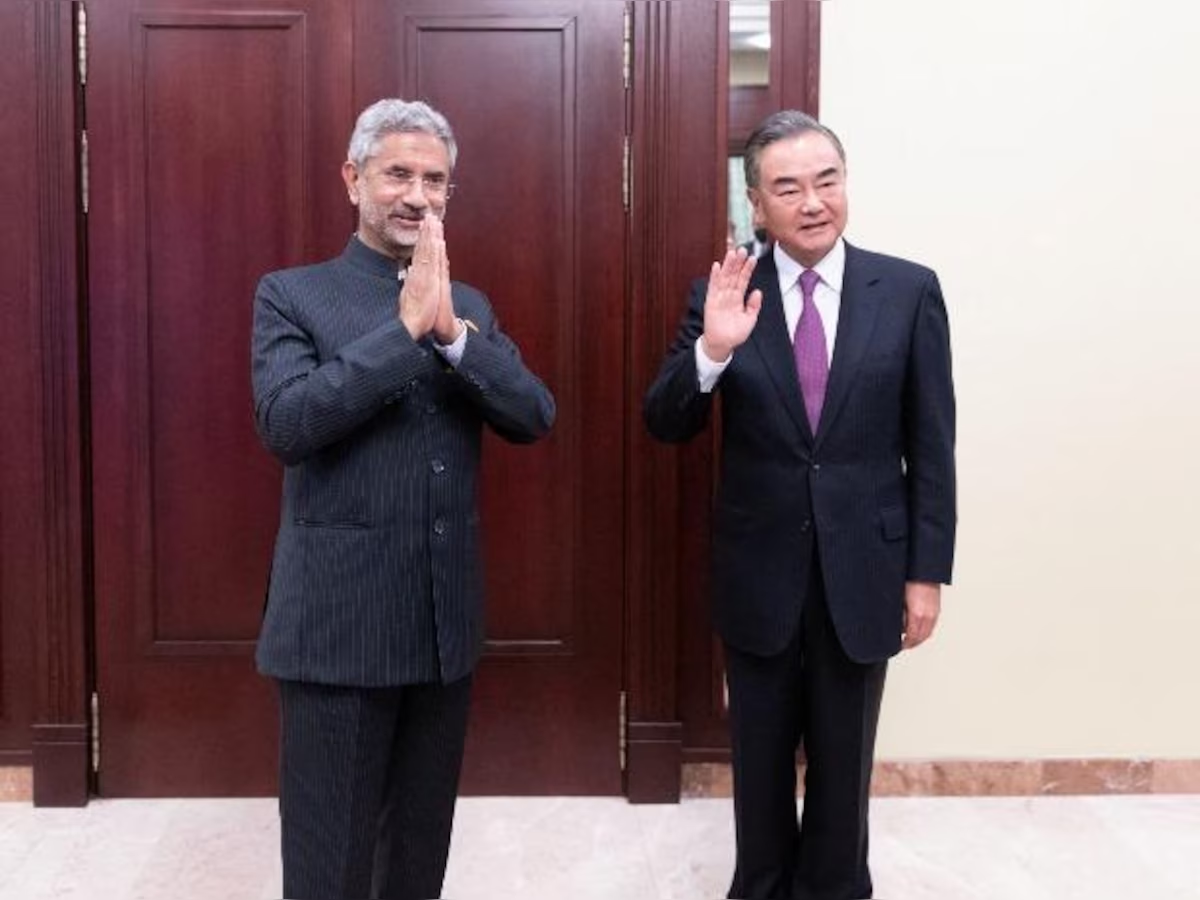
[Jaishankar with his Chinese counterpart, Wang Yi]
Woke up this morning, and was startled by Indian newspaper headlines heralding a new dawn in Sino-Indian relations. All the breathless reporting about agreement being reached on the “patrolling points “northeast of the Y-Junction on the Depsang Plains — proximal to the strategic Chinese lifeline to its western Xinjiang province, is an instance of an over-eager Indian government jumping the gun. The clearest evidence of this? As of 2:30PM IST, there was no like intimation of this serious development by Beijing, which has said not a thing.
Assuming Jaishankar is right in that some outline of an accord has been reached — then it must be only an agreement in principle — as in agreeing to discuss how actual disengagement will take place. In real terms, this means next to nothing! Because, unless the modalities of the Chinese units withdrawing their stranglehold on the Charding-Ninglung Nala Junction and of Indian forward troops re-establishing their right by actually renewing patrolling, are worked out there is NO accord! And to hammer out the terms and protocols could take months, if not years! Indeed, this seems like the usual diplomatic tactic the Chinese have used in the past to string India along with an ‘Alice in Wonderland’ promise of jam yesterday, jam tomorrow, no jam today!
Jaishankar, however, has put himself in a spot because he told the Press that the modalities would be worked out within 10 days. TEN DAYS? Let’s wait and see! He may have set himself up to have egg on his face!
Why has the Modi government put itself in this situation? The upcoming BRICS summit is the reason some say. Because both Russia and China are keen that India decelerate its strategic cooperation efforts with the US and the West. If Beijing is so concerned, why hasn’t Jaishankar used it as leverage against the Chinese?
As a foreign service officer, Jaishankar’s chosen language for training was Russian. But Russia is the one place he never saw any significant time in. MEA’s tested and proven career management practices! But he did spend more than 3 years as our emissary to China without having a clue about the Mandarin language — its nuances and tonal complexities! So, if what the Chinese said to him was proverbial “Greek and Latin” to him, how did he communicate with Zhongnanhai during his tenure as ambassador? Through his fellow IFS juniors on his staff, of course. But how good was their Mandarin? By the way, the NSA, Ajit Doval, has even less Mandarin language skills, but he is the lead border dispute negotiator!
It is the same “failure to communicate” that may have always dogged Jaishankar’s current parleys with his Chinese counterpart Wang Yi. (Old timers may remember that this phrase refers to the most famous line uttered by the grizzled Hollywood veteran, Strother Martin, in the 1967 Paul Newman film — ‘Cool Hand Luke’ — “What we have here is failure to communicate!”) It may have led to our EAM misreading his Chinese interlocuters and, advertently, misrepresenting what was said to him, what with him having to rely on interpreters, and Beijing playing on the Modi regime’s desperation to show some progress, any progress, however ephemeral! Because, Modi’s China policy is one great big failure in which Beijing has held all the high cards.
This Chinese advantage is only because New Delhi is not willing to play the game by the rules of strict reciprocity. So, China proliferated nuclear missiles and technologies to Pakistan, and India did not respond by transferring nuclear missiles to states on the Chinese periphery as would have been justified by the UN’s Article 51 self-defnce provision.
And, since the 2017 Doklam and the 2020 Galwan encounters, it is the Chinese PLA that has strengthened its tactical positions in Ladakh, held Indian forces away from the Xinjiang Highway, even as the Special Frontier Force unit that occupied the Kailash Range heights with a bold and bracing nightime action, were ordered off the peaks for nothing in return. China has had to pay no price in terms of, say, losing its access to the Indian market that the Indian government generously affords it. Nor has Delhi insisted that Chinese tech companies, in particular, wishing to do business here, establish joint ventures and be required by law to transfer all the technology of the products they sell to the Indian people, to their Indian partners, and to manufacture every small sub-component and widget that goes into their products in India itself. Or, to get the hell out, and stay out! These are conditions, by the way, China insists on for any foreign company, including Indian firms operating in China. But no, the Indian government has no such set of pre-conditions. The result: a humungous trade imbalance — just in the first six months of 2024, the trade deficit grew to $42 billion — the highest it has ever been! Meaning $42 billion of India’s wealth has been shifted to the Chinese khazana!
New Delhi’s idea of sticking it to China is to take years and years before making a decision to permit Taiwan to set up a proto-consulate in Mumbai — when, India should have happily let Taipei convert its so-called Trade Office in Delhi into a full-fledged embassy which it really is, long ago — one that can fly the Taiwanese flag (which, by the way, it is not allowed to do!)
The Indian government acts so cowed down by China, it is ridiculous. The pusillanimity of the political class is mirrored by the military leadership with the armed services’ Chiefs of Staff regularly and routinely calling for resort to diplomacy as priority which, in turn, fuels the Modi dispensation’s desire to obtain a border agreement, and to resume trade and other relations with Beijing that are manifestly tilted against Indian interests. This is the unvirtuous cycle India is locked into. Go figure why this is considered good for the country.


 Security Wise
Professor,
When it comes to the Subramanyams, you lead with emotion, not reality. Therefore, one can safely discard a lot of what you say. The article below confirms an agreement was reached – China is saying it.
https://www.globaltimes.cn/page/202410/1321648.shtml
As to egg on face etc. – that’s all emotional baloney. No one is jumping up and down on the deal. Let’s wait and see what happens. But overall this agreement is a good thing as it gives more leverage to India over the U.S. That’s the game that’s going on. No one’s rolling out the red carpet to China.
@amit Did the article mention if China is actually withdrawing to the previous patrolled points where India had access? Has there been any real verification on the ground?
If that’s the case, there should be clear confirmation. Also, if China agreed, what is India giving in return? We know some agreements involve give-and-take under secret deals, but declaring a big win without details is foolish.
Let’s not just throw around empty bravado on this topic.
thats reason i posted message to bharat sir for clarification..
also be civil and cordial while presenting ur facts..if u have genuine facts we are ready to accept and learn from ur knowledge…
@Amit- The Global Times article which you quoted is clearly mocking India as evident by the following;
“Chinese experts called on New Delhi to strictly and fully implement the resolutions.
Since the outbreak of border frictions, which were unilaterally provoked by India in 2020.”
Hi Amit,
Can you discard all of it, please.?
Dear Mr. Karnad, could you clarify what you were alluding to when you made a reference to the ‘Article 5 self-defence provision’ of the U.N Charter. Was that a typo wherein you meant to refer to Article 51?
Indin@ — Thankyou for pointing out. Text corrected. Yes, didn’t fully type the numerals, was referring to the self defence Article 51 of the UN Charter.
Sorry to quibble on this since it’s really not the subject matter of the post, nor does it detract in any way from the substance of the point that you’ve sought to make. However, I’m not sure as to the perintence of invoking the international law regime governing the use of force to drive home this point. The baseline presumption in international law is that there are no rules in international law (save such as might be accepted by the state concerned) whereby the levels of armaments of a sovereign state can be limited. Notwithstanding the protestations of the P-5 states, this is a principle which is valid for all states, without exception (as confirmed by the I.C.J in its 1986 merits judgment in Nicaragua as well).
Were India to have considered the option of similarly arming a state inimical to China, the question of whether Article 51 {and 2(4) by extension} would be implicated would not arise. The provision of weapons and logistical support to non-state actors within another state can indeed implicate the rules on non-intervention and the prohibition on the use of force, however this is not the relevant rule set when arms or technology transfers are being effected to another state during peacetime. India could have validly engaged in that activity without being in breach of any applicable international law (Whether that answer would be the same today, of course, would be more complicated given that the relevant legal landscape today consists of additional legal regimes and more moving parts as compared to the prevalent legal regime many decades back during the pertinent Cold War era).
Indin@ — The point is the lack of strictest reciprocity in our relations with China. Article 51, because the Indian govt is very legalistic and counter-proliferation under Article 51 some legal cover would become more acceptable. Not that I believe international law is other than a vehicle for great power interests, and, therefore, there’s need for India to treat such laws with similar disdain, or it ends up hurting the national interest.
Sir why govt is saying 2 assembly line(1 for private and 1 for HAL i think) is disaster for production of TEJAS??
so u have idea??
can we put forward ur idea to right forum??
https://theprint.in/defence/govt-backs-iafs-plans-to-buy-114-multi-role-fighter-aircraft-but-faces-2-problems-whats-the-logjam/2333510/
Kumar@ — GOI/IAF are aware of the case I have been making for pvt sector to make Tejas. It may have persuaded ACMs VR Chaudhary and AP Singh to make the pitch to the govt.
Even if there is an agreement , it wouldn’t mean a whole lot. Chinese view such agreements as nothing but “piece of paper” ,a sentiment that can be traced all the way back to Mao Zedong , who said to his followers ,when talking about his agreement with Generalissimo Chiang Kai-Shek during the Chongqing Negotiations, that it was nothing more than a “piece of paper”.
The Chinese only need to induce border incidents in areas where they enjoy tactical advantages to build up pressure on GOI . Considering that the US is already building up pressure on the government because of Doval-Amit Shah’s policy of (botched up) assassination plots of Khalistanis in Northern America. Hon’ble Prime Minister Modi and his intellectually bankrupt coterie may now runoff to Russia for help ,off course Putin ,always the strategically minded Russian that he is , may try to get some lucrative arms (or oil and gas) deals from the PM in return for little to no help.The French and British are nothing but spent forces.
There is nowhere to go Prime Minister. Or better nowhere to hide.
@foodometry- Good analysis by you. China will never resolve its disputed border with India. The primary reason being its control of the higher reaches of Himalaya Mountain.
All major rivers flow downstream from there to India. China wants to have total control over the water flowing into India.
Thank you for your compliment. Your comment is insightful as well .
@foodometry can we connect via email I wanted to know about future imperilled as you said you have the book
Sorry I do not have the book, but i read it from the USI library that is situated in New Delhi. It has two copies as a matter of fact.
@foodometry can normal civilians access the USI library or is it exclusive to armed forces officers, analyst ?
Sorry, not sure about who can access USI Library.
@BharatKarnad
Professor a scenario
if in future the Chinese were to withdraw their conventional forces from Ladakh and all these areas of conflict and in future focus on the Siliguri corridor the Achilles heel of India how would we respond?
My point is if in future the Chinese overwhelm us conventionally(considering if situation goes out of our control) in Sikkim and try to cutoff the Indian mainland from north east will that be seen as a red line by us and invite nuclear response on Chinese forces in our territory.
what do you think about this?
In my 2018 book ‘Staggering Forward’ I detailed arguments for forward basing tactical missiles on the LAC as a shortfuse deterrent to overcome India’s conventional military inferiority.
Greetings,
Sir, the only maneuver that will throw the CCP gang off-balance will be a rapprochement between us and you.
China proliferated nuclear missiles and technologies to Pakistan,…
Correction: A lot of the material like centrifuge designs was Western. The delivery system came from the DPRK as well as from other underground sources. Yes, some of that could’ve been delivered via the Chinese territory.
Once acquired, the systems then had to be modified, tested, and maintained, a challenge which our rocket and nuclear scientists expertly overcame.
Regards
the main warheads were given by the Chinese
and Pak army tested it in 1998 after Pokhran in chagai hills so as to confirm it works
I am sorry but that is TimesNow/Republic-Tv-tier balderdash.
It shouldn’t be elevated to the level of serious argument. Let it remain confined to intellectually-challenged television studios.
Izadi@ — Rapprochement is the need of the hour. With the strategic space of the subcontinent united under the joint auspices of India and Pakistan , the world domination plans of Xi Jinping and this CCP thugs would get a much needed reality check.
Regards
Izadi@, foodometry@ — In all my writings, I have stressed the importance to India of recovering the unitary strategic space in the subcontinent lost in 1947 by means of generous economic and other incentives afforded all the states adjoining India to realise what I call the ‘South Asia co-prosperity sphere’ — a far more benign concept than the wartime “Asian co-prosperity sphere” promised by Japan.
@BharatKarnad
professor i am very happy and excited while i am typing this
just know i received a hard copy of nuclear weapons and indian security 2002 edition macmillan
for the past 1 month i was looking for this the second edition which is 9000 was out of reach after surfing on the internet i found this for 2000 only .The page numbers mentioned were wrong but the book cover had your name i was a bit hesitant that it might be a scam but still ordered it.
today just know i received it and it’s on my desk. And it has your personally signed signature on it.
So thank you very much sir. Regards
Sir if you are reading this
i counted this 2002 edition which i have on my desk this has 727 pages approx while the 2005 edition is 767 pages
so sir will i miss out something in these 40 odd pages
or even the 1st edition is completely fine
kindly clarify that as you are the author so the best person to ask
The 1st edition of 2002 is good. The 2nd ed of 2005 updated the narrative to cover the first years of the Manmohan Singh govt
Ohk professor if that is the only difference then i am quite comfortable with the 1st edition
sir can i get any store in hyderabad or i have to write a mail to them?
online its showing around 10k
Sorry, I have no specific info, but most big book shops should have, or could try and get the titles for you from their distributor channels.
professor one last question regarding this 2002 edition i was very interested in reading future imperilled too but could not get one as it went out of stock .So is important content of future imperilled mentioned in this nuclear weapons and indian security 1st edition in this way i may get a jist(summary) of future imperilled too
Basically what is the common content which you have written in both the books. The 1994 one and 2002
There’s nothing in common. In Future Imperilled, I elaborated on India’s weak geopolitics.
China follows the economic policies of Friedrich List; whereas, Modi&co follow some version of milton friedmanism or Chicago School. Given Modi’s limited hotizons, is it any surprise that he neither gets geopolitics nor geoeconomics. Inferior Indian population and their subpar leaders could never command the respect of the Chinese or the Americans, because we are not respectable.
@BharatKarnad
Professor is future imperilled worth reading in 2024 it was written back in 1994 in 3 decades a lot has changed in geopolitics
Worth reading because, in the lead chapter, I discuss India’s history of weak geopolitics, and because it detailed the security architecture “organic” to Asia that GOI has pursued ever since. In brief, there’s Japan and Israel anchoring the two ends of the system, India as the pivot able to switch forces and other resources east and west, and southeast Asia astride the straits (Malacca, Lombok, Sunda) helping to prevent the main heartland power, China, from easily accessing the Indian Ocean. The whole concept was derived from Halford Mackinder’s core idea of the “Rimland” — littoral and offshore Asia, which Nicholas Spykman elaborated in 1945. And because I got various notables to contribute chapters to the compendium, among them, KPS Gill, army chief General K Sundarji, General Khalid Arif, Zia’s right hand man and fellow-Jullandari, running the Pakistan Army, US Senator Larry Pressler (remember the “Pressler Amendment” to the Foreign Aid Act?), and K Subrahmanyam.
looks interesting but from where should i get it it is not available online anywhere
i think hunting for it in the old streets of daryaganj delhi book market is the only option now .
It was a Penguin book, now sadly out of print. Old book shops are the ones to haunt!
I finished ‘Future Imperilled’ today. Have now started ‘Strategic Sell-out’
@BharatKarnad
professor do you see BRICS currency as possible in future what does your analysis and say about BRICS currency replacing us Dollar. Would like to know your opinion.
Perhaps. But not in the near to mid-term future. $ is still too strong.
So should India accept it in future for trade. Or should we stay with dollar only .Americans have threatened sanctions and tariffs to those those countries(ig including India too)who abandon dollar.
Stay with dollar for now because most of our trading partners prefer it.
Professor as now pictures are coming from BRICS summit in Kazan leaders of India, Russia and China together do you ever see these three giants partnering (not in this decade but )in future changing the world order and reducing the American hegemony
Professor,
It was always my view that China was being stupid by antagonising everyone. However, its serious economic weakness and military organisational non readiness, are making it realize that it is no super power, and India is no pushover. India has always hedged its bets with the U.S. and a thaw in relations with China plus good relations with Russia is the most power brake on US shenanigans. That’s how India is playing the game, and there’s nothing wrong with it so far.
A very well researched and written article. It brings out clearly that India will be facing more of the same in the northern boundary. China is going to consolidate its land grab since 2020 by building more and more military infrastructure in Depsang and other places for some time now while India will be busy building trust by not militarily challenging China to wrest back its sovereign territory. Anyway, that has been the Indian mindset always in the history. Thank you, Professor, for recalling.
@BharatKarnad
professor please help me in finding the sialkot grab episode which you detailed in nuclear weapons and indian security(2002 1st edition)i could not find it.The book is huge
What are the page numbers where sialkot grab concept is written
Go through it to find it. Can’t spare the time to do so myself.
@BharatKarnad
professor according to a latest report china is all set to develop 1000 nuclear weapons by 2030-2035 with aim to directly challenge United States.In your book nuclear weapons and Indian security(2002) and Carnegie endowment article you gave a particular number i.e 375-400 warheads if india wants to detter china from doing something stupid.
Curious to know how much time will it take us to to reach this 400 weapons level.Would like to know your opinion
Argued in the book, India could be at slightly less than China’s nuclear weapons strength. And the figure I worked in then was for 475 weapons in 2002 for the PLA strategic forces weapons number at around 500 weapons.
Too many factors are involved to know how long to the 475 weapons level — we are at around 172 weapons now, like how many CANDU reactors can be spare to run on the low burn-up mode to get plutonium, etc. to even make an educated guess. But suffice to say, the Indian governemnt sees no urgency to react to Chinese buildup.
oh yeah 475 but sir you came up with that number in 2002 when chinese were planning for 500
Now situation has changed if chinese are planning to make 1000 how many should we have still 475 or more than that 600-700?
professor the people who are sitting in the top position in the GOI are mindless and they don’t want to risk anything
Officers of strategic forces command must read your nuclear weapons and Indian security book it is amazing do they even read?
Have always believed India needs to be at least at 75% level of China’s N-weapons strength.
As regards SFC officers reading ‘Nuclear Weapons and Indian Security’ — I was once told by a Chairman, Joint Chiefs of Staff Committee, that this book of mine was the “Bible” for the Strategic Forces Command. My riposte was how many people read the “Bible”?
that must be very encouraging for you if such a top officer is commenting about how valuable your book is and indeed it is valuable and the pioneer book in nuclear strategy
sir apart from future imperilled(beacause it is not available) is there any book which explains the concept of rimland ,heartland theory written by mackinder and spykman
i really wanted to know this concept of rimland strategy .From which book did you find out this concept that helped you in writing future imperilled
Halford Mackinder’s 1919 book — Democratic Ideals and Reality. It has more recent reprints.
Professor Karnad@:
What about delivery systems?
Is there even one today which could strike Beijing?
A-5 from most northeastern launch points.
Professor,
Based on what I’ve read, India has the fissile material to make -800 nuclear weapons – of the ‘firecracker’ variety you are fond of describing.
Now, the arming India’s nuclear subs will increase the number of such deployed weapons – Arihant/Arighat add 24 K15s and the S4s add 16 K4s which can also be MIRVs. Assuming 2-3 weapons/MIRV that’s 32-48 new weapons (assuming 2-3 decoys/MIRV). So with the currently manufactured fleet of SSBNs that’s 56-72. My guess is that after the current fleet is commissioned, India will have around 200.
Then we have the S5/5*s coming which will add 16*3=48 MIRV – 96/144 new weapons. Apart from the new weapons added due to MIRV land based missiles – can’t hazard a guess right now what that increase could be.
So India seems to be on a path to increase its nuclear weapons number. Slowly but surely.
But my view is that India needs to focus on building conventional and Cyber/EW/space parity/deterrence with China. Nuclear weapons are not to be used in war and deterrence needs to be achieved by conventional means first.
So, India’s lower (note, not non-existent) priority on building nuclear parity makes sense. And its focus on fixing its conventional capabilities also makes sense. It should do so with greater funding and efficiency though.
@BharatKarnad
thanks professor gonna checkout this one
Can’t K4 missiles(S4 SSBN) strike deep in china ??
K-4, yes. We don’t have them yet.
@BharatKarnad
Professor i am no nuclear expert just a layman but after reading some portion of nuclear weapons and Indian security can’t the government of India and SFC place 50-60 percent of warheads in our SSBN(Future).They are the most secure part of the triad even if the enemy launches a decapitation attack to limit our retaliation option. Still these 50-60 percent warheads in the seas will be ready for countervalue attacks .Bay of Bengal can be a safe launchpad for our SSBN.30-40 percent of the warheads for land based missiles because they are the most responsive and can be fired on launch on warning immediately .Remaining 10-20 percent for Airforce bombers which are the most flexible but i thing in nuclear weapons and Indian security you said that Airforce has no strategic weapons at all
And recently Russia again offered us tu160m(upgraded)but as always the GOI has no brains and strategic thinking.
I said IAF does not have a strategic bomber platform, hence the Tu-160 option.
About the distribution of weapons in the 3 mediums, well, I am sure SFC has thought through things.
@Amit
well absolutely that was a typo sorry not 8 i was talking about 4 missiles
i am considering long range missiles only if i am a strategic planner i won’t waste the submarine launched weapons on pakistan (when our land based and air based vectors can take them out) and would deploy them against china only
so 4 k-4 + 4 k-4 + 8 k-5(4mirv) + 8 k-5(4mirv)=72 warheads considering only 24 k4/k5 missiles are deployed and not k15.And if you consider k15 the number would go upto 72 missiles with single warhead only and insufficient range to reach chinese target
there are no proofs as of now that k4 is mirv.
well certainly indian missiles have low cep and as professor karnad advocates even if we hit a high value chinese target with 3 mirv per target with 20kt firecracker it would still cause a significant damage and professor karnad also said that we cannot go counterforce with a small force we have to go countervalue against the adversary industrial and population base
and one the the formal navy admiral raja menon he suggested only a submarine based and land based force with submarine based weapons as the backbone of india’s deterrence and supported the complete elimination of air based vector as flying time between india and pakistan is quite low and we do not have a strategic bomber yet to reach deep inside china.
@Amit correction
S4(INS Aridhaman) will have only 8k4(4000km)/8k5(6000km,under testing) missiles and not 16
about the MIRV as per reports k5 missiles might have 3,4mirv
so INS Arihant – 4 k4 missiles(single warhead),INS Arighat – 4 k4 missiles(single warhead),INS Aridhaman – 8 k5 missiles(4 mirv),S4* SSBN – 8 k5 missiles(4mirv)
so that mean by the time all arihant class submarines are commissioned india will have the capability to launch 8+8+8×4+8×4=80 warheads
and then S5 as per reports might have 16 K6(8000km)MIRV missiles but that SSBN will take atleast a decade and it will be equal to the SSBN’S owned by P5 members
but yeah as we induct more SSBN’S the warheads in our arsenal will increase
@Aditya, I meant S4+S4* combined is 16 K4s. And the increase I calculated was just based on SSBN capability. Surely, we will have some land based MIRVs also.
Additionally, if I look at the quality of India’s rocket programs, its delivery systems have pretty good CEPs. So even with 20 KN yields, these weapons can take out downtowns of most mid size cities.
So India’s survivable nuclear arsenal is still a reasonable deterrent – more counter value than counter force, but still reasonable. Also, it’s likely India will match China (not sure =75%), but it will do so quietly.
Also, in my view, the Arihant and Arighat will carry only the K15s. So it will be 12+12 not 8+8. Also, my view is that the K4 will also be MIRV, not just the K5. As to number of weapons/MIRV, mine was a guess. It’s to give a directional sense of the increase in India’s nuclear weapons.
Prof. Karnad is neither pro-Congress nor pro-BJP. I used to think he is a Nehruvian. But reading ‘Future Imperilled’ makes it amply clear that Nehru is squarely responsible for situation on LOC and LAC. So if Prof. Karnad is at all anything, he is pro-India. I came to know about him when I read U-2 Shinmaya story in ‘Vayu’ and now I have read all his books (‘Strategic Sell-out’ I’m reading now) except ‘Nuclear Weapons and Indian Security’ which I’ll order soon. I rate my all time favourite authors as follows :
1.V.S. Naipaul 2. Salman Rushdie 3. William Dalrymple 4. Amitav Ghosh 5. Bharat Karnad 6. Arundhati Roy 7. Praveen Sawhney 8. Prof. Prodyut Dass 9. Jhumpa Lahiri 10. Ruchir Sharma
@Gagandeep can we connect via email I wanted to enquire about future imperilled as you said you have the book
you can post here your email. I’ll contact you
@Gagandeep sure
please contact me at prashantnair917@gmail.com
Professor,
Here is an article quoting a Pakistani analyst who says India’s SSBNs alone will require 300 nuclear weapons.
https://idrw.org/indian-navys-ssbn-fleet-alone-will-require-300-nuclear-warheads-pakistani-analyst/
Somewhat in line with the numbers we are coming up with also. He says India has stockpile to make 839 weapons which matches what I have read elsewhere too. Add to this number the land based weapons and by 2035, India will have in excess of 500 weapons. The biggest driver of increase could be the SSBNs.
I also don’t believe India will increase its nuclear weapons numbers without being sure that they work! While Sarkari Tarkari may be rotten at times, the kaddugiri cannot be so intense! So like the guy who quoted his ‘Gramps’ here often said, computer simulation of thermo nuclear weapons must be giving some confidence.
Amit@ — Still, no cigar! There’s no way to credible thermonuclears without resuming open-ended testing.
@BharatKarnad
professor after reading a significant part of nuclear weapons and indian security(2002) a scenario came in my mind can’t we take out the whealth producing part of pakistan by just our brahmos cruise missiles or hypersonic version of brahmos in future like just raining down 100 nuclear tipped cruise missiles during a nuclear war and deploying the much capable agni missiles against china as you advocate
admiral menon also said that cruise missiles are the least provocative and readily deployed
Professor,
One way India can manage the U.S. is by giving enough confidence to China that it will not attack it on the Himalayan front and it can focus on its eastern sea board. This is kind of what happened in the late 50s when the U.S. assured China that it would not attack it on the eastern front, which gave the Chinese the confidence to attack India on the western front.
By doing this, China puts more pressure on the U.S., which ensures it needs India more. That’s the game India should play. Of course, India should never let its guard down with China, but it should cool tensions and let China focus on its eastern front. In return for doing this, it should get some concessions from the Chinese.
This way, the U.S. will see the benefit it has accrued to itself by the Himalayan standoff. However, overall, this is a more complex situation for the world. We will see three poles – the U.S., China and India, with Russia being a powerful swing state between China and India. This is the scenario I see emerging!
Amit@ — seems about right.
@BharatKarnad
professor curious to know whether we have anti access/area denial weapons like the chinese have df-21
are we working on them?
can Agni prime MRBM be considered as a area denial weapon because as per reports it has maneuverable warheads.
futurisric@ – A2/AD is not a single missile but a system — SSMs, SAMs, EW, et al
What should be our response then if a chinese carrier strike group enters indian Ocean to threaten our east coast?
because the chinese have said clearly that they are going to take out the carrier strike group(with aircraft carrier as the main target) completely using their df21 missiles
Can’t we do something similar?
@futuristically, the Chinese have hyped their military and economic capabilities to such an extent that the general impression is that they have a very powerful military. While their naval assets are high in number, they are low in quality and they do not yet have trained crews to operate them. Additionally, their training is suspect – my view is that they will get a walloping if they try stunts in the Indian Ocean. It could be a decade before they become a strong naval power. Until then, we have to wait and watch, and sift out all the hype.
@BharatKarnad professor can you tell about the plague attack of Gujarat which you gave as an example on one of your podcast regarding nuclear policy of India and no first use commitment .Who was responsible for that biological weapons attack?
Source, untraceable!
that is very worrying what if a adversary does something like that again and kills thousands will we still say source untraceable