
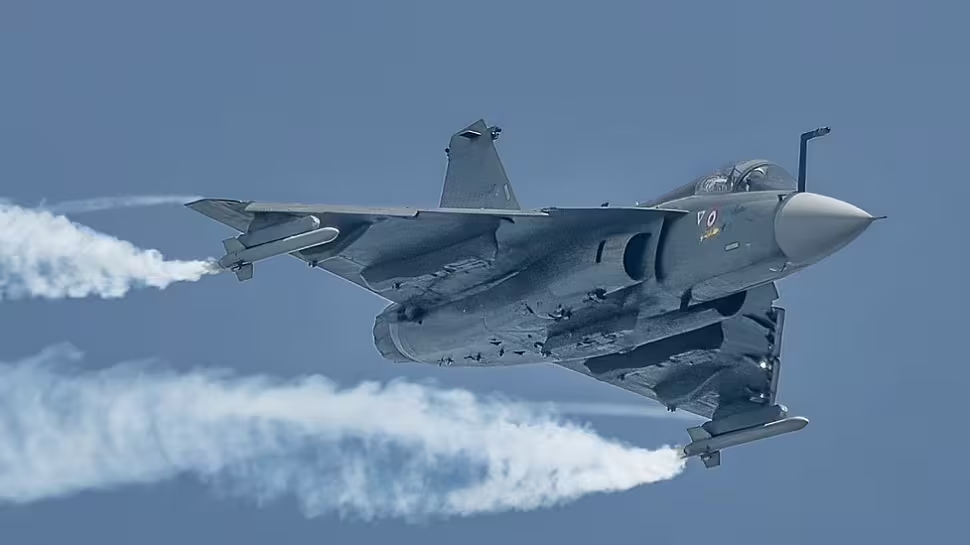
[Tejas — up in the air]
There’s leadership transition at HAL, and Director (Engineering and R&D) DK Sunil is expected to take over at company HQrs in Bengaluru, replacing CB Ananthakrishnan, a former Chief Finance Officer. However this CFO got to be head of HAL, the results are there for everyone to see. HAL’s flagship programmes — the Tejas light combat aircraft and the Prachand Light Combat Helicopter are floundering in terms of production schedules. That’s what happens when a bean counter is put in charge of a strategically important programme.
(Look what David Calhoun, an accountant, did to the venerable Boeing Company. He ‘strip-mined’ the company’s industrial and other assets to pad up the revenues, drive up notional profit and the company’s stock price as also his own remuneration package, and ran a once great aerospace giant into the ground with the laxly manufactured Boeing 737 MAX — doors flying off mid-flight, etc.)
Dr Sunil is a software radio designer with several patents, who won his spurs at the Strategic Electronic Research Design Centre (SLRDC), Hyderabad, working on combat avionics systems. One can expect that his engineer’s mindset will help him to sort out some basic problems. So, what’s the trouble?
The same old ailment afflicting all defence public sector units, in the main, no honest acknowledgement of its limitations as a production entity. Having done little else than produce, under license, various foreign aircraft, starting with, as a private enterprise — Hindustan Aircraft Ltd, assembling the Harlow Trainer, Curtiss Hawk Fighter and Vultee Bomber during the Second World War, and after its nationalisation — a whole series of fighter aircraft — Gnat, MiG-21, Jaguar, Su-30, it did not know how to sell its own indigenously-designed combat aircraft. So, the Dr Raj Mahindra-designed Marut HF-71 happened. It was the successor fighter aircraft to, and derived from, the remarkable HF-24 engineered in Bengaluru by the German chief designer of the Focke-Wulfe fighter bombers for Hitler’s Luftwaffe, Dr Kurt Tank.
Even though underpowered, the 24 was so aerodynamically perfect, it could supercruise without afterburners! IAF veterans who flew it, can’t stop praising it as the stablest aircraft for low level flying they had ever piloted, certainly better than the Jaguar that IAF Chief, PC Lal, and defence minister Jagjivan Ram contrived to buy from the UK, and which deal kicked the legs from underneath the HF-71. Oldies may recall that during the post-Emergency government of Morarji Desai, Jagjivan Ram in MOD, was accused in an article in the magazine ‘Surya’ published by Maneka Gandhi, of taking millions of pounds sterling in commissions from British Aerospace for approving the Jaguar purchase.
The HF-71 was, like the 24, optimised for several roles but was more advanced, more capable, with longer range, and manifestly more effective in low level strike operations than the imported Jaguar. But between Lal and Jagjivan, it didn’t have a chance. The HF-71 programme was thus deliberately killed and, along with it, the country’s painstakingly cultivated homegrown capacity to design and make its own combat aircraft. So began the air force’s inglorious record of ensuring nothing came in the way of West European imports — the latest in the line of such acquisitions being the Rafale, and of HAL screwdrivering foreign aircraft together! The disheartened chief designer of the 71, Dr Mahindra, resigned — not that anyone in the IAF, the defence ministry, or the government of India, cared.
In fact HF-71 and that episode isn’t mentioned in any online official history of HAL, and even the HF-24, gets only a passing mention. Perhaps, it reminds too many people of why so much has gone wrong.
With the passing from the scene of Mahindra, that entire generation of aircraft designers trained by Dr Tank was lost. So, when in the mid-1980s, the indigenous Tejas project was cranked up, it had to start from a near zero baseline — the reason why the regaining of all the necessary designing skills and competencies took time. Something the illiterate Indian Press and media fed on Vayu Bhavan PR never questioned. Rather, the Tejas programme was blamed and still is, for time and cost over runs and for imperilling national security! It was a prelude to making the case for the air force needing imported aircraft to continue to keep in fighting trim — an exercise that included joy rides for TV reporters in pressure suits going gaga over Gripen, Rafale, and whichever other foreign aircraft was in the running for the multi-billion dollar Medium Multi-Role Combat Aircraft contract!
Meanwhile, Russian aircraft buys tootled along. But after the demise of the Soviet Union, when the Russian arms industry found it had to survive by itself, it discovered what the Western suppliers had done late 1940s onwards with the first purchases of the French Fuga-Mystere and the British Vampire, that a liberal distribution of commissions, etc to any and everybody in the Indian defence procurement loop, helped make the sale. Starting with the Su-30, the Russians too joined in this game of arms procurement bonanzas.
This diversion into a bit of history is to contextualise what the next chairman, HAL, Dr Sunil shouldn’t do. However full HAL’s orderbooks and however limited its production capabilities, his predecessors in office did what all DPSU heads do — insist every piece of hardware produced in the country be made within the DPSU’s premises. It is a wrong tack for HAL to take because it is impossible for it to produce 324 Tejas LCAs to equip 18 squadrons in any reasonable timeframe. Considering, its annual production rate is only 6-9 aircraft per year. With an additional production line that number will go up to 18 Tejas annually, meaning it will take HAL 18 years to fulfill the order if everything else works tickety-boo. Because the 2nd Tejas line is yet to get on stream, it will be the centenary year of the republic or later before the last of HAL’s LCAs enters service.
Except, Tejas is a 4.5 gen combat aircraft at a time when 6-gen combat aircraft will soon begin flying. Are you getting a whiff of what the IAF may be up to? How long, do you think, it will be before IAF and the media begin canvassing for a 5.5 gen or 6 gen MMRCA costing hundreds of billions of dollars because, well, HAL is falling way short of producing the Tejas? It is a fine way of also killing the successor Advanced Medium Combat Aircraft. Neat, and a very successful strategy!
This is the reason why I have been advocating for some 20 years now that GOI at least wise up and instruct NAL/DRDO to onpass the Tejas source codes to private sector majors — L&T, Tata, and Mahindra Aerospace and, if GOI is serious, for these three companies to be incentivised with tax holidays and whatnot, to open two production lines each for the 1A and subsequent models of Tejas and the AMCA, for a total annual production of 144 Tejas aircraft, such that the entire IAF requirement is met inside of THREE years from the green signal. It may end for good the military’s foreign fixation.
This is the way, hear me Pradhan Mantri Narendra Modiji, for high value employment to be generated at home rather than in France, UK, US and elsewhere, for the atmanirbharta programme to acquire teeth, for the rapid manufacture of Tejas also for the Trillion-dollar export market, for the Indian defence industry of private and public sectors working in tandem to become an aerospace tech power, and for India finally to take wing as a self-respecting, arms self-reliant nation!


 Security Wise
And…we bought the Jags BEFORE the Brits and Frogs did…
Sir, The role of US (GE-404 engines) is as important for the production of Tejas as enhanced participation of private sector. The recent delays in supply of GE-404 engines by the US could become a major impediment in scaling up production of Tejas. Warm Regards Gp Capt R K Narang VM (Retd.) PhD
Email from Admiral Arun Prakash, former Chairman, Chiefs of Staff, and Naval Chief.
The Admiral, a naval aviator, won the Vir Chakra gallantry award for flying Hunters with an IAF squadron over Dhaka in the 1971 ops.
ARUN P
Fri, 30 Aug at 8:50 pm
Bharat, a bit of hyperbole has crept into your, otherwise, very pertinent article: there was no way, the Marut “could supercruise without afterburners.”
With two little Orpheus engines, she was barely trans-sonic in a dive.
Regards.
Email from Lt Gen Vijay Oberoi (Retd), former Vice Chief of the Army Staff
VIJAY OBEROIBcc:bh_karnad@yahoo.com
Fri, 30 Aug at 8:25 pm
Let us hear the Air Force view.
https://www.globaltimes.cn/page/202408/1318975.shtml
The following line from the aforementioned link says it all;
“This Thursday meeting is not intended to solve the border problem once and for all”
Mr. Karnad I strongly believe that China has managed to successfully set up its moles at the highest level in India otherwise Indian establishment cannot be so naive to believe that China never intends to settle its borders with India.
good morning sir please enlighten us on india’s failure of making its own jet engine..thank you
Professor, you seem to have almost a blind faith in Indian private industry. What makes you think a Tata, Mahindra or Adani can do fighter jets in 3 years when they have never done it before? And where are the engines? Remember the Tatas and Mahindras took more than a decade and a half to sell reasonable cars. With foreign support.
PROFIT motive and guaranteed sales to amortize the invested capital in poduction facilities.
What powerplant will be used for this Tejas LCA? How can we expect to rely on US to give us the GE engines, when US is only interested in creating a dependency situation, to help them in arm-twisting us to abandon our vital interests?
your understanding of what it takes to build things seems limited Professor. These same companies couldn’t build a decent car for decades. My understanding is that even now engine development is an issue. I know firsthand what the Tatas went through to improve their cars and how long it took. So without outside help or more time, no fighter jets! It’s worth trying, but don’t expect fireworks like three years etc.
Depending on the profits they expect to rake, pvt sector companies will do anything — get tech, project managers, whatever from anywhere to meet deadlines.
That’s a Very naive understanding Professor. Capability development takes time, leadership commitment and sustained funding. None of this can happen overnight. Your understanding of the Indian private sector is at best limited. That’s why you make these big statements without a true understanding of what it takes to develop things.
Amit@-It is precisely to marry the superior management and process engg capabilities of pvt sector Cos. with the physical facilities and production experience of DPSUs that I proposed in my 2015 book why India Is Not a Great Power (Yet) a full scale integration of pvt sector Cos. and DPSUs — with DPSUs and all DRDO labs and testing facilities divided into two competing nearly equal def-industrial combines to be headed by the 2 most ethical and comprehensively capable pvt sectpor engg giants — L&T and Tata. And that ALL defense procurement would have to be channelled through these combines, with weighted selection formulae, etc. Look at that proposal it’d be a solution for the country’s def industrial/procurement woes.
I think that when it comes to Indians, they’re willing to try anything, but will often deliver nothing. The history of Indian defense development is littered with so many examples. I think we should set small goals which can be incrementally built upon. It would take a long time to build up to meaningful successes.
Professor, you made a specific comment about producing fighter jets in three years. That won’t happen whether it’s Tata or L&T – they will be subject to the vagaries of US supply just like HAL. Question is whether they can make a jet engine? Possibly, but again they have to prove themselves. No one can argue that the private sector is not more efficient than the public sector. That’s a given. But, Just because they are private means nothing – there are other factors to consider.
https://idrw.org/security-expert-urges-goi-to-establish-private-tejas-production-line/
Sir ..ur suggestion about blogpost is published in IDRW
Just saw an NDTV Profit segment showing Udayant Malhoutra of Dynamatic Tech in Bangalore. They make parts and assemblies for, and have won top supplier awards from Boeing, Airbus, Dassault – they also own foundries in Germany. They are top-notch and should be strongly considered for Tejas, Prachand, Dhruv production.
Tejas has been shot down by Nuclear Sub Project. As a quid pro quo India has to give Russia/France something. Russia/France basically want the whole of India. There is no way India can become self-reliant in arms production without making nuke subs all by itself. We need to ditch Russia and France.
well said sir…guys enginee issue is separate one..bharat sir saying assembling issue where HAL cant fullfill the entire demand and without delivery IAF again will curtail for AMCA and meantime assembly of LCA tejas will create aircraft assembly ecosystem will create infra and production rig and assembly lines which can be reused and repurposed for AMCA by private and they will be interested to AMCA for profit or not to keep their investment idle.
Also @bhrarat sir is right TATA ,godrej, L&T most ethical private corp
Really? The engine issue is separate? That’s the reason HAL is unable to make the Tejas. Otherwise it can make 24 aircraft per year. Private industry can be leveraged to make more than 24/year, but they cannot resolve the engine supply issue. For that they need to be able to make the engine, which I bet they can’t in 6 months as the 3 year timeline seems to imply. Making such statements is lazy analysis.
We wouldn’t be in this engine glitch had GOI stayed with the Kaveri by getting the pvt sector in, and not succumbed to IAF pressure, etc. This was, what, 8 yrs ago.
Dear Amit Ji,
LCA Tejas currently relies on the GE F404 engine. At this stage, a mid-development switch to another engine is neither feasible nor advisable due to integration constraints and the resulting delays in certification. This dependency on GE engines is a bottleneck, but even when the engines are supplied, the production bottleneck lies in the assembly line capabilities, not just the availability of the engines.Production Bottleneck:
The crux of Bharat Sir’s argument is that our assembly lines, regardless of whether HAL or a private player manages them, are too slow to meet the IAF’s requirements for squadrons. The current production system follows a Fixed Position Layout, a manufacturing approach often used for large products like aircraft, where the product remains stationary, and workers and equipment move around it. You can find more details on this concept here: https://www.spanco.com/blog/what-is-a-fixed-position-layout/
https://www.youtube.com/watch?v=liZ0WEEsuz4&t=11s
https://www.youtube.com/watch?v=XgwLa8j2HIk
Given HAL’s current rate of producing only 6-9 aircraft per year, it would take 18 years to meet the existing IAF order of 324 Tejas aircraft. Even if HAL expands production to its maximum of 18 aircraft per year, it would still take 10+ years. This delay could compel the IAF to resort to familiar tactics of pushing for foreign acquisitions like 5th or 6th-generation aircraft, which would further impede our indigenously developed AMCA project.Why Private Sector Involvement Matters:
The private sector has proven efficiency in sectors like space, as demonstrated by companies such as L&T, Tata, and Mahindra, which are known for ethical practices and robust industrial processes. While it is true that producing aircraft is more complex than cars, the private sector excels in managing processes, optimizing production timelines, and scaling up industrial operations — something HAL has struggled with over the years due to bureaucratic inertia and unionisation and sab chalta hain…attitude
With private sector involvement in assembly, we could significantly increase the production rate, allowing us to meet IAF requirements within 5-7 years. This would:
@Kumar, no one is saying that the private sector is not more efficient. However, there are some factors to consider on whether the private sector can jump in overnight and start delivering fighter jets, especially if they have not done it before.
Complex technology takes time to master. So this hypothesis that L&T and Tata will jump in Monday morning and start delivering fighter jets by Friday afternoon is just that. Things will take time to shape up, there will be teething issues and then finally private industry will start delivering. All this will take years.
Secondly, HAL line capacity is 24 aircraft per year. Not 6-9 as you mention.
It is lazy and factually incorrect analysis like this that can lead to poor decisions.
Well, not sure if the Private sector can solve the engine problem. This is where I doubt Indian private sector capability – there is potential promise, but it needs demonstration. However, agree that the GOI should have proceeded with the Kaveri program and funded it well. That is the issue!
I know HAL is ramping upto capacity for 24 but i believe its still not there 24 per year ///its in the process of increasing capacity
https://swarajyamag.com/defence/hal-to-ramp-up-tejas-mk-1a-prodction-rate-from-16-to-24-aims-to-complete-delivery-a-year-ahead-of-schedule-by-2028
our aim should be assembling in faster pace so we need private player to pitch and HAL can focus on AMCA
https://theprint.in/defence/looking-beyond-hal-iaf-proposes-public-private-partnership-to-ramp-up-tejas-production-line/2264726/
Looking beyond HAL, IAF proposes public-private partnership to ramp up Tejas production line
sir …finally they are realising benefit of ur approach
Dair se aaye, durast aaye!
Dr Karnad , I believe in the 90s you had advocated (in some journal or magazine) ,for the privatization of HAL ,which went something like breaking the company into two groups and then selling them through bidding process. Then try to playoff one private sector aircraft manufacturer group against another . By having profit & government contracts as an incentive , the companies would compete with one another by investing in production , research and better resource management. Hence reaping the benefits of a Free Market Economy for strategic purposes.
May be a stretch , but i believe the philosphy behind the defence production reforms that you have been advocating for the past 3 decades or so , have been implemented but in a completely different place i.e in the space sector. The government opened up all its testing and launch facilities for the private sector . The ISRO has started pivoting from the satellite business and towards more pure scientific pursuits like studying black holes, creating a telescope , etc. The technologies created by it is now actively being shared with the private sector . No wonder we are able to produce 3-D printed rockets and create startups like Agnikul and Skyroot aerospace.
It seems as if somebody took your writings applied them in the space sector. Which has been a tremendous success nonetheless.
A propos the Jaguar vs HF-Marut I would note that to my information, the Jaguar is the best fighter-interceptor to-date for air battle in the Western Powers inventory as far as “terrain hopping” capability is concerned. This means, the Jaguar is ideally suited for air battle in the Himalayan mountain. Whether the Russian Airforce has some similar one does not know. Of course the Russians do not require that capability for their air defence and hence did not pursue that technology. The Anglo-French Jaguar is heavy, but you do not need supersonic excellence in navigating mountainous territory. The British and the French are still having Jaguars in their air force. I knew one Indian fighter pilot who told me that the Jaguar is superb in flying. There was some problems with its ground communication system, but over time that has been addressed.
I fail to see how “a software radio designer” could be valuable for aircraft engine etc. which is the “hardware” technology – there is a vast gulf between software and hardware expertise. In any case, as the engineers say, you do not re-invent the wheel in engineering research and development otherwise you will get nowhere finally..
@BharatKarnad, professor is this historical event true that during 1971 war when Nixon and Kissinger had sent their 7th fleet in the bay of Bengal for threatening india to not attempt a offensive against West Pakistan.And in case india goes ahead with its plan to invade west pakistan they were planning to attack or capture indian coastal cities so as to divert our attention from a invasion plan to west Pakistan.Eventually the admiral,indian air force pilots at that time and Indira Gandhi had planned to attack and destroy the US fleet with Kamikaze fighter planes(canberra bomber something like that) literally a suicide mission for our pilots.
If such a plane had been executed by our forces what repercussions would have happened would it be US declaring war on india like Vietnam.
Was all this a possible scenario.
I would love to know your opinion.
No Kamikaze, or any of that. Nixon-Kissinger and the USS Enterprise carrier task group were deterred by Russian N-powered attack submarines following it and threatening to take out the American carrier and its escort flotilla.
Professor,
There seems to be a lot of talk lately of buying the F35, and going for even the F15/F18 before the F35. However, there is no talk about developing the Kaveri engine. There is talk about a JV with Safran for developing helicopter engines, there is talk about partnership with GE, Rolls Royce and Safran, and even Russia on developing the next generation of jet engines, but no one talks about the Kaveri engine. This is the real scandal in Indian Military circles.
Why is the Kaveri engine not being talked up? What about propulsion technologies for helicopters, tanks, submarines, aircraft carriers, etc.? We have to rely on companies like Cummins for tank engines!
The other big issue is the lack of military spending in spite of China increasing its military budget 7+% every year in spite of negative economic growth.
While India is managing its military transformation reasonably well in many areas, lack of funding and backwardness in propulsion technologies, will keep it reliant on other nations for much longer than prudent.
Exactly! Why is Kaveri facing stepmotherly treatment?
I’ve been commenting this same thing. HAL has his order book bulging with close to 200 jets and aspirations for exports. To fulfil that on a timely fashion, it needs the capacity to make at least 40 jets a year, but unfortunately it has only 16 (with the possibility to expand it to 24)
So it’s high time it outsources the manufacturing – either part of it or full – to able private players such as TATA Engineering, L & T, Mahindra etc. by helping them set up the manufacturing facilities across the country. Tamil Nadu offers an attractive atmosphere and HAL should capitalize that.
absolutely agree that all production of Tejas should be in the private sector and only design with DRDO