
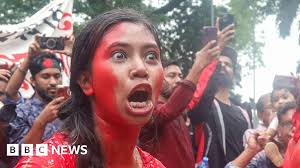
[Bangladeshi blood lust]
Dhaka University students have always been the vanguard of change in a benighted Bangladesh. The massacre by the Pakistan Army of students and select professors — proponents of Bengali nationalism in East Pakistan in March 1971 — killings expressly ordered (Operation Searchlight) by General Tikka Khan, GOC-IN-C, East Pakistan, to quell the nascent separatist movement, backfired spectacularly. Many date the inevitability of an independent Bangladesh to that sorry episode.
It was Dhaka Univerity students again leading the campaign against job quotas in government services for family members of the Mukti Bahini and other sections of society, which precipitated the ouster of Prime Minister Sheikh Hasina Wajed. It was the usual raucous agitation common to the subcontinent — a lot of thunderous speeches signifying nothing. And then Hasina sent in the special riot police to literally knock some sense into them. It angered the students into violence — the wedge the Jamaat-i-Islami’s student wing — Islami Chhatra Shibir were waiting for to kick in the door of the Awami League regime. Under the cover of this popular protest, it pursued its larger agenda of pogrom against the Hindu minority. Repeated bouts of ethnic cleansing of Hindus from Bangladesh by the Jamaat-Shibir have resulted over the years into a substantial 22% minority at the time of Partition being whittled down to less than 3% of the 170-odd million strong population today. The Shibir has been very clear about its objective of zeroing out the Hindus of the country by sword or by conversion. They are almost there.
The communal politics of the subcontinent are simply dreadful and a continuing tragedy. Pakistan has been nearly cleansed of Hindus, as is Bangladesh now. The trouble is these cleansings on either flank make the condition of Muslims in India tenuous, paradoxically, at a time when their numbers have grown healthily to some 14% of the population, or nearly 200 million — the only religious minority that, numbers-wise, is flourishing in South Asia. It sets up a deadly dynamic of Indian Muslims feeling more and more beleagured as the majoritarian sentiment grows less tolerant with newsreports and reliable personal accounts reaching India of Hindus in Pakistan and Bangladesh being subjected to ceaseless violence, dishonour, degradation, and death. These naturally stoke Hindu outrage in this country which, if it gains critical mass, could become unstoppable, snowball into something truly horrendous. The trouble is very soon there will be no atrocities to commit against Hindus, because there will be no Hindus left in either Pakistan or Bangladesh. A tipping point will then be reached as regards the Muslims in India because Jinnah’s principle of minorities as “mutual hostages” will be voided.
The pity is Jamaat-i-Islami in Pakistan and in Bangladesh and their youth wings do not care what happens to the sizable population of Muslims in India. But the view of the Hindu Mahasabha at the time of Partition that there be a complete exchange of populations between “Hindu India” and “Muslim India” to prevent the piecemeal elimination of minorities may then begin to make sense, gain new adherents, with what consequences can only be imagined.
But to return to developments to our immediate east, the speed with which the Awami League government fell apart, does arouse suspicions about a foreign hand. After all, Hasina had placed her Awami League loyalists and people close to her party chieftains, in almost all the strategic posts in the government, especially the police, and appointed Major General Mohammed Hossain Al Morshed in April this year as head of the National Security Intelligence and, earlier, a distant relation, General Waker-uz-Zaman (ex-East Bengal Regiment), as army chief in December 2023. So, what went wrong?
Hard to say, but some rumours suggest that Hasina’s denying permission for the use by the American Navy of a base, possibly Cox’s Bazar, led to the US conspiring with Generals Morshed and/or Waker to depose her — with the student protest providing ample cover. Another story has it that Beijing, upset with Hasina handing over the $1 billion Teesta River development project to India, to crown a series of connectivity projects across Bangladesh linking West Bengal to the states in the Indian Northeast, that she had approved, was only the latest move in a series that also saw her turn to India for arms supplies, and was the poverbial last straw. And that China used the same Generals the US is supposed to have done, to do its work. Choose whichever account you are partial to, because one thing is certain — the regime change did not happen because the denizens of Dhaka U willed it so, or because the Jamaat, whose leadership ranks were decimated by Hasina, was acting in cahoots with the opposition Bangladesh National Party of Khaleda Zia — a largely spent force!
However it happened, the Nobel laureate, Muhammad Yunus (whiling away his exile in Washington) was waiting in the wings, so to say. He did not need much coaxing to agree to lead an interim government in Dhaka, which could be in power for as long as it takes to obtain a regime acceptable to many internal and external interests. India is one of those external players who cannot be ignored. But, the Modi government did get a blackeye owing to its being lulled so easily into complacency by the RAW station, Dhaka, assuring NSA Ajit Doval that all was good. So, when the eruption happened the Indian government was as surprised, and had as short prior notice as Hasina did to pack a satchel and board a helicopter taking her to Kolkatta for an Indian VIP fleet plane to fly her from Dum Dum to Delhi.
The most impassioned, heartfelt, and insightful comments and writings about the happenings in Bangladesh in the Indian media are, not surprisingly, by Hindu Bengalis. In a strange but remote sort of way I feel drawn personally to the Bengal drama. My father, a newly minted civil engineer from the College of Engineering in Pune (at a time when there were only four other engineering colleges in British India — at Guindy, Karachi, Jadavpur, and the Thompson College of Engineering at Roorkie), was selected in 1944 to join the Indian Railway Service of Engineers. This was when the Warrant of Precedence was: Viceroy; C-in-C, India; Commissioner, Railways, etc. For graduating engineers in those days, the railways were it.
My father, an adventurer at heart and a topper in the merit list, who had never travelled north of Mumbai chose Bengal Assam Railway to see the rest of the vast country and the world, with his probationary period spent at the HQ, BA in Sealdah. As required, he quickly became proficient in Bengali, a prerequisite to serving there — a frontier railway in the east and counterpart of the North West Frontier Railway in the west that reached Landi Kotal through the Khyber Pass on the Afghan border — the two railway systems at its two ends tying India together.
Newly married in 1946, my Dad took his then 19-year old wife, who had not travelled beyond Mumbai either, from our home town of Dharwad in what was then the Bombay Presidency and is now in Karnataka, to Calcutta. They reached the once imperial capital just a few days before the great Calcutta killings of 1946 occassioned by the Bengal Chief Minister Shahid Suhrawardy’s call for “Direct Action Day” that saw some 6,000 people killed — the biggest mass murder in the Partition era 3-day stretch, August 16-19.
Protected by armed railway police, my parents were terrified witnesses to many of these random knifings in the street fronting on their home in Tollygunge (I think). My mother was so traumatised she aborted the baby — her first, that she was carrying — my would have-been older sibling. That was her introduction to Calcutta and the Bengal-Assam Railway. She never quite got over it. Over time the memory of the horrors faded, of course but, perhaps, not the fear that had settled deep down within her that no amount of absorbing Bengali culture — speaking the language fluently, engaging in “Rabindro sangeet”, etc., could eraze. My parents considered themselves honorary Bengalis. When I think of the Hindus in Bangladesh today, I speculate about my mother’s state of mind in Tollygunge in August 1946, and break out into cold sweat.


 Security Wise
.@BharatKarnad, professor, this is very heart-felt blog written by you recently. As watching closely what is the situation in neighboring countries, many big forces are ganged up to destabilize indian subcontinent for their own greedy interest.
And other hand, Indian government also fails to secure regional stability having various reason to be unsuccessful. It’s a shame that within the country, we are so much obsessed about other various non security issues, which contributes to nothing but fulfills some handful of people’s interest.
as mentioned in the blog, “The most impassioned, heartfelt, and insightful comments and writings about the happenings in Bangladesh in the Indian media are, not surprisingly, by Hindu Bengalis”. Our Indian media is one of those, which can not be relied upon due immaturity and biased reporting.
Dr karnad, is true that subsequent failure of R&AW due to continously sabotaged by many governments in the past and present what we initially saw at the time when Indira Gandhi newly formed external security as R&AW, who has done tremendous damage to external enemies including liberation of Bangladesh in 1971.?
Great Article Dr Karnad !
I believe you once remarked that there were only two unfinished businesses from partition none of which concern Kashmir as Pakistanis would like to believe.
The first is Bangladesh’s inability to keep its citizens within its border.The Perpetual Human Seepage from Bangldesh that K.P.S Gill talked about in your book , “Future Imperilled”.
The second is Pakistan’s inability to find social peace as a nation.
It is safe to say we can add a third one that is the failure or inability of the Indian leadership during the Partition to evacuate Hindus from Pakistan and Bangladesh(Then East Pakistan) or even trying to come up with a plan to mass evacuate them and settle them in India during the years that followed Independence.Those communities are dying a slow and painful death in their respective countries.
It was interesting to read about your father and your parent’s stay in Bengal. Dr Karnad , can you write more such articles or musings which have a memoir-esque feel to them. Your writing seems to have an old world charm to it.
P.S :- The Americans seemed to have been behind this colour revolution.The “protestors” using American social media platforms to communicate. Getting Nobel laureates to run countries very much looks like Yankee way of thinking even though the track record of it working is almost non existent. Aung San Suu Kyi mismanaged Burma by signing all those CMEC deals and increasing Chinese Influence in that country.Nelson Mandela use to jail his political opponents , when he was the president of South Africa but both of them are hoisted as heroes by Yankees.
Thanks for sharing your family experience Bharat.
Email from Lt Gen Balli Pawar (Retd), former DG, Army Aviation
balli pawar
From:ballipawar@yahoo.com
Sat, 10 Aug at 4:02 pm
Dear Bharat
You have rightly pointed out that this was clearly a regime operation by either US or China. In my opinion US is the more likely culprit.
But unfortunately all their regime change operations always result in chaos and instability. Another headache for India in the region with instability all around.
Regards
Email from Dr V Siddhartha, former Science & Technology Adviser to Defence Minister
On Sat, 10 Aug 2024 at 14:18, V Siddhartha wrote:
Sir, If this pogrom continues what should India do? Is is feasible to partition Bangladesh on religious lines? Or we will have to see the slow genocide of almost 1crore HINDUS before our eyes.
It is a thought. The Buddhist Chittagong Hill Tracts hugging the eastern coast and bordering Myanmar are habited by the Chakma people. CHT, with two strategically significant ports — Chittagong and Cox’s bazar, is a possibility. There’s already the Parbatya Chattagram Jana Samhati Samiti fighting for Chakma rights.
china doesnt have that expertise which US has to orchestrate such coup without leaving any proof. Also it was already confirmed by Hasina officials few months back that US is pressuring her to step down since last year.But whosoever did it, do you think that if similar situation happens in india ,modi govt has plan to thwart and deal with such attempt? Should india make a new laws to declare all people involved in voilent protest against elected government as terrorist and deal with them accordingly?
Lucidly written, but fails to talk about possible measures to remedy the failures of our intelligence chieftains in BD or our counter intelligence (if any) in the US and China under Ajit Doval. What lessons can we learn from this debacle and what solutions/steps are there for us to take pro-actively ? Forcibly moving Indian Muslims to Pakistan or BD can never be the answer or consequence to such political wargames. Also, while education and economic development will always be the long term solution, I think we need to legislate common and non-preferential laws for personal, social and religious rights ….and as a first step, abolish the reservation and quota system for professional education and jobs in India.
Bharat, you are ever so forthright and frank in your views. The external players manoeuvring the fanatical elements to destroy humanitarian values and ethics, could well turnout to be a dragon who kills his own master.
I am of the view that, if basic humanitarian values are to be sustained; the world and specifically the UN should de- franchise ISLAM as a religion.
Narender , 885, KG Belgaum.
KG, Belgaum did instil good values in us, didn’t it?!
Bharat, 628, Georgian, Belgaum
Dear Professor Karnad:
I am a huge fan of your scholarship and writing, particularly your seminar works on Indian security and foreign policy. I also regularly read your columns with a great deal of interest.
Let me introduce myself. I am Rajat Ganguly and I am the Editor-in-Chief of the Journal of Asian Security and International Affairs. The journal is published by Sage Publications and is currently ranked Q1 in the SJR ranking of journals in Political Science and International Relations.
We are planning a special issue on the Bangladesh crisis, and I am writing to ask if you would be interested in contributing a commissioned piece (8000 words) for the special issue on the strategic implications of the Bangladesh crisis for India. My deadline is 30 October 2024. The targeted publication date is March 2025.
Please let me know if you would be interested in this. I look forward to hearing from you.
Kind regards,
Rajat
Dr Rajat Ganguly
Editor-in-Chief
Journal of Asian Security and International Affairs (SAGE)
Web: https://journals.sagepub.com/home/aiaa
Scopus CiteScore (2023): 1.5
Scimago Journal Rank in IR/PS (2023): Quartile 1
[Scimago Journal & Country Rank]
Indexed in: SJR, Scopus, Google Scholar, ESCI, Publons,
JSTOR, Australian Political Studies Association (APSA),
DeepDyve, Dutch-KB, J-Gate, OCLC, Ohio, Portico,
UGC-CARE (Group II)
Tel: +61 435 448 011 (cell phone)
Email: rajatganguly@outlook.comrajatganguly@outlook.com
Dear Rajat,
Would have liked very much to contribute to your journal, whose success I have followed with interest.
The problem, honestly is this: I am trying desperately hard to finish a book that’s long overdue. It
is something I am determined to complete by year-end. Writing a piece for the Journal of Asian
Security and International Affairs with an October deadline is, therefore, quite honestly, beyond me.
All Best,
Bharat Karnad
“.. a substantial 22% minority at the time of Partition being whittled down to less than 3% …” –
Fudged statistics!
According to Taslima (expelled Bangladeshi exiled in Sweden), it was at least 45% of Hindus in “East Bengal” at the time of partition. The West Bengal BJP maestro Tathagata Ray has in recent times documented the reality how the true figures were manipulated by Suhrawarddy in the saddle of Bengal in that era with the British Raj’s connivance to produce such nonsense numerically to engineer Bengal Presidency’s partition in 1940s. The main culprit was the Congress under Gandhi who accepted that as reality without countering.
There are two eye-opening politico-strategic documents by MKB appearing in the press at the moment in the context:
https://www.indianpunchline.com/sheikh-hasina-was-a-time-tested-friend/
and here:
https://www.indianpunchline.com/thailand-aborts-the-colour-revolution/
These two studies bring out the stark grave reality the Indian State is facing in the international world. It shows the naivety and incompetence of Jaishankar and Doval et al being caught wrong footed in their crucial role. I feel sad that Hashina has not been given an indefinite stay in India by Modi Government. She will be the only clutch in India’s hand to hold on to swim in the turbulent waters ahead. It is impossible to believe that a handful of agitating students in Dhaka (are they really students?) to bring down the seat of power in a nation of 170 million of Bangladesh after some years of economic uplift of the population under her leadership.
Don’t spread propaganda Sankar. Come up with a solution if you don’t like what you see. It’s easy to criticise, much harder to actually solve problems. You don’t have much of a history of sound analysis. So your pronouncements on policy don’t carry much weight.
One curious aspect of a contemporary man is his belief that he has flown the perch of history, that he is no longer subject to history. Much of discussion surrounding Islam is delusional at best and downright suicidal at worst. Everything that has happened in Pakistan and is happening in BD could have been foretold by just a cursory understanding of history. India too will be subjected to the same historical forces in the near future. We too will have the fate of the Copts. Only the Spanish have managaed to resist and repel the Muslims, does the Hindu civilization have the will to Reconquista?
Agree with you fully. But I am not so pessimistic about India. Modiji has turned the table in Kashmir and by one slap has reduced to irrelevance the Kashmir card to play in the hand of external powers. At least he has made sure that there is no more “secularism” in India at the cost of Hindus.
There’s no such a thing as ‘secularism’, it does not exist. Prior to Modi, India had been creeping towards islamisation, and after Modi, it’d continue the same path because there hasn’t been any substantial changes— just a whole lot of noise. Modi is a social-democratic low-class peasant, who has limited horizons. When historians look back at this period, they will conclude Modi’s domestic policy as a failure to demonstrate ingenuity and strategic-discipline, his foreign policy as a misguided attempt at making India the satrapy of America, and letting the Americans take foothold in Indian sphere. While China is a significant threat, our biggest enemy is America.
The major issue is how we can keep our neighbours with us! Apparently the China factor is overbearing for India.
If the Americans were to establish a base in Bangladesh, India should immediately start testing 10,000 KM and 12,000 KM ICBMs, which it has not done so far to keep the goras in good humour. That consideration should immediately be chucked out of the window, and then the next round of nuclear testing should start.
India should openly state this and visibly prepare for such an eventuality.
Though, to be fair, St Martin’s Island in Cox’s Bazar, is a base the US may have in mind to use against China.
Mr. Karnad, I would really like to get your opinion on the following article;
https://www.indianpunchline.com/winds-of-change-in-india-china-relations/
Pity that the Modi govt may once again be falling for a practised Chinese policy of deception. The PM has apparently learned nothing from the Wuhan and the Mammallapuram summits with Xi that were followed by the May 2020 Galwan River hostilities.
there is nothing wrong in attracting good investment from china instead of depending on US companies like tesla. Which will never invest in india. On other side its better to get relation with neighbours on track(on our condition though). Because India can never count on US or Russia to help when it comes to fighting against china
Indian army also cannot be absolved of its mistakes during the deadly confrontation with the Chinese in June 2020, when the Chinese troops attacked with clubs and stones, what stopped the Indian army from using its guns? Modi has spoiled the Indian army by unnecessarily glorifying and praising it for no reason whatsoever.
A US base onn Bangladesh’s St. Martin’s Island would be uncomfortably close to India’s nuclear submarine facility.
https://swarajyamag.com/defence/a-us-base-on-bangladeshs-st-martins-island-would-be-uncomfortably-close-to-indias-nuclear-submarine-facility
While the base will be ostensibly to counter China, it can (and WILL) be used by the Americans against India. The convergence of leftists and Islamists in America make this a certainty.
As I said in an earlier comment, India must draw the red line now, and state the consequences of crossing it in no uncertain terms. Nuke testing resumption and 12,000 KM ICBMs.
The great Indian circus is out with its new act. America continues to slap India across the face! India continues to feel it as a pat on the back! Splendid Times!
Meanwhile Italian clowns continue their riots in the parliament. Bollywood celebrities disrupt proceedings over the ‘Tone’ of the chair. The world enjoys its popcorn.
What can be done?
Sit back and enjoy the tamasha!
Prof. Karnad, I’ve been thinking a lot about the Bangladesh events, and one thing that struck me is the lack of a systematic, institutionalized process and effort in Indian strategic circles to understand America and its worldview, what shapes it and who shape it (I am willing to be corrected). My impression is that there is plenty of material published on military developments, but not enough attention is paid to understand the fires that America and others are trying to light in India.
Rajiv Malhotra has done pioneering work in this regard, and has published two widely acclaimed books, namely, “Breaking India” (https://breakingindia.com) and more recently, the successor to it, “Snakes in the Ganga” (https://rajivmalhotra.com/snakes-in-the-ganga). He has also published other works, such as the impact of Artificial Intelligence on power (https://www.aiandpower.com), and he has been prophetic and insightful in his observations.
Mr. Malhotra has stated that people in the Indian Government give him a polite hearing whenever he talks to them regarding these matters, but there seems to be a serious lethargy and lack of recognition of the seriousness of the matter amongst people who can act on these ideological and civilizational threats directed against India from external powers.
Perhaps someone high up in the government might heed you if you spoke up on this civilizational weakness.
By the way, Rajiv Malhotra is in India currently, in case you wish to meet him.
Rajiv Malhotra was kind enough to invite me to his home for dinner when I was a Visiting Scholar at Princeton University over 14-15 years ago and his “Breaking India” is indeed a pioneering tract. Will be happy to meet him during his Delhi visit.
After Dhaka talks in the CIA are “Ekk aurr dhakka aurr Dillli pakka”
Mr. Karnad there are talks in various intelligence circles that finally Modi is warming up to China and a meeting between Modi and Xi is planned for the upcoming BRICS summit to be held in Russia during October.
Annoyed by the aforementioned developments Uncle Sam plotted the overthrow of Hasina government in Bangladesh to enhance its military intelligence in the region and keep a closer look on China.
Your take on this theory?
https://www.hindustantimes.com/india-news/2-ied-like-objects-found-in-guwahati-after-ulfa-i-claims-24-bombs-planted-across-assam-101723723151095.html
The head of this so called ULFA enjoys state patronage in China.
The fact that Indian intelligence agencies have failed to conduct a hit on him a la Nijjar in Canada yet, after all these years makes me wonder if the Indian establishment wants to keep a cartoon character like this Baruah alive to indulge in such periodic shows of drama.
Dear Dr Karnad,
I am back at your site after some time. You have correctly mentioned that “The most impassioned, heartfelt, and insightful comments and writings about the happenings in Bangladesh in the Indian media are, not surprisingly, by Hindu Bengalis. “
I will say the most unfortunate part of the Indian foreign policy is to overlook the cultural proximity factor. Let’s face Kolkata is the closest to 3 of Indian neighbors ie Bangladesh, Nepal and Bhutan with lots of proximity also with Myanmar as well as the Kunming region of China. Unfortunately there is not a single policy advising think tank in Kolkata sponsored by the Centre to look over this important regions. I personally believe Delhi’s priorities are Big powers (US, China , Russia) etc and then Pakistan (probably because of cultural proximity issues since most senior Pakistani watchers such as Sushant Sareen or Tilak Devasheer come from Punjabi or similar ethnic background).
Without substantive investments in Kolkata for observing and analyzing details of these neighbors , I believe Delhi will always have to depend upon good wills of the regimes in power in places like Dhaka or Kathmandu.
Agree entirely.
Good Evening Professor i just finished reading why India is not a great power yet and i regularly read your columns and articles with great interest. All i can say is that your book is an eyeopener masterpiece and positive criticism of the government. Sir i may sound a little bit impatient but i am eager to know what is the next topic on which you are writing your future publication.
Looking forward to your new book which you would publish in 2025.
Thanks, patrol@
Great article, Dr Karnad.
Are the numbers of Hindus in Bangladesh mentioned (3%) in line? 2022 census numbers quoted in Wikipedia, Indian Express article put the number of Hindus at ~13-14 million; ~ 8%. The Hindu also quotes a Bangladesh Bureau of Statistics report of 2015 which is slightly higher. BBC also mentions Bangladesh as having 90% muslims.
India has to be behave like a responsible elder brother in the region and show more statesmanship especially since there is such a large number of Hindus there; and possible repercussions at home in some states. Intemperate comments by our politicians, including senior ministers; and in social media does not help. These echo in Bangladesh too and impact the Hindus there.