
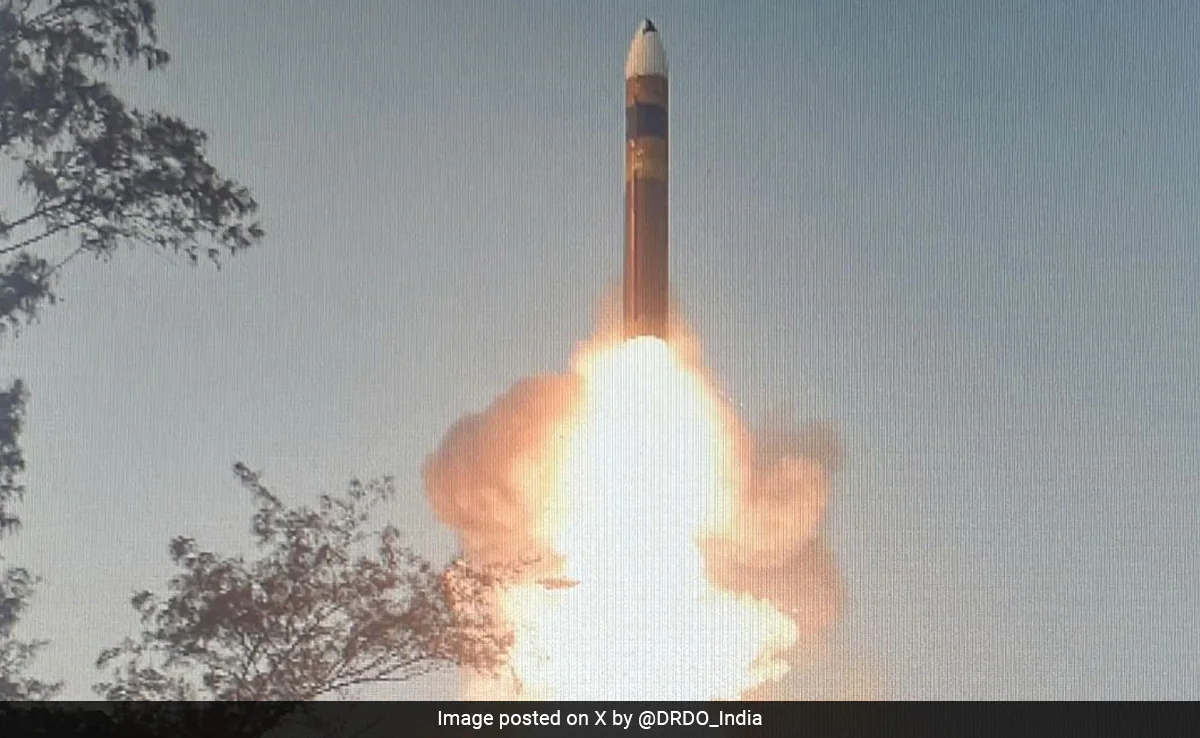
[MIRVed Agni-5 launch]
FINALLY, the Multiple Independently-targetable Re-entry Vehicle (MIRV) system-armed Agni-5 intermediate range ballistic missile (IRBM) — the Divyastra was successfully test-fired yesterday. Nearly twenty years late.
The MIRV tech has been collecting dust at the Advanced Systems Laboratory (ASL), Hyderabad, for the last 19 years. It was a project lovingly shepherded to near completion by RN Agarwal, the then Director, ASL. He wanted to complete it by the time he retired in 2004. But the project missed the deadline by a year. In part because Dr Agarwal’s approaches since 2002 to the first BJP government of Atal Bihari Vajpayee for approval of a test launch of a MIRVed Agni did not elicit the response he had hoped for. The Vajpayee PMO, with Brajesh Mishra, the National Security Adviser-cum-Principal Private Secretary to the PM, heading it, repeatedly said NO! But Agarwal’s spirited campaign for the Indian MIRV project cost him a promotion. He was passed over for the post of DRDO chief and Secretary to the Govt of India (GOI), because Mishra feared Agarwal would use the DRDO pulpit to push MIRV, which Mishra did not want. The head of the Arjun Main Battle Tank Project, Dr M Natarajan, was appointed to lead DRDO instead.
The Manmohan Singh regime wouldn’t OK the MIRV test, and Narendra Modi didn’t either until sometime in late 2022 when he greenflagged the Divyastra test launch.
I had long ago called for the militarisation of Indian Space Research Organisation (ISRO), specially its satellite package injection into designated orbit-technology, which is MIRV in embryo. But there is no reason to doubt Agarwal’s contention that ASL developed the more demanding MIRV tech by itself. Because, MIRV cannot tolerate deviation in “injection velocity” exceding 0.1 metre per second; in comparison for satellite placement, 5 to 8 metre deviation is permissible.
The nose cone geometry of the MIRVed Agni-5 (Prime) — Divyastra IRBM, can carry multiple N-warheads. But, like Agni-1 medium range ballistic missile, Agni-2, and Agni-3 — in fact all Agni’s, the Divyastra is configured to carry either a single megaton weapon, or as many as eight smaller yield nuclear warheads and decoys. For the test launch, the three MIRVed warhead variant was, perhaps, used, with each of the warheads releaseable at one second intervals during which time the missile travels 4.4-5 kms. Its elliptical target zone is calculated as roughly 50 kms by 150 kms.
[By the way, all this information and more on the Indian MIRV tech and Agni missiles was featured in my 2008 book — India’s Nuclear Policy published by Praeger in the US and, the South Asian edition, by the local Pentagon Press.]
But, PLEASE NO TALK anywhere and ever OF THE DIVYASTRA USE AGAINST PAKISTAN by any GOI officials and military officers. India’s reputation has suffered irreparable harm as it is over the years by the government’s and armed forces’ fixation with Pakistan as threat. Think of an elephant frightened by a mouse.
MIRV is a strategic attack and nuclear deterrence multiplier — because more nuclear weapons can be carried on a smaller number of missiles. So, why wasn’t MIRV tested before now?
Brajesh Mishra feared that a successful MIRV test would imperil the Vajpayee government’s policy of rapprochement with the United States, which was upset already, firstly, because Washington had no inkling of the 1998 tests, and secondly, because the S-1 test intimated India’s thermonuclear weapon interest. But the George W Bush Administration ensured during Manmohan Singh’s tenure via the 2008 nuclear civilian cooperation deal negotiated — need I repeat again — by the current foreign minister, S Jaishankar, who was then Joint Secretary (Americas) in MEA. It guaranteed that India would not become a thermonuclear power.
This happened because Jaishankar agreed, in essence, to put a lid on Indian nuclear testing as demanded by his lead American counterpart and, in the bargain, strategically sold India out. The political cover for this concession was Vajpayee’s “voluntary” test moratorium announced in Parliament on May 28, 1998. The deal carries the explicit threat of termination of the deal, if India resumed nuclear testing. It achieved America’s express arms control goal of “capping and freezing” India’s strategic weapons at the sub-thermonuclear level.
‘Strategic Sellout’ is, in fact, the title of a book of essays published in 2009 — a compilation of op’eds and such by the late Dr PK Iyengar, former Chairman, atomic energy commission, and Drs AN Prasad, former Director, BARC, Trombay, and the late A Gopalakrishnan, former chair, atomic energy regulatory commission, and myself, written realtime even as this deal was being negotiated, vehemently opposing each and every deleterious provision in it, as it became known. It was prophetic in how things have turned out, nuclear policy-wise for India, since. India has gained little by way of advanced nuclear technology because the really critical stuff like the plutonium reprocessing tech is, in any case, unavailable to India — deal or no deal! And because no Indian PM — not Manmohan and until now not Modi either, has had the guts to ram resumed nuclear testing down the US throat — even when it clearly is in the national interest to do so. Absent new ThN-tests, India is fated to remain in China’s strategic shadow.
The great villains here are R Chidambaram and Anil Kakodkar. Chidambaram, a crystalographer of middling merit, who did some good work early and for the rest of his career coasted on it, who was installed as successor to Iyengar by Dr Raja Ramanna mainly because of his pedigree, IISc, Bangalore, — Ramanna’s alma mater, when Prasad, BARC director, had better credentials because of his hands-on weapons experience. In this respect, Chidambaram’s calculation of the ‘equation of state’ for plutonium wasn’t as great a thing as it is made out to be. A graduate student of Freeman Dyson’s at Princeton University, calculated it correctly, for God’s sake! Chidambaram was unenthusiastic about the Shakti tests in 1998, and thereafter was the main opposer of nuclear test resumption in government circles as Science & Technology Adviser to Manmohan Singh, from which position he was pushed out by Modi.
Chidambaram is the last man standing to still believe that (1) the 1998 fusion test was a success, and (2) computer simulation with the existing limited computing capability is good enough replacement for actual physical explosive testing to rectify any weapon design weaknesses identified by the 1998 tests! And he’s ensconced as Tata Chair in BARC, still ruling the roost, and preventing any movement in official quarters towards a new nuclear testing regime. Shouldn’t Modi eject him from BARC? Hasn’t he done enough harm?
Kakodkar was a weak-willed engineer who replaced Chidambaram and advised Jaishankar during the civil nuclear deal negotiations. At a crucial moment in Washington, when the deal hung in balance, and a befuddled Manmohan Singh on a state visit to the US, asked him for final advice on whether to proceed with it or not, he gave the thumbs up, dooming India’s thermonuclear prospects. Kakodkar was never able to face the likes of Iyengar again.
Indian strategic weapons programmes have all displayed the same disurbing pattern — they all went into government-induced hibernation just when they needed to be most active. India achieved the N-weapons threshold with the plutonium reprocessing plant in the Spring of 1964 — seven months before the first Chinese atomic test. But it went to sleep until the 1974 test when, rather than weaponise, Indira Gandhi sent it back to snoozing, and yet again after the 1998 tests the same thing again, and that winter of hibernation for the thermonuclear weapons projects has still to end.
In the meantime, the programme weathered Shastri’s interegnum when India came closest to accepting the offer of a Western nuclear umbrella — Ukraine’s present conditions as a war-wrecked country is a stark reminder of taking American promises of nuclear security seriously! And the foolish Gandhian idealist, Morarji Desai, who as PM and prodded by the US, all but ordered closure of the nuclear weapons work in Trombay. [Read my 2002 book, with 2nd ed in 2005 — Nuclear Weapons and Indian Security for all the alarming details!]
One of the main reasons the Indian weapons programme is in the dokldrums is because of a lack of quality leadership. By February 1966, the great visionary and driver of the dual-use N-programme, Homi Bhabha, was assassinated by a CIA timed explosive on board an Air India flight he was taking to Geneva, according to a published confession by a former assistant director of clandestine ops of the agency, Robert Crowley. And, to the country’s great ill-luck, the Indian nuclear weapons programme had no strategic-minded scientists appointed to lead the AEC after Iyengar — only Chidambram, who was afflicted with serious strategic myopia and deserves to be in a purgatory, and a lot of engineers without familiarity of nuclear weapons science and technologies who, if they have distinguished themselves at all have done so as slotted functionaries, not leaders.
For Your Information, R Chidambaram is Jaishankar’s uncle (a cousin of the late K Subrahmanyam).


 Security Wise
Professor, this was only a test of the MIRV. Still a long way to go before production and deployment. My guess on thermo nuclear testing by India – won’t happen until Russia or U.S. test again, or China does something aggressive or there is a flare up in India’s neighbourhood. Till then, heads down, grow the economy, and fix India’s copious conventional military issues.
Amit@ – where anywhere in the post did I not say it was a MIRV test?
my point was that it will take another five years before the MIRV missile is deployed…this was just a test…
If that’s what you meant, then fine.
Bharat: Congratulations to the nation on the MIRV – long overdue. Hope the CEP of the re-entry vehicles was at par. We do not need to stop here, need higher payloads of 8-10+ configurations. IOW: Need a Agni VI.
It has been obvious we need additional TN tests both to prove credibility and weaponize based on evolving delivery configurations. There are two paths to it. 1. Just do it, courage is all that is needed. 2. Co-opt the US.
Shaurya — the trouble is the US long ago co-opted the Indian elite and senior echelons in MEA, MOD, etc!
So the middle brained Mr. Hans Kristensen of Federation of American Scientists will likely say that all the heads on A5-Divyastra are not more than 12kt minnows.
But do you say Prof. Karnad?
Assuming the Bulletin says this, would they be wrong if the only proven and wholly tested weapon is of “20 KT” yield?
When a weapon is claimed to have 20 KT yield, the actual realizable range point can be as low as 12KT-16KT.
Of course Hans Kristensen did not say that precisely in the bulletin, but he has implied that many many times. He even went on to the extent of saying that India would need 100s and 1000s of tests like US and Russia did to get the fusion design right. I am sure you will see how meaningless that is.
(Looks like he has no way out of pandering to his subscribers.)
The question for you is would India spend all this money in testing and productionizing the A5-Divyastra if the warhead is of dubious design? If they did not have any confidence of the heads yielding at least 150kt?
If Shakti 2 had a mere 15kt potential, wouldn’t the heads on A5-Divyastra be far lesser?
Though I must admit that when efficacy of Shakti 2 TN testing was brought up with Mr. Equation of State in the Ranveer show (TNS) and also recently again with Mr. Saraswat by Vishnu Som in NDTV, their expressions completely admitted to the inadequacy of TN.
True, high yield, ThN weapons will, at a minimum, require at least 50-odd tests to collect explosion physics data for various yield packages if not the hundreds of yests Kristensen thinks India needs. Therefore, the “open ended” testing regime I have been advocating.
Not sure the Divyastra warheads exceed 20KT
“True, high yield, ThN weapons will, at a minimum, require at least 50-odd tests to collect explosion physics data for various yield packages if not the hundreds of yests Kristensen thinks India needs. Therefore, the “open ended” testing regime I have been advocating.”
50 odd tests? Common now Prof Karnad. China fizzed the first TN test and got it right the very second time all the way back in 1967 – “the Test No 6.” So do you think India needs 50 tests to vet out the TN design?
“Not sure the Divyastra warheads exceed 20KT”
Ok so lets take this at face value. With a 3 head configuration, 2 live and one decoy the total yield = 40kt.
The other extreme if there are 12 heads, 6 live and 6 decoys the total yield = 120kt.
So A5-Divyastras could be from 40k to 120kt, all MIRVs.
Are you unhappy that this configuration is not enough a deterrent against China?
Itanium@ — China did the ThN the 2nd test around. But then, don’t forget, they conducted 70 more tests! That was for a reason.
As to what’ll deter China — a 12KT over Shanghai may do. Then again not. As I first wrote way back when — and I wish I had
patented this, because this phrase has been used by everyone and his uncle, including K Subrahmanyam !!– that deterrence is a mind game! That said, notional parity is achieved only with like yield weapons. Until India gets as standard warhead what the Chinese have on their DF-2s & 3s — 3.3 megaton, any N-laced confrontation is psychologically lost at the very beginning! This is the argument I have been making from my time in 1st NSAB, and since in all my books and writings — and there’s no credible refutation, especially because of the Indian Govt’s well-deserved reputation of being populated by nervous Nellies.
“that deterrence is a mind game! That said, notional parity is achieved only with like yield weapons.”
If you want to truly achieve all that then you have to go for atmospheric testing which era is long gone. An underground MT test will give more sting , but it is no match for the full visuals of over the surface test.
But here’s the funny thing – if technologically India can reach 250kt TN in the very next step, which is completely plausible and will be akin to how China demonstrated MT TN in Test No 6, then their own testing will tell China the full consequences of A5 – D.
Honestly if I put on the hat of a Chinese leader sitting in Beijing, I would definitely be sure that India is in no position to nuclear blackmail China, but importantly I would also be sure that a retaliatory strike from A4/A5-D/K-15 will bring terminal consequences.
And in that context – they will have to play their games. So the set of moves they have at their disposal is not incredibly large.
But look I am not really trying to oppose you – just trying ground things in reality – the way I see it.
Mr. Hans Kristensen is …. well, I will let his resume do the teaching for you : https://www.nukestrat.com/HansCV.pdf . He is more of an anti nuclear activist and less of a scientist himself. So his opinion on scientific and technical matters of weapons should be taken with a healthy dose of skepticism.
@Brij Mohan Chaturvedi
I lost any sense of value about him the moment he claimed that 100s and 1000s of nuclear tests are needed to perfect TN devices.
We have solid facts to prove the bar is no where that high.
For instance a technologically backward Britain could achieve a MT demonstration all the way back in 1958 or so (in 50s).
Like I said China go it right the very next time in test no 6.
Recently north korea which is far inferior managed to achieve 250kt.
True our leaders mismanaged the test program from the word go – Our testing should have started pronto in 1964, but it also true that India is technologically far far superior to Britain and North Korea and that India can achieve the desired results in the very next step.
So when Prof. Karnad says otherwise it is hard to agree, but without publicly acknowledged yield figures it is impossible to deny him either. And that our predicament – We have to live in this ambiguity.
@Itanium, agree with your assessment in your last two paras. I also don’t believe that Indian nuclear capability is as bad as it is made to sound.
I fully agree Karnad ji.
Except that the test alternative is technically sound and performed and validated few times. So as far as Bharat is concerned there is no doubt. Potential challanger can bid their own luck with breakdown of deterrence.
Our common friend is somethimes tangent ….
-Arun S
But, Bharat, India has perfected production of Tritium since late 80s -90s. We produce Tritium at a very low cost, as a waste from PHWR… remember, we are among the few nations that use PHWR due to our 3 stage plan.
Obviously, India had access to Tritium from its Tritium pilot plan since 80s. That means devices tested in 90s were boosted designs.
With Boosted designs, a 100 KT war head with 3-4 hundred KG mass can be designed following a Swan device like design. This will be powerful enough for deterrance with accurate RV and light enough for to put 3-5 warheads in one missile.
There’s no shortage of tritium. But there’s shortage of empirical evidence that anything beyond the 20KT works. Hence, absolute need more tests.
I have reviewed a lot of interviews (Dr. Santhanam etc…) and public materials around this and it seems the yield was kept deliberately low and the device scaled down to prevent isotopes from releasing into the atmosphere
(It was not done to protect some sorry village as the DRDO, Govt had claimed).
And scaling down/up is a real thing – it is not quack science. I am no nuclear scientist, but I have learnt that scaling down is way more difficult than making big gravity MT devices. So the physics and engineering is on the side of designers here.
But Bharat, I have been going through Boosted weapon tests of a number of countries. I have not seen many boosted device failure. Unlike two stage bombs, boosting scaling seems to be more predictable. We have tested a boosted device in 90s.
Do we really need to do a full yield test of said device?
I can understand a political will to do it because it sends a message.
But really, technically do we need it?
Basic of boosting is how much of Tritium you push into the plutonium pit. If they reduced yield by putting less tritium, they can also scale it by putting more tritium?
I also assume BARC likely should have developed a mathematical model for it.
The problem with Indian thinking — including GOI’s — is that where WMDs are concerned our explorations stop at mathematical modelling, computer simulation, etc. It is more than just a matter of pushing in more tritium. Except, there’s a world of difference between this and actual weapon based on actual tests to verify/validate innumerable design and performance parameters
I understood that we already have boosted fission capability, any idea how it performs compare to normal fission?
A boosted fission S-1 should have delivered lots more than 52 -53 KT (claimed)
That also depends upon how much tritium they have put into the pit. This was one of the methods of “Dial a Yield” warheads. For limiting the yield they would have put less tritium. If they increase tritium, they will make neutron economy better and we get better yield.
Email from Lt Gen Vinod Bhatia (Retd), former DG, Military Operations
Thu, 14 Mar at 1:28 pm
Thank you so very much. Interesting.
Regards
I remember the drivel spouted by supporters of Manmohan Singh’s nuclear deal back in 2008: “Bush will make India a superpower!” Which, hahahahahaha.
Why can’t we take a leaf out of Chinese SOP and provoke them with a little skirmish or so on the Border. Conduct Thermonuclear tests and justify later that the friction with China made us conduct the Tests, put the West (US) in a bind with this as well. Can we take the risk to be a little nasty ?
Were the Indian government as bold, agile and enterprising in the foreign-military policy field, as we all would wish it to be, the country wouldn’t be where it is vis a vis China.
War is unpredictable… no one can predict how it will unfold – so it is with skirmishes. The foundation for power is economic strength. So it is more prudent to grow the Indian economy and build military strength than pick a fight when you are not economically strong, take foolish tough actions and invite sanctions which can crimp economic growth. There are no brownie points for bravado. What matters is economic strength leading to military strength. China’s behavior will automatically change then.
professor you need to give concrete examples from history to back up your bravado security policy. North Korea and Iran are examples I can cite who have suffered for their aggressive nuclear stances. Even Russia grew its economic and military strength before fighting in Ukraine. With a weak economy after Covid and a still unreformed and inefficient military, excessive bravado is the wrong strategy for India. There is no doubt about this. You have to give logical arguments for your approach, which I’m afraid are lacking.
“Growing the economy” — it was called proper ‘sequencing” in the past — has been the govt’s excuse since 1947. It isn’t “bravado” but commonsense to perecive threats correctly and prepare for them which we have not done for most of this country’s inependent existence. And we have woken to the China threat only in the last 7-odd years and then the followup has been haphazard.
There has been a distinct change since 2020 in India’s military modernization. And significant improvement in its economy since 2014. There is no comparison to prior periods. Your book WIiNaGP,Y was written in 2014 – the state of indias economy and military was woeful at the time. Your last book was published in 2018 – which was still a period of dark ages for the Indian military though many economic reforms were happening and some military changes were happening. Since the Galwan incident military modernization has picked up.
You need to recognize these changes Professor. No point in chest thumping bravado at this point in time. I have made several arguments in your blog posts that getting into a war with China or overtly antagonizing the US will only put India’s economic trajectory back. Going against two great powers at the same time makes no sense (frankly India has pushed back diplomatically and through covert ways against the U.S. – which I think is a smart move). You have not made many convincing points to support your approach. Either through historical examples or through strategic logic.
@Prof Karnad and @Amit
A real astute leadership for a country of the size of India and its aspirations would have clearly mandated prompt program of nuclear testing the moment it crossed the threshold in 1960s.
The loss of wealth, aid and minor foreign lifelines would’ve been considered “collateral damage”, a mere toll charge to pay for getting onto full fledged nuclear club.
By 1998 it was too late and now the gates are likely closed on a permanent basis. The big P3 (US, RN, CN) have ensured that their nuclear advantage is frozen forever.
So its an amazing tale of Indian scientific establishment realizing the nuclear capability from scratch, just to be left majorly un-leveraged by an enervated, disconcerted and thoughtless Indian leadership.
Its an extraordinarily loss of opportunity to build a permanent and lasting power base.
Not really sure what we can do now, except feel lucky that we have at least this much like A5 Divyastra.
On a side note around P5 club, I get chuckles when headlines read that “…India has joined an exclusive club of countries that possess MIRV capabilities along with UK….”
I don’t think people in UK realize how precarious their nuclear arsenal hangs around the caprice of US.
@Amit
I mostly agree with your stand. I think @Prof. Karnad is sometimes too pessimistic, but unfortunately there is no getting around question that still remains around TN design.
If TN design is not tested and certified 100% now, given that A5-D is moving towards productionization and deployment, then when will we get full confidence in it? Will we spend next 3 decades without demonstrated TN design deployed on A5-D MIRVs?
And why did our scientists lie to us about the success of TN device in Shakti II? Why was Dr. Santhanam brushed aside?
If Isreal or UK or France or NK or Pak did it, we can understand, their security calculus is much smaller, but is it ok for a country of size of India?
@Itanium, on the nuclear issue, frankly I’m not sure where India’s capability stands. Some people have made the stand here that with simulation, it is likely India has 200KT capability. But some experts say that only the 20-25KT capability is well developed. But India also has enough fissile material to increase numbers in the future. And low CEP delivery capability.
But in my view, India needs to improve conventional capability (including cyber and space), first for solid deterrence as no war will start nuclear, and it has started this process in earnest. Let’s see how the indigenisation effort pans out.
@Amit
In the end its the nuclear arsenal that is ultimate determinant of hard power. That is the main reason why US/RUS/CN tried so hard to freeze the nuclear have-nots into status quo sweethearts using NPT.
Think about it – do you or anyone else consider UK, France, Germany and Japan important pawns inside the world chess board? They all have hi tech conventional weapons a formed industrial defense complex.
But Germany and Japan are non-nuclear – Germany being not allowed to possess or develop nukes after WW2 and Japan due to self imposed non-nuclear virtues.
And UK and France being symbolically nuclear – UK subs/missiles all American based so totally a US puppet, France perhaps more advanced but having no gumption or resources for nuclear projection.
And so nobody really cares about any of them. The major powers of the world today are US, Russia, China and to some extent India – and that is largely due to their ability for massive nuclear power projection.
Take nuclear sting out of India and we are just a 10x Bangladesh.
@Itanium, agreed that nuclear power is required to be a great power. All I’m saying is that India’s conventional forces require so much improvement, we need to invest there. Also, I don’t believe that India’s nuclear arsenal is so poor that it has no deterrence value. Ideally, India should invest in both conventional and nuclear capabilities at the same time. For this India needs to grow its economy and invest at least 2.5% in the military. Which it seems to be on track to doing.
My point on immediate additional TN tests is that it could negatively impact India’s economy just when it is growing steadily. So wait a few years, and then do it. Or do it when the threat perceptions are high and there is low probability of sanctions. No one will be able to stop India then. To follow the examples of N Korea or Iran is not smart.
@Amit
“Also, I don’t believe that India’s nuclear arsenal is so poor that it has no deterrence value.”
Strongly agreed! But remember India has to be at par with China and China wants to be at par with US/Rus. That means India ideally needs 3000 wire ready warheads or so by atleast 2045.
“My point on immediate additional TN tests is that it could negatively impact India’s economy just when it is growing steadily. So wait a few years, and then do it.”
But we have now crossed MIRV capability and looking to deploy it. So when will we have 100% certified TN capability?
And the era of testing may forever be closed – so what are we going to deploy on A5-D? A dubious TN warhead? A low weight, lower yielding boosted fission? A pure fission? If not now, then when are we ever going to certify the TN design? Because remember it will take years after testing to productionize the warheads and mate it to wire ready ICBMs.
“Or do it when the threat perceptions are high and there is low probability of sanctions. No one will be able to stop India then. To follow the examples of N Korea or Iran is not smart.”
I think we should set aside the fear of sanctions at this point. The story was far different pre 1998. We are 5T economy now and growing – sanctions [on India] can have lot of bark, but now it has far less of a bite. Time ticks away the powers of the past – we shouldn’t miss that point and get anchored to history.
@Itanium, I guess taking the risk is a perspective one has. It’s not just the risk of sanctions, but also the turmoil it will create in the global scene. The minute one country tests, I can see several others following. And sanctions would further slow down Indian miltech development. For what? Just because you want to demonstrate TN capability? This is where priorities come in.
I firmly believe India needs to master many conventional technologies before perfecting TN tech. Then India will have true deterrence. Once India’s economy reaches a certain level, it will be able to handle the consequences of sanctions much better (frankly at that point there maybe no sanctions), and it will have developed its own conventional miltech. This is the reality. I just don’t see India testing TN at this stage – rightly so.
@Amit
“I just don’t see India testing TN at this stage – rightly so.”
I don’t see India testing either, but wrongly so! India squandered the opportunity to continue with testing after 1974 all the way until 1998.
We just did not have the guts to do what was in our best interest, or perhaps we were politically in disarray.
Or also perhaps that we are just slow, low energy people incapable of hard headed thinking like Chinese and North Koreans – I do strongly believe in this point. We are chaste, religious and kind human beings alright- but fundamentally of gullible, lethargic and foolish nature. We have never leveraged the advantage our size and population affords us.
Had India started testing in late 60s or after 74, literally nobody could have done anything.
@Itanium, India has made many mistakes in the past. But my argument for sequencing TN tests rests on two reasons. One India needs to develop critical conventional miltech first. Two, avoid sanctions till its economy reaches such a size that no one can stop it (both can happen sooner without sanctions). After that it’s a truly multi polar world. And frankly, a more dangerous one, but hopefully one in which India can exercise more power and influence for peaceful outcomes.
Don’t mean to interject in your debate with Itanium@, whose position is what I have been arguing since the 1998 tests and in my time in 1st NSAB. But your theme about sequencing is the same old thing from the 1970s about India needing to first become an economic power, afford a high class military, before repairing the nuclear stance that I thought was authoritatively refuted in my ‘Nuclear Weapons and Indian Security’, 2nd ed (2005, 2002) and, en passant, in 2015 book — Why India is Not a Great Power (Yet), That’s the reason why no one in authority anymore publicly makes this case anymore. These books are there for any one to read.
Professor, there is a big difference in the India of today and the India that was when you wrote your books. In this new situation, I think it’s smarter to wait on the TN tests, grow India’s economy and close the indigenous conventional miltech gaps. Then do what is needed on TN. Unless the threat perception vis a vis China changes negatively. Then India will conduct TN tests.
Amit@ — My books written 20 years back stand up very well, and nothing’s happened to undermine any of the conclusions — the infirmity and strategic ill-logic of sequencing, in particular.
@Amit @BharatKarnad
well Amit i can personally this(because i have the book on my desk) that professor’s nuclear weapons and indian security 2002 book still holds very good infact professor predicted many think that can happen way back 22 years ago.
i consider the book as an asset and anyone who can get a hold of it should read it.
hope to see a updated edition of this book in upcoming years
@Amit
“Two, avoid sanctions till its economy reaches such a size that no one can stop it.”
Honestly other countries will do everything in their power to ensure India does not become a superpower – that is just common sense and I dont blame them for it.
Another economic superpower on the scene means more competition for limited resources from agricultural produce, minerals to oil, petroleum etc….
So the process of becoming a super-power will translate to geopolitical tensions sooner or later in which case India wouldn’t be able to break out of the situation with “minimal deterrent”.
(A massive power projection would be needed with force multiplier MIRV ICBMs and a high yielding TN warheads. So I am not sure if simple fission or boosted fission heads are cut out for A5-D MIRV. Maybe it works for A-2,3,4,5s but not for A5-Ds)
Hopefully now you will agree why TN warheads are so important. A genuine 250kt-500kt MIRVs that are either rail-road mobile canisters or on SLBMs is the only way out.
If that doesnt convince you, then think about the pickle India is in with North Korea, Pak, China nexus and the TN designs that would have transferred from NK to Pak. Think about Pak having tried and true TN warheads and India being left behind with fission!
@Itanium, I profess ignorance about the need for TNs to enable MIRV systems. If that is so, then it certainly increases the need to test soon and perfect the system. However, I’m sure you would also see the impact of sanctions on Indian military systems (delays in Tejas, jet engines, rocket engines etc.).
I don’t see the examples of N Korea, Iran and Pakistan as good ones to emulate. Their economies are not in good shape. Perhaps France in the mid nineties is a possible example of how a nation can get away with TN testing. But France was developed at the time.
Given how backward Indian miltech is at this time, and the nascent state of Indian economic development, I am still doubtful about the wisdom to test immediately. If as you say, TNs are transferred to Pakistan or some event like that, I’m sure then India will have ample justification to test without inviting sanctions. I profess ignorance on the state of Pak’s TN capability, but Ashley Tellis’ book last year did not seem to indicate that they had something much superior to India’s. In fact, their fission bomb yield is also less than India’s.
In summary, your comments about MIRV do make it imperative to test TNs. But India should also choose a good time to test. I hope you can also see this point.
@Amit
No worries, we are all only speculating here. But yeah a lightweight TN warheads are pre-requisite for MIRVs. Because it carries multiple warheads, they cannot be heavier beyond a point – and that is where TN comes into play.
Look it doesn’t matter what Pak and NK has or does not have. A necessary deterrent for a super massive country like India must include pretty much everything in nuclear spectrum.
Anyhow the most outrageous of all was BARC lying about the TN success. US, China and Rus were never able to succeed in the first try. All of them had to iteratively perfect the TN design. So why did BARC lie to us? They are not gods to get it right the first time itself! Did they think we are fools and will swallow the lies easily? And there lies a big problem. The quasi political, half scientific approach towards development of Indias nuclear deterrence.
In sharp contrast stands India’s very own approach towards its delivery systems A-2,3,4,5,5Ds and K-5,15s, Brahmos etc…. Does anyone have a shred of doubt about Agnis CEP? Not even fools can doubt it – but the same level of confidence is necessary for TN design.
So while we disagree with @Prof Karnad strongly on many points like his near obsessive underestimation of India’s fission capabilities or his proposal on proliferation to Vietnam, his reasoning around the need for TN testing is hard as block of concrete and all the talks in the world by Anil Kakodkar or Dr. Saraswat or Chidambaram cannot toss it out.
Perhaps this is a good stopping point and I should stop here. But these were nice conversations.
Bharatji,
Why India has to kneel in front of France or Russia for Nuke Sub Tech ?
Can India make Nuclear Submarines all on its own ?
India can design and produce most of it, but is still deficient in designing a submarine and in specific technologies — optronic masts, silencing tech, in the main.
Bharatji,
Is it true that USA is helping DRDO setup a High Altitude engine test Facility as a quid-pro-quo for F414 engine deal ?
High Altitude Engine Test facility is so difficult that drdo nutjobs can’t do it on their own. I heard that DRDO/ISRO established hypersonic wind tunnel on their own.
You ok over there. Been a while Prof. I have been following your articles since a few years. I notice a decline in frequency. May be its the ‘chunav’ the only thing that can bring this nation to a halt, not wars not the Chinese.
@BharatKarnad
professor do you think that a 10000km agni6 has already been tested in the name of testing this mirv agni 5
because you only said that we tested mirv technology way back while launching multiple satellites in the space
obviously it was not accepted
What does you analysis say would love to know