
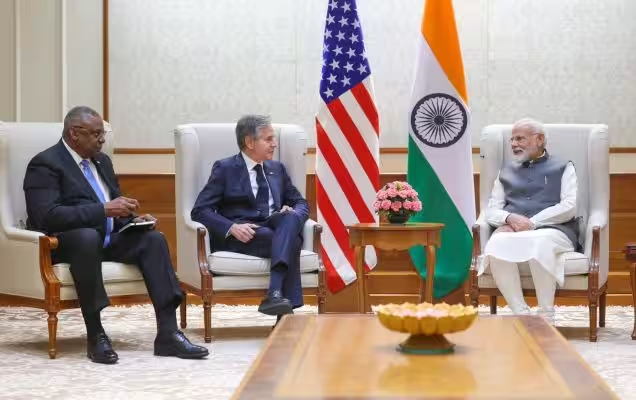
[Modi with US Secretaries of State and Defence, Anthony Blinken and Lloyd Austin]
In international affairs, relationships with friendly states are in greater need of guardrails than ties with adversaries because the worst can be assumed about the latter and protective measures taken. It is a hard fact apparently for the Indian government, MEA and defence ministry to digest that the friendlies require to be defenced against more diligently because the basis and assumptions of convergence of interests on which the edifice of national security cooperation and collaboration is built may be all wrong and wonky. Particularly when the other side has a quite different take on how everything should pan out. Hence, even as the US Federal Bureau of Investigation is moving the Gurpatwant Singh Pannun case in court, the US State Department is blithely assuring India that nothing has changed re: America’s partnering India in the Indo-Pacific, confident that New Delhi will happily overlook India’s own national security interests! Come again! Really?
Containing China is in the interest of both India and the US, of course. But, get this, the US has decided to go punitive on India over some intended harm it alleges would have been done to its citizen. That the US acts according to its momentary interests is well known. including targeting of its closest allies. Thus, in Israel’s case Washington is weighing travel bans on the extremist Yeretz Israel settlers in the West Bank area of Palestine — a US shot across Benjamin Netanyahu government’s bow to mind Blinken’s advice to cease and desist in Gaza, or else. Tel Aviv responded today by cocking a snook at Washington and resuming its aerial and long range bombardment of Gaza as it had promised to do! The right response that shut Washington up.
India, is dubbed a “strategic partner”. But the Biden Administration superceded shared security concerns with talk of India violating the human rights of a Pannun. Plainly, the Narendra Modi regime had not expected such adverse reaction, nor factored it into its calculations. Just how persnickety Washington can get on the human rights score was known to the PM who as the Gujarat chief minister suffered the personal indignity for years of being barred entry into the US owing to his alleged role in the 2002 anti-Muslim riots — the only Indian politician to-date so treated by the US. It was an ostensibly principle-based ban, and was lifted the moment Modi became prime minister!
Meaning, it is at the discretion of the US President of the day to react or not to react and how, to intended and unintended “human rights provocations” by allies and strategic partners. Skating on thin political ice at home, President Biden in this instance decided he did not want to upset the “progressive Left” in his own Democratic Party by being inattentive to alleged Indian silencing of a US citizen, not with a tight presidential race looming once again with Donald J Trump. The White House then upped the ante by approving a US Congressional Hearing on this supposed Indin plot in which GOI, RAW & IB officers will be named, a lot of dirty laundry will be washed, and the Modi government will be hung out publicly to dry. Modi’s NSA, Ajit Doval, can expect to have his name bandied about a lot at these Hearings.
The question is: Why did Biden think there would be no negative consequences for the bilateral ties by proceeding as he has done on the Pannun affair? Well, because he knows that Modi and his foreign policy implementer, S Jaishankar, are too fully into pacifying the US to suddenly grow a spine and stand up to Washington and, even less, aggressivley to take him on as, say, a Xi would.
Given India’s supplicatory attitude of long standing, the Modi dispensation hopes to catch a break because of the shared meta-strategic concerns re: China. Except, the very NRI community in the US that Modi dotes on and whose interests his government has bent over backwards to promote by making the issual of more and more H1B visas and of renewing them with ease, etc his foreign policy priority, ironically, is in the forefront demanding action against this country. The likes of US Congresswoman Premala Jayapala, for instance, are usually the first to dump on India for the flimsiest of reasons because it is an easy way to prove their allegiance to America at the expense of their country of origin. So much for NRIs being our foreign policy assets!
What’s the Modi government to do? Well, the wrongest thing for it to have done is what it proceeded to do — promise an investigation into the US charges, thereby admitting some level of culpability, rather than simply stonewalling, saying nothing other than sticking with the line that the Indian government has nothing whatsoever to do with the alleged plot, to point to violent intra-Sikh community weangles, and otherwise vigorously and volubly discounting all the supposed evidence FBI has collected by charging it was created out of thin air and imaginative cyber fakery that the US agencies are well rquipped to produce, and that too involving a stool pigeon of the US Drug Enforcement Agency. How storybook silly, is this? About tracing any communications to Indian officials — bah! This is so much electronic spoofing and voice replication — technically easy to do!
Has any Modi government representative adopted this position? NO. Then again, has the US ever admitted responsibility for any of the acts of violence, including assassination, it has committed abroad over the decades? No! Against Indian citizens (Shastri, Bhaba, et al)? No! (See the blog post previous the last one) Does any major country ever acknowledge any of its “black” operations? No! So, why is the Modi regime being so lily-livered, putting itself in a position from which it cannot escape responsibility? Why did it buckle under at the first sign of pressure?
Well because like the previous Manmohan Singh regime, and the Vajpayee government before that, and the Narasimha Rao regime prior to that, the Modi government too believes mistakenly that India has more to gain strategically and economically from good ties with the US than vice versa, until now when such thinking has calcified into a policy mindset and become a real huge impediment to this country pursuing its own strategic interests in its own way rather than as a camp follower and a strategic appendage of the US. Scan Indian newspapers, other media, even retired Indian officials speaking to foreign reporters, or any Indian commentators, especially including ex-diplomats and militarymen, and what you find is their advice for India to, in effect, turn tail as Washington approaches.
What requires stressing is that we need to put up guardrails mandating blunt talk with the US government about what the Indian government will not tolerate, and to draw some redlines for the US State Department. Among a host of guardrails should be a clear understanding that any campaign of the Khalistan-type with secessionist rhetoric advocating violence, will not fall within the pail of free speech because it will be viewed by New Delhi as infringing on India’s sovereignty, and will be dealt with as the US government deals with foreigners it consideres “enemies of the state” — not nicely. And that the Indian government is prepared to stand its ground even if it means trashing the four “foundational accords” and rolling back the convivial strategic relations achieved so far by India and the US. Plain talking is a curative for a lot of the coercive nonsense Washington tries ceaselessly to pull on India.
It may be interesting to consider the Dec 1 Washington Post editorial reflecting the US establishment’s view: It harrumphed thusly [with my reactions within square brackets]: The Pannun case, it said “has crossed a red line for the United States, a grave affront to sovereignty that demands an honest ,and complete investigation, with the perpetrators brought to justice and all the facts made known. Any foot-dragging or coverup will weigh upon all the other worthy efforts to build a strategic partnership. [It is as if India gains more from China’s strategic discomfiture than the US!].[Pannun’s group. it said] advocates that some or all of Punjab province in northern India secede and form an independent Sikh state. [Note: inference — a Sikh state carved out of India may be no bad thing, which amounts to condoning, even promoting, Khalistan!] ….The United States has good reason to forge closer ties with India, a democracy and rising economic power that is a valuable counterweight to China. But much depends on how India responds to the indictment. A string of Biden officials have signaled this to India in recent months.” [So India is warned. Now what? Oh, right! Washington — Try and keep China down without India holding up the northern end of southern Asia on the Tibet line and the Indian Ocean end. Good luck!].”
Besides drawing the redlines for Washington on what India will not countenance by way of the remotest hint at balkanisation and danger to internal security, the Modi government should publicly demand also — as the Biden Administration has done vis a vis the supposed plot against Pannun — that the US government investigate to India’s satisfaction the assassinations by the US Central Intelligence Agency of Prime Minister Lal Bahadur Shastri and the nuclear stalwart Dr Homi J Bhabha — killings claimed by no less than the CIA’s then head of clandestine operations, Robert Crowley, in order to bring to international notice the US government’s ongoing policy and programme of physically eliminating inconvenient foreign personages. Remember the late President of Chile, Salvador Allende — his assassination ordered by the late and little lamented Henry Kissinger, and engineered by CIA in September 1973?
Instead, of installing guardrails, given the GOI’s institutional tendency, the PMO/MEA will likely listen quietly to official US complaints and threats of punitive action if Delhi doesn’t do this, that or the other. India and Indians desperately want a government to show self-respect, some back bone, and not to dance to whatever tune the US rings up. The trouble is a pliable New Delhi — terminally bent and coerced, invariably gives in and responds as Washington expects it to.


 Security Wise
Professor,
While you are right that India must show some backbone in dealing with the current Tamasha over Pannun with the U.S., your article makes it sound like it won’t, or it doesn’t. It’s premature to make such judgements. India dismissed 41 Canadian diplomats – that’s a strong message to Canada in spite of U.S. support for it. The fact that many anti India elements have been knocked out in the west is also a strong message to the west. So let’s wait and see what India does. It’s too early to judge.
Professor,
From your writings it is clear that you seem to be stuck in the idea and reality of India from the 2000s, and refuse to acknowledge the India of the present. Maybe you too should watch some of these YouTube channels to get a new perspective on what may be happening in geopolitics.
Infiltrated communications, treating the U.S. as one single entity, imagined weakness of the Indian response before the response is made, refusing to acknowledge the strong responses India is actually making – all indicate a refusal to acknowledge reality and what is really happening. You may want to reconsider your approach.
Good perspective Bharat.
In my opinion, going back into history of 50+ years does not relate with people of the present generation as they don’t know who they are and unable to relate to them.
True. Then again, unless the younger generation is apprised of the past, its understanding of present developments will remain shallow.
Atleast Strategic partner ‘amreeka’ is shaking modi to live in reality , but how many times should india be shaken
I am increasingly convinced that we have an all-pervasive American fifth column in the country that includes politicians, bureaucrats, military men, university professors, journalists, and columnists; the who’s who of the chattering classes. Why does India, irrespective of the man in South Block, bend over backwards to appease the Yankees, who let no opportunity go waste to embarrass it in turn?
Here is an assessment of Indian diplomacy by MKB which I wonder can be dismissed perfunctorily:
https://www.indianpunchline.com/how-saudis-overcame-reputational-damage/
@Sankar, this article actually was interesting in highlighting how Saudi Arabia handled the ‘liberal hegemonists’ in the U.S. India has more leverage over the U.S., and I hope it plays its hand well. Maybe postpone the quad meeting in January if Biden continues playing games.
In the US all politics are local and immediate. For Biden to be reelected he needs to tame inflation and bring down the price of gas. One suspects that the ostensible locking horns between the CCP and the US may be in part a show for internal political consumption, on both sides. There is absolutely no doubt the economies of both are so intertwined that any disruption on the supply chains will usher in untold hardship on Americans. The last Biden Xi meet most likely resulted in some sort of bargain; that cheap Chinese manufactures into the US will ease the burden of inflation. CCP websites have sprouted like mushrooms all over the US with some clearly selling goods below cost. Not a peep from Biden. Additionally Biden has moved to ease relations with Venezuela. India should not be carried away by meaningless rhetoric. Follow the money.
“Tel Aviv responded today by cocking a snook at Washington and resuming its aerial and long range bombardment of Gaza as it had promised to do! The right response that shut Washington up.”
Sure, the “right response” is to continue the carnage of innocents.
By God, I tell you all, hindu nationalists are so completely irredeemable soul-diseased.Their just comeuppances will be served sooner or later. If not in this life, there is always Hell to look forward to.