Orbital Jumps, But How?

In Beijing to prepare the ground for the Narendra Modi-Xi Jinping summit, National Security Adviser Ajit Doval talked of Sino-Indian relations as primed for an “orbital jump”. Seeing these bilateral ties as a satellite in a low-earth orbit which, presumably powered by the success in the apex level talks, will be thrust into a high-earth or more strategic orbit is fine. The problematic part is to know what will push the ties into that more desirable state.

Low-earth orbit satellites have relatively short life because pulled by the gravitational force they eventually collapse back into the earth’s atmosphere and burn upon re-entry. But a low orbit policy, metaphorically and otherwise, hews more closely to ground reality which is that, with the border dispute, the India-China relationship is dictated by the line of actual control (LAC) and what transpires around it.

The ongoing incident in Chumar with Xi in India, suggests China is playing a different game to what New Delhi believes it is in. For Beijing its territorial claims on Arunachal Pradesh and in Aksai Chin are uncompromisable (hence, “stapled visas” for Arunachalis) because accepting the status quo as boundary solution with India would pressure Beijing into accommodating several Southeast Asian nations on its extensive “nine-dash line” claims in the South China Sea. So, a resolution of the dispute can be safely pushed out to the remote future, with Special Representative talks only offering cover for lack of progress.

Modi’s plea for increased Chinese investments in infrastructure and manufacturing sectors and for shifting Chinese manufacturing plants to India as means of balancing Sino-Indian trade grossly favouring China was met partially with promises of foreign direct investment in industrial parks, etc. But there’s an irreconcilable clash of visions here.

Modi’s view of turning India into an international manufacturing hub generating massive employment runs smack into Xi’s vision for an “Asian century of prosperity” premised on coupling China’s “workshop” to India’s “backoffice”—the hackneyed Indian software wedded to Chinese hardware type of thinking. In other words, Xi is for freezing China-India economic ties on the basis of current national strengths, which surely is unacceptable.

With economic relations on the upswing, hardpower and geopolitics will matter more. India can exploit the mutual antipathy China and Japan feel for each other by acting the cat in the Panchtantra tale playing the two monkeys off each other. Japan will need no coaxing to assist New Delhi in slanting the balance of power and influence in landward and maritime Asia against China.

Modi can mouth trade makes for peace-mantra and grow the Chinese economic stake in India. But for larger impact, he should payback Beijing for its planned proliferation of nuclear missiles to Pakistan by transferring Brahmos supersonic cruise missiles to Vietnam, the Philippines, and any other state on China’s periphery desiring them, something I have advocated for over 20 years. There was talk of such transfer when the external affairs minister Sushma Swaraj and later president Pranab Mukherjee visited Hanoi on the eve of Xi’s visit, but New Delhi got cold feet. Unless India exploits the prevailing fear in Asia of China to the hilt, India will be forever disadvantaged. New Delhi better muster the will to conduct this two-faced game, or lose ground to Beijing.

Ties with the United States can be launched into a higher orbit by simply agreeing to buy several Westinghouse enriched uranium-fuelled reactors, the Indian liability law be damned. This is not going to happen. In the event, the bilateral relations will fall back on familiar themes. The trouble here is that, contrary to the rhetoric of India as “net security provider”, the US is mostly interested in seeing how India can fit into its Asian security architecture.

Washington is habituated, from Manmohan Singh’s days, of talking up the “strategic partnership” but only as vehicle for advancing US interests. In its “war on global terror”, for instance, Washington expects New Delhi to do everything to zero out the risk to Americans but does little to pre-empt terrorism targeting Indians as that involves Pakistan Army’s sponsorship of terrorist outfits.

This is reflected in the nature of the intelligence exchanges — the US insisting on raw data while only providing information filtered through American policy lenses. In this same vein, the US government is always keen to shape Indian foreign policy as it did during Congress party rule regarding Iran, for example.

At the heart of the bilateral relations, moreover, is sheer divergence of interests, especially relating to India’s great power aspirations the core of which is nuclear security. The United States has been active from John Kennedy’s time to pre-empt and prevent India’s becoming a consequential nuclear power, scrupling to nothing, including buying into China’s scheme to nuclear arm Pakistan.

In the wake of the 1998 tests, it accepted a civilian nuclear cooperation deal that New Delhi for some mysterious reasons was eager to have on the condition India never test again, thereby ensuring India never has a modern high-yield arsenal of proven thermonuclear weapons to match China’s. The tragedy, of course, is successive Indian governments have partnered the US in thus reducing India.

Modi can right the relationship with America by telling President Barack Obama some home truths. Such as the fact that courtesy US policies of the past there’s a huge trust deficit between the two countries, that the transactional tilt of US policy is robbing the bilateral relations of strategic value, that India’s nuclear liability law is not some trifling matter that can be overturned to please Washington, that the United States has gained in the last 60 years from Indian foreign aid worth hundreds of billions of dollars in Non-Resident Indian talent, and that the djinn of Islamic extremism was uncorked by the United States (with its founding of the Taliban in Afghanistan).

It will help that, unlike with Xi with whom he has a warm, personal, bond Modi, who was treated shabbily by Washington on the visa issue, will be correct when he officially converses only in Hindi, with a laboured translation for Obama, symbolising the distance that still separates India and America.

[Published in the New Indian Express on Friday Sept 19, 2014 and available at http://www.newindianexpress.com/columns/Orbital-Jumps-But-How/2014/09/19/article2437745.ece ]

Posted in Afghanistan, arms exports, Asian geopolitics, China, China military, Defence Industry, Geopolitics, Great Power imperatives, India's China Policy, India's strategic thinking and policy, Indian Army, Indian ecobomic situation, indian policy -- Israel, Iran and West Asia, Indian Politics, Internal Security, Japan, Military Acquisitions, Missiles, nonproliferation, Northeast Asia, nuclear industry, Nuclear Policy & Strategy, nuclear power, Nuclear Weapons, Pakistan, Pakistan military, Pakistan nuclear forces, satellites, society, South Asia, South East Asia, Strategic Forces Command, Strategic Relations with South East Asia & Far East, Strategic Relations with the US & West, Terrorism, United States, US., Weapons | 9 Comments

Month of Plain Talking

All diplomacy is calculation but it is how the lines of national interests and strategy clash or converge that are of concern during state visits which, otherwise, are staid, scripted affairs. The decade of the wimpish Congress party regime showed an India at its most pusillanimous, wracked by doubts about leveraging the country’s myriad strengths. The spate of visits this September starting with prime minister Narendra Modi’s to Shinzo Abe’s Japan followed by jaunts to New Delhi by his Australian counterpart Tony Abbott and by Chinese president Xi Jinping, ending with Modi’s September 30 meeting in Washington with US president Barack Obama will, hopefully, reverse the trend. These will be occasions when foreign leaders, because Modi is new on the scene, will be keen to size him up, read his mind, try and decipher his intentions and get a fix on his foreign policy orientation and attitude.

Modi must have been disabused of the notion that cultural links and personal bonhomie count for much in international relations when Tokyo insisted on an unambiguous commitment against resuming nuclear tests before approving a nuclear deal. Despite being fully aware of this precondition why Modi still pitched for a nuclear trade accord isn’t clear. It is troubling that the Indian government from Manmohan Singh’s days persists in making a “nuclear deal” with every passing country the test of its seriousness to engage India, when actually what it does is reduce India to a supplicant and erodes its prestige. One hopes Modi reminded Abe that sections within Japan, which is the proverbial screwdriver’s turn away from the Bomb, are calling for nuclear weaponisation to deal with the North Korea-China combine, and that a thermonuclearised India and Japan at the two ends of Asia is the best solution to keep Beijing quiet. Moreover, surely Modi isn’t prepared to waive India’s liability law and buy the unproven Toshiba-Westinghouse AP 1000 enriched uranium-fuelled reactor just to please Tokyo? An aside, but prioritising the Mumbai-Ahmedabad Shinkansen “bullet train” line in existing Indian conditions may not be pragmatic considering it will also take a big chunk ($10-$15 billion) off the promised Japanese $35 billion foreign direct investment (FDI) in infrastructure build-up. It will cost more to protect the special corridor than run the high-speed trains.

Rather than “nuclear deals” and stuff, Modi should propound the logic of geopolitics and military cooperation. It pays. For instance, Modi’s reference in Tokyo to the 18th century-style imperialistic tendencies of China to grab land and sea territories, and Tokyo’s agreeing to sell 15 US-2 amphibious aircraft along with transfer of technology (ToT) that will result in a US-2i version tailored for Indian needs to be designed with Indian military’s inputs, and the talk of the Soryu-class conventional hunter-killer submarine in the Indian fleet, have made an Indo-Japanese pincer real. Beijing has reacted with reports suggesting that Xi Jinping is preparing to match Abe’s ante and to up it with even more attractive investment and other deals. To maximise geostrategic gains, Modi should maintain pressure by announcing the sale/transfer of Brahmos supersonic cruise missiles to Vietnam and other Southeast Asian states in the run-up to Xi Jinping’s visit.

Beijing is worried. The Islamic insurgency is taking hold in the Uyghur Muslim-majority Xinjiang, and Tibet continues to seethe with people angry with the Chinese policy of rubbing out Tibetan cultural identity. In this context, Modi should respond to Xi Jinping’s pleas for restricting the Tibetan exile community’s activities by suggesting the restoration of genuine “autonomy” for Tibet and as buffer zone devoid of the Peoples Liberation Army presence as the foundation for lasting peace.

Australia is ready to sell uranium in order to balance the exports of the same commodity to China and as a hedge against Beijing cornering the market on Australian natural resources, whence Canberra’s encouragement to Indian industrial houses, such as the Adanis, to invest in the Australian coal and minerals extraction sector. But a strategically more potent issue requires to be broached by Modi. Abbott should be sounded out about permitting Indian SSBNs (nuclear-powered ballistic missile-firing submarines) to stage out of a deep water port on the northern Australian coast as a means of increasing the strategic reach and deterrence impact of the Arihant-class boats. Such a basing-option will also enhance the “theatre-switching” maritime riposte preferred by New Delhi to Chinese aggression across the land border. An agreement on such basing would be welcomed by an Australia itching to be part of the evolving Asian security architecture rather than remaining a Western outpost.

The logic of strategic ties with the US is getting simpler. Washington has lost the will and doesn’t have the money to be very active in the Indian Ocean region and is eager for New Delhi to pick up the slack. America’s declining stock allows Modi to do some plain talking. The PM’s counter to changing India’s liability law should be to ask Obama to reform the nuclear deal enabling the 2006 Hyde Act instead. Washington wrongly assumes that an Act legislated by the US Congress is dearer to New Delhi than a law promulgated by the Indian parliament. He should also demand changes in America’s transactional, “buy this, buy that” bent of policy.

Modi should inform Obama that henceforth there’ll be no off-the-shelf weapons purchases, and US and other foreign armament producers will have to manufacture all military hardware from scratch in India itself starting with the first buy (as has been wisely decided in the case of the army’s utility helicopter fleet). It will catalyse high-tech manufacturing sector growth and generate a demand for skilled labour and massive employment opportunities. American arms companies should be incentivised to set up shop in India or concert with Indian private sector companies to “Make in India” for the Indian market and, to make such presence economical, use their facilities here to source whole weapons systems, spares and service support to countries in Asia and Africa. India’s aim of self-sufficiency in armaments will thus be advanced, the haemorrhaging of hundreds of billions of Indian dollars end, and the country’s economic prospects immeasurably brighten.

[Published in the New Indian Express on Friday September 5, 2014 at http://www.newindianexpress.com/columns/Month-of-Plain-Talking/2014/09/05/article2414561.ece

Posted in arms exports, Asian geopolitics, Australia, China, China military, civil-military relations, Defence Industry, DRDO, Geopolitics, Great Power imperatives, India's China Policy, India's strategic thinking and policy, Indian Air Force, Indian democracy, Indian ecobomic situation, Indian Navy, Indian Ocean, Japan, Military Acquisitions, Missiles, Northeast Asia, nuclear industry, Nuclear Policy & Strategy, Nuclear Weapons, South Asia, South East Asia, Strategic Forces Command, Strategic Relations with South East Asia & Far East, Strategic Relations with the US & West, Technology transfer, United States, Weapons | 8 Comments

Create Defence-Industrial Giant

Prime minister Narendra Modi extolled “Made in India” products from “satellites to submarines” in his Independence Day address. A day later he demanded that “Instead of having to import even small things…India…become an exporter of [military] equipment over the next few years”. And, he exhorted foreign countries and companies to “make in India”. Rendering the country self-sufficient in armaments, it turns out, will help India emerge as workshop of the world manufacturing all kinds of quality goods economically. But it will require the PM to do to the Defence Public Sector Units (DPSUs) overseen by the ministry of defence (MoD) what he did to the Planning Commission—utilise their resources more effectively.

At the core is a fact that cannot be glossed over: DPSUs are deadweight. Despite outputting some 800 combat aircraft and thousands of jet engines not an iota of any of the technologies, for example, have been absorbed let alone innovated over the past 60 years by Hindustan Aeronautics Ltd. Indeed, DPSUs haven’t progressed much beyond assembling platforms from imported kits achieved during the Second World War when Harlow PC-5 and Percival Prentice trainer aircraft, trucks, and mortars were mass-produced for the Allied armies. In this context, the indigenous HF-24 supersonic fighter developed from scratch in the 1960s seems an aberration. It is because the DPSUs have stayed stuck at the screwdriver technology level that the department of defence production in MoD has evolved a procurement system willy-nilly funnelling billions of dollars to foreign vendors with minimal transfer of technology (ToT). DPSUs neither ingest foreign technology nor let the private sector benefit from it.

How much the ToT provisions are eyewash and how much the military procurement system favours imports and enriches foreign countries may be gauged from a few facts. Firstly, the technology transfer content in deals is not required to be divulged by the foreign vendors until after the bids are in and a supplier chosen! This empowers the vendor to restrict the technology it chooses to transfer, usually basic stuff related to the platform—a ToT threshold DPSUs are comfortable with. As prime buyer India doesn’t use its leverage to squeeze state-of-the-art technologies out of the suppliers, is uncommonly generous in forking out huge sums at the outset, and tolerates delays in delivery and non-transfer of technology. Hence, gains from indigenisation even from the offsets policy are minimal. It leads to imports of high-value packages being locked into long-term deals. Dassault, for example, will supply 30% of the advanced avionics amounting to over $10 billion of the $30 billion plus contract for the full duration of the Rafale programme.

Secondly, ostensibly because of foreign currency fluctuations foreign suppliers are not held to the cost-figure in their winning bids, even as Indian bidders who may buy technology from abroad and refine it here are! Foreign suppliers are thus incentivised deliberately to underbid to win contracts and then to raise the price at the price negotiation stage without incurring any penalties. The French firm, Dassault Avions, originally offered the Rafale combat aircraft with comprehensive ToT for $10 billion. But after winning the tender, it increased the cost to over $30 billion and the MoD did not blink! This skewed system is bolstered by the military’s preference for foreign, especially Western, hardware. India, consequently, is routinely relieved of monies and Indian private sector companies are prevented from winning procurement contracts.

The extant system has evolved around the fact that the remit of the Defence Production Secretary as the guardian of DPSUs is to ensure their order books are full. Because DPSU capability is limited to licensed manufacture, procurement deals centre on it. Committees chaired by ex-bureaucrats, the most recent one by Vijay Kelkar, are periodically constituted to recommend revamp of existing protocols and procedures but without disturbing the dominance of DPSUs. This is akin to leaving a cancerous tumour intact while fiddling with the tissues around it! In the event, documents such as “Defence Procurement Policy-2013” are meaningless.

But how can competition and profit motive, the two great drivers of any vibrant industry, be injected into the defence industrial and military procurement spheres? The solution lies in eliminating the spurious distinction between public and private sectors and meshing their resources and capabilities. It was outlined in a 1999 paper by me to the technology review sub-committee in the first National Security Advisory Board. Keeping in mind the need to amortise sunk costs in building up impressive laboratories and physical facilities for R&D and weapons testing under DRDO (whose “chalta hai” attitude was decried by the PM) and production facilities in innumerable DPSUs and ordnance factories, I proposed that all these installations, some 50-odd, be divided into two nearly equally capable defence R&D and manufacturing combines and be led as commercial enterprises by two of the most ethical and industrially versatile business houses—Larsen & Toubro and Tata.

These two combines, subsuming the capacities of L&T and Tata, would pay the government rent for the DRDO centres/DPSUs/ordnance factories in their group and royalty for the technology, software, and hardware outputted by them. They’d bid for all weapons contracts with funds being provided by MoD to develop prototypes, and the winner determined by a transparently conducted run-off. What technology is procured from where under what financial terms, and which foreign or local firms are associated on which project, would be the sole concern of the combines. It will hasten the globalisation of Indian industry.

Such a scheme, besides creating a world-class defence-industrial complex and arms exporter, will rid the procurement system of its most serious ills—the inclination to import, endemic corruption and influence-peddling, the self-defeating lowest tender (L-1) process, production orders in small tranches that undermine economies of scale, and the bans on commercialising imported technology and exporting military products. Integrating private and public sector skills and wherewithal, inducing competitive pricing, and rewarding performance will increase labour productivity and efficient resource-use resulting, say, in the Kolkata-class destroyer being produced not in 8-9 years but the international industry standard—three years. Unsurprisingly this “out of the box” proposal is collecting dust.

[Published in the New Indian Express, August 23, 2014 at http://www.newindianexpress.com/columns/Create-Defence-Industrial-Giant/2014/08/22/article2391250.ece

Posted in arms exports, Asian geopolitics, civil-military relations, Defence Industry, DRDO, Europe, Geopolitics, Great Power imperatives, India's strategic thinking and policy, Indian Air Force, Indian ecobomic situation, Indian Navy, indian policy -- Israel, Iran and West Asia, Indian Politics, Military Acquisitions, South Asia, Strategic Relations with the US & West, Technology transfer, US., Weapons, Western militaries | 25 Comments

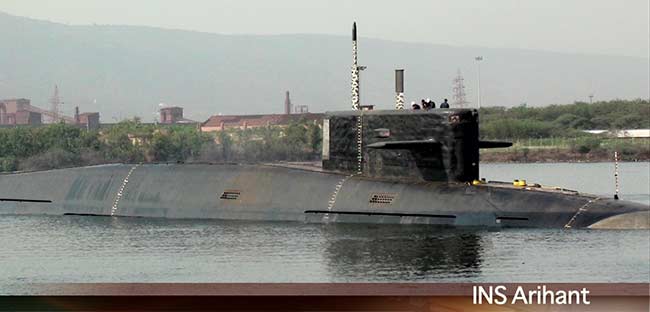
Arihant has dived below “crushing depths”

Call up a recent photo of Arihant SSBN publicly available at
http://www.ndtv.com/news/images/story_page/INS_Arihant_650_final.jpg.
What do you see?

The most obvious thing that has not been commented on is the humpback on the hull — the so-called “one and a half hulls””– that
permits the boat to slice through water, performing diving and other actions more efficiently. It is a design aspect, along with several other design features, taken from the Russian Severodvinsk and Borei class nuclear subs.

The less obvious but far more significant things to notice is that Arihant has apparently returned from a mission where it dived below crushing depths of well over 300 meters, around 340-350 metres, to see how well the hull would hold up. It has held up beautifully.

But how can this be deduced?Look closely at the smooth skin on the hull. The titanium alloyed hull has withstood the quite enormous pressures on it in the deep without crimping. But on the differently metalled conning tower there is evidence of the skin being crunched — see the wavy formations? — at great depths. It cannot be reproduced in labs or synthetically. And it couldn’t have happened because the Arihant dived to the 100 metre depth of the Vizag channel leading to the open sea. That the structure held up very well may be attributed to the extraordinary welding that fused the tower to the hull.

While it has been publicly put out that the Indian SSBN was working up its nuclear power plant to full power, etc., the fact is it takes no more than a month at the most, at a graduated pace, to reach the full 80 MW drive power. So for the rest of the last 8 months or so, it has been cruising and diving, including below crushing depths. After several more such deep dives the Arihant will have anechoic tiles — able to absorb sound waves, making detection by sonar more difficult — attached to its outer surface, and it will be ready for induction into fleet operations.

The most commendable aspect, other than the high-class technology and manufacturing skills of Indian welders, is the guts shown by the CO, XO, and the rest of the crew of the Arihant in making these repeated hazardous dives but required as a stern test for an SSBN.

The BIG QUESTION that arises is: With so much evidence of indigenous design and manufacturing skills on the Arihant, why is the Indian Navy still hankering for foreign submersibles and not trusting Indian capabilities to produce the Project 75i conventional submarine???

Posted in arms exports, Asian geopolitics, Defence Industry, DRDO, Great Power imperatives, India's strategic thinking and policy, Indian Air Force, Indian ecobomic situation, Indian Navy, Indian Ocean, Indian Politics, Military Acquisitions, Nuclear Policy & Strategy, russian assistance, russian military, South Asia, Technology transfer, Weapons | 65 Comments

A former AOC-in-C, Operational Command, writes

[Reproduced below is an e-letter, dated Aug 10, 2014, from a highly respected Airman, a former test pilot and AOC-in-C, Operational Command, who wishes to remain anonymous.]
———
I read your pieces Fire Up Defence Industry & Favour Tejas to Meet IAF Needs with great interest as indeed I do your other writings.

I thought I would take the liberty of sharing with you my personal experiences borne out of having been intimately involved with the IAF Plans Branch and as a test pilot both with DRDO and the Industry.

In ‘Fire Up the Defence Industry’ whilst talking of the HF 24 programme you make the point about a foreign aircraft fixated Air Force and the aircraft being aborted for being underpowered. Also that this has resulted in an endless cycle of licensed manufacture.

Whilst it is true that the HF 24 did not get the uprated Orpheus and hence fell short of level supersonic performance, we had found it to be a first class ground attack platform. I can say with confidence that the squadrons were happy and if HAL had continued to promptly address its technical, maintenance and other design problems, perhaps it would have served the IAF well.

HAL could not introduce design changes to clear the aircraft to fire its four 30mm canons in service and there were in-service fire problems that led to serious accidents and prolonged grounding. In my view having got the HF 24 into service, the HAL design team lost interest in keeping up with in -service design changes (which are essential for any aircraft-I think the Hunter clocked many thousands in service modifications).

Instead they had their eyes on the HF 24 Mk 1R which was the airframe with GTRE modified Orpheus Reheat engines. We had many a lively discussions with the design team and I recollect their complete belief that this should enter service, not with standing the fact that modification of the rear fuselage to accommodate the reheat had increased drag and affected speed performance to below that of the Mk1! Sadly Gp Capt Das’s fatal accident put an end to this futile debate.

The HF Mk 2 was proposed with the Mig 21 (If I remember the R 25 engine). Again this would have involved major aerodynamic changes and we were not sure how this would affect the performance of a Kurt design with an ‘area ruled’ fuselage shape. Ultimately I think the proposal was dropped by HAL itself when they saw that the IAF had reservations. Such a programme even if it were viable would not have achieved fruition in time to prevent seriously depleting the IAF’s strike capability.

(You do mention Raj Mahindra in the context of the HF Mk II and if I recollect he did appreciate our reservations on modifying the HF 24 fuselage for an R 25 engine. I may mention that we worked very closely with him on clearing the HJT 16 for the IAF including the difficult spinning trials. He was truly a hands-on designer who worked so closely with us that we were one team. Perhaps this is one reason the HJT 16 has served the IAF so well for so long)

In the late sixties IAF had identified a requirement of a Fighter-bomber, as we could see that Medium Bombers like the Canberra were becoming vulnerable. After the 1971 operations, some instances of corrosion were reported from both the Hunter and Canberra fleets. This would have had a serious impact on our strike capability. This, along with our ASR for a DPSA resulted in the Jaguar induction, which was cleared by the Morarji government.

In the mid seventies the following areas were drawing our attention in the Plans Branch.

· Reduce multiplicity of types

· Reduce total dependence on Only Soviet source

· Aim for a balanced Force- Mix of High performance/High Cost & Light/low cost. Keep affordability fully in mind

· Ensure that indigenous design and production expertise grows

That is why the Ajeet programme was launched by HAL even as the LCA requirement was being formulated.

Unfortunately, in a way, the Ajeet followed the same trajectory as the HF. As soon as it entered service our industry started to look for the next design project. Not surprisingly the Ajeet, like the HF was prematurely withdrawn from service. Having been part of the HAL team during the Ajeet development I can say that enough was not done by the industry to keep this programme afloat perhaps because they had their eyes on the LCA!

It was the desire for a relatively light, maneuverable and not very high speed and low cost primarily a ground aircraft in our inventory that resulted in our evolving the initial LCA ASR. Unfortunately this was hijacked by the scientific community who wanted to build a world-class light aircraft with multi role capability. What we were promised was an indigenous design with indigenous engine and indigenous multi mode radar in a time frame to replace our ageing Mig 21. Having deliberately kept the IAF out during the Project Definition Phase when many critical decisions were taken (Arun Singh was told that IAF was coming in the way of a fast track project) the IAF was finally asked to comment of the PDP report. I can say with hindsight that every cautionary note that we struck in that report has been more than proven by subsequent events. I have often written that purely as an exercise to learn lessons, an institution like the College of Defence Management should conduct a management study of how this vital project has been mishandled by personalities for egoistic ends.

As if this was not a challenge itself, HAL Design was kept out and instead a Society to oversee ADA was formed to manage the project. So we have ADA as the design authority, HAL as the production agency and one responsible for providing product support to the IAF. ADA will be busy with the next generation design and when in service problems arise, one can visualize passing the buck between HAL and ADA with the IAF facing the consequences! I do not wish to be a pessimist, but my experience cautions me of a repeat of the HF 24 and Ajeet histories. Sadly at great cost to the nation.

Let me also say that the IAF could boast of the finest Plans Branch and planning systems starting from the sixties. Integrated within the system were not just test pilots and engineers but financial planners as well. Our Air Staff Requirements were thoroughly made and then not compromised. Because planning is a long-term activity, people with experience were rotated within the system.

ASRs were what the IAF needed not what others thought we needed. So when the LCA ASR was being discussed and the DRDO wanted these to be moderated, the ASR was not changed. Instead the concession was mentioned against the required performance. In the ASR. Similarly, if for some reason of cost or availability, the MOD wanted concessions to be made, these were recorded as concessions with reasons and not as changes to ASR.

I must say to my regret that from the early nineties IAF leaderships, for whatever reason, failed to maintain the integrity of the Planning Branch. Whether it was external pressures or those from within, it is not for me to say, although I have my serious reservations on some of the leaderships of the time. Committing the IAF to the Su 30 heavy fighter within a year of the Chief saying there was no such requirement (and that too a two cockpit fighter which has a huge impact on pilot demands) is I believe an event that has not been studied enough nor commented upon. The rot was setting in and the recent revelations about the VVIP helicopter Staff Requirements being changed due to extraneous factors merely confirms this and does not surprise me.

I have always believed and advocated that we as a nation have the wherewithal to become a producer of world-class aeroplanes. What is lacking is a strategy and to work as one. When Dr Kalam was President of the Aeronautical Society of India a paper was put up for a National Aeronautics Policy. In 2004 the AeSI revised the proposal and a paper titled ‘National Aeronautics Policy’ August 2004 was put up to the government. As one of the Vice Presidents of the Society at the time I was one of the principal architects of this paper. I understood that the then NSA Mani Dixit was pursuing it, but perhaps because of his untimely demise no follow-up took place.

I do share concern of where IAF plans are leading us. I thought that as a historian and academic you may be interested in some of the more hidden aspects from the other side as it were, aspects which otherwise will die as generations move on, depriving us to draw appropriate lessons.

Posted in Asian geopolitics, civil-military relations, Defence Industry, DRDO, India's strategic thinking and policy, Indian Air Force, Military Acquisitions, russian assistance, russian military, society, South Asia, Technology transfer, Weapons | 10 Comments

Favour Tejas to Meet IAF Needs

Winston Churchill, as the First Lord of Admiralty in 1911, is credited with “technological prescience” by British commentators for building the 12-inch gunned Dreadnought-class battleships. When the First World War began, the Royal Navy’s Grand Fleet was the British force to keep Kaiser Wilhelm II’s seaward ambitions in check even as an unprepared army was mowed down by the German juggernaut, in the opening phase.

Remarkably, the Churchillian kind of prescience was manifest in Jawaharlal Nehru’s nursing a weapons-capable nuclear energy programme because he believed India could not afford to miss out on the “nuclear revolution” as it had done the “gun-powder revolution” consequenting in its enslavement. And, in the conventional military field, it was evident in his seeding an indigenous defence industry with combat aircraft design and development at its core. Nehru imported, not combat aircraft but, a leading combat aircraft designer—the redoubtable Kurt Tank, progenitor of the Focke-Wulfe warplanes for Hitler’s Luftwaffe. Tank succeeded in putting an HF-24 Marut prototype in the air by 1961 and in training a talented group of Indian designers at Hindustan Aeronautics Limited (HAL).

By the time the Tank-trained Raj Mahindra-led team designed the successor Marut Mark-II, Nehru was gone and neither Lal Bahadur Shastri nor his successor, Indira Gandhi, unfortunately had the strategic vision or technological prescience to provide political support for it. Indira permitted the purchase of the British Jaguar aircraft for low-level attack, leading to the termination of the Marut Mk-II optimised for the same mission. It ended the chance of India emerging early as an independent aerospace power in the manner Brazil and Israel have done in recent years. The inglorious era of importing military hardware was on. The resulting vendor-driven procurement system has decanted enormous wealth from India to arms supplier states—Russia, UK, France, the United States, Israel and Italy.

Arun Jaitley, the BJP finance minister-cum-defence minister, is saddled with the familiar problem of too many high-cost government programmes and too little money. He has an opportunity to reduce the huge hard currency expenditure involved in buying foreign armaments and reverse the policy of ignoring indigenous options and private sector defence industrial capability. He can give the lead to the Indian military as the British Treasury had done to the Admiralty in 1918-1938 by pushing for the development of aircraft carriers when the Royal Navy was stuck on the Dreadnought.

There are two far-seeing decisions he can take. With the US bid of $840 million for 150 M-777 light howitzers (without technology transfer) rejected as cost prohibitive, Jaitley can instruct the army to test and induct the modern, ultra-light heliportable gun, to outfit the new offensive mountain corps, produced jointly by a private sector company and an American firm, Rock Island Arsenal, that’ll cost less than half as much. And he could terminate the Rafale contract and, importantly, restore responsibility for the Tejas programme to the IAF, which was kept out of it by the science adviser—SA—to defence minister V S Arunachalam in the 1980s. It will mean IAF funding further developments in the Tejas programme from its own R&D budget which, according to an ex-senior defence technologist, can be increased to any amount, and was the course of action recommended by the Aeronautical Development Agency (ADA) and SA. It will render IAF accountable to Parliament.

The choices before the BJP government are stark. Is it pragmatic to channel in excess of $30 billion to Paris that’ll keep the French aerospace sector in clover and help amortise the multi-billion Euro investment in developing the Rafale, which has no customers other than IAF? Or, use the present difficulties as an opportunity to fundamentally restructure the Indian military aviation sector? This last will involve getting (1) HAL to produce the low-cost (`26 crore by HAL’s reckoning) Tejas Mk-1 for air defence with 4.5 generation avionics, low detection, and other features, for squadron service, and to export it in line with prime minister Narendra Modi’s thinking and to defray some of the plane’s development costs, and (2) ADA and the Aircraft Research & Design Centre at HAL to redesign Tejas Mark-2 as a genuine MMRCA with the originally conceived canard-delta wing configuration (whose absence has made the Mk-1 incapable of meeting onerous operational requirements, like acceleration and sustained turn rates in dogfights) and having it ready for production by 2019—the dateline for Rafale induction.

With the Rafale potentially out of the picture and IAF left with only a limited-capability Tejas for air defence, security needs for the next 15 years until the Russian Fifth Generation Fighter Aircraft enters IAF in strength, can be met by buying additional Su-30s and MiG-29s off-the-shelf and/or contracting for larger numbers of the Su-30s to be built by HAL with a deal to get the private sector to manufacture the required spares in-country, all for a fraction of the cost of Rafale. Some Service brass do not care for Russian aircraft but Su-30MKI and MiG-29 are already in IAF’s employ, and are rated the two best warplanes available anywhere (barring the discontinued American F-22) for combat and air defence respectively. A new Su-30MKI, moreover, costs $65 million, which is slightly more than what India forks out for upgrading the 30-year-old Mirage 2000.

Had the design-wise more challenging canard-delta winged Tejas, recommended by four of the six international aviation majors hired as consultants, not been discarded and international best practices followed from when the Light Combat Aircraft programme was initiated in 1982, ADA (design bureau), HAL and IAF would have worked together. IAF would have inputted ideas at the design and prototype stages, HAL produced the prototypes, and IAF pilots flown them. The design validation and rectification, certification, pre-production, and production processes would then have been in sync and progressed apace. The Tejas air defence variant will have entered squadron service and the larger Mk-2, close behind, occupied the MMRCA slot. The lessons are that indigenous weapons projects demand integrated effort, weapons designers need to be less diffident and Indian military ought to helm indigenous armaments projects. Jaitley can ensure these things happen.

[Published in the New Indian Express on August 8, 2014 http://www.newindianexpress.com/columns/Favour-Tejas-to-Meet-IAF-Needs/2014/08/08/article2368799.ece

Posted in Asian geopolitics, China military, civil-military relations, Defence Industry, DRDO, Europe, Geopolitics, Great Power imperatives, India's strategic thinking and policy, Indian Air Force, Indian Army, Indian ecobomic situation, Military Acquisitions, Russia, russian assistance, russian military, society, South Asia, Strategic Relations with the US & West, Technology transfer, United States, US., Weapons, Western militaries | 37 Comments

Additional response to AVM (retd) Bahadur on Tejas

A well informed correspondent pulled me up for not pointing out in my counter-response that AVM (Retd) Manmohan Bahadur (“MMRCA misgivings unfounded”) rather cavalierly dismissed Tejas. Bahadur declares that Tejas Mk-1 does not meet IAF’s needs. Strange, considering the Mk-1 is supposed to be the replacement aircraft for the large number of MiG-21s in the IAF fleet, which aircraft has been given an extended stay in the fleet into the 2020s with the Bison variant! And, in what way does the Mk-1 lag? Not in terms of weapons load capacity or even range, surely? And, certainly not in terms of its 4.5 generation avionics that’s a match for anything the Rafale features (except, perhaps, in data fusion (what to talk of MiG-21)! And, how then does he explain the Swedish Gripen NG, with almost exactly the same performance characteristics, being shortlisted by IAF in the MMRCA sweepstakes?

As a fighter pilot, Bahadur, in line with the IAF’s view, instead of hurrahing every imported or importable aircraft, may care to look inwards a bit and see how different the scene might have been had the IAF, especially in view of its, what many would call an “änti-nationalist”, terminator role in the HF-24 Marut Mk-II project — made amends and taken charge and responsibility for the Tejas programme, rather than attacking it from the sidelines, bemoaning weaknesses in the Tejas R&D and production schemes, and habitually pitching for cost-prohibitive Western aircraft. And whether or not the $30 billion plus — that India simply cannot afford — to be expended on the Rafale, will not be better spent at home beefing up the Tejas programme and fast-tracking the Mk-1s and Mk-2s into operational service. Perhaps, this is too much to expect of the IAF and veterans from the Service.

Posted in Asian geopolitics, civil-military relations, Defence Industry, DRDO, Europe, Geopolitics, Great Power imperatives, India's strategic thinking and policy, Indian Air Force, Indian ecobomic situation, Indian Politics, South Asia, Strategic Relations with the US & West, Technology transfer, United States, Weapons, Western militaries | 48 Comments

Counter-response to Air Marshal Barbora, and others

Nowhere in my article – “Why Rafale is a big mistake” did I raise any question about the rigorous testing regime the IAF employed to shortlist the aircraft in the running for the MMRCA slot, and yet the former Vice Chief of the Air Staff, in what’s presumably the institutional response to my piece, makes it, nonsequiterishly, the centre-piece of his response – a tactic to divert from my main theme.

Nor is the American F-35 and its price the issue. This aircraft is a horrendously costly aircraft, which I have time and again trashed as a possible IAF option in my writings and even in a luncheon meeting (where other Indian commentators were present) with the US Assistant Secretary of Defence. F-35 is, as many in the US describe it, a boondoggle and “white elephant” – expensive to acquire, inordinately difficult to maintain in service and at, trillion dollars, unaffordable even for the United States in terms of its lifetime costing – and the last thing that IAF should have on its mind. It is another matter that in the run-up to the Rafale announcement many senior officers in the IAF and many more commentators in the media were actually gung-ho about this aircraft and championed its acquisition (in lieu of the F-16/F-18)!

But Barbora has been more honest than his service colleagues who have published their responses. Air Vice Marshal Arjun Subramaniam, was deployed by the IAF on a previous occasion when I called for terminating the Rafale deal as wasteful in extremis (See “”Stop wasteful military deals”, New Indian Express, November 1, 2013 featured elsewhere in this blog and at http://www.newindianexpress.com/columns/Stop-wasteful-military-deals/2013/11/01/article1866740.ece. Subramaniam reacted (See his “Undermining national security”, New Indian Express, November 7, 2013 at http://www.newindianexpress.com/columns/Undermining-national-security/2013/11/07/article1876105.ece, by warning that such writings undermine national security – as if national security, other than being a special preserve of the uniformed brass, was some delicate exotic hot-house orchid that can weather no critical storm. Further, his doubts about the Tejas – the weaknesses in which project is due not little to IAF’s refusal to own up and be accountable for this project – were substantively answered by a flood of on-line reaction commentaries by technically proficient and knowledgeable writers who backed my contention that Tejas can be the answer to IAF’s prayers (and which commentaries have since mysteriously disappeared from the New Indian Express website (!) but are retained for posterity on this blog – refer the air force section in this blog).

But senior airmen are in a habit of not grappling with the central issues that are raised, jagging off, for example, into this analyst’s honest mistake of spelling CAS’ name as Saha, rather than the correct Raha, etc. Consider in this respect Air Vice Marshal (retd) Manmohan Bahadur’s critique of my case for a strategic bomber “Strategic bomber for IAF”, New Indian Express, February 7, 2014 on this blog and at http://www.newindianexpress.com/columns/Strategic-Bomber-for-IAF/2014/02/07/article2042008.ece. He veered off on a tangent saying how difficult it is to produce a strategic bomber indigenously when the country cannot even manufacture a trainer plane, etc, when actually what I had suggested was leasing (as we do nuclear attack submarines) Tu-160 Blackjack strategic bomber from Russia as the manned strategic delivery option. In this diversion, he, of course failed to address the larger point about the IAF leadership in the early 1970s fouling up by not accepting the Tu-22 Backfire bomber Russia was keen India offtake, and what it revealed about the lack of the “strategic” sense of the IAF, etc.. To the extent this was taken up, Bahadur sought to pooh-pooh it by sloghing the responsibility off to the Government, referring to the straitened financial circumstances the country was in at the time, the trend of policy, and other such extraneous factors when actually the Tu-22 could have been secured on the same terms as was the MiG-23BN, which was IAF’s choice! (“Fallacies of strategic bomber”, New Indian Express, February 11, 2014 http://www.newindianexpress.com/columns/Fallacies-of-Strategic-Bomber/2014/02/11/article2049378.ece

Unlike, Subramaniam and Bahadur, the more senior and apparently more responsible, ex-VCAS Barbora, is candid in acknowledging that costs are a factor, and that the unit cost of any fully loaded 4th generation fighter is presently in the $300 million-$400 million range, which is precisely the price range I said Rafale falls in. However, notwithstanding the quite extraordinary expenditure involved, which Barbora does not dispute, he is for acquiring it because, well, the long selection process was swell, IAF’s need has to be filled and, though he does not say it in so many words (see his last para), how Rafale in IAF’s inventory will raisie India’s stock in “the comity of nations”!

The Indian defence industry was crippled at the start by IAF’s hankering for Western combat planes. The fully locally developed HF-24 and its follow-on Mk-2, were ruthlessly killed off by IAF, doing away what little chance India had of emerging as an independent aerospace power in the manner that Brazil and Israel have done in recent years. The IAF’s role in ending the Marut project in the early Seventies to favor purchase of the Jaguar Deep Penetration Strike Aircraft (which as I pointed out at the time can, ironically, penetrate deep or strike hard but cannot do both at the samke time!) and its subsequent reluctance to nurse an in-country combat aircraft R&D and production project, especially the Tejas, lest its umbilical linkage to imported aircraft be severed, is there for all to mull over. Tejas, it must be remembered is a DRDO-driven programme. These are touchy issues for the IAF that I often bring up in my writings, and which are at the core of why India, fatally for a country with pretensions to great power, remains an arms dependency, but which issues no commentators from IAF want, for obvious reasons, to tackle.

What thus ends up being reiterated is the official service line, repeated ad infinitum, for example, (again) by AVM (retd) Manmohan Bahadur (“MMRCA misgivings unfounded”, New Indian Express, August, August 2, 2014 at http://www.newindianexpress.com/columns/MMRCA-Misgivings-Unfounded/2014/08/02/article2359756.ece), who is apparently, IAF’s designated batter. He writes re: Rafale as MMRCA that “Costs, albeit important, don’t decide acquisitions; it is the capability one desires that is the driving factor and it’s our misfortune that HAL has not delivered this to the nation. The IAF just looks at getting the right product to safeguard the national skies, as it is its duty to do so.” His and IAF’s contention thus is that costs to the exchequer should be of less concern than IAF having the Rafale in its stable! And, moreover, as is the service’s wont, he covers up for IAF’s acquisition visioning and strategizing failures by telescoping IAF’s urgent needs with DRDO-HAL’s shortcomings.

The question the Indian government confronts is whether to take the easy way out and meet the MMRCA requirements but only half-way (80 or so Rafales) as is the first indication from the Modi regime, or will it bite the bullet, as it were, and decide to end for once and for all the policy of pell-mell importation of unbearably expensive aircraft, and order IAF to take charge of the Tejas programme and rationalize its force structure with just two main lines of combat aircraft, the mainstay Tejas Mk 1 for air defence, Mk 2 in the MMRCA role, and the Su-30 and FGFA Su-50. There’s no other way.

The pleas by the likes of Bahadur to “let the professionals do their job of recommending what is good for the defence of the nation” would be reassuring if the IAF brass actually knew what they were doing, or that they are even clear about the nonsense designation of the Rafale as “medium” combat aircraft. That IAF is in the dark on most such issues and the entire MMRCA schemata mainly reflects IAF’s mindless procurement thinking and confusion, may be evidenced in a 4-part video uploaded on youtube of a Vayu-Strategic Post hosted seminar on Indian airpower, July 4, 2014, the relevant 2nd part of this seminar is available at http://www.youtube.com/watch?feature=player_embedded&v=9jCpOqAlvN8. All the IAF luminaries – ACM (retd) SP Tyagi on down, it is obvious, have no clue about what “life costing” metrics are all about, and routinely talk down Russian aircraft, but are mute when informed about the intricacies of lifetime costing of aircraft and about the fact of the 44% availability of Rafale in the French AF, which matches the availability of the Su-30 in IAF. This last is in the 4th part of the above seminar at http://www.youtube.com/watch?feature=player_embedded&v=fhtb19cjvVw#t=0.

There’s even more damning stuff about, such as the scale of “commissions””, etc. on offer or already deposited which, as one of my well-informed correspondents writes, tongue barely in cheek, would put the Rafale in the “heavy” class. And there’s lots more — all there for the BJP government to examine, enough reason, in any case, for it to revisit the matter of MMRCA, and just how and why the Rafale deal will not only beggar the country – not that the IAF cares — but take down the Tejas programme and the nascent Indian defence industry with it.

Posted in Asian geopolitics, civil-military relations, Defence Industry, DRDO, Europe, Geopolitics, Great Power imperatives, India's strategic thinking and policy, Indian Air Force, Indian ecobomic situation, Indian Politics, Latin America, Military Acquisitions, russian assistance, russian military, society, South Asia, Strategic Relations with the US & West, Technology transfer, United States, Weapons, Western militaries | 32 Comments

Ex-VCAS, Air Marshal Barbora’s response to “Why Rafale is a big mistake”

Response of Air Marshal (retd) Pranab Barbora, Vice Chief of the Air Staff during the MMRCA evaluation (faxed personally to the author 28 July 20.14), reproduced in toto.
——–
Point by point comments/views on the article by Bharat Karnad, ‘Why Rafale Is a Big Mistake’ are enumerated below:

Composition and force structure of the Air Force fighter and bomber categories is best left to the IAF specialists, who have intricate knowledge of country specific requirements based on India’s internal and foreign policies, and not on any individual’s viewpoint. I agree Mr. Bharat Karnad is a very well versed and knowledgeable person in military affairs and economics: however, without adequate information on the subject of the MMRCA deal, to comment on it adversely may not have been very prudent on his part.

A short brief on how MMRCA‘s process came alive in respect of India. As all of us are aware that the IAF has an ageing fleet of M1G 21s, MlG 23s and MIG 27s which would have to be replaced over a period of time supposedly by the famous LCA conceived way back in the mid-eighties, but till date not one operational squadron is available to the IAF. Reasons for this are so many that one could write a book on it.

Way back in the late 1990s and beginning 2000, the IAF projected to the GoI its concerns about the depleting fleet because of the void being created with the LCA project not meeting the assured timelines. The IAF took up the case for procurement of additional Mirage 2000 variant (a fleet that has stood the test of time in respect of operational worthiness) to try and stop the downslide. However, because of the procurement policy etc. etc. this specific choice of Mirage 2000-5 was turned down by the government, and the IAF was asked to go for an open tender for practically the best possible aircraft in that category (cost not being the hindrance as India’s GDP was growing at a fast pace). The IAF followed the government’s instructions and the MMRCA concept was born: and an RPI followed by an RFP was issued.

Six aircrafts were short listed for test evaluation. The undersigned was the Vice-Chief during the period of testing and trials. Unequivocally, this was the first time in the history of military aviation that such an elaborate testing of six frontline fighter aircrafts was undertaken. The testing was very thorough and elaborate and more so, very transparent. I salute the testing team. Every shortcoming was informed to the vendors during the process of evaluation. This was even appreciated by the vendors themselves.

MIG 29 variant, F-16 and F-18 did not qualify based on performance and technical specifications, whilst the Gripen was yet to certify MIL standards on many new aspects incorporated in the aircraft. The undersigned would like to iterate here itself that the Swedes got this new version of Gripen thoroughly tested by India at practically no cost to themselves. I am sure the shortcomings have been rectified post the testing. The remaining contenders that is the Eurofighter and Rafale were the only two to qualify technically and performance based trials. Here, I agree with Mr. Karnad that there are certain aspects that were not incorporated in the test aircraft as per the IAF requirement .However, these aspects were demonstrated to the testing team in the laboratories/other platforms.

As regards cost, are we aware what will be the final cost per piece of the LCAMK 1 or- 2 ? (Mr. Karnad you may get a heart attack). Let us also wait to see the final costing of the F-35. Again, in the opinion of the undersigned, no fourth generation aircraft will cost less than 300 to 400 million dollars all encompassing; at the present time. The final cost per piece of an aircraft is dependent on many factors such as ToT, transfer of source code of platform and weapon systems etc. etc. based on customer requirements.

Aviation related DPSUs in India are a long way from meeting the lAF’s immediate requirements including the basic and intermediate trainer aircraft, forget about the frontline fighter aircraft. However we must encourage the Indian industry, both public and private, to come up with indigenous products to meet India’s defence requirements of the future.
Choice of Rafale vs. the Euro fighter was based on the bids which were opened post the testing and trials, which for the first time included life-cycle cost. Selection of Rafale as the best choice was a joint decision of the IAF, MoD and Gol (CCS), where the lAF’s say was minimal. Nixing the deal at this stage, wherein there is already a delay of two years since the selection of Rafale, would be disastrous for the nation and the IAF as a fresh process of acquisition will take nothing less than a decade plus to fructify in totality.

If India has to take its rightful place in the comity of nations progress in the economic front is not the only criteria. A nation is recognized by both its economic standing and defence capability. Growth in both fields has to be parallel and in tandem.

Posted in Asian geopolitics, civil-military relations, Defence Industry, DRDO, Europe, Geopolitics, Great Power imperatives, Indian Air Force, Indian ecobomic situation, Indian Politics, Latin America, Military Acquisitions, Russia, russian assistance, russian military, South Asia, Strategic Relations with the US & West, Technology transfer, United States, Weapons, Western militaries | 1 Comment

Why Rafale is a big mistake

Why would India buy the Rafale combat aircraft rejected by every other interested country—Brazil, Canada, the Netherlands, Norway, South Korea, Singapore, and even the cash-rich but not particularly discriminating Saudi Arabia and Morocco?

The French foreign minister Laurent Fabius’s one-point agenda when he visited New Delhi was to seal the deal for Rafale, a warplane apparently fitting IAF’s idea of a Medium Multi-role Combat Aircraft (MMRCA) in the service’s unique typology, which includes “light” and “heavy” fighter planes as well, used by no other air force in the world. Alas, the first whiff of corruption led the previous defence minister, A K Antony, to seize up and shut shop, stranding the deal at the price negotiation committee stage. It is this stoppage Fabius sought to unclog.

France’s desperation is understandable. Absent the India deal, the Rafale production line will close down, the future of its aerospace sector will dim, and the entire edifice of French industrial R&D sector based on small and medium-sized firms—a version of the enormously successful German “Mittelstand” model—engaged in producing cutting-edge technologies could unravel, and grease France’s slide to second-rate technology power-status.

More immediately, it will lead to a marked increase in the unit cost of the aircraft—reportedly of as much as $5-$10 million dollars to the French Air Force, compelling it to limit the number it inducts. With no international customers and France itself unable to afford the pricey Rafale, the French military aviation industry will be at a crossroads. So, for Paris a lot is at stake and in India the French have found an easy mark, a country willing to pay excessively for an aircraft the IAF can well do without.

Consider the monies at stake. Let’s take the example of Brazil, our BRICS partner. For 36 Rafales the acquisition cost, according to Brazilian media, was $8.2 billion plus an additional $4 billion for short-period maintenance contracts, amounting to nearly $340 million per aircraft in this package and roughly $209 million as the price tag for a single Rafale without maintenance support. Brazil insisted on transfer of technology (ToT) and was told it had to pay a whole lot extra for it, as also for the weapons for its Rafales. But the Brazilian air force had doubts about the quality of the AESA (active electronically scanned array) radar enabling the aircraft to switch quickly from air-to-air to air-to-ground mode in flight, and about the helmet-mounted heads-up-display. Too high a price and too many problems convinced the government of president Dilma Rousseff that the Rafale was not worth the trouble or the money and junked the deal, opting for the Swedish Gripen NG instead.

During the Congress party’s rule the Indian government did not blink at the prospective bill for the Rafale, which more than doubled from $10 billion in 2009 to some $22 billion today, and which figure realistically will exceed $30 billion, or $238 million per aircraft, at a minimum. But India, unbeknownst to most of us, is apparently a terribly rich country, with money to burn! Meanwhile, the United Kingdom, an apparently poorer state or at least one more careful with its money, is blanching at the $190 million price tag for each of the 60 Lockheed F-35Bs (vertical take-off, technologically more complex, variant of the air force model)—a full generation ahead of the Rafale—ordered for the first of the Royal Navy’s Queen Elizabeth-class 65,000-tonne aircraft carriers.

The prohibitive cost of the French aircraft supposedly made finance-cum-defence minister Arun Jaitley apprehensive. He did the right thing, as is rumoured, of revising the order downwards from 126 aircraft to 80 or so Rafales. The IAF headquarters pre-emptively acquiesced in the decision to save the deal. However, if this change was affected in the hope of proportionately reducing the cost, it will be belied. Because in contracts involving high-value combat aircraft, the size of the order does not much affect the unit price, the cost of spares and service support, and of ToT! This is evident from the rough estimates of the per aircraft cost to Brazil of $209 million for 36 Rafales compared with the $238 million for 126 of the same aircraft to India!

Because New Delhi has been inclined to make India a military “great power” on the basis of imported armaments—a policy that’s a boon to supplier states as it generates employment and new technologies in these countries, and sustains their defence industries, a confident French official told me with respect to another deal that “India will pay the price”. Considering the various negatives of the proposed deal and the long-term national interest Jaitley would do well to nix the Rafale transaction altogether.

The bureaucratic interest of the IAF prompts it to exaggerate wrong threats and talk of declining fighter assets. But it will not tell the defence minister about the logistics hell routinely faced by frontline squadrons in operations owing to the mindboggling diversity of combat aircraft in its inventory, a problem the Rafale acquisition will only exacerbate and, hence, about the urgent need to rationalise the force structure, ideally to Su-30s, the indigenous Tejas Mk-1 for short-range air defence, Tejas Mk-II as MMRCA, and the Su-50 PAK FA as fifth-generation fighter. Nor will the department of defence production officials disclose to Jaitley that the ToT provisions in arms contracts are a fraudulent farce because, while the foreign suppliers pocket billions of dollars, no core technologies, such as source codes (millions of lines of software) and flight control laws, are ever transferred. And that the local defence industry monopolised by defence public sector units (DPSUs) is incapable of absorbing and innovating even such technology as is, in fact, relayed to it because it only assembles aircraft from imported kits.

Terminating the Rafale deal will be disruptive but sending the message to the military, the DPSUs, the defence ministry bureaucracy, and foreign companies salivating for rich, one-sided, contracts that the Narendra Modi government is determined to make a new start and conduct defence business differently, is more important.

[Published in the New Indian Express on Friday, July 25, 2014 at http://www.newindianexpress.com/columns/Why-Rafale-is-a-Big-Mistake/2014/07/25/article2346825.ece

Posted in Asian geopolitics, civil-military relations, Defence Industry, DRDO, Europe, Geopolitics, Great Power imperatives, India's strategic thinking and policy, Indian Air Force, Indian Politics, Military Acquisitions, russian assistance, russian military, society, South Asia, Strategic Relations with the US & West, Technology transfer, United States, US., Weapons | Tagged | 22 Comments