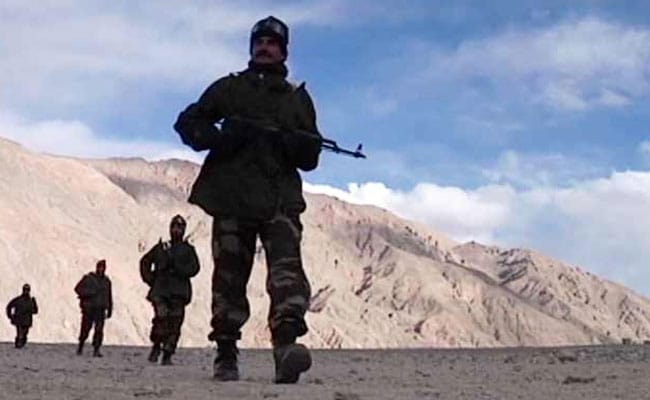
Several Rajya Sabha TV panel discussions — ‘Security Scan’ & ‘The Big Picture’ aired over the last three weeks, regarding PM Modi’s trips to the US, Israel, and the Astana summit of SCO.

(Doklam)
It is surprising to see the increasingly truculent, even provocative, statements being made by the Zhongnanhai (Foreign Office) in Beijing, with the line obediently parroted by the Chinese ambassador in Delhi, that — and this is the latest — that India should stand down from the stand-off with PLA on the Doklam Plateau, withdraw from the forward position held by the Indian forces, before the Chinese will deign to sit down and talk to the Indian side. In the context, moreover, of the previous statement reminding Delhi not to forget the lessons of the 1962 War, it almost amounts to a challenge.
Meanwhile, the silence from the MOD, MEA and the Indian government, generally, is deafening, with Foreign Secretary K Jaishankar in Jerusalem refusing to say anything about the unfolding events in Bhutan. Is this silence by design or because a fearful government has lost its wits?
General Bipin Rawat visited Sikkim, conferred with the XXXIII Corps senior officers, and especially with the GOCs of the Mountain Divisions on the Chinese forward line in the extended area. One wishes the COAS had said something to the effect that the Indian Army would welcome any opportunity to back defence minister Arun Jaitley’s contention that 1962 was a one-off fiasco. That disaster involved no more than a Division and a half in actual ops and, in hindsight, can be seen as nothing more than a fairly minor affray. Sure, PLA too has improved since then as Beijing reminded India, but the Indian military has enough forces to blunt the PLA group armies aggressing at full tilt. One assumes that, unlike in 1962, the IAF will go into action right off the bat.
But what’s the legal basis for the loud and cantankerous calls by Beijing to India to withdraw? None, whatsoever. The 1895 Anglo-Chinese Treaty that China keeps harping on has long been superseded by the 1998 and 1999 agreements Thimpu signed with Beijing that requires both sides to respect the status quo pending the delineation of the formal border in the underway bilateral negotiations. If India has intervened on Bhutan’s behalf it is because, notwithstanding a similar understanding in another area, the PLA went ahead and constructed a loop road, and presented Thimpu with a fait accompli the Bhutanese could not overturn. This is precisely what the Bhutanese government doesn’t want to see happen again. Reason why the Indian army is on the Doklam high ground — at the express invitation of Bhutan, which is unable to protect its sovereign territory all by itself. Under international law, this is perfectly permissible — a weak country can call on military help and assistance from a friendly strong country to fend of the actions of a proven regional bully, in this case, China.
The problem though is this: China has publicly gone so far out on a limb, loudly threatening India with all kinds of retribution, with edgy statements being daily issued by some Chinese source or the other, that it has now engaged its national ego. Backing down would incur a loss of face, not doing so could lead to a situation spiraling out of Beijing’s control. It will be interesting to see how China resolves this mess they have willfully created for themselves.
At one level, the silence from the Indian quarter serves the purpose of goading China into a shriller stance, which shows up that country’s essential inability to handle a crisis with a modicum of grace. On the other hand, the Indian government’s reserve could be interpreted by Beijing as diffidence that it could decide to exploit by trying to pressure India into doing its bidding. It is this last possibility that’s most troubling because there’s every reason to expect that as a result the Chinese PLA may opt to scale up the school-boy type shoving and pushing on display to some serious military hostilities. And it is hostilities the army better prepare for.
Some say MEA is using these incidents to gauge how its strategic partners, in the main, the US and Japan will react, whether they will show any signs of support. This sort of passive/defeatist thinking of the China Study Circle-influenced Indian government, is what India can do without. Assuming such thinking is actually on, then may be MEA mandarins should be assured in the strongest terms that, as I have maintained over the last 25 years of writing, nobody but nobody — least of all India’s latest “true friend”, Trump, will join India in the possible fracas with PLA, and we will have to do the fighting, heavy or light, by ourselves.
The other reason some have speculated for this show of bellicosity is as a reaction to India’s turning down the OBOR invitation. This is even more nonsensical. How pray would badgering and threatening to beat up on India convince Delhi to toe the Chinese line?
But in the worst case, and the worst case may transpire, and shove comes to stomp, the army will be able to test how well its Mountain troops can pull off the mobile warfare tactics they have been practicing for many years now. The IAF has to get into the game. There was some chatter in China which hinted with a wink and a nudge that the crash of the Indian Su-30 in the border Kameng District of Arunachal on May 23 was due to offensive electronic measures mounted by a forward ground unit. This cannot be discounted because the PLAAF too flies the same plane, and has worked up its ground-based and airborne EW capabilities very well. It may also be no bad thing for the Indian Navy to aggressively tail the 13-odd warships — very, very far from their logistics base — being tracked by the Indian naval surveillance satellite, and make clear what could happen to them in case the PLA starts acting up in the hills. And ships out of Port Blair should begin steaming towards the Malacca Strait, just in case.
One hopes Modi will not back down and equally that he will not prevent the Indian army and IAF from responding in kind and with force should the PLA cross the Rubicon. The only way to react to a bully is to counter-punch him in the face. And India is surely well-placed to do that.
Published in BloombergQuint.com on July 1, 2017 in my ‘Realpolitik’ column, https://www.bloombergquint.com/opinion/2017/07/02/modi-in-israel-need-for-more-equitable-defence-collaboration

It was not too long ago when Israeli diplomats considered India a hardship posting. Those souls braving the pokey confines of the Israeli Consulate on Peddar Road in Mumbai, protected 24×7 by a contingent of armed Maharashtra Police, were incentivised by higher emoluments and career advancement. This was before diplomatic relations were “normalized” and the representation scaled up in 1992 to the ambassadorial level by the Narasimha Rao government. In the new millennium, Delhi is a much sought after station. Ambassador Alon Ushpiz, for instance, went from Delhi to an appointment as Adviser to Prime Minister Benjamin Netanyahu in one fine leap and lost no time in urging his boss to establish a separate bureau in the Israeli Foreign Office to deal with India, which Netanyahu duly did two months back.
India and Israel have a uniquely close relationship. It dates back to trade in King Solomon’s time, and the first Jews seeking refuge in India after the razing of the Second Temple in Jerusalem by the Romans in 70 A.D.
The departing British colonial power did its standard ‘cut and run’ in the Palestine Mandate territory in 1948, as it had done in the subcontinent the previous year, leaving behind the bloody partition debris for the peoples to build on.
Now, India seeks from Israel advanced military technology, agricultural techniques to turn deserts into orchards, and inspiration to be another ‘start-up nation’ in cutting edge technologies. The two countries, in other words, have experienced sort of Kondratieff Cycles in civilizational ups and downs, before settling into a steady state. In fact, in describing the prospective partnership between the two countries it is common to hear Israeli defence ministry officials use a phrase popularized by the Deputy National Security Adviser, retired Major General Amos Gilad – “the sky is the limit.”
Other than arid land agriculture, Israel’s advanced military technology sector is at the heart of that country’s success story. This latter has three aspects – two of them that have negatively impacted India and may prevent really robust Indo-Israeli cooperation in the future.
Over 80 percent of the Israeli military research and development is funded by the United States, which endows Washington with a veto over what and to whom Tel Aviv can sell/transfer technology.
More often than seems good for India’s relations either the U.S. or Israel, deals have been nixed owing to caps on technology imposed by Washington. Thus, while Israel was eager to give its Elbit 2052 computer at the core of the Active Electronically Scanned Array (AESA) radar India is building for its combat aircraft fleet (to enable fighter-bombers to switch mid-flight from air-to-ground to air-to-air roles), the US disallowed it, permitting the use of only the inferior 2032 version.
The second aspect is that the two best customers for Israeli military products are India and China. The Israeli defence industry cannot do without either because exports to these two countries virtually constitute all of its foreign sales. In 2015, for instance, of the Israeli arms exports worth $5.7 billion, China bought military hardware valued at $3.4, and India at $2.3 billion. But, here’s the rub. Beijing has looked askance at Israel helping India produce the ‘Swordfish’ variant of its Green Pines long range radar that can be used by the Indian ballistic missile defence system to detect incoming Chinese missiles 800 kilometres away.
Thus Tel Aviv has always to reconcile U.S. and Chinese concerns with Indian demands, and India loses out.
The other bit of grit that has got into an otherwise well-oiled Indo-Israeli arms supply machine is the rising discontent evident in the Indian Defence Research and Development Organization (DRDO) with the Indian buys from Israel, which other than avionics, have been mostly in the missile field. Currently three large procurement/joint development projects are underway – the $2.5 billion deal for 50-70 kilometre medium-range surface-to-air missile (SAM) for the Indian Air Force and Navy, the $1.5 billion contract to produce the 15 kilometre short range SAM to replace the Barak system on Indian warships, and the $2.75 billion buy of the Spyder quick-reaction mobile air defence missile for army deployment on the border with Pakistan.
DRDO’s peeve is two-fold. One, that instead of the government and the armed services asking for variants of the indigenous 25 kilometre range and effective Akash surface-to-air missile already with the military to cover the medium and short ranges and giving a fillip to Prime Minister Narendra Modi’s ‘Make in India’ programme, money is needlessly expended on Israeli items. And, secondly, that in the joint development projects, India and DRDO agencies are stuck with the low-end work of making canisters and launchers, not the front end high-value stuff, such as warhead, guidance, and fire-control systems. The proprietary knowledge – design innovation and system algorithm – is retained by Israel, when rightly it should be Indian intellectual property because India has paid for its development.

These difficult issues need to be sorted out, lest the relationship begins to sour at the Indian end. Modi should ask for an equal share to India of the intellectual property rights created by high-value Israeli military technology development subsidised by Delhi. Whether he will do so remains to be seen, but the resolution of such contentious issues will brighten the prospects for meaningful future collaboration.
Modi could also, more productively, learn from Netanyahu how the Israeli government long ago transformed the socialist setup of its state-owned defence industry into a world class, cost-efficient, technology creator, with a view to replicating the Israeli model in India.
But the Prime Minister seems more intent on connecting with the section of the Israeli population that has India links at a planned mass reception of Modi in Tel Aviv (like those staged in Wembley Stadium in London, Madison Square Garden in New York, the Allphones Arena in, and more. It will not do much for India, but it is good theatre.

(Modi’s jhappi for an awkwardly unprepared Trump at the White House)
He did it. Prime Minister Narendra Modi did stride across to the other lectern and envelope US President Donald Trump in a hug. Now slo-mo that entire sequence and you’ll see that even when forewarned about the Indian leader doing precisely this, Trump was unprepared for the physicality of it, and with some awkwardness limply reciprocated by putting his arm around Modi’s shoulders. This was the PM’s way of imposing himself physically on his American counterpart, forcing him to react. This was no bad game play.
But this imposition did not extend to the economic aspects of relations in the joint statement, where the US had its way. Sure, the designation of Syed Salahuddin of the Hizbul Mujahideen as global terrorist (GT) must have satisfied the Indian side enough for it to hold back on injecting anything remotely related to the free flow of services and skilled manpower (H!B visa issue) in the public statement by Modi. Moreover, while there was mention about destroying “radical Islamic terrorism” — which phrase for Trump was a repeat from his Riyadh summit with the Saud-led sunni collective, there was none about Pakistan, its role in using terrorism against India or Afghanistan, or any pointed reference as was sought by Delhi.
The US State Department’s cleverness here must be noted. It played up to the Indians with the naming of Salahuddin without undermining its interests in Pakistan, which last would have happened had the Lashkar-e-Tayyaba chief Hafiz Sayeed earned the GT label from Trump as well, something MEA had lobbied for. Why was the fingering of Salahuddin, and not Sayeed, by the US clever from the American perspective? Because Salahuddin is a native of the Srinagar Valley, was a candidate in the 1989 state elections and crossed the LOC into POK only after his electoral defeat (assisted, unfortunately, by the Indian authorities), and labeling him as GT would not upset Islamabad as much as directly naming Sayeed would have done. Getting wind of what was in the offing, the Pakistan government quickly staged the terrorist incidents and rolled out the videos of Salahuddin ordering strikes on Indian targets in the last 2-3 days almost as if to prop up the US case against the Hizbul leader. This to say that Pakistan was quite happy to sacrifice Salahuddin, while protecting Sayeed.
For the rest, the American had the run of it. There was not even an indirect and remote reference to H1B-immigration issues and their cost to the Indian IT industry, nor any concern expressed in the PM’s statement about unwarranted pillorying of the Indian pharma industry juxtaposed against fulsome mention of unbalanced trade, and trade deficit that Trump stated needed correction by India requiring to open up its market to American imports of all kinds. Trump also was happy with the Indian side signing up for American shale gas.
But fortunately, Modi did not succumb to the trap set for him by those in Washington advocating that India buy the vintage F-16 aircraft to merely update its combat aircraft assembly line technology, combined with the move by Lockheed Martin to precipitate a positive decision by securing an MOU with Tata Advanced Systems for assembling the F-16.
The fact is the US, notwithstanding its high-flying rhetoric about empowering the Indian military with cutting-edge fighting technology to keep the common threat, China, on its toes, not a single military high-tech collaboration has got underway from the time such talk was initiated by President Reagan’s Defence Secretary Caspar Weinberger in the mid-1980s. There’s something really wrong here.
The US hesitation in exporting/selling to India some decisive miltech is evidenced, for instance, in Washington’s approving the long-range, long endurance, Predator drone for maritime surveillance rather than the armed Predator India was keen to buy in fairly large numbers, because the US State Department fears these would be used against terrorist targets in POK, and upset the American apple cart in the Af-Pak Region.
Further, as I have consistently pointed out, it seems Trump’s government, in line with the previous regimes in Washington, has decided to impose a low lethality ceiling on the armaments/technologies the US sells to India. Whence the American eagerness to sell unarmed drones, obsolete F-16 type combat aircraft, and prohibitively expensive technologies that Indian platforms cannot cost-effectively integrate, such as the EMALS (Electro-Magnetic Aircraft Launch System) for the 2nd and 3rd indigenous V-class carriers being built in Kochi.
Perhaps, the Modi government, aware of the limitations of the America connection, sent off part-time defence minister Arun Jaitley to Moscow to firm up defence ties with Russia (including the lease of the second Akula SSN, and investing in the FGFA) around the same time as the PM was taking off for the US.
Better to have the Russian bird in hand, than two American birds in the bush.
But there’s a great danger looming. There’s obviously a certain warmth in the Trump-Modi tango — they seem personally to like each other, each pressed the right buttons — Trump by praising Modi’s leadership and his stewardship of India, etc, etc — something the PM craves as personal endorsement; Modi in praising his opposite number, being over-effusive in expressing his gratitude for the reception by Trump, inviting the President’s daughter Ivanka to lead the US investors’ delegation to Delhi, etc., etc. So what’s the problem? The danger is that Modi will nurse such warm feelings for Trump and in the wake of a “successful” summit in Washington impulsively approve/order the purchase of the extremely dated F-16 aircraft or the completely inappropriate EMALS, etc. After all, impulsiveness has its costs. The country will be paying for the Rafale folly for decades. To add the F-16 to this mess would be to sink the Indian Air Force.

(Modi being greeted by a gaggle of NRIs on his arrival in Washington from Portugal June 24, 2017)
It is unfortunate that prime minister Narendra Modi, like his predecessors in office, reiterated that old saw — “all world is family” ( vasudhaiva kutumbakan) for an audience of NRIs at the Ritz-Carlton in Virginia June 25 evening. He further elaborated on this foundation of his policy, assuring everybody within earshot and the larger policy audience in the Washington Beltway that India would not, during his tenure, disrupt the global order even though it is entirely skewed against India’s national economic and security interests, but rather work within it. It is thinking that’s entirely contrary to the Trump Admin’s views.
The US National Security Adviser Gen. HR McMaster and White House senior staffer Gary Cohn authored an op-ed in the Wall Street Journal, May 30, 2017, showing up Mr Modi’s tired old idea as so much nonsense which, incidentally, is the thrust of my detailed argument against such vacuuous thinking that animates Indian foreign and military policy in my last book ‘Why India is Not a Great Power (Yet)’ . Trump, they wrote, “embarked on his first foreign trip with a clear-eyed outlook that the world is not a ‘global community’ but an arena where nations, nongovernmental actors, and businesses engage and compete for advantage.” So Modi proposes that India keep fighting by the rule book while everybody else chucks it. Good luck then for getting any results!
The PM then compounded the problem by insisting that this everybody is family-concept won’t hinder any actions he might order to counter terrorism and mentioned, in this respect, the so-called “surgical strike” he had ordered a while back. As revealed in my posts on this blog at the time, the surgical strike was a shallow penetration, counter-force measure that took out a few jihadis and possibly Pakistan Army support personnel and differed very little in its essentials from previous such almost routine strikes the Indian Army’s Special Forces conduct across the LOC. And as I predicted this strike has not in the least deterred or in any way dissuaded GHQ, Rawalpindi, from using its terrorist proxies (Lashkar-e-Tayyaba and Jaish-e-Mohammad) to infiltrate Indian Kashmir at will and to create mayhem. This much is evidenced in the record of continued cross-border atrocities, including yesterday’s incident of the attack on paralmil soldiers by terrorists (who then holed up in some school premises and were shot). So, not sure why the PM keeps referring to this act of retribution as something unprecedented and stellar when plainly it has had no effect whatsoever and is considered by both sides as part of the tit-for-tat hit game. But it does indicate that the “surgical strike” — however it plays in his mind — is the limit of punitive action Modi is willing to risk for fear of upsetting the “international norms” he says India will not violate. Which is another way of saying that the country cannot and should not expect any end to Pakistan-prompted terrorism.
There are two other takeaways from Modi’s much reduced exposure to NRIs this time around. His repetitive and effusive praise for the MEA and how, under minister Sushma Swaraj’s ministrations, it had become responsive, receptive, and attentive to NRIs’ concerns. It covered up the fact of the Foreign Office’s marginalisation in that it simply isn’t the source of policy ideas but is merely asked to busy itself with keeping NRIs in good fettle and doing consular work well. This may be no bad development considering now we know whom to blame for foreign and military policy missteps.
More masterfully, in a roomful of contented and hurrahing NRIs, Modi subtly seeded a doubt about their own physical safety and well being in Trump’s America that could at any time turn against them as an alien, albeit prosperous, hence a more noticeable and targetable, minority. This was a delicate indictment of the extant socio-economic reality in Trump’s USA by Modi — though the audience seems not to have got it — in the context of his reassuring the NRIs of Delhi’s readiness at all times to fly any beleaguered India-origin Indians anywhere home to safety.
Given this curtain-raiser (and the by now standard meeting with the usual American CEOs whom the PM met with separately), it will be interesting to see how the White House Modi-Trump one-on-one pans out some nine hours from now, and especially whether our pradhan mantri will be able to resist buying the F-16 that the MEA may have wanted off the table but Trump may push anyway.

(Lt Gen Hasnain in the centre, at one of the “awami sunwayees”)
The murder of Lieutenant Ummer Fayaz (2RajRif) in May and the public killing of the Deputy Superintendent of Police Mohammad Ayub Pandit outside the main Srinagar mosque, Jamia Masjid, on late June 22 evening that Mirwaiz Umar Farooq did not even see fit to mention in his Eid festivities-related address, could constitute something of a turning point in the affairs of Kashmir. With the Muslim society of the Srinagar Valley now cannibalizing itself, it is the right time for the Indian government to embark on a far-reaching policy to finish off the separatists once and for all.
If Fayaz’s murder wasn’t, the lynching of Ayub could be the polarizing event that compels the Valley folks to take sides. The heart-wrenching scenes of the DSP’s relatives defiantly proclaiming their Indian-ness and challenging the extremists to do their worst is just the sort of thing needed to turn the people against the militants, and to collar them as well as the larger problem of separatism. This is how it can be done.
J&K Police have been for a while now chafing at the bit, demanding to be allowed to respond to the violent provocations of the separatist/extremist elements with force. This is significant. J&k Police comprises people from the Valley, of persons living in the lanes and mohallas of large towns — Srinagar, Baramulla, Anantnag, etc — as Aub did, not a stone’s throw away from the Jamia masjid, where he met his bloody end. The specialist counter-terrorist force in the JKP is the Special Operations Group (SOG) which is made up of motivated manpower from the JKP, who flow with the Valley social slipstream and can generate solid intelligence regarding militants and their wellwishers active in the towns and the countryside. SOG combining with the JKP forces should now be given the license to do whatever is necessary to end the separatist movement. Chief Minister Mehbooba Mufti has hinted at this. The JK government should now show steel and proceed with this line of action.
SOG will not require any outside prompting and will prosecute actions. They should be encouraged to show no mercy whatsoever to the militants, miscreants, and their supporters. A KPS Gill like cleansing of the Valley society is now in order, and Mehbooba should order it. with Delhi’s support. The army’s role in the operation will not be insignificant. Like rats scurrying out of harm’s way, the Ayub killers are trying desperately to get the hell out. Between the army and the JKP, they should be able to get hold of these vermin, even as SOG — acting as the Punjab Police Commando did in Punjab against the Khalistan-boosters — goes about physically eliminating the militants and Lashkar and Jaish members, ex-Pakistan. Army’s Srinagar-based XV Corps has its role etched out.
Indeed, it is a pity that the institutionalized habit of an officer appointed to a new post insisting on doing things his way by undoing/disregarding whatever his predecessor did even if it fetched results has so taken root, it is hurting the national interest and undermining security. Thus, the approach and innovative methods adopted by Lieutenant General Syed Ata Hasnain as XV Corps commander, 2010-2012, were lost almost immediately after he moved to Army HQrs as Military Secretary. Some blame the bad blood between Gen VK Singh, who was long involved in Kashmir ops ( as commander of the Victor Force) and had supported Hasnain’s efforts from the time the latter commanded the 12th Infantry Brigade, and his successor, Bikram Singh, who brought in Hasnain as his Milsec, for this discontinuity. It is such small and petty inter-personal frictions that also derail the army. In any case, what is it that Hasnain did that was worthy of the army making it a permanent template for XV Corps’ internal security operations?
Firstly, Hasnain (Garhwal Rifles) — a khandani fauji, his father was the late Major General Syed Mahdi Hasnain — instituted the periodic durbars, the “awami sunwayees”, wherein the locals would publicly air their complaints and, as Corps commander, Hasnain would just as publicly, try to deal with these and otherwise resolve their everyday problems on the spot. The Valley Muslims had never experienced such a cordial relationship with the army, and very soon developed an intimacy that helped Hasnain’s other prong — using the army, SOG, and intelligence –IB/RAW to go after cross-LOC militants and Lashkar/Jaish leaders who had infiltrated the Valley society, to work. What was significant was that all these agencies cooperated to eliminate, and this is important, ONE militant leader at a time. Why was this “one at a time”-rule imposed by Hasnain important? Because it focused the minds and the efforts of all those involved wonderfully well, and cut down on the usual mad scramble of each unit acting on its own, obtaining in the aggregate a welter of haphazard efforts involving too many targets, and achieving nothing very much as a result. This, alas, is the case now. The Hasnain methodology evidenced the smooth working of the classical “hearts and mind” strategy in a counterinsurgency situation, except it lasted only as long as Hasnain’s posting in Srinagar. And that’s the pity.
The pity is that the Indian armed services are so centered on the unit commander of the moment that any good the previous incumbent may have done is, as mentioned earlier, swept away as detritus by the new incoming head. This pattern is replicated at all levels right up to the top. At the highest armed services’ level, this has meant chief of staff-centred armed services, a liability the Indian government over the last nearly 70 years has done nothing to tackle. Such ridiculously counterproductive and wasteful approach in the military needs immediate correction. A simple directive that no new chief of staff can trash, overturn, or negate any ongoing approaches, solutions, programs, and procurement priorities without first clearing it with MOD would have a salutary effect. This order can be appropriately configured for application at all levels of the armed forces, just so ongoing fruitful activity is not disrupted. This is a longstanding necessity, but something so commonsensical has been studiously ignored. Indeed, military does not even think of it as problem. Then again, in the prevailing Indian system, common sense may be as alien to the Indian armed services as it is to the Indian government.
True, Gen. Hasnain was fortuitously placed to carry out his strategy, not least because he is a Muslim steeped in the subcontinental Islamic culture, and could pick up easily on cultural nuances and empathize with the Valley Muslims. This no doubt helped him to eradicate their fears while stoking their optimism and hope. There’s no dearth of motivated Muslim officers in the Indian Army. Could the Army HQrs, perhaps, do some career management, and begin grooming the best among them for longtime posting in Kashmir as Hasnain enjoyed, in his case, by sheer luck and happenstance? This will take care of the continuity problem.
For a start, a formal revival of the two-pronged Hasnain strategy is in order. If the army has no institutional memory of it, the COAS Gen Bipin Rawat, could call on General Hasnain — a Delhi resident — to help out. He could be specially commissioned to reestablish the modalities of the “awami sunwayees” and the army-SOG-JK forces-intel interfaces, so the army — and especially XV Corps, can get going independent of the politically floundering PDP-BJP government, which may be too constrained openly to help.
But a third prong should be added to make the Hasnain strategy still more effective. And that is the cultivation of the Liaqat-Kukka Parey option that I have long advocated in my writings. Yes, Liaqat grew a little too big for his boots and began hurting the locals’ interests, and Parey joined the political mainstream and was killed by the militants. But the groundswell against the Fayaz and Pandit murders should point out the more angry among the lot who are bent on vengeance. Like the young Jat Sikh lads Gill recruited to hunt down and rid the Punjab landscape of the Khalistani villains, young Kashmiris who feel done in and victimised by the militants should be helped in every way possible with training and other resources to be the irregular arm of the army and assisted to “do the dirty work”, and a well-oiled scheme for rewarding those showing initiative in this respect embedded with the GOC, XV Corps.
The Indian republic has been too lenient in the last 70 years with terrorists, militants, insurgents, Maoists, and ruffians of this ilk. How long does the Union have to suffer them? The time to act is now.
‘Security Scan’, the Rajya Sabha TV programme, aired a panel discussion on “India’s China Policy” in the last few days, featuring fmr Secretary, MEA, TCA Rangachari, Jabin Jacob and yours truly, at
What Narendra Modi will confront on his US visit is Donald Trump’s ‘America First’ doctrine in action
PRIME MINISTER NARENDRA Modi should have pondered the perils of visiting Washington this early in Donald J Trump’s presidency. It will do him and the country no good, especially if Trump chooses to turn it into a staged affair of yet another third-world leader paying him obeisance. At a time when the US president is distracted by numerous investigations of Russia’s role in tilting the 2016 US presidential election his way, Modi may find the unpredictable Trump in a funk, or in a flinty mood.
This is a roundabout way of saying Trump doesn’t give a damn for India (or any other foreign country for that matter). If Modi thinks he can cash in once again on that clichéd rhetoric of shared liberal values, democratic freedoms, et cetera, he had better do a rethink, lest the airing of such sentiments lead Trump to first delay their meeting and then cut their eventual discussion short, as he did with Australian Prime Minister Malcolm Turnbull in early May when the latter brought up the subject of refugee intake. Some of Trump’s best friends are dictators and the regimes he is most comfortable dealing with are autocratic. Ask Chinese President Xi Jinping. Or, better still, Russian President Vladimir Putin. India and Modi lose out on both these counts—unless, who knows, Trump takes a liking to the strongman in Modi.
To the extent India is on Trump’s mind at all, it is as a country that has ripped “billions and billions of dollars” off America, a claim he used to justify yanking the United States out of the Paris Climate Accord, and as one stealing ‘well paying’ jobs from hard- working Americans while dumping low-paid Indian techies in America via the H1-B visa channel. “I love the Hindu!” Trump had exclaimed to a bemused NRI crowd in New Jersey during his election campaign, but Modi will be shown none of it.
What Modi will confront is Trump’s ‘America First’ dogma in action. Translated into a one-way transactional tilt of foreign policy, it will mean Trump asking Modi what India will do for the United States. Such an ask of foreign leaders is, after all, at the centre of the US president’s ‘successful’ interactions with them. Trump’s meeting with King Salman of Saudi Arabia in the third week of May led to Riyadh promising buys of US military hardware to the tune of $110 billion. The success of the June 1st Washington visit by Vietnamese Prime Minister Nguyen Xuan Phuc that followed was, likewise, predicated on Phuc signing deals with American companies valued at $8 billion, including $5.3 billion worth of energy equipment from General Electric, and US- produced content in them supporting 23,000 jobs. Should Modi ignore this pattern, and reverse the ask and plead for lenient treatment of the Indian infotech and pharmaceutical sectors (already, H1-B visas to Indians are down by 37 per cent) and for free trade in services to counter the US demand for facilitation of foreign direct investment in India, he may well be told to do something about the 30,000 Indians illegally in the US and to buy more American.
Modi can, under the circumstances, adopt one of two approaches. He can be the usual foreign supplicant, eager to get into the White House’s good books by forking over tens of billions of dollars in contracts that do not serve the national interest but permit Trump to Twitter-boast about his ‘amazing’ skills as a ‘great deal maker’. Or, Modi can do what Chinese President Xi Jinping did to temper Trump’s eagerness to fix the bilateral trade keeling over to China’s side: meet him head on.
India lacks China’s economic heft, but Modi can leverage two robust factors: the US interest in accessing the vast Indian market, and in having India join the emerging security architecture to hamstring China in Asia, and, from an Indian point of view, to confine it to east of the Malacca Strait. These are formidable prizes to dangle before Trump. By way of whetting Trump’s interest, Modi could even throw him a bone. The public sector Gas Authority of India Ltd (GAIL) is considering importing large quantities of shale gas from the US to ensure a competitive price for the Liquified Natural Gas (making up 65 per cent of the country’s requirement) from Qatar. It is a deal Trump, as a booster of the hydrocarbon economy, will appreciate, considering he recently approved the construction of the north-south Keystone oil pipeline cutting through the American Midwest that was held up during the Obama Administration for environmental reasons.
What Modi must absolutely resist is the tendency of Indian prime ministers in meetings with US and West European leaders to supinely make concessions and hand over whatever is demanded of them without asking for equally large if not larger benefits for India in return. A succession of US presidents, starting with Ronald Reagan in the 1980s, had promised advanced military technology, but not one deal of any significance has actually fructified in the last 30 years, even as off-the-shelf sales of transport aircraft, heavy lift and attack helicopters, the M-777 howitzer, etcetera, have proliferated. Meanwhile, the Indian market has been opened to American companies and investors and—courtesy the nuclear deal signed by Manmohan Singh—India may end up rescuing the US nuclear industry. If Modi buys the Westinghouse AP1000 nuclear reactor that has safety problems and remains uncertified by the US Atomic Energy Commission, as Washington wants him to, then India may have hell to pay. The Toshiba-Westinghouse company producing it is bankrupt and may soon cease to exist, and there may be no way for India to enforce technology quality guarantees. If Modi is prevailed upon to buy this lemon of a reactor instead of investing in our own advanced pressurised heavy water reactors, he can be persuaded to buy anything.
But India’s rescue act is endemic to its dependency-promoting economic policy and diplomacy. By not trusting Indian talent and industry to design and develop in-date military hardware, Delhi has perpetuated reliance on imported arms and on licensed manufacture of foreign equipment by the public sector-dominated defence industry that is stagnating at the screwdriver technology level. But these procurement deals have proved a boon for foreign defence industries. Thus, instead of pushing into prominence the indigenous Tejas light combat aircraft at home and selling it to other developing countries as an affordable state-of-the-art alternative to immensely expensive fighter planes, Modi, almost on a whim, threw a lifebuoy to the financially-strapped French aviation major, Dassault, with an order for 36 Rafale combat aircraft. The small number of Rafales is not large enough to have military impact, but will divert enormous funds—as much as $25 billion—towards sustaining the French combat aviation sector while starving India’s own Tejas project of resources.
If Hollande had Rafale, Trump has the Lockheed Martin F-16 to peddle to India. Except, buying the latter makes even less economic and military sense, considering it is a bare-faced attempt by the US to palm off an obsolete fighter plane on the pretext of seeding a modern aircraft assembly line in India. It will be precisely the sort of unequal deal that ends up saddling our armed services with nearly useless weaponry.
When military procurement happens as per laid down processes and procedures, the Government has the option even at the final stage of price negotiations to junk the deal. When the Prime Minister himself commits to a government-to-government deal, the country has no escape route. That’s why despite the Rafale being a bad buy, the Government will go through with it at an unbearable cost. Hopefully, Modi will not buy the F-16 aircraft and the AP1000 nuclear reactor for a pat on the back and a handshake from Trump, because then India, its Air Force, nuclear industry and the Prime Minister’s reputation as a dealmaker will all take a hit.
Rajya Sabha TV program on “Indo-Russian relations: emerging frontiers” was broadcast last week, features Prabhat Shukla, former ambassador to Russia, pramit pal chaudhury and yours truly. It may be viewed at https://www.youtube.com/watch?v=OduwYhNJ2uc&list=PLVOgwA_DiGzpWrMV__M9_rHINn7PzABlM

This is departure from the usual foreign/military policy related post, but not entirely unconnected to the subject of hard power central to this blog. The last time I wrote on an extraneous subject was when in November 2013 I excoriated the Manmohan Singh government for conferring an entirely undeserved Bharat Ratna on Sachin Tendulkar — “Bharat Ratna for thwacking the ball?” (https://bharatkarnad.com/2013/11/17/bharat-ratna-for-thwacking-a-ball/. For reasons I cannot fathom, this piece in the archives of this blog is truncated. Should I smell a conspiracy?!)
I have just returned from lunching with a high official presiding over the fate of Indian cricket, and hence world cricket. What he said may be of interest and, in any case, is a story I am now breaking! But I will get to it after the preliminaries!
The Indian people turning on their television sets and tolerating unending advertisements for this and that between sessions of cricket (currently, in the ongoing one day ICC championship in Britain) are the reason India is the cricketing super power that it is. If you pay the piper, you get to call the tune. But that’s not what all the other cricketing states think is right. The billions of dollars that television advertisements generate, fill the coffers of the BCCI, of course, but also sustain the game in all the other countries. The trouble is India is the global purse other cricketing powers want to raid, for which purpose they voted to have a fairer, more equitable, distribution of the revenues, in which India’s take from the worldwide cricket revenue pot was restricted to $339 million, when it was responsible for for almost all of it. Originally, India, Australia and England took the giant’s share of the monies so generated, with India helping itself to $445 million.
Correctly judging such shanghai-ing of India’s monies to be intolerable, the Supreme Court appointed Committee (SCAC) has told BCCI reps to negotiate with the ICC but as a compromise to accept nothing less than $420 million as India’s share, a figure amended to $425 million (owing to the unfortunate allusion to the IPC provision 420 for the crime of cheating!) So, India will have its $425 million — a full $20 million less than its original take — or the ICC and international cricket can go take a hike!
There’s no wiggle room afforded the BCCI reps. Either the world cricket body accepts the revised Indian position that involves India’s taking $425 million, or India will decide, I presume, to cut separate deals with cricket control boards of various countries. That’s the story here! But, if it comes to that stage, then GOI may want to coordinate with SCAC to use the leverage of interest in cricket and generosity to reward friendly cricketing states and punish states not toeing India’s line, as extension of the Indian foreign policy. This is at once right and necessary. Think of it as a sports great power imperative!
This person also revealed the shenanigans of the Sharad Pawar group and the more powerful Srinivasan group (with the much smaller Anurag Thakur coterie on the sidelines) that, in their tussle to control BCCI, tried everything, including upending the recently concluded IPL by denying the use, as reported by the press, of stadia for the matches, etc. In this standoff the BCCI staffers, most of them contract workers, cagily weighed the balance of power between these two groups before siding with this or that group on issues of import. It led to an ultimatum to the BCCI staff from SCAC to implement decisions taken by SCAC, or to not turn up for work, which did the trick.