
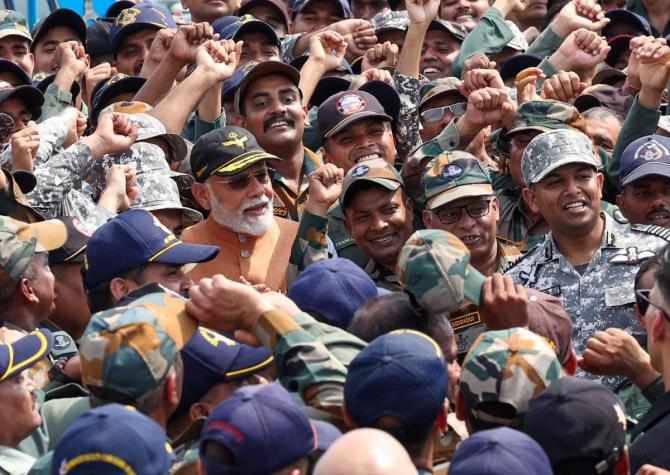
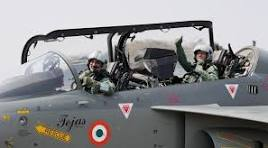
[The PM at the Adampur air base that Pakistan claimed had been destroyed by their missiles]
Rediff.com sent me a slate of questions May 12, 2025 for an email interview. I responded. My original replies reproduced below. A more sanitised version, was published in 2 parts. The first part was published May 13, 2025 — “‘India Missed Opportunity To Take Back Parts Of PoK’ , at https://www.rediff.com/news/interview/operation-sindoor-india-missed-opportunity-to-take-back-parts-of-pok/20250513.htm; and the 2nd part — “China Will Keep Supplying Pakistan Weapons”, at https://www.rediff.com/news/interview/operation-sindoor-china-will-keep-supplying-pakistan-weapons/20250514.htm was published May 14, 2025.
The interview with my original responses:
1) President Trump said a little while ago that ‘We stopped a nuclear conflict. I think it could have been a bad nuclear war. Millions of people could have been killed.’ Were India and Pakistan, in your assessment, truly on the verge of atomic Armageddon last week? Or is it typical Trumpian overstatement?
A: It is the usual Trumpian hyperbole. The nuclear swords were nowhere near being unsheathed as the US President makes out. It is in his interest, however, to vastly exaggerate his role as ‘peacemaker’, considering he has been frustrated in Ukraine and Gaza, so Op Sindoor was a godsent for him.
2) CNN reported that US Vice President Vance, Secretary Rubio and White House Chief of Staff Wiles were alerted by intelligence on Friday that compelled the US to get quickly involved in resolving the India-Pakistan crisis after initially shrugging off any involvement. Apparently, the ‘intelligence’ was about an Indian airstrike coming perilously close to breaching one of Pakistan’s nuclear storage sites. Could we have done so considering both India and Pakistan have a list of each other’s nuclear sites, precisely to avert that dire possibility?
A: Indian missile attack on Chaklala — HQ Strategic Plans Division — Pakistan’s nuclear secretariat, may have been a wakeup call. But the ops cell of SPD is situated underground which the Indian missile could not have, and was not, designed to penetrate. The message sought to be conveyed to Pakistan was the seriousness of India’s intent. Whether its was so accepted is questionable.
3) If this information to the White House came from the Pakistanis, could it have been truthful? Could it have been classic ISI deception designed to alarm the Americans, get them involved in finding a resolution and get them to persuade the Indians to call a cessation of hostilities especially when Pakistan is in no economic condition to continue a long war?
A: Sure, it is quite possible the Indian attack on Chaklala (and also allegedly on targets in the Kirana Hills where there might be some nuclear testing facilities) was exploited by Islamabad to get the Americans to step in to stop the proceedings. But that is not the reason for the American intercession. The fact is the US cannot afford to let Pakistan go under, or to suffer grievous harm because it is at once the most pliable and the most critical ally in Southwestern Asia which it simply cannot do strategically without. It is this fact of international life Messers Modi, Jaishankar and the MEA seem not to appreciate with their futile attempts to try and replace Pakistan with India in America’s strategic calculus. Islamabad knows its value, its indispensability, to the US and the West generally and, therefore, keeps pushing the envelope. In the event, if India ever girds up its loins to militarily wrench important areas of POK from Pakistan, it will have to do so in the face of active American opposition. Understand that!
4) Should India have accepted the offer of a ceasefire when its military objectives were incomplete?
A: No. But then it does not seem the Indian government and the military had any LOC-changing, POK territory-grabbing, objective in mind for Op Sindoor. And a golden opportunity to exercise the option of making a lasting impression on the Pakistan army was lost. More so because Pakistan had opened the doors for Indian actions to grab vital pieces of POK when Islamabad announced it had “suspended” the 1972 Shimla Accord, which legitimised that ceasefire line — the LOC as virtually a boundary. The chance was thus missed to rationalise, i.e., to straighten, the LOC as I had advocated in my ‘Security Wise’ Blog of April 30, by capturing the Haji Pir Bulge at one end, and even Skardu at the other end to link up with the Indian control of the Saltoro Muztagh to the Siachin Glacier.
The short point is, a military operation has to impact an adversary’s thinking and mindset in the manner desired. Had Haji Pir and/or Skardu been taken, the message would have gone out not just to General Asim Munir and his cohort in the Pakistan army but to the Pakistani people that every terrorist incident in India would lead to substantial loss of territory in POK. This would have proved a powerful motivation for GHQ, Rawalpindi, to give up its use of terrorism as a successful tool of asymmetric warfare against India.
5) Do you think India had no option but to accept the ceasefire because the government would not want to displease Mr Trump?
A: Have never understood the tendency of the Indian government, whether under Manmohan Singh and now Narendra Modi, to bend its knees to Washington. It is, by now, a reflex Indian policy. Think of the leverages India has that the government does not use. Its geostrategic location and resources. Without India’s help and assistance the US policy of containing China in the Indian Ocean with India’s position astride it, and in Central Asia with its geographic reach to the north, is null and voided. And what about the “access to the Indian market” economic leverage? No economy, not the American, not the Chinese, can do without selling to India, peddling their wares to Indians. The government scrupulously avoids using it against the US and China, or in the context of the Free Trade Agreements being negotiated left and right. It is hardly a surprise that India, far from getting respect, has a burgeoning reputation for its timidity and for being a sucker.
6) Or was a ceasefire okay with the government and military because 1. We had achieved militarily more than what we set out to especially during days two and three of the conflict, and 2. Because the nightly drone attacks from Pakistan had scared and unnerved the unprepared-for this population in north Indian cities?
A: Of course, the Indian people have no experience of war, are easily rattled, and are jingoistic only upto the point nothing happens in a crisis! If this is a given, surely, the government would have factored this aspect into its calculations before embarking on the punitive drone and missile strike mission. And what great results have been achieved with these hits on Pakistani targets, pray? Indeed, if anything, the damage is so easily repairable, the Pakistani government, army and people are already celebrating the ending of the 3-day “war” as a great win for Pakistan! If anything Sindoor has led to elation in Pakistan as to how well its military handled India.
7) As one of India’s premier national security experts, what is your assessment of Operation Sindoor?
A: Sindoor served as a symbolic gesture more than it achieved a substantive aim. What, after all, was the purpose of the minimal military actions we saw unfolding in realtime? It is not at all clear. Will it prove a deterrent for the Pakistan Inter-Services Intelligence (ISI) from mounting terrorist actions in the future in J&K and elsewhere? Of course not, especially with the restoration, for all intents and purposes, of the status quo ante. So, what was it all about? Sure, as I suggested in my Blog post of May 7, a psychological barrier has been breached with the strikes on the campuses of the Lashkar-e-Tayyaba in Muridke and of the Jaish-e-Mohammad in Bahawalpur. But the effect should not be overstated. Because the Pakistani authorities had vacated both areas of people the day before the Indian missiles struck, suggesting the Pakistan army had intelligence on the incoming Indian attacks. Still, strikes on Pakistan’s Punjabi heartland is a threshold crossed.
8) By striking a wide number of terrorist targets in the first round on Tuesday night and military airfields in consecutive rounds on Wednesday night/Thursday night, did we inflict enough punishment on the ISI and the Pakistan army for the horrific Pahalgam attack?
A: No. Sindoor has caused some deaths and material losses, true. But the destroyed physical facilities can be quickly rebuilt, And youth schooled in little else but Koran in extremist-run madrassahs provide a steady and unending supply of jihadis and mujahideen. So net result: Sindoor will make no difference whatsoever to Pakistan’s attitude to Kashmir or to use of Islamist terrorism.
9) What surprised you most about Operation Sindoor?
A: I was surprised by just how restrained the Indian military effort actually was in contrast to the rhetoric following the Pahalgam massacre on April 22, when Modi talked of “unimaginable consequences”. So were any of the Indian strikes during Sindoor unimaginable? I was astonished, as well, that the government and the military did not prepare for swift and telling actions to oust the Pakistanis, at least, from the Haji Pir Salient that offers the ISI with the main infiltration routes into the Srinagar Valley from south of the Pir Panjal Range. One would have thought the time lag between Pahalgam and Sindoor would be used to get the forces ready for capturing Haji Pir. It was captured by 1 Para in the 1965 War only to be returned at the Tashkant talks in exchange for Chhamb that the Indian army lost. (Except, Chhamb was lost again to the Pakistan army in 1971, this time for good.)
10) Did any aspect of Operation Sindoor disappoint you?
A: Absolutely everything except the symbolic hits on Muridke and Bahawalpur, for the reasons detailed above.
11) Do you believe Marc Rubio’s assertion that India agreed to discuss all issues with Pakistan at a neutral venue? Would External Affairs Minister S Jaishankar and National Security Adviser Ajit Doval, who Rubio interacted with, given the Americans such an assurance? Has the Trump administration restored the hyphen with Pakistan that vexed India’s leaders and diplomats for years?
A: There’s some confusion about what it is the Jaishankar-Ajit Doval duo agreed with the US Secretary of State Marco Rubio on. According to retired dipomats, who may or may not be plugged into the official loop, that “neutral site” was accepted on ambiguous terms. That does not detract from the fact that New Delhi wilted under American pressure. Whatever the truth, the fact that the Modi regime accepted the US as an intermediary establishes a bad precedent that Pakistan will capitalise on in the future both because it formally defines America as an enforcer against India, and because it re-hyphenates India and Pakistan — a giveaway which is a manifest diplomatic disaster. One had hoped that South Asia had left behind the hyphenation phase for good.
12) In a sense, does this conflict redefine war, when adversaries don’t cross their territory, but hurl swarms of drones and missiles at each other? Can such a stratagem be limited in its duration and geographical spread?
A: Yes, in fact, this is medium-term future war in embryo. Weapons with lethality and range will be more important than platforms, like combat aircraft. This future will transition soon to Artificial Intelligence-driven autonomous weapons systems slaved to fused information dissemination systems aided by quantum computing with the ability to surveil and prioritise target sets, in effect, to war solely by machines. Such wars were first imagined by HG Wells in his 1898 book — the War of the Worlds! Except, Wells’ adversary were Martians invading the earth!
13) Do you believe India achieved its objective — of punishing the terrorists and their sponsors — this time more than it did in 2016 (the surgical strikes) and in 2019 (the Balakot air strikes)? Unlike those two military events where evidence was rather inconclusive and sparse, there is enough photographic and video evidence this time to satisfy sceptics.
A: With the hysterical TV, press and social media coverage, where are the skeptics? The few of us, saying “Hang on! Look at the evidence” are drowned out. Not sure what great effect the 2016 response to the Pathankot attack, had. Further, as analysed in my wriings, the 2019 Balakot operation was a sheer failure with the Israeli SPICE 2000 GPS-guided bombs overshooting the target, and a farce even, with the IAF MiG-21 pilot, Abhinandan, captured the next day, returned, and given a gallantry award for getting shot down!
14) Will such forceful military action get the terrorists and their sponsors in the ISI and Pakistan army to end their campaign of murder and mayhem? Or is that highly unlikely given that using terror to hurt India is a long established Pakistan military doctrine and not one the ISI/Pakistani army will renege from no matter what India’s actions? The terrorists may lie low for a while before resuming their sinister campaigns.
A: Pakistan lost nothing in Sindoor for its army to change its mind about the utility of terrorism as an asymmetric weapon to keep the Indian government and military unsettled. Why would they give it up?
15) Prime Minister Modi just declared that future terrorist attacks will be dealt with militarily, like the one we saw last week. This seems like a directive from the Mossad stylesheet. But Israel bombing weakened neighbours is very different from India taking on Pakistan each time — God forbid — terrorists strike in the Kashmir Valley, especially as some Indian defence observers have pointed out there is near parity between the two militaries. Is this new ‘doctrine unrealistic with the possibility of continued and sustained actual military confrontation like we have not seen and the possibility of this going off message in an extremely dangerous way?
A: Please don’t compare Modi’s list to Mossad’s modus operandi, which is nothing as catholic! Israelis never leave anything they start half done.
16) Since the ISI and the Pakistan army won’t call off their beasts, what options does India have to prevent horrific acts of terror like Pahalgam 22/4?
A: If the Indian government won’t use the incidence of Pakistani sponsored terrorism to territorially diminish POK, there is no disincentive whatsoever to ISI to divert from its strategy that has pushed India to the wall.
17) What has been the fallout of Operation Sindoor in Pakistan in your opinion? This entire episode, beginning with the Pahalgam attack, was seen by Pakistan-watchers as a gambit by Asim Munir to shore up his own and the army’s battered-by-Imran Khan image? That the Pakistanis would once again see Munir and the army as the only guardians of national interest, able to protect them, against India. Has that illusion been shattered by India’s deep strikes into Pakistani territory? Why do you think the Pakistan military failed to thwart India’s attacks?
A: Whatever the other fallout, the Pakistani military, surely, would worry about just how porus and ineffective its air defence systems proved in preventing Indian drone and missile salvo firings. Otherwise, the Op Sindoor worked out according to their script!
18) What about the Chinese presence in this 72-hour war? Beyond the anodyne statements asking India and Pakistan to observe restraint, was China a not visible participant in this conflict by transmitting satellite-conveyed observational intelligence to GHQ Rawalpindi and, of course, by pitting Pakistan’s Chinese weapons against India’s Western origin armaments.
A: China visibly gloated — did anybody notice the self-satified smirk on the face of the Chinese government spokesman when he advised retraint? Its client, the Pakistan Air Force, in particular, professionally combined its Swedish Saab Erieye AWACS to spot IAF aircraft as targets in Indian airspace, the small numbers of the Chinese J-10C fighters armed with the apparently deadly Chinese long range PL-15E air-to-air missile (A2A), flying in passive mode until cued to the target by Erieye, and firing on Indian aircraft for very good effect. There was no comparable IAF performance. Indeed, after the first day the Rafale was grounded along with its much touted Meteor A2A missile with the supposedly largest kill-cone of any A2As of some 65 degrees. This grounding suggests a Rafale was shot down by a Pakistani PL-15 over (Bhatinda? in) Indian territory, and why the IAF did not want to risk another such Pakistani hit.
19) What does the almost direct Chinese involvement in the 72-hour war augur for future conflicts with India? Could the Indian Army confront a two front situation in the future, and how could we overcome it?
A: The lesson Beijing would have learned is that there is, cost-benefit wise, no better option than to keep the Pakistan military supplied copiously with its most advanced armaments, certain that in hostilities with India these would be used for maximum effect. And that this, in turn, would burnish the image and reputation of Chinese-built military hardware in the exponentially growing international arms bazaar and increase its arms exports, besides showing up India and its military as not even the equal of Pakistan.
20) Was the rapprochement of October 2024 with the Chinese a mistake? Why did we reach out to the Chinese after four years of asserting how badly the India-China relationship was? What, in your assessment, was the reason for this? Was it the uncertainty of dealing with the Trump administration that led us to this folly?
A: Prime Minister Modi and the external affairs minister Jaishankar should answer this. Sure, in Trump’s world it is good for India to have relations with China as policy leverage. But considering that the status quo ante on the disputed border with China as of 2020 has not been restored and China has made no concessions elewhere, such as in trade and investments and, on the other hand, Trump has time and again succeeded in making Modi look like a chump who can be pressured into doing whatever Washington wants, including buying, as is strongly rumoured, military hardware including the hopelessly bad F-35 “so-called 5th gen” warplane. The fact is whatever the policy the Indian government is pursuing is not working. How much more evidence do they need?
21) 60 years ago, Britain negotiated a ceasefire between India and Pakistan after repeated skirmishes in the Kutch. A couple of months later, India and Pakistan fought a brutal war. Could we see a replay this year, especially with an ambitious and unpredictable general at the helm of Pakistan’s army? Will Pakistan use this pause in battle to rebuild its arsenal with Chinese help and perhaps some part of the billion dollar loan that the IMF had just given Islamabad (who is to know, right?)?
A: Look, it is clear the $1.3 billion IMF loan was the means to influence Islamabad into accepting the termination of Sindoor. There’s another $7.4 billion tranche of credit awaiting clearance. So, GHQ, Rawalpindi, will do nothing until that second lot of money is in their hands before letting the ISI allow the LeT/JeM cadres, now grouped under ‘The Resistance Front’, to once again launch terrorist acts in J&K, and possibly elsewhere in India. If Modi is to be taken at his word, this will mean many more Sindoors, hopefully, with different results!



 Security Wise