Modi Government’s death blow to Indian defence industry & IAF chief’s fantastical claims — 2 Notes

[Heavy Vehicles Factory, Avadi]

This is what a pink paper, not known for criticism of government policies, said on Oct 3 about the Modi regime’s move to allow Indian subsidiaries of foreign arms manufacturing corporations to bid for defence procurement contracts as Indian entities. “In a move that could severely undercut India’s domestic defence industry, the Modi government is considering allowing wholly owned local subsidiaries of foreign original equipment manufacturers (OEMs) to qualify as ‘Indian vendors’ in defence procurement. This long-pending demand of multinational arms makers, discussed by a special task force led by former cabinet secretary Rajiv Gauba, threatens to hand the lucrative defence market to global giants while sidelining homegrown firms. Instead of strengthening indigenous manufacturing, the government appears set to empower foreign corporations at the expense of Indian companies, raising questions about its oft-repeated rhetoric of Atmanirbhar Bharat.” (https://economictimes.indiatimes.com/news/defence/govt-likely-to-recognise-foreign-defence-companies-local-arms-as-indian/articleshow/124278267.cms)

The instant conversion of a foreign company into an Indian one that foreign equipment manufacturers have been clamouring for just so they can crowd the genuinely home-grown Indian companies out of the bids for military hardware, is recommended by a taskforce chaired by Gauba, whose tangential exposure to defence issues was as a young IAS officer appointed private secretary to defence minister George Fernandes in the late 1970s. It means, essentially, that he is another successful babu, our very own “Sir Humphrey” (from that BBC comedic takeoff on the British civil service — “Yes, Prime Minister!”), who has next to no domain expertise in defence and national security but does fine winging it in all policy areas, just so things don’t change very much! And a policy failure is portrayed as roaring success!

It is exactly the sort of civil servant Prime Minister Narendra Modi seems to have a liking for even if what Gauba advises be done will gut especially the Indian private sector defence industry that is still at the takeoff stage because it has been prevented from actually taking off by the BJP government’s atmnirbharta policies that promote only superficial arms self-sufficiency.

That Modi, like Gauba, cannot distinguish between “Made in India” — where the entire weapon system is designed, developed, and produced in the country, and “Make in India” where any foreign goods can be imported in disaggregated kit-form and assembled or screw-drivered — something the Defence public sector units — HAL, Mazgaon, the Avadi tank factory, et al, have been doing for the past 70 years, was pointed out by me way back in 2015 or thereabouts when the PM started talking about atmnirbharta without detailing his agenda. 11 years later we know what that means.

It is not that Modi (or a Gauba) does not understand the difference, but that he is into taking a shortcut for a policy that far from making the country atm nibhar will drive it further into foreign arms dependency while sounding the deathknell for worldclass private sector companies that have come up — not because of, but despite, the government. The L&Ts, Godrej Aerospace’s, Bharat Forge’s, Mahindra, and hundreds of other large firms and SMSEs that produce components, ancillaries, and sub-assemblies that have together built nuclear submarines, complex space systems and what not, now find themselves up a creek, even as the state-funded DPSUs who are corporatised only in name and wouldn’t survive a day were they to actually compete with L&T, Bharat Forge, and so on, prosper.

But Modi, a couple of months back, publicly disclosed what he meant by atm nirbhar — his “Make in India” policy, he said, involves “Indian toil”. So, for the PM it is enough that Indians employed in these Indian factories of foreign arms companies, being set up here in the hope of getting the exact bonanza they are getting now, will be screwdrivering vintage second rate military hardware the Indian military seems to be enamoured by. So, at least, the country should have no illusion that it is getting anything more than an ersatz arms self-sufficiency. And the contracts these foreign companies masquerading as Indian firms will generate will be but a channel to divert national wealth into defence industries abroad, but now indirectly! But, this policy wrinkle will simplify procurement by bypassing the “jhanjat” of tech transfer. So nothing has changed, will change! This is next generation reform.

It is clear why the Gauba Task Force on “next gen reforms” was constituted — mainly to provide justification for a policy that already had Modi’s stamp — the policy in the PM’s words of “GLOCAL” — GLObal + loCAL! Hurray, Go Glocal!!

There would be NO problem at all if foreign arms producers established their manufacturing units here to avail of lower labour and running costs, produce military goods exclusively and strictly for EXPORT. But now when this policy is implemented, the local private sector defence industry — the sharp edge, will suffer the proverbial double whammy. It will not be able to underbid these foreign-companies in Indian guise in deals from the Indian armed services, and the armed services will indent for major weapons platforms directly in g2g (govt-to-govt) deals with foreign countries because there’s no restriction to their global tendering. That’s how a whole bunch of exorbitantly priced items made their way into the Indian order of battle — Rafale aircraft, Scorpene diesel submarines, T-90 tanks, and similar ridiculous buys whose sell-by date has long since expired.

Welcome to India — the dumping ground for antique Western weaponry, and at humoungous hit to the national exchequer! But India is a rich country with a $21.87 trillion economy (in Purchasing Power Parity terms) per International Monetary Fund data — the third wealthiest in the world (after China and the US), don’t you know!

Anytime the Government of India ends up doing the country’s national security apparatus real harm, there’s always a government commission, committee, or taskforce providing the road map, that it can blame for things going wrong. That dirty work is now being done by the Gauba Taskforce that has striven to kick the legs from underneath the halfway, half-hearted effort mounted so far by the Modi regime to have the country become a supposedly militarily significant power propped up by a hollow indigenous defence industrial might.

Surely, in the Gauba taskforce report the case will be elaborately made about out how and why foreign arms companies permitted entry into the Indian market through such means will ultimately help Indian defence industry “mature” and thrive. There will be lots of technical business jargon, and colourful “pies” and venn diagrams — stuff Modi likes in the presentations made to him. And very likely that part of the report will be authored by someone called Janmeya Sinha, chairman, Boston Consulting Group (BCG), India. BCG is a major consultancy hired by American defence companies when they make their sales pitches to the Pentagon. The Indian station of the BCG now is part of the Indian government’s decision making to ease the entry of US companies into the Indian defence sector. Can there be a more obvious Trojan Horse that we are pulling right into our battlement? Guess whose instructions the Indian branches of Lockeed, General Atomics, General Dynamics, Boeing, Northop Grumman, etc. will follow? Government of India’s/Indian Defence Ministry’s or Washington’s — and that too, Trump’s America???

But this turn in India’s defence economics of putting the foreign fox — BCG — in the Indian hen house — India’s defence procurement decisionmaking process, seems by now quite routine. There’s no ministry or Department of the Government of India that has not recruited one of these Western consultancy firms — Mckinsey & Co., Pricewater-houseCoopers (PwC), Deloitte Touche Tohmatsu Limited, Ernst & Young Global Limited and KPMG International Limited, to tell them what they already know but want the imprimatur of foreign consultants. In the period 2017-2022, 308 consultancy assignments valued at some Rs 500 crore from various government ministries, departments and organisations, are in the books. (https://indianexpress.com/article/express-exclusive/in-5-years-16-ministries-gave-rs-500-crore-work-to-big-five-consultants-9018061/) This is a new kind of scam the Indian government is now a willing partner in. It begets the kind of situation the country had until recently when the Department of Telecommuications was a Huawei fort inside the BSNL and government.

But this development seems in the mainstream of the Modi government’s recent initiatives that see nothing wrong in signing Free Trade Agreements left and right drawn up by that shortsighted commerce minister, Piyush Goel, and his bunch of babus, with provisions in them to permit British and European companies to bid for all Indian government procurement contracts at the central, state and local levels worth $750 billion annually, which will void the Indian industry. There are other provisions in them that will bar Indian entities from demanding the transfer of source codes as part of sales deals to enable the re-engineering, say, of weapons and other systems for retrofitment on imported hardware and weapons platforms, to fit India’s needs and requirements. Hence, Dassault Avions’ refusal to part with source codes for the Rafale aircraft means that DRDO cannot integrate Indian designed and produced missiles and ordnance into the IAF Rafales. And even for the most minor modifications the IAF will have to go to the French company — an endless revenue stream for Dassult! Apparently Paris had alerted the French defence industry to New Delhi’s agreeing to such provisions in the soon to be formalised FTA with EU (and also with the UK and the US).

Is there to be no end to India’s sucker-hood? Apparently not, because Modi’s atmnirbharta policies are cementing India’s reputation as a classic sucker, the yokel who time and again is taken for a ride! But worse, considering this trend of foreign elements dictating the course of the nation’s security, economic, commercial, and trade policies, and everything else, India can’t be far from full-blown Banana Republic status.

——–

[ACM AP Singh, Chief of the Air Staff, in the Tejas cockpit]

Three months after Operation Sindoor, Air Chief Marshal Amar Preet Singh, just the other day came out with the fantastical claim that the IAF had shot down/shot up/destroyed as many as 12 to 13, even 15, Pakistani military aircraft, ranging from F-16 and JF-17 fighter planes, C-130 transporters, to the Saab Erieye airborne early warning aircraft, besides damaging numerous PAF air bases and radar installations while, ironically, rubbishng Pakistani claims of IAF losses as so much fiction. Why he suddenly woke up this late in the day to voice such patent nonsense, is not clear.

If it was IAF’s belated attempt to challenge the successful Pakistani narrative pushed by Field Marshal Asim Munir that convinced US President Donald Trump — the wrecking ball bringing down the bloated US government, who was inclined any way to give the benefit of doubt — if there was any, to Pakistan about just how the three day “WAR” panned out, it failed! Trump has repeatedly stated publicly that 5 to 7 IAF were lost in that operation.

This is credible information because, as I keep iterating, the Indian government and military are so fully penetrated through human intelligence, electronic intel, and most importantly, and so transparent because of the high resolution 24/7/365 satellite imagery, especially from low earth orbit satellites with sub-10 cm resolution that can spot a football from space. Do you reckon, Washington does not know in excruciating detail just how many aircraft and air bases were shot up in either India or Pakistan? Are aircraft, Brahmos missile, drones and loitering munitions not bigger than a football?

So, even if we believe nothing else the US President says, one can trust what Trump said about IAF losses. If the Air HQ knows better, now is the time for AP Singh to furnish the evidence to contradict Trump’s figures, and to back his own claims of the destruction of 12-15 PAF aircraft — any photo imagery, satellite imagery (even if nowhere reaching the minute resolution levels of the US Kh-11 ‘Big Bird’ optical intel satellite constellation), infrared thermal imagery, sensor reads, signals intercepts, absolutely anything to prove the Air Chief Marshal was right, will do. But, of course, no such proof or evidence will be provided. This only doubles the mystery about why such ludicrous claims were made at this time.

The air chief said he would not help out the Pakistanis by releasing information about Indian losses in Sindoor. Ummm! So he thinks the Americans won’t give it to GHQ, Rawalpindi? And then he wondered if there was even a single photo evidence of a downed IAF aircraft, when actually there is –hasn’t he seen the Rafale debris video from a Bhatinda native — it is there, available on the internet. In the day of mobile telephony it is always better to say nothing, than to open your mouth and get immediately refuted.

AP Singh’s boast of a 300 km deep “kill” within Pakistan and of radar suppression is, however, more believable — but some evidence will be helpful, if only to inspire confidence that when the Indian military brass speak, they are not always serving up dollops of “khyali pulao”! And when thrown a dolly about declining squadron strength, the IAF chief promptly talked of 114 more Rafale, what else! Yea, the same Rafale, whose high-value Spectra avionics and electronic warfare suit laid such a big egg in Sindoor. The same Rafale whose source codes are unavailable, so DRDO is unable to retroactively mesh Indian missiles with its fire control system. So, a fleet of this frightfully expensive and intrinsically flawed aircraft is going to go up against the Chinese Air Force? Good Luck!

Posted in arms exports, asia-Pacific/Indo-Pacific, Asian geopolitics, civil-military relations, corruption, Culture, Decision-making, Defence Industry, Defence procurement, DRDO, Europe, Geopolitics, geopolitics/geostrategy, Great Power imperatives, India's Pakistan Policy, India's strategic thinking and policy, Indian Air Force, Indo-Pacific, Intelligence, Islamic countries, MEA/foreign policy, Military Acquisitions, Military/military advice, Missiles, Pakistan, Pakistan military, Relations with Russia, Russia, russian assistance, russian military, satellites, society, South Asia, space & cyber, Technology transfer, technology, self-reliance, United States, US., war & technology, Weapons, Western militaries | Tagged , , , , | 43 Comments

Pakistan now squarely in Israel’s crosshairs

[Pakistani Shaheen III MRBM]

Talk of volunteering one’s neck for the Israeli chopping block! Pakistan has gone and done it.

At least two things, known for quite some time now, have come out of the nuclear closet. Firstly, that Saudi Arabia has finally owned up, formalised an arrangement with a nuclear proxy. Having financed Pakistan’s acquisition of nuclear weapons and missile technology from China in the 1980s, Riyadh is now asserting its seignorial rights to the Pakistani Bomb but cleverly putting Pakistan up as its nuclear front man to face Israeli ire. And secondly, that it is, in fact, what was always claimed for it but mostly by foreign analysts — an “Islamic Bomb”, meaning that it will be at the service of shia and sunni rulers alike, enlarging in a very real sense the role of Jinnah’s “New Medina” as the literal protector of the Prophet’s estate — the old “Medina” spreading over South Asia, Southeast Asia, the Gulf, and the Maghreb.

The statements by an Iranian general and Pakistani ministers support just such a reading. “Pakistan has told us that if Israel uses nuclear missiles, we will also attack it with nuclear weapons.” So declared Mohesen Rezai, Senior Islamic Revolutionary Guard Corps (IRGC) general to the Press in Tehran (http://timesofindia.indiatimes.com/articleshow/121873943.cms). Pakistan defence minister Khwaja Asif dilated on the topic some more. “We have not named any country whose attack would automatically trigger a retaliatory response”, he stated coyly. “This is an umbrella arrangement offered to one another by both sides…not an aggressive pact”, he clarified. “This agreement will not be hegemonical arrangement…We don’t have any plans to conquer territory or attack anyone” — which must come as a relief to someone — but who, it isn’t at all clear! Further, he described offering its nuclear weapons to other Islamic states as a “fundamental right”, and “sacred duty” to protect the holy Islamic sites in Saudi Arabia. Not to be outspoken by a cabinet colleague, foreign minister Ishaq Dar disclosed, more mysteriously, that “some other countries want to enter into an agreement of this nature.” Abbas then topped of by going overboard. “What we have, our capabilities, will absolutely be available under this pact” to the regime of the Saudi ruler, Crown Prince Mohammed bin Salman, before iterating Pakistan’s bonafides as a “a responsible nuclear power” — a status, he claimed, has “never” been challenged. So all the regular N-sabre rattling emanating from west of the Radcliffe Line must be sounds of one hand clapping — do you hear it?!

It is plain that it was Riyadh that put Pakistan upto it — though the grand opportunity to project Pakistan’s “power” in the Islamic world and beyond must have appealed strongly to Asif Munir FM, because he is thus annointed the “Guardian of Mecca and Medina”! That such a treaty has been in the works for a while now is a load of nonsense. A couple of things happened that made Salman want a nuclear weapon at his beck and call: The Israeli air strike on the Hamas leadership in Qatar carried out with Trump’s consent, showed that the “good faith” notions cementing the September 2020 Abrahamic Accords between Israel, UAE and Bahrain that Trump orchestrated his first time around, has come unglued. Indeed, Trump now wants to expand these Accords to include Saudi Arabia, Syria and Lebanon. That won’t succeed. What Riyadh has realised is Israel can’t be stopped, and America is only a bystander once Tel Aviv decides to act. In the event, Salman apparently believes that having a live nuclear option offers him better leverage with the US and in the region than relying on Trump’s word, which counts for nothing — a view his “good friend” Modi no doubt now agrees with! That was the fun part for Munir and Pakistan.

Now comes the hard part – MOSSAD!

Ever since the news got out in the Eighties — I was the vehicle for this bit of news being made public, courtesy my chance meeting in the Kiryat Shimona kibbutz during the June 1982 Lebanon War with the redoubtable Major General Aharon Yaariv, former Head of Military Intelligence — that Israel, in cooperation with India, had almost pulled off the bombing of the Pakistani nuclear weapons labs at Kahuta in early 1982.

General Yaariv, who cut his teeth in the pre-Israel paramilitary, Haganah, in 1948, at the age of 63 was called up from the Reserve for active duty, for the Israeli advance into Lebanon. He relayed to me the details of the planned joint Indo-Israeli air strike operation that Prime Minister Indira Gandhi pulled out of at the last minute, creating no end of frustration in Tel Aviv. Yaariv, who directed the mission to hunt down and execute the killers of the Israeli athletes at the 1972 Munich Olympics, was exasperated as hell, telling me, as I remember vividly, that India doesn’t seem to know its own interests. Who is to say he was wrong? The Indian goverment is like that only!

Incidentally, the Kahuta op was to be a near repeat of the Israeli strike to take out Saddam Hussein’s nuclear power reactor — Osiraq, near Baghdad in June 1981, an attack ordered by PM, Menachim Begin. It too involved F-16s for ordnance delivery, and F-15s flying escort, and was to be staged out of Jamnagar and Udhampur.

It put the fear of Allah in Pakistan army Generals, because thereafter they began making representations to the Israeli government saying the Pakistani nuclear weapons would under no circumstances be used for other than against India. It was during Parvez Musharraf’s tenure as COAS and then President that Pakistan’s efforts to reassure the Israelis were at their strongest.

Neither Tel Aviv nor Mossad was ever convinced, however. Now with Salman flaunting his finger on the Pakistani nuclear weapons, and Rezaei in Tehran sounding off, guess who has been pushed up and centre into Mossad’s crosshairs?

Munir and cohort don’t quite know, to mix metaphors, the noose they have stuck their necks into. Watch out, and consider the ingenious ways other than the more straightforward tactics, the Israelis will now be mobilising against them. They would be well advised to at least become familiar with the methods that may be used to eliminate the more prominent among them who had a hand in this decision, along with the leading scientists and engineers working for the Strategic Plans Division, Chaklala. Strange things may begin to happen! Field Marshal sahab, order your copy fast of ‘Rise and Kill First’ — Mossad’s operational motto, and the title of a book by Ronen Bergman, on targeted Israeli assassinations! Some of these kill ops were nursed over years.

Israel is not India, Mossad is not RAW, and Benjamin Netanyahu is not Narendra Modi. Expect action.

Good Luck, Pakistan army flag rankers! You’ll need it.

Posted in asia-Pacific/Indo-Pacific, Asian geopolitics, civil-military relations, corruption, Decision-making, Geopolitics, geopolitics/geostrategy, Great Power imperatives, India's Pakistan Policy, India's strategic thinking and policy, indian policy -- Israel, indian policy -- Israel, Iran and West Asia, Indo-Pacific, Intelligence, Internal Security, Iran and West Asia, Islamic countries, Israel, MEA/foreign policy, Military/military advice, Nuclear Weapons, Pakistan, Pakistan military, Pakistan nuclear forces, society, South Asia, Terrorism, United States, US., West Asia | Tagged , , , , | 39 Comments

IAF and the French Defence industry

You can never go wrong under-estimating the Indian Air Force and the Indian government’s strategic foresight. They prove this again and again until now when attaching the adjective ‘strategic’ to any defence-related decision they take, is to stray into oxymoron territory.

Why? Well, consider just the following two cases.

Three weeks back we learnt from defence minister Rajnath Singh that the French jet engine maker, Safran (earlier Snecma) would help India design and develop its own jet engine — no, not by building on the Kaveri 35VS engine that produced 81 kiloNewtons (kN) of thrust in a dry test — which, incidentally, is some 9kN more than the 73kN thrust developed by the engines on the Rafales flying with the IAF currently. And, notwithstanding some Rupees 20 BILLION the country has sunk into the Kaveri project, including setting up the impressive jet engine facility at the GTRE (Gas Turbine Research Establishment), Bengaluru. But rather by forking over $10 BILLION to Safran for passing off the Snecma M88-4 engine with some tinkering, as some new fangled power plant for the Tejas 1A and Mk2.

Except, the M88 is a design product of the 1970s, that is, it is an over 50 year OLD jet engine!

The defence minister very proudly declared that the indigenous twin-engined advanced medium combat aircraft (AMCA) would be powered by this engine. Sure its power is going to be increased to 120kN but on the same old design. In other words, by the time the AMCA — a supposedly 5th generation aircraft is airborne realistically no earlier than 2040, the engine it will be outfitted with will already be 70+ years old!!!

Why is soooooooo wrong a decision not obvious to the Defence Ministry and Government of India?!!!

Well, if the old turbofan technology is what the IAF and defence ministry were satisfied with, then why did they turn down the joint proposal by the Indian industrial giants — Larsen & Toubro and Godrej Aerospace to develop the Kaveri Derivative Engine (KDE) with 75 kN thrust for the Tejas 1A and a 98kN version for the Tejas Mk-2, predicated on their accessing all Kaveri source codes, testing data, and design and structural knowledge? The KDE proposes to incorporate, moreover, the afterburner tech developed by Godrej in collaboration with Brahmos Aerospace and a prototype is here, meaning it would be an ALL INDIAN jet engine from start to finish, or isn’t that what the Modi government wants? It will void relying on the American GE 404 and GE414 engines whose flow is susceptible to America’s geopolitical interests of the moment. Consider that between 2021 when the contract was signed for the GE 404 and now, exactly one or two engines have been delivered, along with no end of excuses! Indeed, Godrej AS have already delivered two fully operational 48kN dry thrust turbofan engines for the longrange Ghatak drone (unamanned combat aerial vehicle), displaying its tech mastery plus its promise that it can scale up its capability to manufacture 98kN jet engines to power the Tejas Mk2. In any case, KDE is the way to go for India to become a jet engine maker.

For a government that incessantly crows about atmnirbharta, NOT trusting Indian private sector companies in the military tech sector is incomprehensible, while TRUSTING GE and Safran, whose interest is in stringing India along, not in making it self suffcient. In this regard, there are two reasons why the choice of Safran as partner is mighty suspicious. It had a consultancy-collaboration contract to help get the Kaveri over the hump with the help of Snecma M88 engine technolgies. And this was part of the 2015 offsets deal! (So we know how offsets are treated by foreign companies. In fact, I know of many of these firms including the cost of “seminars”, trips for Indian military personnel, etc as part of the offsets!!) Except that contract collapsed two years later because GTRE accused Snecma of reneging on the transfer of critical technology that was promised and contracted for! So, the latest deal with Safran is a double payment — it pocketed its part of the contract for the 36 Rafale in 2016, and now gets another $10 billion to transfer the technology it was supposed to in 2016 but did not!

This leads to the second factor — France’s utmost reluctance to part with technology. French defence companies, recently publicly upbraided the German submarine Thyssen Krupp Marine company for offering the source codes for its HDW 214 submarine for the Indian navy’s Project 75i — another boondoggle (we will get to it another time)! They were upset that Thyssen would set a precedent, and they too’d be compelled to do the same thing in the future. But here the Indian government came to the rescue of French, German, and every other Western supplier. The Free Trade Agreement the Piyush Goel-led commerce ministry negotiated with the UK and is negotiating with the EU and the US, permits Western supplier firms to deny transfer of source codes for their wares!

To get back to the M88. It is OLD tech. The latest advances in jet engine design and technology — the Variable Cycle Engine (VCE) that will soon be equipping modern combat aircraft is in its final stages of development in many leading countries. The VCE is distinguished by the fact that its turbofans rotate at different speeds enabling the optimising of fuel efficiency and thrust in subsonic, transonic and supersonic flight modes. The M88 and other engines of that generation and their variants had to be designed to optimise either thrust or fuel efficiency, they could not have both. With VCE you do.

Two foreign companies were in the running for the engine deal — Rolls Royce of the UK, and Safran. The curious thing is that Rolls Royce, it is said, promised the VCE but over a longer time span because it is still under development. France-Safran has no such underway project, and is into extending the life of the basic M88 design as much as possible, and which design improvements now will be subsidised by the Indian taxpayer with the $10 billion payout! Safran originally offered only 50% tech transfer but matched Rolls Royce after the latter offered 100% tech transfer with source codes, et al. On the source codes, despite Indian government pressure, Dassault did not relent on transferring Rafale source codes. Hence integrating Indian missiles and other armaments on the Rafale aircraft, is impossible. Dassault is angling for separate contracts to integrate specific Indian weapons! There go more billions of dollars into Dassault account! Why because no one in the Indian defence ministry had the wit to include transfer of source codes in the original contract.

Sure, Britain is an American hanger-on trying to humour Trump by doing things like having King Charles entertain him soon at the Windsor Castle to massage his ego just so he reduces the tariffs on British exports! And yes the bad experience, for instance, with the British Sea King anti-submarine warfare helicopters with the Indian Navy may have influenced the decision to go with Safran. Sea Kings were instantly grounded when the US imposed sanctions on India for the 1998 nuclear tests, because the rotary aircraft had American Pratt & Whitney engines. But the record shows that France is no more trustworthy.

Recall that in the 1982 Falklands War, the Argentine Navy operated the Super Etendard armed with the anti-ship AS 39 Exocet cruise missile. After the Argentines sank the Royal Navy destroyer HMS Sheffield (on May 4) as also several landing ships not long after the establishment of the British naval blackade on April 30, London asked Paris for the performance parameters and other design details of the Exocet, which the French promptly handed over. It helped the British to neutralise the Exocet — there were no further sinkings of RN ships. The point is there is no guarantee of what France may do by way of informing adversary nations about their hardware in Indian employ. Not, of course, that the Indian military has any secrets — just about every weapon system used by the armed services has a Western or Russian pedigree. And weapons platforms wholly of Indian design, like the Tejas light combat aircraft, are actively disfavoured by the services. And lest there be any misunderstanding, the Tejas LCA was imposed on the IAF by the Modi government.

But having done the right thing by the Tejas, the government went ahead and torpedoed the plane’s chances by handing the full production contract over to the defence public sector unit HAL — supposedly a “navratan”! This wretched DPSU like its kindred Mazgaon Dockyard, Avadi Heavy Vehicles, etc., guzzles money and survives only because the Department of Defence Production in the Defence Ministry thinks it is its remit to keep these DPSUs afloat. In all the years since their inception thay have not done anything remotely innovative by way of technology. Unless you count screwdrivering weapons platforms from knocked down kits innovation!

The more obvious solution would have been to have DRDO transfer the Tejas source codes, etc to L&T and Godrej Aerospace for them to set up additional Tejas production lines of their own, as I have been advocating in these posts, thereby augmenting the HAL production rate of 16 aircraft per year. With the second HAL assembly line that rate would go up to 32 aircraft annually. But the IAF requirement already contracted for is 180 Tejas 1A and Mk2 aircraft. At a 32 aircraft production clip, it will take HAL 6 some years — and that is a theoretical minimum. In reality, HAL delivered just TWO this past year because, well, of GE’s delay in sending the F404 engines! Precisely the reason why the Defence ministry should still choose the indigenous KDE option.

Additional L&T and Godrej production lines for Tejas and for the 73kN KDE power plant would have made the Tejas enterprise entirely independent of foreign engines and potentially a huge revenue generator if these private firms were also tasked,simultaneously, to sell Tejas abroad, find an international market for it. And this is the option NOT selected by the Defence Ministry.

The Defence Secretary Rajesh Kumar Singh at a media event last week explained why the IAF and the other two services bank on imported hardware. “There is always a tradeoff between what you can buy of the shelf and what you develop over time in terms of what the forces need immediately. We have trid to provide them”, he said, ” the flexibility through the emergency procuremenrt process….There is a tradeoff in the short term, but in the long run, the intent is to go fully indigenous in all of these capabilities.”

This immediate need-indigenous capability tradeoff as I pointed out in my 2015 book Why India is not a great power (yet), is not convincing, and is actually the reason why India remains an arms dependency and will continue to do so into the future. This is because a small number of Rafale aircraft, say, bought to meet urgent needs becomes the wedge in the door for the IAF to get more of the same foreign aircraft at the expense of the indigenous, also 4.5 generation Tejas aircraft. The Tejas programme was put through the meat grinder to realise a perfect aircraft without kinks, in the hope that it would simply die! The funding for the imports as a consequence is assured, not so for the home grown item which is made to jump through unending hoops. Does anybody care to remember that the Tejas was found unacceptable by the IAF because weapons had not been integrated into it, delaying its induction by 4-5 years. BUT, the IAF was happy to fly the Mirage 2000 without any weapons for several years before they were outfiited with them! Because IAF had not contracted for the weapons! Or, did but did not get them with the platforms as contracted.

And, does anybody ask about the deficiences of the imported plane? So, how did Rafale fare in Sindoor, pray? The Spectra electronic warfare suite at the heart of this supposedly advanced high-tech combat aircraft and constituting — by rule of thumb — some 20% of the price of the plane, proved a DUD. Spectra is described by Wikipedia as a system incorporating “radar warning, laser warning, and missile appoach warning for threat detection plus a phased array radar jammer and a decoy dispenser for threat countering”. OK. So, what happened? None of these do-dahs worked! Its radars and sensors could not pick up the Pakistani Saab 2000 Eriye Airborne Warning and Control System surveilling the Indian skies and specifically tracking the Rafale once it came into its view as target of interest. And the Spectra had even less clue about the Pakistan Air Force JC-10 loitering in passive mode before closing in for weapon release, leave alone about the PL15E air-to-air missile it fired, resulting in the targeted Rafale getting downed in Aklia village outside Bhatinda. And, the country is supposed to pay tens of billions of Euros for 114 more such lemons?!!!

In the IAF and the Indian Navy brass, the French defence industry has found a bunch of connivers who are making a perennial sucker out of India. (On the navy and 75i, another time.) Then again, with Mirage-Rafale-Scorpene buys requiring repeated trips to Paris and its allurements catered for as part of the offsets, no one will object to buying these pieces of hardware, especially as the Indian government is complicit. It behaves as if it has all the money in the world to waste, except when it comes letting the Indian private sector in, when every paisa gets counted. The fear among many military personnel and defence civilians is that this easy channel of corruption — Paris trips being only the proverbial tip of the iceberg, would be eliminated.

India paid some Rs 59,000 crores for 36 Rafales, or Rs 1,640 cr per aircraft in 2015, and Rs 62,000 crores for 26 Rafale Marine, or Rs 2,385 cr for each aircraft to adorn an Indian deck, for a total of Rupees one lakh twenty-one thousand crores, so far for 62 aircraft. Notice the inverse relationship between the cost of aircraft and their price. How much will the 114 more Rafales cost? Who knows! Dassault can quote any damned price they want, and the supplicant Indian government will pay it, with dozens of guaranteed trips to, oh yes, Paris by the Price Negotiation Committee! Another among the routine Third World country scams that go unnoticed! That’s the price the country pays for NOT DESIGNING and making its own weapons systems, even when it is perfectly capable of doing so, if only Modi and Rajnath Singh looked beyond the DPSUs.

The fact, specifically, is that the IAF is a foreign aircraft junkie and has been since its birth, doing whatever it can to get its next fix of non-performing junk of flying metal. The reason this is allowed is that the Defence Ministry and PMO act like indulgent parents of a dope addict — who, they think, can do no wrong. Except in real life, the defence ministry-PMO are bereft of domain expertise and very nearly oblivious to developments in warfare generally, and air warfare in particular, and choose to leave it to the “professionals” to do right by the country. But all the Vayu Bhavan brass seem to do is make self-serving decisions.

Posted in arms exports, asia-Pacific/Indo-Pacific, Asian geopolitics, China, China military, civil-military relations, corruption, Culture, Decision-making, Defence Industry, Defence procurement, DRDO, Europe, Geopolitics, geopolitics/geostrategy, Great Power imperatives, India's strategic thinking and policy, Indian Air Force, Indian Navy, Indo-Pacific, MEA/foreign policy, Military Acquisitions, Military/military advice, Myanmar, Pakistan, Pakistan military, Relations with Russia, Russia, russian assistance, russian military, sanctions, society, South Asia, Strategic Relations with the US & West, Technology transfer, technology, self-reliance, United States, US., war & technology, Weapons | Tagged , , , , | 34 Comments

Modi’s effusive response to Trump sets India up for more humiliation

[Hello, did you miss me?]

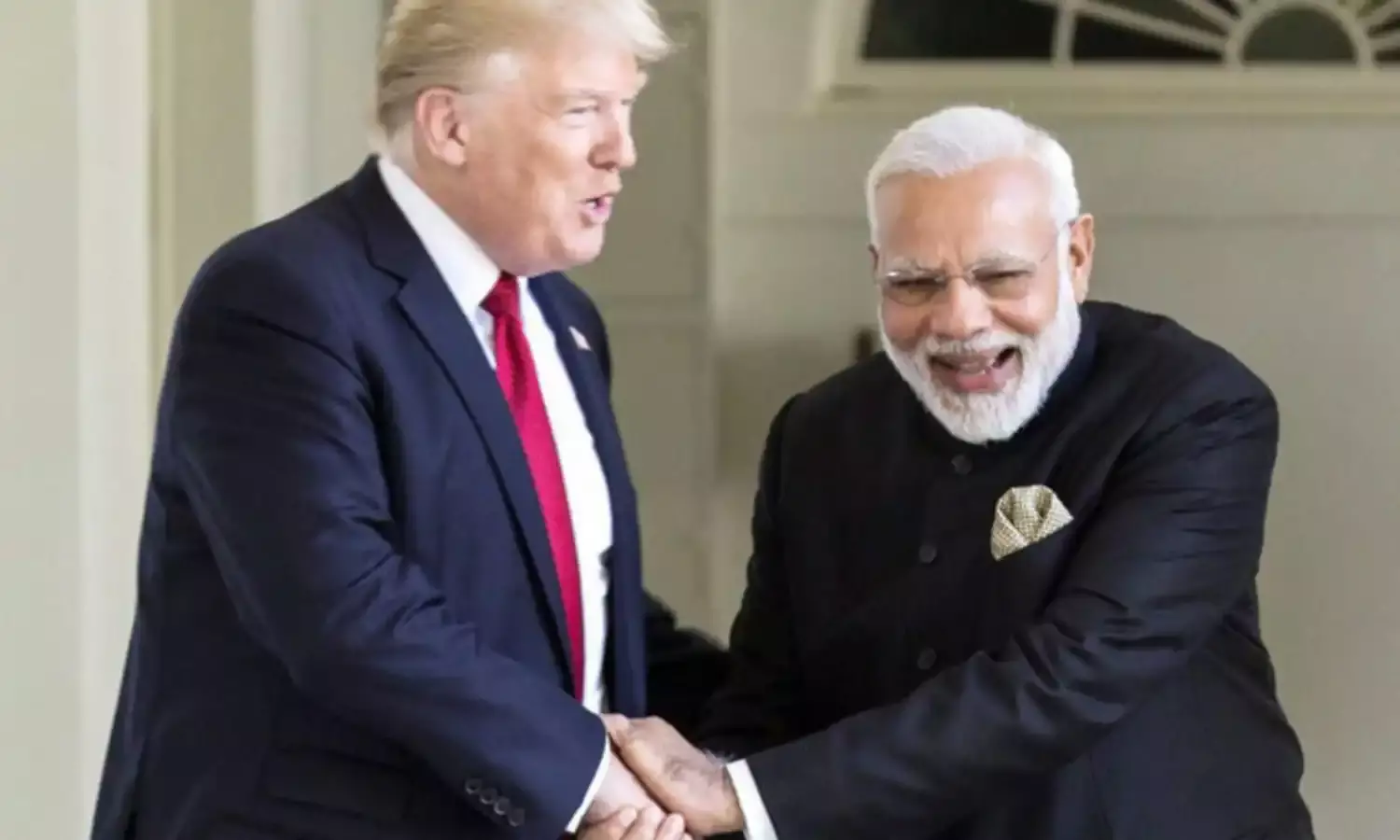
Photographs often reveal the subsurface reality as nothing else does. Just call up the trove of Modi-Trump pics on the net and what you see in most of them is Modi fawning over Trump, looking up endearingly at him, just too eager to please. The one with a bemused Melania (look at her eye, above) looking on as Modi embraces the US President ardently even as the latter reciprocates stiffly, is comical.

It suggests just how much Modi wants Trump to like him, and wants him to muster the intimacy the PM himself feels for the American — why? is not clear. It also suggests that the Indian leader is stuck in time, in the heyday of the “Howdy, Modi!” phase of their personal relations, but that Trump has moved on. As has US policy from centering on India to pivoting on the extended region. It is the reason why the 38-year old, Russian-speaking Sergio Gor, in-charge of personnel at the White House is the ambassador-designate not just to India but to the entire region, including presumably Pakistan and other South Asian states and Central Asia. Gor’s nomination can be a good thing for India, because the US will, per strategic logic, need an anchor for its regional policy and it cannot be any other country than India. This fact can be used by New Delhi to shape Gor’s mindset, Trump’s attitude, and the US policy. The more likely thing to happen is Gor tending the Kurilla way, and India being in the outhouse.

General Michael Kurilla is the recently retired chief of the US Central Command, who described Pakistan as a “phenomenal partner” in fighting terrorism, and couldn’t quite contain himself when praising the Pakistan army and its chief! Gor can then be expected to look upon Pakistan as the less difficult, more pliable, client state led by Field Marshal Asim Munir who, reportedly, has parked his wife and children in America where they have taken up US citizenship. With the Trump Family’s crypto and mining businesses dictating US policy, and Munir promising implicitly to add hugely to the US President’s personal wealth while, no doubt also enhancing his own family’s fortunes, this is the direction the US will be heading in.

Being on the outs with America is, in any case, what India should prudently prepare for. Instead, the Modi regime seems inclined to cling to the hope that treating Trump like some old style oriental potentate would prompt him to shower favours on India. On Friday (Sept 5), Trump said he’ll “always be friends with Modi”. When queried if he was ready to reset relations, he replied with a non-sequiter — “India and the United States have a special relationship”, adding that “There’s nothing to worry about. We just have moments on occasion.” And then he kvetched again about India buying oil from Russia and about his 50% tariffs to punish the country. The Indian prime minister reacted instantly and in an embarrasingly effusive manner: “Deeply appreciate and fully reciprocate President Trump’s sentiments and positive assessment of our ties. India and the US have a very positive and forward looking Comprehensive and Global Strategic Partnership”. This, as a Sunday newspaper felt constrained to point out, was only a day after Trump had posted on social media that the US had “lost” India to “deepest, darkest” China! And his prime attack dog, the commerce minister Edward Lutnick, had confidently predicted India would “say sorry” and return to finalise a free trade agreement! There was no reminding Trump by Modi in his response that the Indian government acts and will do so always on the basis of the country’s national interest, not on someone else’s say-so, that India is energy deficient and will continue to buy oil and gas from the cheapest source, and that Russia is an old friend and will remain so. This Modi and his regime did not do and, therefore, would Trump be wrong in assuming he can kick Modi and his government around every time he initiates these “moments”, and can compel them to do his bidding without disrupting or harming Indo-US ties?

Former Indian ambassadors to the US contacted by the media for their reactions uniformly said reponding “politely” to Trump was the right thing to do. No one said that making up with America is fine, but Washington ought to be put on notice if not by Modi than by Jaishankar, that India is not a Munir-ruled Pakistan to be trifled with. Nor did any amongst them criticise the external affairs minister for instead stressing the warmth in Modi’s personal relations with Trump! It appears there are no costs, no consequences for Trump treating India with disdain and its leader with contempt. National self-respect must mean something. If it doesn’t it must say something about us, and how much we lack by way of self-esteem.

Recall that Zhouenlai’s proffered hand was ignored by John Foster Dulles, Eisenhower’s Secretary of State, in the 1950s. The Chinese state never forgot that insult and no Chinese leader shook hands with Western leaders again until Nixon on his breakthrough trip in 1972. Aware of this incident and how it had rankled the Chinese Communist brass, Nixon walked the length of the red carpet at the airport with outstretched hands, and it was only after Nixon stood before him for a few seconds still with his hand out did the great Mandarin deign to shake it. That’s how nations win respect, and not when leaders snivel around for attention. China is a nation with a long memory. India is without one no matter how much hurt and humiliation is heaped on it. This is a historical fact.

Which way America tilts wouldn’t really matter all that much if Indians and their government had a sense of themselves and of the country’s geostrategic and economic importance in the world, and did not approach the US, or anyone else, as a supplicant. The Italian film maker, Pier Paolo Passolini, visiting in the 1950s called India “a nation of beggars”. The indigent still clog our cities, and Indian politicians, diplomats and bureaucrats have their metaphorical hand out. So, what has changed?

There may, however, be a general awakening, including wthin the government and the community of retired babus and the like, specifically to the danger Trump and the US pose India, Reflecting the unease. Arvind Virmani, a former chief economic adviser wrote on social media “I am …gradually coming around to the view, that a large fraction of US elites prefer an India which is weak & subservient to the US and/or China over a strong India. The puzzle is why?”

WHY? Because as I have been at pains to emphasise over the last 35-odd years, that the US, like all big powers, is unscrupulous in pursuing its interests, but it is more venomous than others. India meanwhile has been busy trying to act the vishwa this, vishwa that, and to be a “responsible state”, and has ended up mostly hurting itself. Soft power, the government thinks, is all that India need have. What hard power and military muscle the country prides itself on couldn’t withstand the slightest pressure from Trump during Sindoor. The Modi regime seemed as eager as the Munir Gang on the other side to end that farce of a “war”. There are no points awarded, no gains registered, in international relations for restraint. And no national interest is served by restraint. It is always the narrowly defined national interest that has to be realised at all cost and by any means, and in extremis. There’s just too much of the supposedly elevated thinking the Indian government seems afflicted by. It has time and again been conned into believing that what’s good for America/the West is good for India, into supporting idiotic causes like nuclear disarmament and nonproliferation, into asserting that shared democratic values, etc. matter. They don’t.

Have long maintained that because India and the Indian government have shown they are completely bereft of any strategic sense, the country’s interests would be better served if MEA and Defence Ministry merely aped Beijing and did what the Chinese do, and how they do it. The trouble is we can’t even do that. China proliferated nuclear missiles to Pakistan without a second thought. But merely mentioning a strictly reciprocal gesture of transferring nuclear missiles to states on China’s border to equalise the strategic situation, has our netas and babus breaking into cold sweat. Doing anything that Washington or Beijing frowns upon is likewise No Go. It seems there is nothing that India does as well as playing the victim. We also refuse to learn lessons from our own experiences, leave alone from others’.

What should the Indian government’s response have been to Trump’s attempt to reconnect?

The reaction ought to have been standoffish, with only the MEA spokesman saying something to the effect that “The Indian government notes President Trump’s interest in repairing relations with India, but trust cannot be easily restored. The US government could make a start by unconditionally removing the unfair and unjustified tariffs imposed on Indian exports.” That’s it. Nothing more! It would have set Trump thinking that India is harder to deal with than he thought. With Modi nor Jaishankar mentioning tariffs, the White House is free to believe the Indian government is fine with it!

It could put some teeth into this stance moreover by, for instance, holding all major capital acquisition/military procurement deals on hold. And doing the same to the free trade agreement neotiations. And to ensure India did not again step into any trap set by Trump’s whimsy-as-US-policy, the government should actively facilitate Indian exporters’ finding alternate markets for their goods, and to conspicuously ramp up economic and other relations with Russia, EU, China, and BRICS, and military cooperation with Australia and Japan — US allies that have about had it with Trump’s tariffs and unpredictable policies, and displayed it with more anger than New Delhi has shown. Especially now that the Pentagon has made public its intention to concentrate US resources on securing the homeland and the Western hemisphere leaving Asia, presumably, to China to lord over. This is G2 in the making I have been warning about. It is precisely the incentive needed for Asian states to cooperate, collaborate and mobilise to strategically tie down China — an evolving milieu New Delhi appears unmindful of. And for India to join Israel and Japan to develop advanced technology, freed from the oppressive American pressure and concerns.

Posted in arms exports, asia-Pacific/Indo-Pacific, Asian geopolitics, Australia, Brazil, Central Asia, China, China military, civil-military relations, Culture, Decision-making, Defence Industry, Defence procurement, disarmament, domestic politics, DRDO, Europe, Geopolitics, geopolitics/geostrategy, Great Power imperatives, India's China Policy, India's strategic thinking and policy, Indian ecobomic situation, Indian Politics, Indian state/administration, Indo-Pacific, Islamic countries, Israel, Japan, MEA/foreign policy, Military Acquisitions, Military/military advice, Nuclear Policy & Strategy, Nuclear Weapons, Pakistan, Pakistan military, Russia, russian assistance, russian military, SAARC, sanctions, society, South Asia, South East Asia, space & cyber, Strategic Relations with the US & West, Technology transfer, technology, self-reliance, Trade with China, United States, US., war & technology, Weapons | 21 Comments

Geopolitics-geostrategics post-Sindoor, after Trump-tariff rift

This CHAKRA podcast “Why Trump Turned on India & Why It Backfired: The Sandeep Unnithan Show” was recorded on Aug 29, 2025 with Sandeep Unnithan.

It was an hour long recording trimmed to fit a half-hour slot!

Posted in arms exports, asia-Pacific/Indo-Pacific, Asian geopolitics, China, China military, civil-military relations, corruption, Culture, Decision-making, Defence Industry, Defence procurement, domestic politics, Geopolitics, geopolitics/geostrategy, Great Power imperatives, India's China Policy, India's Pakistan Policy, India's strategic thinking and policy, Indian Air Force, Indian Army, Indian democracy, Indian ecobomic situation, Indian Navy, Indo-Pacific, MEA/foreign policy, Military Acquisitions, Military/military advice, Missiles, Nuclear Policy & Strategy, Nuclear Weapons, Pakistan, Pakistan military, Pakistan nuclear forces, Russia, russian assistance, russian military, sanctions, society, South Asia, Strategic Relations with the US & West, Technology transfer, technology, self-reliance, United States, US., war & technology | 3 Comments

Modi showed spunk and spine, now time to bolster India’s leverage and really reform

[Making a point — Modi with Putin & Xi in Tianjin]

Narendra Modi and Donald Trump are hewn from the same narcissistic-autocratic Alpha leader cloth. And their clash may be pictured as between two tough mountain goats in a hard head-butting bout, neither backing down, and each trying to push the other over the cliff.

Trump was being Trump when, his hopes of the Nobel Peace Prize dashed by Modi’s refusal to support the nonsense about the US President’s role in ending Op Sindoor, he raked the Indian PM over the coals. He obviously expected that imposing 50% tariffs on India would lead to a chastised Modi folding, a’la Zelensky, and suing for peace. And, having shown up the Indian leader as his vassal, he’d then respond by magnanimously announcing a reduction of tariffs to the 25% level to Modi’s great relief! That didn’t work. Next, he had Peter Navarro, his Trade representative whom fellow economists call “stupid” and worse, try and exert pressure on New Delhi by ramping up the rhetoric about Ukraine being “Modi’s war” and India a “laundromat” for Russia’s ill-gotten monies. That didn’t work either, leaving the US Treasury Secretary, Scott Bessent, who had berated India for buying Russian oil, to tone down the invective by telling Fox News that “at the end of the day we will come together.” Nope, that isn’t happening!

Instead, the next thing that actually happened was India walked out of the Free Trade Agreement negotiations (as Navarro tells it), and Modi betook himself to Tianjin for the Shanghai Cooperation Agreement summit to talk things over with Putin and Xi Jinping. But not before first flying into Tokyo, there to sign a ramped up defence cooperation agreement with Japan, and publicly to support Japanese claims on the Senkaku Islands in the East Sea disputed with China — an “in your face” move that must have rocked Xi and his team back on their heels. Because they surely expected a cowed down Modi to be more malleable. So, for the first time in his tenure as prime minister — and for the first time, in fact, since whenever, that an Indian leader showed spunk and spine. That he did so before entering the lair of the dragon, is particulary commendable.

One so wishes Trump had mistreated Modi in this manner in his first term, just so the country was spared the ensuing spectacle of the leader of a proud country acting like a servile and obsequious nobody in the court of Trump. Still, now with Modi humiliated he reacted as he should have done all along — standing his ground, and telling Trump and Xi Jinping where to get off!

The most interesting thing to happen in Tianjin, incidentally, was outside the conference hall. Modi and Putin, it is said, spent a whole hour together inside the latter’s posh armoured vehicle, before reaching the summit site. Whatever they talked about, they seemed at the end of their closed interaction inside Putin’s car — no doubt swept clean of Chinese listening devices, and not anywhere outside where their conversation may have been picked up — to have a spring in their step as they walked in seperately to be greeted by Xi. Bet, it wasn’t just niceties they exchanged!

It is good to see the Indian PM with a chip on his shoulder for being treated shabbily, and publicly at that, by the US President. I had said in my 2018 book ‘Staggering Forward: Narendra Modi and India’s Global Ambition’ that Modi’s “creeper vine foreign policy” of wrapping itself around America, would NOT turn out well for India. It turned out even less well for Modi, personally, especially when he had invested so much political capital in building Trump up as his “good friend” and India’s relationship with America, as special — an enterprise hurrahed along by retired diplomats, generals, JNU academics, and lay media commentators. All these people, not surprisingly, beseeched Modi in op-eds in the wake of his breakup with Trump, to grin and bear the personal hurt, and for India to absorb the tariff pain, and generally to behave like a nation of Gungadins!

Shame! Shame!

What is galling is why the government never got its story right, off the gate, on the Russian oil at the centre of this brouhaha. At the Bratislava Forum early in the year, foreign minister S Jaishankar said that India was buying oil from Russia at discounted rates at Washington’s behest. More recently, petroleum minister Hardip Puri told BBC that India’s decision to buy Russian energy was for purely commercial reasons — it was available cheap. So, which is it, because it matters? Apparently, Jaishankar was being more candid. But he also revealed that New Delhi was happy doing first Biden’s and later Trump’s bidding, and buying oil just because at that time the international oil price stability served the interests of the US and European states who needed diesel and other refined oil products that they previously secured from Russia directly. In fact, so convoluted is the energy politics that the diesel produced by the Reliance refinery in Jamnagar from processed Russian crude actually makes up some 15% of the Ukrainian requirement of diesel! So, would India not be hurting Kyiv’s war effort by stopping Russian oil purchases?

To return to Tianjin, as if to cement the fracture in relations with the US, Modi in his formal speech at the summit, said: “India and Russia have a special and privileged partnership. In the most difficult and testing times, India and Russia have always stood by each other,” and added that India “eagerly” awaits Putin’s visit later in the year. With respect to China, Modi was straightforward. “Our cooperation is linked to the interests of 2.8 billion people of our two countries”, he asserted. “This will also pave the way for the welfare of all humanity. We are committed to advancing our relations based on mutual trust, respect, and sensitivity.” Not to be outdone in sentiment, Xi referred to the world “undergoing rapid transformations and international instability. China and India are the two major Eastern powers and the most populous countries in the world…We uphold”, he declared, “strong commitment: advancing the unity and revival of developing countries and promoting human progress are important strategies. As good friends and partners who support each other, integrating and uniting should be the right path for China and India.”

Under assault from Trump, it indicates a certain solidifying of the RIC (Russia-India-China) grouping, which effect will spill over in the economic realm into a strengthened BRICS, with Brazil, like India, smashed with 50% tariffs. Brazil has, remained defiant, with President Luiz Inácio Lula da Silva ensuring that his predecessor, Jair Bolsonaro, charged with treason, whom Trump tried to save by threatening tariffs, will be tried in court. Indeed, Lula is fortifying the military guard around Bolsonaro lest he try and escape, perhaps, with American (CIA) help.

What Trump has unwittingly achieved is solidarity of all the major non-NATO countries that together will be too much for a receding power like America or even the US+NATO to handle.

What Modi has to now ensure is that India does not lose the leverage it has gained with the US and China. He will have to resist the pleadings from the corporate world and the internal leanings of the MEA under Jaishankar, to reach an understanding with Trump. The US President finds himself up a creek and there’s no reason to rescue him by having the Indian governement climb down from its principled position.

There’s the deal for 113 GE 414 jet engines, for starters. Modi can drive a hard bargain by demanding that GE hand over source codes to India — a demand that should be made with the French firm, Dassault Avions, as well for the source codes for the ridiculously expensive 4.5 generation Rafale and Rafale-Marine aircraft, on the pain of rescinding the deals for them. It is the French, we must remember, who not too long ago admonished Thyssen-Krupp for promising to furnish India with the source codes for the HDW 214 diesel submarine with Air Independent Propulsion for the Indian navy’s Project 75i. (More on these deals, hopefully, in a future post.)

With regard to the US and China, moreover, India has to conduct its foreign policy nonlinearly — something China and America have always done expertly with India. Thus, because US healthcare depends on generic drugs produced cheaply by Indian pharma companies, their import is exempt from Trump’s tariffs. Jewelry, leather goods, etc are not exactly great things for India to export and the fact that they are tariffed, well, what the heck they may be routed into the US market via third countries. The consumer goods, let Indian manufacturers find alternate markets in Africa and Latin America for them by producing them more cheaply than China does. Hey, that’s the marketplace logic. Swim or sink! The Modi government has also instantly to diplomatically stop opening H1B type visa doors for would be Indian techie immigrants to the US, West European states, and Australia that they prefer to go to. There are cultural resistance movements in all these countries against Indians in their midst. It reflects on the country that so many want to escape it.

RIC and BRICS are fine by way of balancing the US economically and politically. But China too has to be balanced, but militarily and here BRIS (Brazil-Russia-India-South Africa) and Modified or Mod Quad (India-Japan-Australia and the US replaced by a group of Southeast Asian countries) should be diligently pursued, and loose and informal securitised dyads and triads of, say, India-Japan-Australia, India-Japan-South Korea, India-Indonesia-Philippines, India-Vietnam-Philippines, etc — as I argue in my next book that I am currently finishing, will provide precisely the overlapping military protection for regional and sub-regional countries without the impedimenta of formal alliances, etc.

Shouldn’t Modi, at least now, after seeing India getting kicked with tariffs, and the closing of H1B visa channel and restrictions on entry of Indian students — because both he and Jaishankar have been going round over the years preaching “labour mobility” to advanced countries who are not listening anymore, do what he has long promised but not delivered — “Reform, Perform, Transform”? Or, is it forever to remain just a slogan?

With digitisation successfully implemented, has the Prime Minister ever wondered why the government portals dealing especially with licenses are always not working? Because this is how the babus make money? And why are the babus still permitted discretionary power — a means of generating bribes? And why are there so many licenses to open and conduct business, any way? And why are so many paper documents needed in the digital age for bureaucratic oversight? Where, in fact, is the “ease of doing business” that the government keeps boasting about?

And what happened, PMji, to getting the government out of the business of business? Why not, in this respect, start by privatising the defence public sector units? You corporatised them, good. Now let them go to the market for capitalisation, sell shares, as L&T, Mahindra Godrej Aerospace, et al, do, and have them compete for military contracts instead of, as happens now, the Department of Defence Production in the Defence Ministry, in sweet heart manner, channeling contracts to the hopeless and resources- wasting HAL, Mazgaon Dockyard, etc.

Please, Modiji, pay attention to these aspects of administration. Artificial Intelligence can remove the need for most of these armies of peons, clerks, section officers clogging up the system. Let AI take over these roles, allowing you to drastically prune the central government — which would lead, in its train, to the shrinking of state and local governments.

But efficient and effective AI requires that the mountains of laws, rules, regulations, to simply be discarded whole — these are the remnants of the British Raj. Time they were given the heave ho. And with the government bringing in Constitutional Amendments left and right, why not do the country and its people the ultimate service of removing Article 311 in the Constitution that provides lifetime security of employment to government employees, chaprassi on up, as a means of sprucing up the government?When public servants know that their continued employment depends on their effectiveness and efficiency in office, they will perform and, voila!, the Indian society will be transformed!! No Indian Prime Minister then would have to go on bended knees to foreign leaders to offtake employable youth to avoid an explosive social powder keg from developing at home.

These reforms and such steps are what will push India into the great power category by 2047. Looking to the US, China or anyone else for help and assistance which, in any case, will be unavailable, is not going to get India there.

Posted in arms exports, asia-Pacific/Indo-Pacific, Asian geopolitics, Australia, Brazil, China, China military, civil-military relations, corruption, Culture, Decision-making, Defence Industry, Defence procurement, domestic politics, DRDO, Europe, Geopolitics, geopolitics/geostrategy, Great Power imperatives, India's China Policy, India's strategic thinking and policy, Indian Air Force, Indian Army, Indian Navy, Indian Ocean, Indian Politics, Indian state/administration, Indo-Pacific, Iran and West Asia, Islamic countries, Israel, MEA/foreign policy, Military Acquisitions, Military/military advice, Russia, satellites, society, South Asia, South East Asia, Strategic Relations with South East Asia & Far East, Strategic Relations with the US & West, Technology transfer, technology, self-reliance, United States, US., Vietnam, war & technology | Tagged , , , , | 38 Comments

Hard knocks for Modi

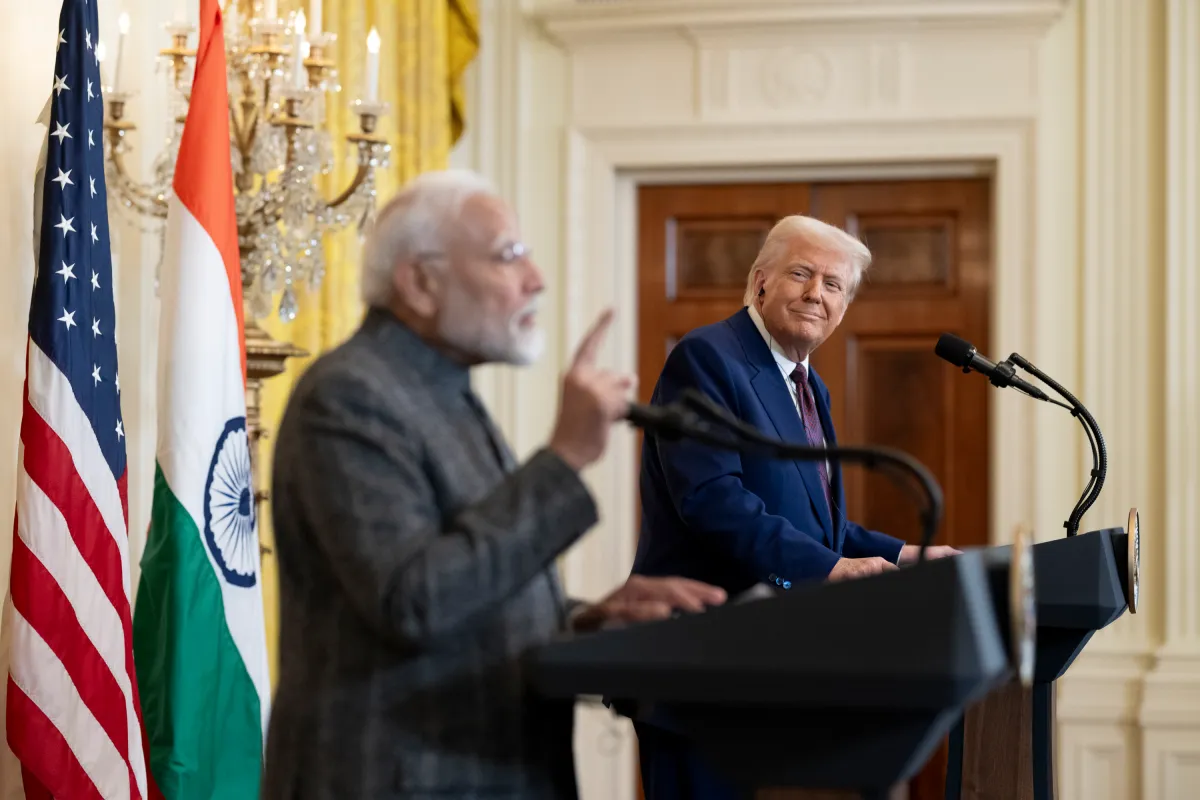
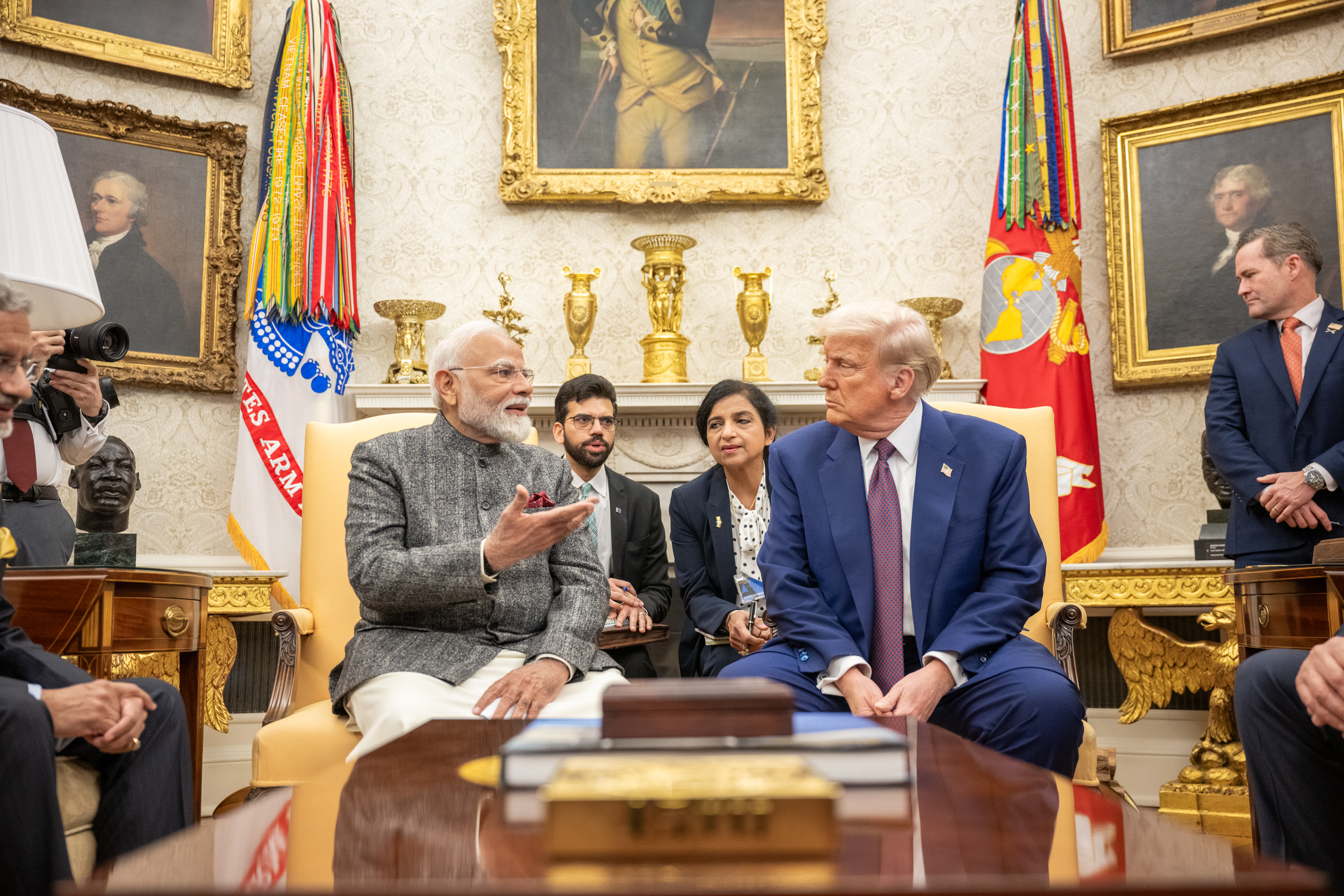
[Modi and Trump in Feb 2025]

People ask if I feel vindicated with Trump and the US turning on Prime Minister Narendra Modi and India, and heaping insult on humiliation with a 50% tariff that’s the highest imposed on any country. There’s something to be said after all about the satisfaction with saying “I told you so!” But I have been saying so for decades, and satisfaction wears off quickly to be replaced by frustration at the amateurs in Delhi trying to play in the realpolitik major league and being nowhere up to scratch.

The desperate diplomatic lunges by NSA Ajit Doval towards Moscow is to be followed soon by the country’s leading pusher of good relations with America at any cost — even India’s sovereignty — S Jaishankar, our esteemed external affairs minister (EAM).

(Incidentally, IFS officers in MEA, I am told, are surprised and appalled by the extent to which Jaishankar is pushing the “give in to Trump”, “buy peace with Trump” lines, and by how much he is willing to compromise the national interest.)

Meanwhile, Xi Jinping sits pretty in Zhongnanhai watching, as is every Asian government and regime, India getting kicked around by Trump with a mewling response from New Delhi. This even as China is the biggest importer/buyer of Russian oil and gas via direct pipelines to the energy sources in Siberia and suffers no proportionate tariffs because, well, Beijing can deny exports to the US of rare earths magnets critical to many US weapons systems. So we have, as someone noted, the deliciously surreal scenario of a country withholding supply of something to another country needing it to fight the supplier state! But Xi is a cool hand at this game. And must be licking his chops awaiting Modi’s state visit — the first in 7 years when he too can turn the tourniquet, seek a modus vivendi on the LAC on Chinese terms, which, in any case, the PLA has snatched on the ground.

Or, for that matter, what do you think Putin’s treatment of Jaishankar would be when he visits Moscow to once again seek support now that Trumpian America has kicked India to the curb? And why he’d be met with a mix of barely concealed contempt, condescension and not a little schadenfreude, even as Putin too would happily turn the screw, but more silkily. Russian oil might become dearer for a start!

Modi’s response to Trump’s relentless attacks is to say he is prepared to “pay a heavy price. [And] India is prepared to pay a heavy price.” Brave words and fine, but a predictable and nearly useless response other than as a warning to the Indian people to tighten their collective belt for the leaner times ahead. Because, all it will do is to motivate Trump and to an equal degree Xi, and even Putin/Peskov/Lavrov in Moscow to see just how far the US can push India around, or to put it differently, what Modi’s breaking point is, if there’s a breaking point.

But the question is how did Modi get India into this position? Obviously because, advised and prodded by Jaishankar, he gave every indication that he’d walk the extra mile in placating and pacifying Trump, and preparing to move all the country’s eggs into America’s basket, leaving the country overly vulnerable. Except Trump understands how he’s relatively placed with the other leaders. With Putin and Xi, he knows he can’t do other than play it straight. Modi, he realises is a clinger, with a policy of clinging to any passing coattail, and can be dealt with abruptly and with a dismissive attitude.

Modi is not a Luiz Lula da Silva of Brazil nor a Claudia Sheinbaum of Mexico, a Berkeley PhD in energy management and hence clearly an intellectual overmatch for Trump. Lula shot down Trump with his gringo-jibe, and Sheinbaum has been, as the online political magazine, Politico, described her, “icy cool”, refusing to rise to his bait, but taking actions beneficial to both countries. Like hammering the drug cartels. Trump therefore finds nobody to bully except Modi. And because he finds Modi cowed, the Indian PM can expect yet more bullying, and still more after that next bout, until Modi stands up and and says no more!

But, where and who can Modi turn to now — Kremlin? Dusting off India’s attribute as a geostrategic leverage against both the US and China is the best bet. But, perhaps, on stiffer terms. And Modi will take himself to Beijing and deal with Xi from a much weaker position. He may not get kicked in the face as he bends his knee, as he was by Trump, but he won’t come away with consideration either.

Things however have got to such a pass, it has now become personal. Here Modi is up a creek. He has always acted the inferior with Trump — and that’s the way the latter likes it. The US President has seen all Europe and the Asian Far East Asian allies accept his economic diktats. And everybody’s on board to humour his conceit as a peacemaker and win the Nobel Peace Prize to match the one awarded to President Barack Obama in 2009 for doing nothing more strenuous by way of peacemaking than delivering a speech in Prague. Quite literally! So why not double down — and this is a piece of advice to the Nobel Peace Prize Committee — on the joke they authored: Hand the damn thing to Trump keen on besting Obama at every thing, and let’s be done with it!

Azerbaijan and Armenia appreciate the joke only too well as their leaders have accepted Trump’s invitation to sign a peace accord in the White House to buttress its present occupant’s supposed peacemaking reputation! The chances are that Trump does not know where either of these countries is, or what peace it is which he has allegedly mediated and over what (Nagorno-Karabakh, an Armenian Christian enclave that’s been virtually ethnically cleansed of Armenians in the wake of the war between them in 2020). But these are details, and unimportant! It is the peacemaker role he was robbed off by the Indian government refuting his involvement in Op Sindoor which, in Trump’s imagination, he had ratcheted all the way up to a near nuclear exchange!! One can see how compelling that narrative might have been to the Nobel Committee in Stockholm had it an iota of truth in it, which the Indian government, spoiling it for Trump, said there wasn’t. General Asim Munir, quick to spot an opportunity to massage Trump’s ego, had Islamabad write an official note thanking the US President for his fictional “peace-making” intervention, and won Trump’s confidence. As easy as that! And then followed Trump’s venomous actions against India, ensuring some four decades of painstaking diplomacy, of building up India-US relations, of getting India over the hump of its deep down and well merited distrust of America, went up in smoke.

The upside is Modi may be cured of his unrequited love for Trump and America and, if the PM has any sense, he may care to put Jaishankar out to pasture as well, in the main because he is associated principally with fleshing out the US tilt in Indian policy that has proven to be such a monstrous disaster. Because, as long as he is still pulling the strings in the MEA, there will be no movement toward equilibrating the Indian foreign policy between Asia-minus China, Russia, EU and the US with BRICS, the security-related BRIS (BRICS minus China) to militarily balance China without America that I proposed (in my 2018 book — Staggering Forward: Narendra Modi and India’s Global Ambition), and with the same objective in mind, a Modified Quadrilateral (India, Japan and Australia) with the US in this group replaced by a bunch of Southeast Asian nations — so that a loose overarching security architecture does not have to depend on an unreliable and untrustworthy America. (An analog of this seems to be what President Emanuel Macron of France has in mind for an exclusively European defence system.)

Alternative security arrangements, more organic to Asia, need to be conceived and considered by the Indian government and the military, because to continue to bank on any external power for strategic security against China is to set India up for more surprise and humiliation in the future of the kind it is suffering at Trump’s and America’s hands.

Ultimately, it is a matter of national self-respect and goes beyond Modi or any other Indian leader of the day. Modi may be willing to stomach Trump’s obloquy; but the nation cannot bear to be so deliberately dishonoured.

Posted in asia-Pacific/Indo-Pacific, Asian geopolitics, Australia, Brazil, China, China military, Culture, Decision-making, Europe, Geopolitics, geopolitics/geostrategy, Great Power imperatives, India's China Policy, India's Pakistan Policy, India's strategic thinking and policy, Indo-Pacific, Japan, MEA/foreign policy, Nuclear Policy & Strategy, Nuclear Weapons, Pakistan, Pakistan military, Pakistan nuclear forces, South Asia, Strategic Relations with South East Asia & Far East, Strategic Relations with the US & West | 71 Comments

Modi talks national interest protection, but India surrenders digital sovereignty in FTAs and ignores trade imbalance favoring America — what is happening??

[Modi and UK prime minister Kier Starmer]

When Sir Thomas Roe presented himself in the Mughal Emperor Jehangir’s court at Agra in 1614 as the ambassador of Elizabeth I of England, he did so on the condition he would not observe the rituals of paying obeisance — all the bowing and scraping, to the Badshah. But Roe was an effective enough salesman to have his social transgressions tolerated, because in next to no time he came away with a royal firman permitting the English a trading post in Surat. Apparently, Jehangir didn’t think much about allowing the firangis an economic toehold on the subcontinent. Had he foreseen that small measly presence being parlayed by Britain in time and by strategem into the Raj – the crown jewel of its worldwide empire and the Pax Britannica that followed, he might have had second thoughts. But early 17th century was not exactly Marshall McLuhan’s global village, and inconceivably long distances and a remote kingdom “saat samandar paar” seeking to buy spices, etc. would have been seen as affirming the status of the “Great Moghul”. So Jehangir may be excused his inflated sense of self-importance, and ignorance of geostrategics.

But, what is Prime Minister Narendra Modi’s excuse for gifting India’s sovereignty to Britain 411 years — read that again, four hundred and eleven years — later, this time in the digital realm and, once again, by way —what else— of a trading arrangement? Now it is not spices but sovereignty over source codes and the ever-growing mountains of accumulated and aggregated uniquely Indian government data that foreign countries covet, and the sovereignty over which the Indian government has agreed to surrender to Britain as part of the Comprehensive Economic & Trade Agreement (CETA). So what Modi has sacrificed, in effect, is the country’s digital security and sovereignty.

Seeing the wide, self-satisfied, smile of commerce minister Piyush Goel as he signed CETA even as his British opposite number smirked (or did I imagine that?) like the Cheshire cat in Alice’s Wonderland, whose smile remained even as the feline disappeared, it is plain that neither Goel nor the so-called trade “experts” in his ministry have even a smidgeon of understanding of what “digital sovereignty” is, or comprehend the enormity of what they have so breezily given away. But giveaways, as I have time and again mentioned in my books and other writings, are an Indian government standard. So, what’s new? Goel is a minion of little importance, but he took his tasking orders from the PM. So it is Modi who has to answer for imperiling and compromising the nation’s digital future.

Ironically, around the time Goel was claiming a “gold standard” for CETA and asserting that no sensitive sector was compromised — by which he just meant agriculture, GM foods, Modi in his Varanasi constituency was waxing eloquent about swadeshi and dilating on the global economy, which he said, faced “multiple uncertainties and an atmosphere of instability. In such a scenario”, he declared, “countries across the world are focusing on their own interests”, before exhorting everyone to “remain vigilant about our economic interests.”

Either, Goel has not got the message, or he is doing his master’s bidding. If it is the latter then it suggests that neither Modi, nor anyone else in the vast Government of India, quite has the hang of the digital world, and how the PM’s talk of zealously protecting India’s “economic interests” and his minister’s making India-generated data about everything (every little digital transaction, digitized bank account data and digitized bits of personal information of a billion and 400 million Indians however gathered) a universal commons, as it were, where any country can graze and mine data for its purposes, are contradictory policies. And with Goel & Co. formally conceding access to Indian “government data” and opening up government procurement to the British, will the European Union, the United States, Japan, and whichever other country seeks a free trade agreement be far behind in demanding similar consideration?

Indian government procurement contracts at the central, state, and local levels worth some $750 billion annually are now opened to bidding by foreign companies — a more deleterious development for local industry cannot be imagined, but here we have the Modi regime permitting it! This subject has been dealt with in previous posts.

This post is about the two other issues: First, digital sovereignty, and secondly, the quite astonishing negotiating error of not including major streams of transfer of India’s wealth to America by the Commerce Ministry when negotiating an FTA with the Trump Admin. After all, what is trade but the transfer of wealth from one country to another.

But first, digital sovereignty. It has two components — “source codes” and “digital data”. Source codes refers to the software behind all goods and services. “The most surprising giveaway”, write Smita Purushottam and Parminder Jeet Singh in an op/ed — “What has been missed is India’s digital sovereignty”, The Hindu, Aug 2, that everybody in government ought to read, “is on India’s sovereign right to seek ex-ante access to the source code for foreign digital goods and services, even for those deemed sensitive.” (Ex-ante, is a Latin phrase denoting predictions and forecasts about future events, and with reference to CETA means that India cannot insist on source codes for anything the country may buy from the UK even though software is integral to nearly all products and services.) This, as Purushottam and Parminder point out, is “a 180-degree turn away from [India’s] steadfast stand in the World Trade Organisation”.

The source code issue in defence is exemplified, for instance, Dassault Avions refusing to part with the source codes from the Rafale combat aircraft that the Indian Air Force and navy have bought at enormous expense to the exchequer (at last count exceeding $35 billion). No source codes means India cannot integrate its missiles to this combat platform. Why has the Modi government not insisted on source codes as part and parcel of the multibillion dollar deals? Perhaps, Paris was aware for many years that New Delhi was prepared to cutout the source code issue from its FTAs , as now proven by CETA. Who knows?

Purushottam is a former Indian ambassador to Switzerland and founder of a remarkable little organisation — SITARA (Science, Indigenous Technology, Advanced Research Accelerator), comprising a team of domain expert volunteers in the forefront of pushing indigenous technology to an Indian government and military inclined, at the drop of the proverbial hat, to “buy foreign”. I know of no other diplomat who, in retirement, has done more substantive work in the nationalist cause. And Parminder is arguably the leading expert on digital sovereignty in the country. Their views are known to the government. Both of them should have been an inalienable part of the Commerce Ministry teams negotiating the FTAs, but are not.

Incidentally, the US, recognizing that security, regulatory and law enforcement imperatives require source codes, reversed its stand on source code prohibitions. Washington likewise backtracked on “granting equal and non-discriminatory access” to government data (which in an earlier era represented “government transparency”) to foreign countries in its FTAs. The Modi government, in its wisdom or lack of it, has taken an exactly reverse tack to what America has done even when such modified position grievously hurt the national interest.

But the Modi regime — flowing against the current — reversed itself , for no sensible reason, on the source codes and access to government data issues thereby centrally endangering India’s digital sovereignty and, principally, national security. It has created a new vast vulnerability from what was an extraordinary position of strength — its massive government data bank generated within India that the UK and other foreign countries will now be able to exploit at will. “It is incomprehensible”, write Purushottam and Parminder “why India with intention to become an Artificial Intelligence (AI) super power” would accept in principle that government data “is not a sovereign resource.” Facilitating easy foreign access to this data will, they warn, “erode India’s competitive advantage” in using its own data to create Indian AI products. Such as its own large language models. And further, that foreign states with access could easily weaponise the massive Indian information bank against India.

After all Artificial Intelligence is nothing more than machines discerning patterns in mountains of data — the larger the data pool the better, at phenomenally high compute speeds, to provide options to the decision maker in the corporate world, government, and the military.

Providing further evidence that Goel and his Commerce Ministry babus are a bunch of reckless dunderheads, they agreed to further consultations with the UK government on “free flow of data” and “data localisation” — the two most contested issues in the AI field, and denotes they write, “a dangerous regress and visible vulnerability” with regard to the country’s long held positions. Again, the US as the leader in the AI field along with China, has withdrawn from propagating these issues, even as India heads blindly into digital bondage because, as Purushottam and Parminder also point out, FTA texts will end up defining the global digital order. In this situation India can opt for the Western big-tech-oriented digital architecture or preserve its digital autonomy and sovereignty — it cannot do both at the same time. And once in, and the deeper India is entangled, the more difficult it will be for the country to extricate itself.

As in the foreign and military policy spheres, in the digital area too the Indian government has so far blundered along, keeping its head above water by being “reactive”, with no “clear road map” of where it wants to go. This policy path of not knowing where to go and how to get there is a liability dragging down the country. Per Purushottam and Parminder what is desperately needed is the formulation of “a full-fledged digital security” and “digital industrialization” policy, which alone will enable the government to negotiate from a strong position and to “create the space to become a digital super power” rather than remain a “digital colony”, which is what FTAs like CETA will end up doing.

—————

But, alas, the national interest is hostage to the tender mercies of the generalist diplomats and civil servants running the show, even as Modi believes he is doing so! In the recent past, it obtained for the country the 2008 nuclear civilian cooperation deal negotiated by the generalist joint secretary and now minister, S Jaishankar, that strangled India’s ambitions of becoming a hefty thermonuclear weapons power until such time as the country gets a government with the will and the gumption to resume open-ended high-yield thermonuclear tests in the face of American opposition, and repays China for its nuclear missile arming of Pakistan by nuclear missile arming every country on the Chinese border. And now we have these generalist IAS-wallahs and their ilk screwing things up things fatally for India and complementing Jaishankar’s surrender of the country’s thermonuclear security by surrendering its digital sovereignty as well, all without flinching.

But not content with undermining India digitally they are now ensuring, under Goel and the aegis of the Modi dispensation, that India slips into the status of America’s economic vassal. Or, why else would the instructions go out from the PM’s office to every ministry to make lists where concessions can be made, and products and services can be bought to reduce the trade deficit with the US? The Modi regime behaves like a mangy dog with its tail between its legs when approached by a bigger one making noises.

If with respect to digital security and sovereignty, the Commerce Ministry had better learn from Messrs Purushottam and Parminder and recover the lost ground fast, with respect to the nitty gritty of negotiating with Trump’s trade reps, the country’s interest would have been better served had they heeded Ajay Srivastava’s advice. Srivastava, a 1989 batch trade officer, left the comforts of a sarkari job to start a think tank — Global Trade Research Initiative (GTRI), which is doing yeoman service for the nation. In a Reuters story published by Business Standard, May 26, Srivastava revealed the fundamental flaw in Minister Goel and his Commerce Ministry’s strategy of limiting the negotiations to what Washington desires, just trade where India has a $44 billion surplus, a figure that has got Trump hot under his collar.

But this is only the visible part of the trade imbalance iceberg. What the Indian side has not done, Srivastava reveals, is bringing to the negotiating table the US revenues generated in India for the American education, digital services, financial activities, intellectual property rights payments, Hollywood, Netflix and entertainment industry, royalties, and defence sales sectors, which when added up would turn the tables all the way around, and show a $35-$40 billion US surplus. More than enough for India legitimately to justify imposing higher tariffs on these unaccounted American export sectors and activities the “massive earnings” from which, Srivastava says, “do not show up in the narrow goods trade statistics. When you factor them in…the US…is sitting pretty.”

Srivastava deconstructs the “the non-trade” figures of the US trade surplus with India thus: Indian students payout to American universities in Fiscal 2025 is $35 billion ($25 billion in tuition and $10 billion in living expenses); Tech giants — Google, Meta, Amazon, Microsoft, et al earn from India some $15-20 billion, American Financial Institutions and Consultants earn another $10 -$15 billion, and Global Capability Centers that create and innovate new technologies, services, and products for the American majors take in $10-$15 billion, and IPR payouts in pharmaceuticals, et al amount to $1-$1.5 billion. All this adds up — at the highest end of the revenue scale to some $86.5 billion. (Not sure why in the Reuters story Srivastava pegs this transfer of Indian wealth to only $35-$40 billion when it is more than twice that amount!)

So, how come the geniuses led by Goel in the Commerce Ministry, and other resident economic geniuses in the Government of India (in the PM’s panel of Economic Advisers, for instance) missed such a vast amount of wealth being yearly shuffled off to the US right before their eyes? Talk of being robbed blind. Shouldn’t Modi demote Goel to Animal Husbandry or something lesser and send the generalist babus assisting Goel responsible for this ridiculous situation, packing?

It is a situation where the Modi government is cringy and fearful of the next Trump strike, when the figures show that, far from India being on the defensive — something the Indian government reflexively adopts in any interaction with the US and the West, the Modi regime should be on the offensive in the trade negotiations with the Trump Administration, and talk of raising tariffs on US imports to equalize the transfers of wealth.

But will Modi, even at this late stage, do what’s beneficial for the National Interest and scrap any talk of any more buys to placate Trump, and stand up to Washington or, will he, as is likely, do as he has done repeatedly — cave in to every big power in sight — to the US, China, and whoever else next comes before him?

Posted in arms exports, asia-Pacific/Indo-Pacific, Asian geopolitics, Central Asia, China, China military, civil-military relations, Culture, Decision-making, Defence Industry, Defence procurement, domestic politics, Europe, Geopolitics, geopolitics/geostrategy, Great Power imperatives, India's China Policy, India's strategic thinking and policy, Indian Air Force, Indian ecobomic situation, Indian Navy, Indian Politics, Indian state/administration, Indo-Pacific, MEA/foreign policy, Military Acquisitions, nonproliferation, Nuclear Policy & Strategy, Nuclear Weapons, Pakistan nuclear forces, society, South Asia, Strategic Relations with the US & West, Technology transfer, technology, self-reliance, Trade with China, United States, US. | Tagged , , , , | 15 Comments

India’s Modi & Brazil’s Lula — what a contrast in tackling Trump

[Modi’s February 2025 visit with Trump]

The perils and pitfalls of getting close to America and Trump were obviously not studied in any seriousness by the Indian government before Narasimha Rao began the movement in the early 1990s towards a US-tilted foreign policy — the dangers of which I have been warning incessantly about in my books and other writings. This skewed policy took wing with Manmohan Singh’s regime when his chief negotiator S Jaishankar, then MEA joint secretary (americas), fetched for the country the most disastrous one-sided nuclear cooperation deal (2008) imaginable that killed off India’s chances of ever emerging as a muscular thermonuclear weapon state. That policy flowered even more with Modi starting in 2014 with S Jaishankar again, this time as minister Sancho Panza, that has resulted in a policy of multi-billion dollar arms buys to gain American friendship that resulted in all sorts of vintage weapons and platforms (M-777 howitzers, C-17s, C-130s) in Indian inventory at huge cost, and has landed the country in such a sorry pass that these days Trump seeks by choice to beat up on Modi and India in lieu of anyone else to bully and badger!

Readers of this blog may have noticed the recent flurry of articles and op/eds by the country’s media commentariat (featuring retired foreign secretaries, diplomats, and such) suddenly discovering how perfidious America can be — something that I have been sounding the tocsin about over a very, very long time. The media has been party to popularising the view that Donald Trump in his second term would come through for his “friend” Narendra Modi and help India reach the “viksit Bharat” goal which, incidentally, is still the delusion driving the country’s foreign policy. After being slapped silly and mercilessly taunted by Trump, it is still not certain Modi will take umbrage. Or, to put it another way, how much more outrageously and offensively would Trump have to behave for Modi to respond? Because it is not just Modi who is being denigrated but also India, or is the Prime Minister unaware of this?

The confusion and perplexity at this adverse turn of events is mirrored in the actions of Modi, Jaishankar, and the MEA-NSC lot that had laid such great store by Piyush Goel and his commerce ministry babus reaching a “mutually beneficial” Free Trade Agreement (FTA) with America, little anticipating that the Indian government was rushing headlong into a tariff ambush Trump was laying for them. That Trump’s intention from the start has always been more than tariffs was plain enough — it is to make America’s European and Asian treaty allies and strategic partners, especially India, also its economic vassals. Economic vassalage, Trump and his advisers have determined, would be easiest to impose on Modi’s India considering how the Indian PM and his foreign minister, Jaishankar, have sought to ingratiate themselves, in big ways and small, to Washington and the West generally since 2014.

The immediate impact of 25% US tariff on Indian exports is bad enough, exceeding the 15% rate arbitrarily imposed on Japan, and 19% on Philippines and Indonesia in Asia. It is the Indian contracts for Russian oil and military equipment that are going to draw the biggest penalties and these imposts will amount to tens of billions of dollars. The grander aim appears to be, proverbially, to kill two birds with a single stone, i.e., to collapse the BRICS combine in which India, China and Russia are prominent members. BRICS, potentially an economic giant, is seen as the greatest danger to the US retaining its economic status as the ‘numero uno’ power. His fear is that BRICS is large enough, has the most dynamic economies of the world, to do serious damage to America’s standing if it also leads the charge in de-dollarising international trade. India’s rupee-rouble energy and defence transactions, and China’s preference for trading with Southeast Asian nations in its own currency — yuan, is for the US a red flag.

But to undermine BRICS, the US first seeks to reduce the strong alpha male-strong man leadership of the leading countries in this grouping — Putin, Xi, Modi, Luiz Lula da Silva, and Cyril Ramaphosa in the eyes of their domestic audiences. Putin is nearly immune to Washington pressure. Xi holds the promise of a state visit to Beijing that Trump wants as leverage for the US to not behave outrageously towards China. In fact, such is Xi’s command over Trump, and Washington is so eager to please Beijing, the Taiwan President Lai Ching-te was refused a transit through the US to visit the only three Latin American states that recognise Taiwan — Paraguay, Guatemala, and Belize. And this mind, is the America the Modi regime had all along hoped would act in terms of India as bulwark against China! Ramaphosa was insulted in the White House with Trump creating a controversy out of thin air by talking of “white genocide” of South African farmers. The South African, in turn, mocked Trump’s understanding of anything, leave alone anything related to Africa, and South Africa in particular. The recently elected President Lula in Brazil, however, took the fight to America. Calling Trump’s tariff threat “blackmail”, Lula, doubling on the provocation, declared that “the gringo will not order this president around.” Suitably elated with their man showing brass, Brazilians have responded by increasing their popular support for their presidente.

Contrasting Lula’s or even Ramaphosa’s strong reaction to a deliberately insulting Trump to Modi’s, who caved in instantly to Trump’s “request” (by the US president’s own account) and ended the Sindoor hostilities, is to realise just how little America really thinks of Modi and India, and contrarily how much Lula’s telling Trump where to get off has raised Brazil’s profile in the world at a time when European states and Japan are falling over themselves to prostrate before the US President. In fact, if as Viktor Orban, the Hungarian Prime Minister and arguably the leader with the keenest personal insight into Trump, said that the EU’s conceding a 15% tariff rate was the consequence of Trump having the European Commission chairperson, Ursula von der Leyen , who negotiated this deal, “for breakfast”, then by his reckoning, the Trump Administration surely made a lunch out of the Indian minister Goel and his commerce ministry bumblers, and more centrally of the Modi government. But is there even a squeak out of New Delhi other than Rajnath Singh’s unconvincing rebuttal on Sindoor in Parliament to Trump’s unending insults?

What is unfolding is a tragedy for India masquerading as power play. The next time Trump talks of his “friend” Modi, New Delhi should be prepared for another American strike! The fact is the US President and his advisers have concluded that Modi is an easy mark and India a pliant enough state for Trump to crown his tariff war with success by arm-twisting India into America’s economic fold. Because manipulating Ramaphosa, Lula, Xi and Putin is deemed a more onerous task.

I mean, would Modi even remotely consider setting Trump and the US right by, say, freezing all defence acquisitions from America, informing Boeing about a stop to offtaking its passenger aircraft by any Indian airline, creating difficulties in the case-by-case consideration of any American request with regard to the four foundational accords? And, mull not offering Washington leverage by ending all talk in official channels of H1B visas for Indian techies (who will take care of themselves)?

Posted in Africa, arms exports, asia-Pacific/Indo-Pacific, Asian geopolitics, Brazil, China, China military, civil-military relations, Culture, Decision-making, Defence procurement, Europe, Geopolitics, geopolitics/geostrategy, Great Power imperatives, Indian Air Force, Indian Army, Indian ecobomic situation, Indo-Pacific, MEA/foreign policy, Military Acquisitions, Military/military advice, Pakistan, Pakistan military, Relations with Russia, Russia, russian assistance, South Asia, South East Asia, Strategic Relations with the US & West, Technology transfer, United States, US., Western militaries | Tagged , , , , | 27 Comments

On a down path, Jaishankar leading

[Jaishankar & other SCO foreign ministers with Xi presiding]

India is tending irrefutably downwards in the external realm, perhaps, for the first time in Prime Minister Narendra Modi’s 11 years in office to-date.

The fiasco of Op Sindoor May 7-10 was the curtain raiser. I had wondered in a post on the mystery of no deaths other than that of family members of the Terrorist Azhar Mahmood in the Indian strikes on Muridke and Bahawalpur on May 7. That was cleared up early by foreign minister S Jaishankar’s revelation that Islamabad had been pre-warned about the incoming missile attacks on Muridke and Bahawalpur along with an assurance that no military facilities would be struck, and that this was a pre-offer to GHQ, Rawalpindi, to “stand down” after the attacks went through. And how in the wake of the effective May 10 missile and drone barrage, as it were, it was the Pakistan military that sought a ceasefire. (https://www.youtube.com/watch?v=KiVNgeKrm-E)

This raises the legitimate question: whether Jaishankar, who is tasked with implementing Modi’s policies re: US — to get close, and China —to give no offence, wasn’t being too clever by half. Jaishankar who apparently prides himself on knowing the American system decided he’d win some brownie points with Washington by alerting the Trump Administration to the M-B strikes before Islamabad was contacted. It boomeranged on India in two ways.

Firstly, Pakistan military, confident that the Indian armed services would be lax, not expecting a hard Pakistani response because New Delhi had given the game away (with its warning of specific targeting) saw it as an opportunity, using the Saab2000 AEWACS and the Chinese satellite guidance, to take down a few unsuspecting IAF aircraft. And also confident that with the US government put in the know by New Delhi, the Indian response even to the takedown of IAF planes — which in Asim Munir’s mind evened out the exchange and the Pak military’s ego was salved, would be limited. This proved to be the case. Why else, if the Indian government felt that it had militarily the upper hand, would it accept Pakistan’s offer of ceasefire May 10 considering Pakistan had hit back and its narrative was gaining traction worldwide at India’s expense? Recall that not a single country supported India’s actions.

Secondly, by informing Washington first, or at all, Jaishankar had set Trump up for an easy boastful diplomatic romp, and the Modi regime for a fall. Not one to miss out on hyperbolicising the “nuclear” aspect of any conflict, especially one that can be given a religious colouring an India-Pak, Hindu-Muslim, skirmish and trumpeting his own exaggerated role in defusing a flashpoint. He is so desperate for a Nobel Peace Prize — remember he wants to match Obama, who won the prize for nothing more than a single peace speech in Prague— surely, in his blunderbuss fashion Trump has done more!!

Short of broadcasting it through PIB, the Modi government had made the restricted nature of India’s Pahalgam retaliation amply clear, once it broached the topic of Indian strikes to the Trump Admin. So, any follow up actions by the Indian army to capitalise on the situation were ruled out, given that there was no offensive warlike disposition of the army, in any case.

What then was the whole Sindoor episode about other than to polish up Trump’s fictional narrative to boost his Nobel chances??? The government put out that Modi was steaming in frustration with Trump for stealing his thunder, by taking undue credit for shutting down any Indian military escalation as Washington claimed was the case when, other than, the intra-mural (as I called it) motivation to show up Munir for his puerile “48 hour” threat with the Indian May 10 missile attacks, nothing else was on the cards.

What this episode revealed was Modi’s low standing with Trump because of the latter’s conviction that the Indian PM would not publicly and personally refute his claims’s of his alleged central role in ending Sindoor. And further, that the Indian leader would swallow the insult of Munir’s notable welcome at the White House without in any way damaging the prospects of the Free Trade Agreement with India under negotiation, or hurting the general direction of bilateral relations. Again, Washington was proved right. Because commerce minister Piyush Goel, was gung-ho about an FTA, lining up India for concessions and economic giveaways, including $750 billion worth of annual Indian central, state, and local public procurement that, following the FTA lead with UK and EU, will permit American firms to bid for — driving a stake through the heart of Indian industry.

But Indian-origin —who else? — Washington Beltway think tankers are demanding more. Of India! One of them wants the Modi dispensation to reciprocate years of what he calls America’s “strategic altruism” with more giveaways. Perhaps, the American altruism includes Zbigniew Brzezinski — President Jimmy Carter’s NSA’s policy of encouraging China’s proliferation of nuclear weapon and missile technologies to Pakistan starting in 1979, continued by the incoming Reagan administration, in return for Pakistan army ISI’s staging the CIA’s mujahideen operation to undermine the Soviet military presence in Afghanistan. Just, may be, Jaishankar’s attitude resonates with such advice and India is returning love and bouquets for Trump’s brickbats!!

But shouldn’t the PM be concerned with the “practical” advice he has been getting from his foreign minister, Jaishankar, on how specifically to handle Washington and Trump, in particular? Japan, America’s closest ally in Asia, for example, decided to cancel the scheduled 1st July 2×2 meeting of foreign and defence ministers, to protest Trump’s tariffs and his pressuring Tokyo to increase its defence spending to 5% of GDP. And then here’s Modi’s India, pushed by Jaishankar, revealing plans for a surprise attack on Pakistani heartland, and expecting not only that Washington would be simpatico with the Op’s anti-terrorist slant, but would back it in the venture, entirely misreading the historically strong US commitment to Pakistan, and Trump’s special love and longing for tough-talking generals and in Munir’s case, a self-appointed “Field Marshal”. And more, the Indian government is preparing to “open up” India for American business — as reward for the Trump Admin doing what? Courtesy Jaishankar, for showing up Modi as a weak-kneed leader, and for getting political-diplomatic mud on India’s face. And for the Indian military — not known for being offensive-minded, reinforcing its reputation only for small time actions against a small time foe?

At the other end, there was Jaishankar’s trip to Beijing ostensibly to attend the SCO foreign ministers meet. But his being in the city for several days before the start of the conference led, as a Taiwan-based Indian academic noted, in snide Chinese media reports of India seeking to mend its relations with China and preparing in effect to do what it does best — kowtow! Indian industry’s shortages of rare earths materials and base chemicals for its pharmaceutical factories and electronics components for its telecommunications manufacturers, and the troubling matter of an active Chinese military role with its Beidou LEO satellite constellation the PAF plugged into during Sindoor, and China’s successful forays in winning over the states neighbouring India — Nepal, Sri Lanka, Bhutan, Bangladesh and, of course, Pakistan, are all seemingly concerns inducing New Delhi to cry Uncle! And for Jaishankar to go cup in hand to his counterpart, Wang Yi.

This dependence on China was engineered by MEA fixated on warm relations with China over decades. After all, what does the Indian Foreign Service officers believe their remit is?? It is apparently not to think strategically, whether in economic or military terms. Because if economic strategies were their concern, they would have long ago warned the Indian government to incentivise the production of electronics components and base chemicals and such, and urged setting up a rare earths refining capacity. Just to make clear, rare earths minerals are available everywhere in lesser or larger quantities — so mining and refining becomes ultimately a costing exercise — what is the country willing to pay for getting indigenously-produced rare earths, that’s the question. In Jaishankar’s MEA calculus, rare earths and base chemicals from China constitute an economic option — no more informed than the Chawri Bazar trader who imports some lampshades! Meanwhile, the Chinese leadership and state were busy cornering not just the global rare earths market by taking ownership of mines and unmined reserves in Africa, Central Asia and South America, but also the manufacturing jobs, and leading the charge on cutting edge science and technology, especially the defining technology of tomorrow — Artificial Intelligence, to boot.

Meanwhile, a decade plus into his job, Modi is still mulling over whether and how much to de-bureaucratise the economy! And ease up on the land, labour and taxation laws to allow investment flows in the manufacturing sector to flood in.

So, how about military strategics? Well, the less said the better I still have the then Foreign Secretary K Raghunath’s words ringing in my ears when I asked him in an NSAB’s session with MEA in 1998 about India’s alighting on a tit-for-tat measure — and I have recounted this interaction umpteen time on this blog and in my books, of nuclear missile arming countries on China’s periphery with nuclear weapons — an albeit belated response to Beijing’s cold blooded equipping of Pakistan with the same along with the transfer of all requisite technologies and designing expertise, even as the US rode shotgun on this illicit commerce. And all that the wretched MEA babu had to say to the NSAB was that reciprocal action was “NOT A PRACTICABLE SOLUTION”!!!

Did anyone in Zhongnanhai caution Chairman Dengxiaoping against such n-proliferation when he embarked on his “Nuclearising Pakistan” actions because it was not befitting “a responsible state”? Or, did anyone in Washington cry halt! when the US first proliferated to Britain and later France, and still later permitted France to nuclear-wise help Israel get over the weapons hump? Or, anyone in Kremlin stop Khrushchev from sending in the mid-1950s nuclear weapons and missile materials, technologies, and experts to China to beef up Communist bloc solidarity?

It falls then to the “responsible state” theming MEA to successfully canvas AGAINST India doing what all the major countries have done when proliferation served their national interests — PROLIFERATE to do in the enemy, the more recklessly the better to have the intended effort. Would Beijing be acting the way it does now with India had New Delhi grown a bit of spine and transferred entirely indigenously developed weapons technologies and expertise to states seeking absolute security against China?

Guess who stops India now from doing the same? It is Modi’s fear of the US and China, and the efforts by MEA personages, like Jaishankar, to bolster that fear to ensure not only that India does NOT use the self defence provision — Article 51 of the UN Charter to onpass sensitive N-tech to friendly countries bordering China, but actually to hamstring the country by pushing it towards shackling itself with still more constraints. Such as membership in, say, the Nuclear Suppliers Group, the MEA craves as they have already done vis a vis missile technology by having India sign the Missile Technology Control Regime, join the Wassenaar Agreement, the Australia Group, et al. These are MEA personnel seeking to curry favour with Washington and European governments because their children all reside in the US and the West. A former IFS man and Congress party apparatchik Mani Shankar Aiyar reckoned that over 95% of senior Indian diplomats’ progeny are so placed! Senior Indian military officers too have been part of this game for some 30 years now.

Everybody in the Indian government seems to be up for sale. Who in the Indian government can an Indian citizen anymore trust to do well by the country?

US ambassador John Galbraith during the Kennedy years confessed that a cabinet decision would be communicated to him for a bottle of Scotch! This was the Sixties. Today the price has gone up and is in the form — not of secret offshore accounts — that’s passe’ — but of sons and daughters of officials being taken care of by “scholarships” to Ivy League universities, jobs with Western companies, and resident visas. Talk of a “bikauu” (purchasable) Third World Indian government bureaucracy!

India’s ultimate foreign and military policy tragedy is that foreign interests have always driven them. If, in the early years Nehru relied on the Mountbatten-Blackett duo, in the main, to shape the external policy and national security outlook and approach, today we have our own leaders, diplomats, secretaries to the government and the lot, and senior military officers channeling India into the American/Western dependency trap, while mouthing the “strategic autonomy”-“Nonalignment 3.0” claptrap

Why not just hang a placard — “India for SALE”?

Posted in Afghanistan | Tagged , , , , | 66 Comments