Sometimes you know when a political leader’s career has ended. Losing an election, of course; in Donald Trump’s case, however, when General James “Mad Dog” Mattis, the former US defence secretary, published a damning essay yesterday in the Atlantic magazine. The presidential election will just be a formality, clearing the White House of Trump. The Donald is a lame duck.
In the critical part of his article, Mattis says of Trump that he has “made a mockery of the Constitution” and “is the first president in my lifetime who does not try to unite the American people—does not even pretend to try. Instead he tries to divide us. We are witnessing the consequences of three years of this deliberate effort. We are witnessing the consequences of three years without mature leadership. We can unite without him, drawing on the strengths inherent in our civil society. This will not be easy, as the past few days have shown, but we owe it to our fellow citizens; to past generations that bled to defend our promise; and to our children.” This is a straightforward plea to Americans to vote out Trump.
From the time of a rising Athens, the military has always been held in the highest regard in democracies because it represents in the most basic sense the people’s voluntary participation in their own defence and as the means to realize their ambitions for the nation. This slight digression about Athens is because US Marine General Mattis, known in the American military as the “warrior monk” and with a personal library of some 7,000 books, always carried into battle copies of Thucydides’ The Peloponnesian War and Herodotus’ The Persian Wars. Any military man so aware of Athenian history would be only too conscious of how great a liability a half-literate demagogue and, by definition, incompetent leader is for a democratic country. The prompt for Mattis’ sounding the tocsin was Trump’s calling out US military units to deal with citizens taking to the streets in most large American cities to protest the public murder of an unarmed, unresisting, black man, George Floyd, in Minneapolis.
Mattis’ slamming Trump has particular significance because the President had wrapped himself round the General when he inducted him in his cabinet in the first year of his term. His charge of the president undermining the Constitution arises from the 1st Amendment right freely to peacably protest. As many American stalwarts expect, Mattis’ coming out openly against Trump will motivate more senior military officers to do the same and undercut the incumbent president’s nationalist credentials. Moreover, so many and so highly regarded retired military leaders emerging in opposition will have a multiplier effect of influencing millions of military veterans — a large domestic constituency, to mobilize against Trump.
He has specialized in fakefully building up a reputation as a successful businessman, but it is unravelling. His flagship Trump Hotel in Washington, DC, for instance, is up for sale, he paid millions to the gullible who sought real estate business wisdom from his scam Trump University and paid very high fees, and threatened to take Trump to court, etc. Politically, other than his base — less than 30% of the white, evangelical, less educated crowd, he is becoming anathema to everybody else.
And things are not smooth sailing on the other fronts that matter either. There is Trump’s usual bluster but neither he nor his Republican Party have any solution for the corona pandemic, a slumping economy, trade war with China, 30 million unemployed, internal unrest owing to the racially-motivated police and vigilante killings, and alienated allies in Europe and Asia. In the event, the US presidency will be handed to Joe Biden of the Democratic Party on a platter along with control of the US Senate.
To paraphrase John Milton’s line, all Biden has to do to gain is stand and wait!
Strange, but there was no mention of the troubles the country is facing on the disputed border with China by Prime Minister Narendra Modi in his latest monthly edition of radio talk “mann ki baat” on May 30. It is as if all is normal on the national security front and Beijing, emulating the Modi regime, has fully imbibed the Wuhan and Mamallapuram spirits and is committed to resolving all issues peacefully. Except, a month plus into the confrontation with China, Beijing’s territorial grab at various points on the 3,800 km disputed border, especially in the western sector, is reality.
The Narendra Modi government and the Indian army’s response to this aggression has been along predictable lines. It is being officially stated that (1) there has been no territorial loss, (2) India has adequate forces to deal with any China front-related contingency, and (3) existing negotiation mechanisms at various levels ranging from field commanders at one end, MEA, to the hotline connecting the Prime minister and Chinese President Xi Jinping at the other end, are working to defuse the situation.
The third factor — diplomacy and negotiation — that the army and the government are stressing and is being publicized is possibly because that’s what they are relying on to restore a modicum of peace but on Chinese terms — meaning Delhi’s acceptance of the new territorial status quo, because the Indian army, honestly speaking, is in no position forcefully to restore the status quo ante. As regards, the first two assertions — well, to put it bluntly, they are false.
There has been serious and extensive capture of territory over time on the Indian side of the claim line by the People’s Liberation Army (PLA), most recently and egregiously in the eight terrain features, called “fingers” abutting the Pangong Lake (discussed in the preceding post) . The wide-area satellite imagery that has been available to the Indian government since well before Narendra Modi became prime minister ought to have alerted the army and government to the larger picture of relentless expansion of its presence on the LAC but did not. Why not, is a legitimate matter for investigation. It proves not just the loss of valuable real state elsewhere, but particularly here in one of the most strategically sensitive regions.
The government’s military pointman on the China border issue, the Mandarin-speaking Lt Gen SL Narasimhan, one-time commander XXXIII Corps, Military Attache in Beijing, and presently a member of the National Security Advisory Board, firstly voiced the unexceptionable opinion that the reason PLA has acted up is to hinder military-use border infrastructure construction proceeding apace on the Indian side. Like the long, high altitude, Chewang Rinchen bridge across the Shyok River in eastern Ladakh connecting Durbuk with Depsang via Murgo. Secondly, he attributed the clashes on the LAC to the summer patrolling season, and conceded that territory may have been lost owing to an undefined border. He then adopted a variant of the MEA line that nothing’s amiss to make a perplexing statement: “I think [the Chinese] are trying to lay claim to their perception of LAC. I don’t think it should be seen as if they want to pick up territory or otherwise. It should be seen as they are trying to lay claim to their perception of the LAC.”
Well, what is it, General Narasimhan? Has the PLA ventured onto the Indian side and captured territory, or not? China’s laying “claim to [its] perception of LAC” surely amounts to its creating a new LAC and “picking up” Indian territory, no? Or does he think the enemy’s “perception of LAC” can be abstracted from his activity to realize his perception on the ground? In any case, what kind of hair splitting is this, and that too by an army general? In the event, nothing good can be assumed about the quality of his advice to the government. (https://indianexpress.com/article/india/face-off-along-lac-in-ladakh-chinese-build-up-will-be-matched-says-nsab-member-6432174/)
Narasimhan’s confused and confusing statements notwithstanding, there’s in fact a methodical buildup by the PLA of staging areas, including a forward air field in Ngari, shelters for infantry combat/light armoured vehicles and associated stores, permanent shelters for troops, etc. on India’s side of the claim line that leaves little doubt as to Beijing’s intent to convert this line into the new LAC, one from which it will not withdraw.
But this is not the sensible conclusion reached by the government. Modi’s thinking, embellished by MEA and the likes of Narasimhan, is reflected, for instance, in today’s newspaper op-ed by the ex-foreign secretary Shyam Saran, also Mandarin conversant, who believes that despite the construction by the PLA of military facilities on various sites on the LAC, China will withdraw upon a negotiated settlement. (See https://www.hindustantimes.com/analysis/as-the-lac-heats-up-reading-china-s-playbook/story-0b7pzNwsL282ktzMsj5YWK.html). It is an MEA pipe dream the Indian government has long been lulling itself into quiescence with. On the ground though, per Saran’s own report India as of 2013 lost 640 sq kms of territory — a loss that may have doubled by now with China’s policy of creeping occupation of contested and strategically important territory.
Recent writings by senior retired army officers attest to this territorial loss. The outspoken Lt Gen HS Panag, Northern army commander 2006-2008, is forthcoming on this score. Panag, it may be remembered, was transferred by the then army chief General Deepak Kapoor to the Central Command to serve out his career for initiating an investigation into the so-called “eggs and tents” scam occurring during his predecessor Kapoor’s tenure in Udhampur, (See https://timesofindia.indiatimes.com/india/Army-chief-gets-his-way-Panag-shifted-out-of-JK/articleshow/2814108.cms)
Panag writes that “the PLA has crossed the LAC and physically secured 3-4 km of our territory along Galwan River and the entire area between Finger 5 and Finger 8 along the north bank of Pangong Tso, a distance of nearly 8-10 km. There also seem to be minor incursions in the area of Hot Springs, in Ladakh’s Chang Chenmo River valley and at Demchok.” More worryingly, the territory the PLA has actually secured may be many times more because, he asserts, “the intrusion by regular troops is not linear like normal border patrols going to respective claim lines. If a brigade size force has secured 3-4 km in Galwan River, it implies that the heights to the north and south have been secured, thus securing a total area of 15 to 20 square km. Similarly, along Pangong Tso, the PLA brigade having secured 8-10 km on the north bank would have also secured the dominating heights to the north to physically control 35-40 square km. And if China subsequently realigns its claim line based on the areas secured, the net area secured would increase exponentially.” [Refer https://theprint.in/opinion/china-believes-india-wants-aksai-chin-back-thats-why-it-has-crossed-lac-in-ladakh/430899/].
Labeling the slow but deliberate occupation of Ladakhi real estate as “provocations”, the more cautious vice chief of the army Lt Gen Vijay Oberoi, 2000-2001, writes, that on the 489 km-long LAC in Ladakh, the “traditional disputed points” at Trig Heights and Demchok, are “now expanded to ten” with China raising fresh disputes on the Pangong Tso and at Chumar. Oberoi also recalled from his time as member of the China Study Circle, the apex China policy-making body, that MEA’s accommodationist ideas invariably prevailed over the army’s views. (https://www.thecitizen.in//en/NewsDetail/index/4/18814/The-Many-Reasons-For-Chinas-Transgressions-Across-LAC).
Interestingly, while both Oberoi and Panag blame the dual-control the army wields on the LAC, and particularly in the Ladakh sector, with the paramilitary Indo-Tibetan Border Police for the surprise the PLA was able to spring on the army, the latter also rounds off on the external intelligence service RAW (Research and Analysis Wing) for the fiasco. “At the strategic level, it was the failure of the Research and Analysis Wing (R&AW) to detect the build-up of the PLA formations from the rear bases to replace the border defence units”, avers Panag, before admitting that the army’s “tactical surveillance with UAVs and patrols has been inadequate to detect this large-scale movement close to the LAC.”
According to Panag, brigade-sized PLA forces are deployed in the Galwan valley and the north bank of Pangong Tso, and possibly “precautionary deployment…at likely launch pads for offensive and other vulnerable areas along the LAC”, with adequate reserves no doubt placed to be readily at hand “to cater for Indian reaction/escalation”. In support are the upgraded Ngari base hosting fighter aircraft, with “additional troops” posted in the Depsang plains, Hot Springs, Spanggur Gap, and Chumar. This is a good reading of the state of affairs in Ladakh.
[Reproduced below are the two maps, perhaps, with his own markings that General Panag attached with his article.]
But what is transparent to Panag is not so plain to Narasimhan. According to the latter, it isn’t at all clear to the government and the army brass just how many PLA troops there are on or proximal to the LAC, nor the specific numbers of PLA troops that may have transgressed into Indian territory to set up camp. “I have heard variations from 500 to 5,000 to 10,000. It will be extremely difficult to predict,” he states. But the adversary’s force strength is not a matter of “prediction” but a conclusion to be reached on the basis of multiple-sourced information and intelligence, lot of it available in the open realm. But this only points to the larger problem — the Indian military’s inability to estimate the kind of forces the PLA High Command can bring to bear against it, in this case, what forces can be detached at short notice from the 200,000-strong main force based in Tibet to partake of contingent hostilities on the LAC. Without this predicate, plans cannot be made for resisting the operational punch of such PLA deployment. In the circumstances, Narasimhan’s comment that “It is not required to predict the numbers…. if there is a build-up from Chinese side, there will be an equal build-up from our side” is less than reassuring.
In the event, is it the army’s contention that it will be able to summon a Tibet-based PLA sized force if and when it is needed? If so, then unbeknownst to many of us we, the armed services included, are inhabiting cloud cuckoo land where military prowess can be conjured out of thin air, the country is ‘atm nirbhar’, and there’s nothing the country needs to do save await the multi-trillion dollar economic great power status round the corner. Alas, in the real world, the severely depleted War Stock of ammo, artillery shells, and chemical explosives means the movement of guns and longrange artillery to the Ladakh frontlines is of little avail. A down-to-earth assessment would question the Indian army’s ability to survive 6-7 days hostilities against the PLA conducted at full tilt, even if restricted to the LAC.
The still grander malady lurks elsewhere. Here I can do no better than revert to my pet theme of two-odd decades that the army, because it disproportionately stresses the minor Pakistan threat, has lacked the resources to invest in comprehensive capabilities to fight China defensively on the LAC and, even less, offensively across it, leave alone take on China and Pakistan in a two-front war — an unwarranted boast the Indian military brass routinely make. It was a case last iterated in my India Today column of January 26 this year [Refer https://www.indiatoday.in/magazine/up-front/story/20200203-two-front-war-a-convenient-fiction-1639507-2020-01-24; it was posted on this blog].
As detailed in my earlier writings and at length in a chapter in my 2015 book Why India is Not a Great Power (Yet), there is a practical solution, the only one, staring the country in the face, short of the Modi sarkar committing 3%-4% of GDP every year for the next 15-20 years for the purpose of achieving an all-aspect force for the China front that is as large as it is sophisticated, and matches up with the PLA on all counts. Such gigantic fund sequestration being unlikely, my solution is unavoidable. It requires the implementation of far reaching measures — the army reverting to 5-7 year colour service for jawans and in lieu of pensions a one-time grant to demobilized jawans (to slice the pensions/payroll expenditure by half or thereabouts), majorly derating the Pakistan threat, rationalizing the three strike corps into a single composite corps, and diverting the freed up manpower and relevant war materiel to raising two additional offensive mountain corps equipped with light (30-35 ton) tanks, for a total of three such corps each with, among other things, integral air assault/air cavalry units for taking the fight to the PLA on the Tibetan plateau.
These and other recommendations were featured in the classified report I authored, as adviser, defence expenditure, and which report was ceremonially submitted along with the main documents by KC Pant, chairman, 10th Finance Commission, to the then President Shankar Dayal Sharma in the Rashtrapati Bhavan, and hence to the (Narasimha Rao) government, exactly 25 years ago. That report, relegated to a back shelf in some office in the Ministry of Defence, must by now have collected a heap of dust.
It is not hard to see why China decided at this time to pick at the scab of disputed border with India by starting ruckuses along the length of it at Daulat Beg Oldi, Galwan Valley, the Pangong Lake, Bararahoti, and Naku La in Sikkim. Xi Jinping and his ruling cohort find their pretense to Asian hegemony challenged in their own backyard. Developments in Taiwan and Hong Kong have shred China’s “one country, two systems” policy. President Tsai Ing-Wen, elected to a second term, has made it clear that Taiwan is separate from China and sovereign. The people of Hong Kong, with less latitude, are fearlessly resisting rule by Beijing’s puppets.
Elsewhere, the United States is embarked on a Cold War that is halting China’s economic gravy train. By pouring advanced weaponry into Taiwan America is making the difficult task of invading that garrison-state People’s Liberation Army (PLA) generals dream about, unthinkable. Japan is waving China off the Senkaku Islands, and the freedom of navigation patrols by several extra-territorial navies in the South China Sea and assertive actions by littoral states are making nonsense of China’s “nine dash line” claims.
That leaves the big, cowering, India an easy target for Beijing to coerce to show other Asian countries who is boss.
What is unusual about the latest Chinese provocations are the medieval arms the PLA wielded in the encounter in the Pangong Tso area of eastern Ladakh. An Indian army colonel and a major accompanying a small patrolling unit were grievously injured early May by Chinese troops swinging solid wooden batons with protruding nails! Perhaps, it is time Indian soldiers are armed, other than the standard infantry weapon, with hefty wooden clubs with embedded steel spikes for free use at close quarters against PLA soldiers.
The still greater surprise was the nonresponse of the Indian army and government. The spokesman of the army’s Eastern Command, almost condoned Chinese provocations saying “Temporary and short-duration face-offs between border-guarding troops do occur as boundaries are not resolved.” The Ministry of External Affairs, equally conciliatory, conceded PLA had disturbed India’s “normal patrolling patterns” in Ladakh, but referred to the “established mechanisms to resolve such situations peacefully through dialogue.”
It is as if the clubbing of senior Indian officers is normal and the Chinese are amenable to quiet persuasion. No hint here of what this portends for the armed monitoring of the Line of Actual Control (LAC) or of the potential for such designed eruptions to escalate into war.
Such anodyne statements, moreover, do three things. They demoralize the frontline troops, hide from the public the seriousness of India’s deteriorating military situation vis a vis China, and by reflecting the acute timidity characteristic of the Indian government and army leadership when confronting China, encourage Beijing to be even more obstreperous. Aggregated, such reactions only reinforce Beijing’s contempt for India and convince it to push India around some more.
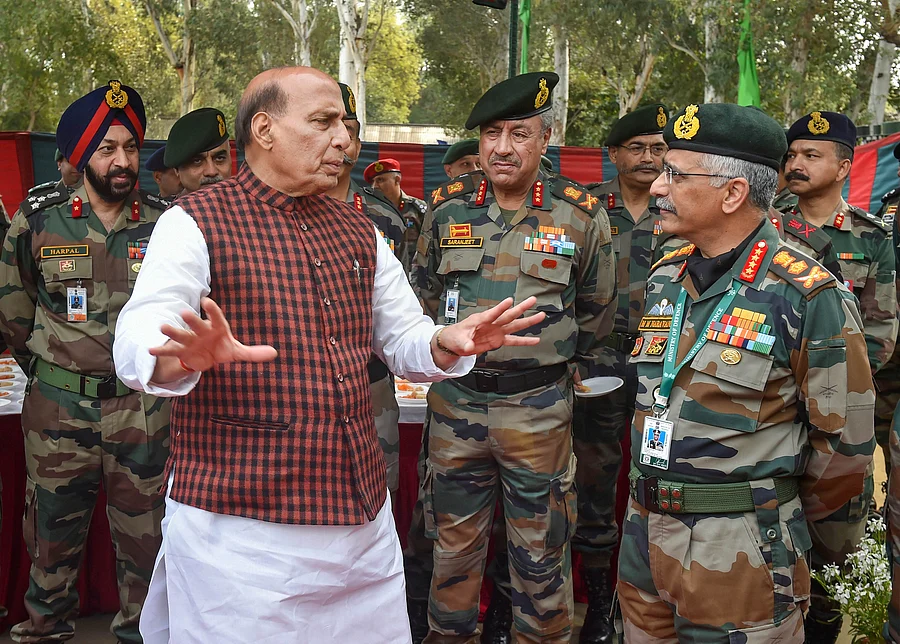
[ Defence Minister Rajnath Singh with General MM Naravane]
The latest events on the LAC may have shaken Prime Minister Narendra Modi’s confidence in his policy of rapprochement with China that pivots overmuch on his personal relations with the Chinese President Xi Jinping. Otherwise the apex meeting of the principals called by Modi on May 26 would not have so quickly followed the May 23 briefing of defence minister Rajnath Singh by the army chief General MM Naravane who bore ill-tidings from his Ladakh trip, with national security adviser Ajit Doval and chief of the defence staff General Bipin Rawat in attendance.
Obviously, the situation is grim and getting worse. While the decision by the PM forcefully to oppose the Chinese changing the status quo on the LAC and especially in the sensitive Daulat Beg Oldi sector is reassuring, it fails to address the central problem of sustained piecemeal territorial aggrandizement by China.
Just how much territory has been lost is revealing. Punchok Stobdan, a native Ladakhi and former ambassador to Kyrgyzstan, refers to a 2013 report by Shyam Saran, former foreign secretary (2004-2006) that indicated China had until then annexed 640 sq km of Indian territory deploying “area denial” measures that, in effect, changed the alignment of LAC on the ground. It is an activity, incidentally, that has proceeded unmolested by Indian forces. With China creating new status quos and Delhi accepting them there’s every incentive for Beijing to persist with this “no cost” policy.
Invariably there’s strategic intent behind Chinese moves.
Regarding the Chinese claim of 80 sq kms in the Chumur region containing the Tible Mane (stupa) holy to Tibetans, for instance, Stobdan points out that its control is “critical” for the safety of the Leh-Manali road. And, in an extended geographic context, why the PLA is “desperate” to grab the Lukung Lake area to stage operations from to cut off Indian access to the Chip Chap plains, the Aksai Chin in the east and the Shayok Valley to the north, and how this will create a new LAC bracketed by the Indus and Shayok rivers. Gaining control thus of the southern side of the Karakoram range China, he explains, can then reach the Siachen Glacier from Depsang and cover “the Tashkurgan junction from where the China-Pakistan Economic Corridor (CPEC) crosses into Gilgit-Baltistan”. It will weaken India’s proximity to, and leverage over, CPEC, the Indian military’s hold on Siachen and, according to Stobdan, permit the diversion of the waters of the Shayok, Galwan and Chang-Chenmo rivers to Chinese-occupied Aksai Chin.
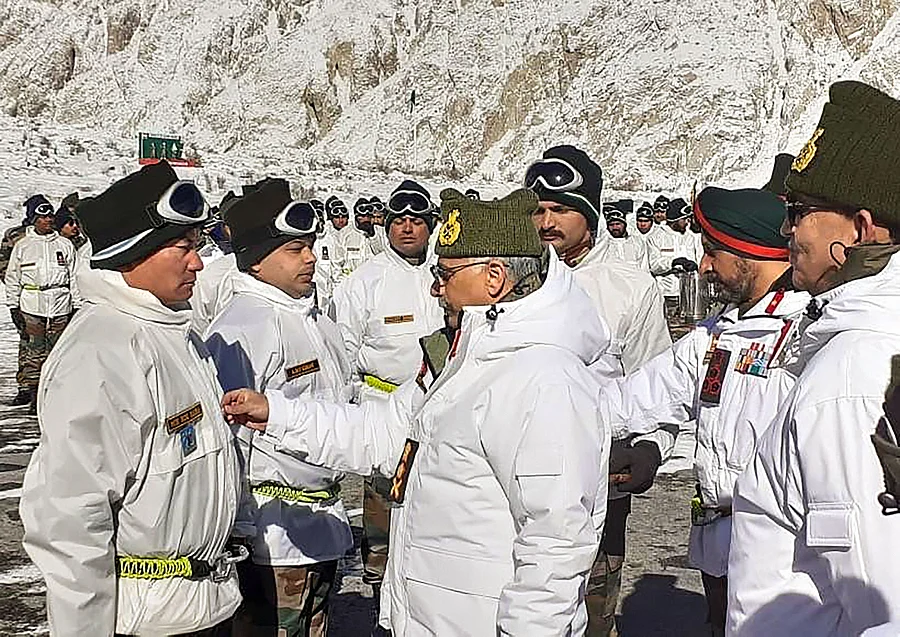
[Army Chief General MM Naravane in Ladakh]
China’s “occupy, build-up, intimidate, occupy some more, build-up”-policy begun in the early 1950s and proceeding apace has hollowed out India’s paper claims. More brazenly, Beijing is justifying PLA actions on the basis that India is constructing roads, bridges and airfields on its side! If the Modi government fails to implement a policy of absolute reciprocal actions, such as filling vacant spaces beyond Indian claim-lines with armed encampments, allowing the Indian army to blow-up offending Chinese infrastructure and, by way of retribution, ambushing passing PLA troops, and relies only on endless and futile negotiations, then India should be prepared for a map thoroughly changed by China.
[An Indian soldier stopping a PLA soldier — a mobile pic hurriedly snapped]
The Press reported that on Saturday May 23 the Army Chief, MM Naravane, briefed Defence Minister Rajnath Singh about the state of affairs in the Ladakh sector of the Line of Actual Control he visited in the days previous. That the National Security Adviser Ajit Doval and Chief of Defence Staff General Bipin Rawat attended this briefing suggests the situation is more worrisome than the army has let on.
Indeed in a short interview carried by Indian Express May 14, (https://indianexpress.com/article/india/army-chief-mm-naravane-downplays-india-china-border-skirmishes-in-ladakh-and-sikkim/) Naravane was complacent, pooh-poohing the violently intrusive tack the PLA has taken in asserting China’s territorial rights to the detriment of India’s claims. “All such incidents are managed by established mechanisms where-in local formations from both sides resolve issues mutually as per established protocols and strategic guidelines given by the PM after the Wuhan and Mallaparam summits,” he averred. He clarified, helpfully, that such confrontations arise due to the unresolved “differing perceptions of the alignment of boundaries”. To tamp down on speculation regarding the potential for such incidents to snowball into active hostilities, he added that the Chinese aggression in the Pangong Lake region of eastern Ladakh and on the Sikkim border in the Naku La section (on May 5-6) are not “co-related nor do they have any connection with other global or local activities”. In other words, that these were one-off incidences with no connecting policy skin and that the Indian media would do well not to play them up.
However, on May 13 newspapers had reported serious injuries to a Colonel and a Major in the Pangong Tso environs because they were clubbed by the intruding Chinese troops with a new version of a medieval weapon — nail-studded wooden batons — that were being swung freely and with intention to do harm. In short, it was not latest in the series of mildly frictive pushing and shoving matches (as at Dok La in 2017) that have to-date typified Sino-Indian border interactions.
Apparently, General Naravane and the Modi government do not consider the use against senior Indian field officers of long nail-studded wooden clubs by Chinese troops an escalation nor perceive such incidents to be other than of little account because their public statements seem to be drafted by the worst of the panda-huggers in the Ministry of External Affairs. The best possible spin on this is that Army HQrs have imbibed a bit too much of the Wuhan and Mallapuram spirits brewed up by Modi than is good for India’s security, thereby indicating that they cannot be relied upon to call a spade a shovel where China and LAC are concerned, let alone to respond heftily in kind. Not for the forward deployed Indian units then the retaliatory joys of cracking open a few senior Chinese officers’ heads with a policy of ambush and hammer.
A weak-kneed Indian government has long been suspected as infecting the Indian military with its preference for shambolic gestures instead. So, two Su-30s were dispatched from the Leh air base to patrol the skies around the Pangong Lake located at 5,000 metre altitude to do what good is anyone’s guess. Because a Sino-Indian agreement to peacefully manage the LAC bars combat aircraft from flying within 10 kms of it. If an aerial gesture had to be made, why did the PMO (which has to clear any and every proactive measure or meaningful action and reaction on the 3,800 km-long China border) not deploy an armed helicopter or two for low-level flying the PLA troops could see to deter them from physically belabouring Indian soldiers in the cruel manner they did? Helicopters are permitted by the same accord to fly within one kilometre of LAC. In any case, the minimum response to such PLA atrocities should have seen Naravane decree that, along with normal infantry weapons, every Indian soldier be armed with a heavily weighted baseball-type bat with sharp protruding metal spikes he can pull out and smash PLA troopers’ faces with with at the first hint of trouble at close quarters. This, of course, hasn’t happened.
Indeed, Indian army brass have taken great care to mention that these border ruckuses also involve Indian troops, thereby in effect equating Indian soldiers guarding the peace on LAC and the Chinese troops disrupting it, perhaps, because they expect the Indian jawans to stand still while getting whacked in their faces. In fact, the over-conciliatory tone adopted by Naravane with subdued action in train may now be the military’s norm. This even when PLA troops seem at liberty, when not wielding their 5.8 mm QBZ-95 assault rifle, to clobber Indian soldiers with metal spiked clubs. The Indian political and military leadership alike take comfort, ironically, from the short duration of these faceoffs, little realizing that such PLA actions can, when not meant to intimidate, instantly lead to unanticipated but planned follow-up actions. Absent the sort of dense military use infrastructure buildup on the Chinese side of LAC and beyond into Indian territory, the Indian forces, will find such moves hard to resist.
Ponder, for the nonce, the PLA’s modus operandi. The Pangong Lake terrain features 8 hilly features, referred to as “fingers”. The western side of the lakefront is claimed by India, with Delhi stating that the LAC, running alongside these fingers, “co-terminates” with Finger 8. China, on the other hand, asserts its rights to almost all of the lake barring the 45 km lakefront held by India. By Delhi’s reckoning, Finger 2 lies wholly within Indian territory, except PLA built a 5 km motorable road in this area in 1998 when the Indian army was busy evicting the Pakistan army’s Northern Light Infantry from its redoubts in the Kargil heights, and which road the Chinese have patrolled with light vehicles ever since. There’s similar construction, for instance, in the Finger 4 area. In other words, even as China has constructed such roads, the Indian army and government contend that no such infrastructure has come up! The better, presumably, to deny that any violation of the LAC has taken place at all!
Does this not mean that anytime the PLA aggressively stakes its interest in a piece of contested territory, Indian army and government all but readily concede it? So, the likely future is for a slow territorial aggrandizement by China — an exercise in which the Indian army and government are and will, in equal parts, be complicit and for which they are culpable.
That leads us to the issue of why it is that Beijing decided to stir up trouble in the first place along the entire LAC, including the Central Sector, with armed interventions even in and around Barahoti, which until now was considered “settled” border, meaning about which neither side had any problems? There are two sets of reasons — one military-political, the other internal.
“It has come to our attention that some political forces in the US are taking China-US relations hostage and pushing our two countries to the brink of a new Cold War,” declared Chinese foreign minister Wang Yi last evening at a press conference in Beijing. The possibility of a Cold War of the kind that brought down the Soviet Union in the early-’90s and which the Xi Jinping regime believes Trump’s America can unleash, is very much on Zhongnanhai’s mind. The vilification campaign against China as the locus genesis of the COVID-19 global pandemic, the closing off of America to Chinese travelers and most exports, and the sanctioning of Chinese high-tech companies (Huawei, et al) is perceived by Trump as only the opening shot in this war. The undertaking by the World Health Organization to examine the coronavirus spread and to assign responsibility for it, will provide Washington with the ammunition to begin orchestrating a much wider, more telling, international political criticism and effort to quarantine and globally sideline China by cutting off its revenue stream, market access, and strategic reach.
In just the first two months of 2020 China’s exports, according to the South China Morning Post, dropped by 17.2% with that country for the first time since 2009 experiencing a trade deficit of US$7.09 billion, compared to the surplus of US$41.45 billion over the same period last year. This could be a prelude to a plummeting of the Chinese economy, a process that could accelerate should Beijing reject the demands by disparate countries of sub-Saharan Africa and even states like Pakistan to write off infrastructure projects-related debt totaling hundreds of billions of dollars that have have so far been racked up. In that case China stands to lose both goodwill and markets and still be saddled with unserviced debt that Beijing can do nothing about short of wiping it off its slate at heavy cost to itself.
Along with a downward spiraling economy, there’s the military angle. The US Navy has increased its freedom of navigation patrols through the waters of the South China Sea at a time when Vietnam and Malaysia at the two ends of the Southeast Asian littoral, far from backing down, are actively protecting their maritime assets and brown water and blue water territories. And as if to worsen the situation from the optics as well as the substantive ends, Taiwan has resoundingly re-elected Tsai Ing-Wen to, in effect, sound a death knell for the “one country, two systems” conceit Beijing has nursed all these years. “We hope that this election result”, said President Tsai, “can give the Chinese government an accurate message: the Taiwanese people reject ‘one country two systems’. We value our democratic lifestyle, and we defend our sovereignty.” Complicating the situation some more for China, Tsai has promised help to Hong Kong. Taiwan will, she said in a Facebook post, “even more proactively perfect and forge ahead with relevant support work, and provide Hong Kong’s people with necessary assistance”. In the last four months, there has been a 150% increase in immigrants to Taiwan from Hong Kong.
The murmurings inside PLA circles about forcefully stopping the Independent Taiwan wagon in its tracks, now that it might pick up speed, by invading that fortified island-nation is mired in serious doubts about whether the Chinese military, despite the out-sized growth in its capabilities, can pull it off. Worse, the relative pimple of a problem — Hong Kong, is proving nettlesome; its people long used to democratic rights and freedoms are resisting Beijing’s attempts at curbing them. It prompted Beijing to simply end that erstwhile British colony’s status as an entity separate from China — no pretense here about two systems, etc. The President for life, Xi Jinping, suddenly finds his dilemma to be like the proverbial frog’s in the warming bowl of water — unable to jump out because China still benefits all round from propping up the current international system, but facing far too many challenges to do nothing.
With the welcoming world order China exploited since Dengxiaoping’s time in the late 1970s collapsing around it, and Taipei and the Hong Kong people throwing down the gauntlet, Xi no doubt feels uneasy and, therefore, senses he has to do something. More so because internally there are sections within his support base in the PLA and the Communist Party which are inclined to blame Xi, in the instance of Taiwan and Hong Kong, for doing nothing and doing something a little late respectively, and on the other hand, for needlessly goading America into action by disregarding Deng’s aphorism about “hiding your strength, biding your time” by openly flexing China’s military and technological muscles guaranteed, even without an impulsively bellicose Trump in the White House, to get the US all riled up and ready to get at China’s throat.
So, PLA felt compelled to let off steam safely and a calculating Beijing to allow it, but against whom? Hong Kong is in the bag — small change, Taiwan cannot be invaded, Japan cannot be run out of the Senkaku Islands, Russia cannot be pushed around, Vietnam cannot be browbeaten, and taking on the US is surely to end China’s dream run. That leaves the usual target — the weak-willed, strategically dim-witted, India to pick on. But this too is a balancing act. Beijing has to calibrate the hostilities in a way so as to not precipitate a war and lose a huge market that grows more precious by the loss of markets elsewhere, but nevertheless to show up a big India and America’s friend as a country without a fight in it, and to hold out this non-confrontation as an episode for other Asian states watching the show to learn from.
In the circumstances, what should a self-respecting India do, assuming such an avatar emerges by magic?
Well, Delhi can follow what I have been advocating over the last 20-odd years. In no particular order (1) ask Beijing to shut the f…k up on Kashmir, and take to wagging an admonishing finger at Beijing on every forum now that it has tethered the freedom loving Hong Kongese to the Chinese Communist totalitarian yoke; (2) publicly initiate negotiations with Taipei to upgrade the extant trade and consular relations into a full fledged diplomatic relationship with the sovereign state of Taiwan, and use Taiwan’s manifest superiority in high-technology to upgrade India’s manufacturing base, and industrial and military wherewithal — a perfect riposte to Beijing’s recently raking up the Sikkim status issue; the “virtual participation” in President Tsai’s investiture ceremony by BJP MPs Meenakshi Lekhi and Rahul Kaswan ought to be a precursor event; (3) officially bury China’s spurious “one country, two systems” policy by withdrawing support for it with respect to Taiwan, Hong Kong and also Tibet, the last on the legally sound basis, I have long advocated, of Tibet not being genuinely “autonomous” in any way and hence no part of China as Delhi had originally recognized it, thereafter India should spearhead a worldwide “free Tibet” Movement; (4) openly support the Uyghur cause and use the OIC to mobilize the Islamic opposition to China’s systematic denigration of the native Muslims there and for turning Xinjiang into a vast prison camp for the natives; (5) cutoff imports of all goods from China, and having done that negotiate small incremental increases in access to the Indian market in return for strict reciprocity in trade and commerce combined with a heavily punitive regime to prevent small and big time traders within India from transacting any goods from China, and the formalization of LAC as formal border; (6) as current chairman presiding over WHO, use the underway scrutiny of China on the Covid-19 issue to skewer China and pillory it as an opaque and irresponsible state not worthy of respect from the international community; (7) for God’s sake, use the precedent of China’s secretly transferring nuclear weapons and missile technologies to Pakistan to pay back Beijing in the same coin, even if 40 years too late, by onpassing the very same technologies, or better still, the nuclear warheaded Brahmos cruise missile, to any state on China’s periphery desiring the ultimate means of militarily keeping Beijing quiet. Philippine President Rodrigo Duterte, are you listening?!, and (8) by way of meta-strategic arrangements, minimize China’s global salience by weaponizing BRICS by excising China from it and getting Brazil, Russia, India, South Africa (BRIS) into a loose and informal security coalition; and to complement it by sewing up a similar coalition to India’s east — the ‘Mod Quad’ — the Quadrilateral of India, Japan, Australia, and a group of rich and capable Southeast Asian countries minus the unreliable United States. It is an organic security scheme that will permanently box in China politically, militarily and economically with a marginal, extra-territorial, role for the US should it want one.
What India will actually do owing to a long habit of slavish thinking and a self-abnegatory mindset is this: It will continue doing what it is doing — trying simultaneously to curry favour with both Beijing and Washington — a high theme of the late K. Subrahmanyam’s supposedly superlative thinking Modi subscribes to and is now bureaucratically furthered by his son, S. Jaishankar as MEA minister. It is a policy previous governments, for reasons that are incomprehensible, have been entranced by and which Modi feels will serve him as well. But he does not see, as Vajpayee and Manmohan Singh did not in their time at the helm, about what will, in fact, transpire. In attempting to be too clever by half, India will end up getting sucker-punched by both. But to be laid low thus requires India to be a sucker, and that is what India has time and again proven to be. And a sucker, as WC Fields reminded us, never gets an even break.
The announcement by Finance minister Nirmala Sitharaman that there would be a “ban” on imports of armaments was music to my ears and meant that something I have long been advocating had finally come to pass. This was so until she qualified her remark by adding that the Defence Ministry would produce a negative list of weapons systems whose imports are barred and that there’d be deadlines for each of these items from when this ban will come into effect. So an escape hatch has been left open for the armed services to continue sourcing their high-value hardware/software requirements and keeping them out of this list. Should the Services fail to convince the defence ministry on this, they will no doubt endeavour to extend the deadlines so that most of the arms import transactions in the pipeline come in under the wire.
The point is not that reasons cannot be adduced for this or that military product to not be on this list. But rather that such a course of action will be used by the armed services habituated to “buying foreign” to persist with this habit. As a result, even a modicum of self-sufficiency will be hard to achieve. Because it is certain the Services HQrs will fight tooth and nail to ensure that their main weapons platforms — main battle tanks, combat aircraft, diesel submarines, helicopters and ballistic missile defence systems and the like, inclusive of their associated electronics, and systems and sub-systems, remain outside the negative list. It could, in effect, leave the country still forking out enormous amounts of hard currency to foreign suppliers even as the process to make India self-reliant stays unachieved.
One can only fervently hope that the Modi government will be rude and ruthless in first enlarging the list of defence items that cannot anymore be bought from foreign vendors and, simultaneously, nullifying or at least drastically pruning the underway deals.
Given the capabilities especially in the private sector — navy’s Project 75i cannot, in the context of nuclear submarine building wherewithal in-country, be permitted to import other than the design and certain highly specialized technologies, such as mast optronics from competing submarine builders (Rubin Bureau of Russia or DCN of France or ThyssenKrupp Marine of Germany); there’s absolutely no need for importing self-propelled and towed artillery, or tanks when there’s the Arjun MBT to refine and design-wise down-scale to obtain a 30-ton light tank for Tibetan plateau use prospectively by the offensive mountain corps; and even less point to flying in foreign combat aircraft to fill the IAF’s MMRCA fleet when there are Tejas derivatives, such as the AMCA to fast forward. For sure, there’s need for foreign assistance in re-working the Kaveri jet engine and there’ll be no dearth of companies competing for India’s custom. But that doesn’t mean the country has to buy a combat aircraft with it. Which is to say that the procurement principle the defence ministry should follow is to buy the specific technology India is deficient in, not the whole damned weapons system package that gets us nothing and in the bargain loses us our purse!
Moreover, with the private sector leading the charge the country is primed to realize inside of 5-7 years Prime Minister Modi’s goal of ‘atm nirbharta’ in weaponry if he is serious about it. But this will require the Indian military and government, as I keep iterating, to trust in Indian talent and invest in Indian programmes to deliver the most sophisticated military goods.
The danger to attaining the above goal is in Sitharaman’s announcement of the other defence industry-related reform, namely, the raising of FDI limit to 74%. The expectation apparently is that foreign arms manufacturers allowed to set up shop freely and with no prior authorization, will jump at the opportunity. Not so fast, Speedy! There would be no problem and such ventures would be welcome if foreign defence companies set up their arms production plants here, and benefit from labour cost advantages, using India as a manufacturing hub mainly for exports. They may be induced to do that only if GOI also allows them guaranteed sales in India. This could lead to foreign vendors setting up factories to dump a whole bunch of obsolete or fast obsolescing weapons/platforms by assembling them here for the Indian armed services, thereby pushing off into the indefinite future the possibility of the Indian military becoming technologically in-date and consequential.
Thus, Lockheed, for instance, which has already tied up with Tata to produce in India the F-21 (the vintage F-16 by another numeric) will come in fast and try and seal a deal with the IAF. From the Washington end Trump can be relied on to do the pushing which our main man, Modi, is unlikely to resist, he being only too eager to please Trump at every turn. (Refer the PM’s expressing his gratitude yesterday to Trump for his promise to send, unbidden, some excess ventilators the US has no use for possibly because these Chinese-produced items have been found to be defective!)
But there are larger issues here that remained unaddressed by Sitharaman. 70% equity and controlling shares is all very well, but before foreign Original Equipment Manufacturers take up the offer, won’t they insist, as regards labour, on hire and fire practices prevailing in the West and elsewhere so they don’t ever get stuck with a low productivity workforce they can’t be rid off? And won’t these foreign firms also insist on ‘one window’ clearance for all permits, local level up, so they aren’t mired in red tape nor compelled to function at the sufferance of defence production babus as Indian companies are forced to do? And further, will the potential investors not demand that the land acquisition be simplified and facilitated which will need the centre and the state governments to be on the same page? The Finance Minister said nothing about any of these things. Result: There’ll be some uptick in foreign interest but no rush into India from foreign quarters, unless they too get the sort of consideration that Lockheed is banking on.
Revamping the land and labour laws, rules and regulations, is a prerequisite for the country becoming a workshop to the world. The Modi regime has done next to nothing in the last 6 years in these respects, other than floating the ‘Make in India’ rhetoric, but still wants India to become a manufacturing station servicing global needs. So much for building a house roof down!
Whether by coincidence or design, Prime Minister Narendra Modi’s two most recent speeches — first on the National Panchayat Day and the second, the TV address yesterday which, incidentally, was the third one on the coronavirus crisis and the first in terms of promising a comprehensive economic package, had a common theme. It was self-reliance. “The global contagion has …taught us”, he said April 24, “a very important lesson; that we have to be self-reliant and self-sufficient. It has taught us that we should not look for solutions outside the country” and added that the fact that “we should not depend on others for fulfilling our needs is centuries old…”
Sure, he then veered off, as the occasion demanded, into suggesting that villages should become self-sufficient in their needs raising, in the process, the Luddite nightmare that Mahatma Gandhi — who had strange ideas and did even stranger things — had conjured up when he talked of India as a collection of “village republics”!!
In the address last evening there was considerable confusion — which is increasingly the hallmark of the PM’s public utterances. His khichdi speech mixed self-reliance with global welfare and with India making a place for itself in “the global supply chain” before turning 180 degrees and urging the strengthening of “the local supply chain” and the Indian people needing to trust and buy Indian products as a first step towards making them “global brands”. Modi concluded by saying that “Self-reliance leads to happiness, satisfaction and empowerment” and how “Our responsibility to make the 21st century, the century of India will be fulfilled by the pledge of self-reliant India.” He ended with an exhortation: “Now we have to move forward with a new resolve and determination. When ethics are filled with duty, the culmination of diligence, the capital of skills, then who can stop India from becoming self-reliant?”
Who, indeed? Unless it is the government itself.
Coroniavirus vaccine is fine. Supply-chain aspirations are good. It is a pity though Modi did not in his speeches once touch on the one sphere, that of armaments where India absolutely has to become self-reliant to maintain its sovereignty which has been sliced away over the last 60-odd years due to the military’s relentless hardware buys from abroad for which the politicians, bureaucrats, DPSUs and Ordnance factories and the armed services’ brass are almost equally to blame. It is a vicious circle any of the numerous PMs in power could have broken, but did not.
So, Indian politicians’ blathering on and on about self- reliance is a bit rich and counter-pointed most glaringly in the country’s almost total, abject and shameful dependence on foreign armaments. This last, moreover, is at the cost of indigenous effort, talent, and capability richly available if the government only looks for it outside the waste and corruption-ridden defence public sector units (DPSUs) and Ordnance factories. To put these latter wretched, money guzzling, government-owned defence ministry-run agencies, maintaining whose health at whatever cost is the defence production department’s sole remit, in-charge of the task to achieve arms self-sufficiency is to take the axe to national interest. It is to put a partially blind man at the steering wheel of a bus and expect he will take us to the destination, when the surprise will be if India gets to the gate without mishap.
After almost surrendering the telecommunications future to the PLA outfit, Huawei, and China, the government, prompted by organizations such as SITARA (Science, Indigenous Technology & Advanced Research Accelerator), is finally permitting Indian private sector high-tech achievers to enter the field of 5G and potentially even 6G systems. SITARA is headed by an unusual former Indian diplomat, Smita Pushottam; unusual because the Indian Foreign Service usually breeds foreign arms lovers. Similar telecom sector type thrust will have to be given by the Modi regime in defence, aerospace, and electronics sectors generally, lest national security continue to be willfully compromised. There is more than critical mass of Indian companies with skills and competences in these fields to free the country from the “commissions and considerations in kind”- racket within the portals of government that lubricates the present procurement system.
The danger though is that Modi, who is his own and only adviser, will decide to buy antiquated fighters (F-16-F-21) and such and compel Indian industry to produce this trash item just so his ‘Make in India’ programme is not seen as an out and out fiasco.
The only consolation is the treasury will be emptied out with 10% of the GDP or Rs 20 lakh crore ($260 billion) staked by Modi to revive a moribund economy, with industrial output down by 16.7% and sliding downwards, and an annual growth rate estimated at best to be no more than 1%-2% this year and at the worst decline to negative growth in this fiscal.
In the event, now may be the time, if he is really serious about self-reliance, for Modi to announce an end to all purchase of armaments, and aerospace systems and sub-systems, and high-value electronics components, as I have been advocating, and for his government to stop dilly-dallying [detailed in my 2015 book Why India is Not a Great Power (Yet)] and put up the money for establishing a high value microchip fabrication facility to drive the technology sector. It will mean, by way of a beginning, the long overdue dismantling of the extant procurement processes and systems in the defence ministry and the departments of Space and of Electronics.
We may do well to recall as a cautionary tale the country’s sorry condition in the electronics field being the result of the historic blunder committed by the late MGK Menon-led electronics commission in the 1970s, which advised the Indian government to concentrate on developing software capability while ignoring development in-country of computer hardware capability. It allowed companies like TCS, Infosys, et al to grow and prosper, of course, and all to the good, but did not help India become comprehensively independent in high-technology. Whence the awful state the country is in with Huawei and China lording over us in the telecom sphere, as does every half-way industrialized state supplying India where armaments are concerned.
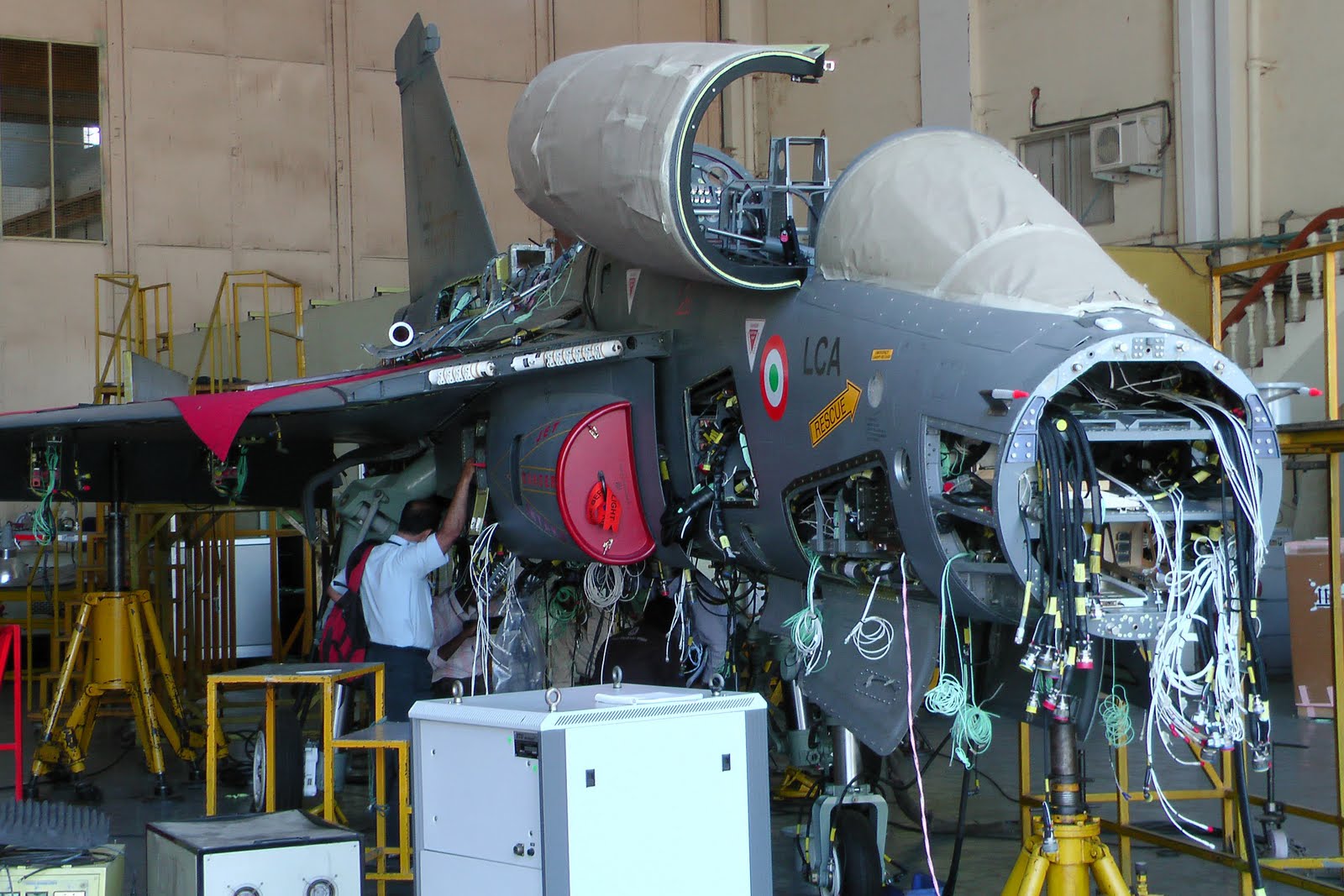
In the defence arena the indigenous capabilities that produced the Tejas LCA, the nuclear-powered submarine, and the Arjun MBT as the principal technology programmes can be enabled to seed design-to-delivery projects for future advanced manned and unmanned combat aircraft, conventional diesel submarines, and various infantry combat vehicles, including a light tank derivative (for Tibetan plateau use) for the mountain corps, for instance. This is the time for Modi to take such disruptive measures and bring the armed services forcefully in line and ensure the success of his government’s “atm nirbharta” policy.
But, as I conclude in my latest book — ‘Staggering Forward’ Modi may not be the leader to take hard decisions to realize technological autonomy because, among other reasons, he is too besotted by the US and the West to not sustain the entrenched import culture inside the government which benefits them, his rhetoric to the contrary notwithstanding.
India has feasted diplomatically on Pakistan’s complicity in terrorist acts over the past two decades. There was a credible enough case made for the UN Financial Assistance Task Force (FATF) to put Pakistan on its sanctions’ ‘grey list’ owing to Islamabad’s well-known role in mobilising Islamist militants from West Punjab and Khyber-Pakhtunkhwa to replicate the Taliban success in Afghanistan in Jammu and Kashmir.
The troubles began for Pakistan with the 9/11 strike in 2001, propelling to the forefront terrorism and Islamic extremists as existential threats to international order. Islamabad’s use of jihadis began to draw censure and, in the wake of the 26/11 seaborne attack on Mumbai by Pakistan-based terrorists in 2008, sealed that country’s standing as a sponsor of terrorism, legitimating India’s retaliatory actions. For Pakistan, the political and economic costs began to outweigh the politico-military gains from using terrorism to wage asymmetric warfare. Once the pariah status took hold, foreign countries became wary of dealing with Pakistan, a Pakistani passport became a liability, foreign direct investment dried up, its economy plummeted, exacerbating, in the process, societal faultlines. Even the Gulf countries, hitherto staunch supporters, began to distance themselves.
This allowed Prime Minister Narendra Modi to pitch India as a partner of choice for these states, consolidate its position as supplier of cheap labour and safe destination for Arab petro-dollar investment. The warming of ties also permitted these Arab states to leaven their autocratic reputation by associating with a democratic India. The muted response of the United Arab Emirates to the abrogation of Article 370 and Saudi Arabia’s agreeing with Delhi that it was an “internal matter” crowned India’s West Asia policy, handing PM Modi his only real foreign policy success.
And then the corona pandemic struck. For the first time, Islamabad saw a clear way to not only blunt India’s charge of fostering terrorism but to push Delhi on the back foot. This they did by conflating the actions of local authorities to corral attendees of the Tablighi Jamaat meet in Delhi as potential COVID-19 spreaders with three unconnected issues—alleged human rights abuses in J&K, ill treatment of Muslims under the BJP dispensations in Uttar Pradesh and other states, and the Citizenship Amendment Act, which triggered nationwide protests and was described by Islamabad as a “pogrom” against Muslims.
It was this storm of supposedly anti-Muslim measures that burst on the Indian government, something Islamabad gleefully capitalised on and Islamic countries could not ignore. Pakistan, in any case, was working since August last year to erode the support for India in the Islamic bloc. In February-end this year, the Organisation of Islamic Cooperation (OIC) urged India to end violence against Muslims, and Turkish president Tayyip Erdogan asked Delhi “to stop the massacre” of Muslims, a phrase repeated by Iran’s Supreme Leader, Ayatollah Khamanei, on March 5. Following the April 28 release of the US Commission on International Religious Freedom (USCIRF) report recommending that the state department designate India as a country of ‘particular concern’, Kuwait condemned the “violence” against Indian Muslims, an emboldened Gulf Cooperation Council may follow suit, and Arab activists are using social media to excoriate the Indian government for fuelling “Islamophobia”.
India is in a pickle, its policy of equipoise between Sunni Gulf states as source of energy and remittances (worth $80 billion annually) and Shia Iran as pivot, and its plan for a south-north road and rail grid out of Chabahar port affording access to Afghanistan and Central Asia while helping the Indian Navy outflank its Chinese counterpart in Gwadar collapsing under the weight of the growing disillusionment of Islamic countries with India. This may also hurt Indian strategic interests in Southeast Asia, especially in Muslim-majority Malaysia and Indonesia. With Al Qaeda and the Islamic State weakening and terrorism off centre-stage, international relations are returning to their old moorings where human rights matter. Which is why Pakistan now has “organised cruelties against Indian Muslims” to bludgeon India with every time Delhi cries “terrorism”.
[ERJ-145 — one of Embraer Company’s bestselling medium haul passenger aircraft]
Twitter has been justifiably agog with the news of Dr RK Tyagi, former Chairman, HAL, writing to minister for civil aviation Hardip Puri, urging him quickly to get the Indian government to bid for control of the Embraer Company of Brazil for as little as $5 billion, Boeing having withdrawn from its 80% stake in it worth $4.2 billion. This Brazilian firm specializes, among other things, in producing various bestselling passenger aircraft (such as 30-110 passenger carrying E2 and ERJ-145 series of single engine, single aisle, transporters) which can also converted to maritime reconnaissance, aerial early warning, cargo, and VVIP flight missions. In fact there are already a number of these aircraft flying in India. Just to provide perspective: India has failed to manufacture any such plane despite a number of underway projects over the past 30 years to design and produce them. Acquiring Embraer will thus vault India into the front ranks of aircraft producers.
In his letter dated 27th April 2020 to Puri, Tyagi mentions that the projected demand by 2035 in India for these types of aircraft is between 350 to 500. So it makes ample economic sense to grab Embraer at this time, and act fast to do so before “other other players, potentially China, enter the scene and pitch for the Embraer stake”. He adds that “Apart from the possibility for phased manufacturing in India, there is also the potential to attract OEMs (Original Equipment Manufacturers) of aircraft engines, wheels and braking and landing gears, avionics, etc to set up MRO (Maintenance and Repair Organizations)/manufacturing in India since the scale and size of the business are potentially sustainable. It will also add to indigenous design and engineering skills.”
Tyagi recommends that (1) “the extant opportunity be [expeditiously] seized”, (2) “An interim Expression of Interest” be “communicated to the Government of Brazil to bid time”, and (3) “India actively considers acquiring a 51% stake into Embraer either through a SPV (Special Purpose Vehicle) created by equity participation by Hindustan Aeronautics Limited acting alone or in partnership with the private sector.” Private sector participation by such Indian firms as L&T and/or Mahindra, or Godrej Aerospace makes ample sense in terms of spreading the risk and distributing the benefits, such as transfer of technology and skills, of this acquisition. Indeed, Indian twitterites have been besides themselves enumerating the immense possibilities of such a deal. Such as producing the Tejas LCA in Embraer production facilities to sell in the promising Latin American market.
In case, his acquisition idea finds favour with the Modi government, Tyagi suggests constituting “a small team of policy/industry experts”, and ends his letter with a warning: “This may be once in a lifetime opportunity for us” and hence, by implication, not to be missed. It is copied to defence minister Rajnath Singh, PK Mishra, principal private secretary to the PM, and Amitabh Kant, ceo, Niti Ayog.
What are the chances this proposal for securing controlling shares in Embraer will be entertained by the Modi government, and these four notables — Messrs Puri, Singh, Mishra and Kant will succeed in speedily getting the Prime Minister’s and, more important, Finance Ministry’s approval and release of the necessary funds, and that in the meantime MEA is tasked to discuss the topic to the Bolsonaro government in Brazil and prepare the politico-economic ground for such Indian investment, and to seek his help in keeping out other potential bidders, especially China? President Jair Bolsonaro, after all, was wined, dined and feted as the chief guest at the Republic Day parade this year and will have warm memories of his Delhi sojourn and, if properly approached, would be receptive.
One wishes though that the Modi regime had by now articulated a strategic vision such as the one proposed in my ‘Staggering Forward’ book of a smaller geostrategic grouping of BRIS (Brazil, Russia, India and South Africa) derived from the purely trade and economically oriented BRICS. An Indian majority stake in Embraer would fit nicely in a BRIS schemata. Any which way, this deal justified by the Indian government, the right touch may be provided by Modi broaching this topic directly and personally to Bolsonaro in a phone call, leaving their respective government functionaries to work out the details.
So what’s the proverbial fly in the ointment? Well, Puri, a former diplomat, Mishra and Kant are all civil servants used to working in a certain leisurely bureaucratic style and pondering procedural hurdles at length, rather than getting on with it and showing some urgency in cutting through the red tape. The mind boggles at the potential of this transaction and how Embraer in the Indian fold would turbocharge Modi’s so far idling ‘Make in India’ policy and programme, generate huge employment, and keep the immense Indian wealth that has to-date been frittered away in arms imports, within the country.
Is all this enough for these durbans (gatekeepers) to Modi to get their political master to act without losing time? And if adequately briefed, will Modi have the foresight to pilot the Embraer company acquisition through the bureaucratic thicket that is the Government of India? Time will soon tell or, as is more likely, when newspapers report that China has already grabbed Embraer even as Delhi is still at the starting gate mulling over the matter!
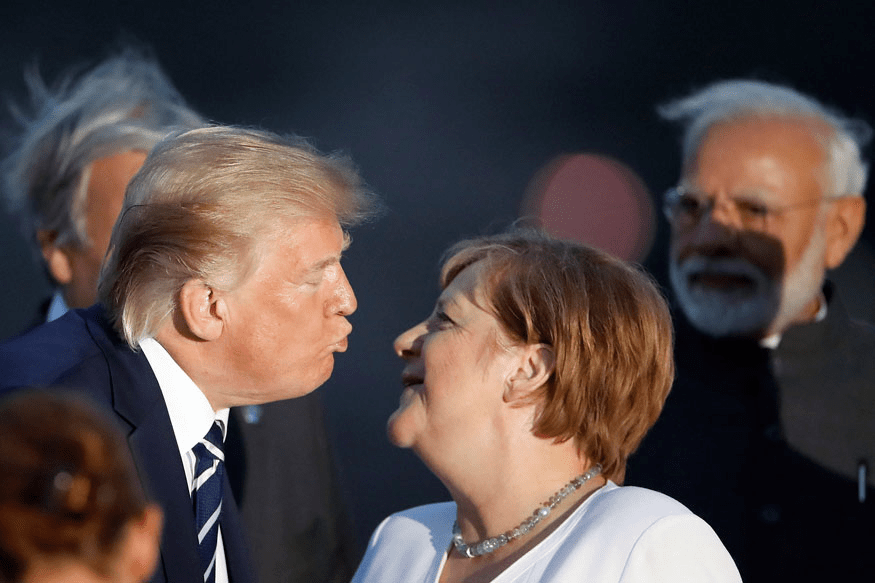
[Trump and Angela Merkl in smooch mode; Modi looks on]
With every passing oped of his, it becomes more difficult to take Ram Madhav, General Secretary of the ruling BJP and sometime RSS pracharak, seriously. The upside, however, is these pieces provide no end of amusement. One can see just how desperate Madhav is to impress Narendra Modi with his flattery and supposed profundity (as reflected in quotes from here and there). His articles are a baffling mix of disjointedness and incoherence, spiked with random mentions of people, bits of history, and recent developments. Taken together they make no sense. For instance, his latest — “India can collaborate with the US and Germany to mould a new world order” [https://indianexpress.com/article/opinion/columns/coronavirus-global-lockdown-exit-strategy-ram-madhav-6385391/].
In this piece may be found references to Trump, Modi’s “democratic activism” — whatever that is (because there is no explanation), coronavirus, Niall Ferguson, Hitler, nationalism, ultra-nationalism, World War Two, Mao, Dengxiaoping, China, modern day Germany, and God knows what else, arrayed almost in bullet-points with no connecting tissue and constituting a melange that does not support his conclusion, which is that “In the unfolding new world order, India, along with countries like America and Germany, can play a pivotal role in building a world based on ‘human-centric development cooperation’ as suggested by Modi. It is time for a new Atlantic Charter: Environment, healthcare, technology and democratic liberalism can be its foundations.”
For a geopolitical grouping to amount to much, it has to be underpinned by geographic logic and power balancing imperatives. Consider any strategy or alliance for tactical or strategic reasons, for short-term gain or for the long haul, and one discovers two factors at work — geographic considerations and the desire to balance power against the dominant or would-be dominant state. Both these factors aligning is when a coalition or geopolitical strategy achieves success. 16th Century onwards, Britain practiced its ‘continental strategy’ of preventing any single continental power from attaining dominance. In pursuit of this strategy, Britain enforced a naval blockade of Napoleonic France in 1804, responding to which Napoleon enforced a ban in 1806 on European powers trading with Britain. Otto von Bismarck, who forcibly amalgamated the Germanic states in Central Europe into a single powerful entity, created an alliance system crowned by the 1882 ‘Triple Alliance’ featuring Germany, the Austro-Hungarian Empire and Italy to isolate chief rival, France. Imperial Russia, France, and Britain building on the 1894 Franco-Russian accord forged the 1904 ‘Triple Entente’ to hem in an ambitious Germany. Britain and Japan turned treaty allies in the first 2 decades of the 20th Century ostensibly to fight off Imperial Russia in Asia but in actuality to protect their colonial interests in China and Korea. In the throes of revolution, Russia signed the 1918 Brest-Litovsk Treaty with the German-led bloc of Central European powers to stabilize its borders. Some 20 years later, in August 1939, a month before the onset of the Second World war, Germany and Soviet Russia signed the Ribbentrop-Molotov accord to carve up Poland. Post-1945, the so-called “Atlantic Charter” (that Madhav bungs in for no good reason in his piece) resulted in NATO, reacting to which the USSR formed the Warsaw Pact consolidating, in the process, the US and Soviet spheres of influence in Europe. To firm up Communist solidarity and the control of the bulk of the Eurasian landmass, the Soviet Union closed in with Mao’s China to present a solid front to the West generally, and to the US and its allies in the Pacific specifically.
By what geopolitical or geostrategic metric and in what conceivable way does a grouping in the present day of a receding America, a much reduced Central European state, Germany, with no great independent military capability to speak of, and India, a country that has over time relentlessly marginalized itself to a point where it does not even pull its weight in its own backyard, leave alone assert itself as the primary rimland power in Asia, in a position to shape the world order as envisaged by Madhav? There’s, moreover, obvious natural affinity of race, culture, religion, etc., between the US and Germany, an affinity in no way shared by either of these countries with India.
Just how much of an interloper India is in a US-European concert is depicted starkly in the pic above where Modi and, by extension, India stand forlornly, watching the American and German leaders whoop it up even though German Chancellor Angela Merkl can barely conceal her contempt for Trump and thinks the US an unreliable ally, and Trump has labelled Merkl’s policies “insane” and has threatened to withdraw military support for Germany. There is nevertheless much there in the long term, Trump notwithstanding, for a new Atlantic Charter. But how can India expect to muscle in on this US-European partnership, considering there’s almost no serious overlap in the strategic interests of the US and Germany on the one hand and India on the other hand, unless one counts as common interest a peaceful global security milieu and a liberal trade regime which everybody craves, including the arch-global disruptor of the current order, China?
So the question of these three states getting together to construct a new international system does not arise. Also because there’s the inconvenient fact of what it is the three countries bring to the table. The US comes in with unmatched military and economic power, Germany pitches in as the European economic behemoth able to swing the European Union behind it. In comparison, Modi and India can boast of little more than the former’s flatulent ‘vishwa guru’ conceit (that Madhav predictably waxes on). Delhi, with a failing Indian economy and constricted strategic vision and policies and, therefore, limited military clout, cannot even get its immediate neighbours to support it.
In the circumstances, pray, what can India contribute to ‘human-centric development cooperation’? The US and Germany, having achieved by their own effort high living standards, have excelled in human centric development; in comparison India has stumbled through 70-odd years of socialist development that Modi in his time in office has done nothing institutionally to correct, other than ring in cosmetic changes in the functioning of a still corrupt, inefficient, wasteful, and ineffective apparatus of government that persists from socialist times but produces very little governance. So, does Madhav’s “human-centric development cooperation” not seem like a plea for alms, an artful dressing up of the beggar’s bowl?
Wanting to capitalize on the imagery involving the PM, on Modi’s flying around hither and thither, visiting every country under the sun, and conferring with the high and mighty in international meets — the sort of activity the corona pandemic has shut down, Madhav conjures up, if only for the sake of op-eds, alliances out of thin air, fueled by nothing more, it’d appear, than passing whimsy! Damn good reason to deny him the role he apparently seeks for himself as some sort of intellectual vanguard, God forbid, for the PMO and the BJP government, unless Modi wants to further trivialize himself and India in the eyes of hardened professionals crafting foreign policies elsewhere in the world.
[Indonesian Navy officers at the jetty in Surabaya to welcome INS Rana, Nov 2018]
Hard for one’s admiration for China’s single-minded drive to at all times advance its strategic interests come rain or shine or the corona virus, to not grow by leaps and bounds. Nothing diverts Beijing and the Chinese military in particular from flexing its muscle, asserting its rights and claims, and seeking to frighten the local opposition to get out of its way in a region it intends to dominate absolutely. Even as that country is fighting the COVID menace successfully — and why not? It created the corona bio-weapon, lost control over it, regained it, mounted an integrated scientific effort to tame it and will likely be the first to patent a vaccine and make oodles of money out of its sales worldwide — the PLA Navy did not forget its mission.
Two new “districts” were announced by Beijing a few days back to administer several rocky outcroppings that are being fashioned into man-made islands with dredged up sand, etc. in the disputed but appropriately named Mischief Reef area which Beijing claims in its entirety. Around the same time and a little to the west, a Chinese survey ship accompanied by an armed Chinese Coast Guard (CCG) vessel contested a Malaysian ship drilling for valuable seabed minerals within Malaysia’s Exclusive Economic Zone. Simultaneously, a large Vietnamese boat fishing offshore was rammed by a CCG corvette. But, last week when three US warships (America with a F-35B complement onboard, missile cruiser Bunker Hill, and missile destroyer Barry) in an expeditionary task group (detached from the carrier task force headed by the nuclear aircraft carrier USS Theodore Roosevelt, which lies anchored mid-Pacific in Guam owing to a coronavirus infected crew) turned up in the South China Sea in what is described as “security and stability operations”. And it exercised with an Australian warship (HMAS Parmatta), prompting Beijing sanctimoniously to urge the US and Australia to please “not disturb the peace” in the region! That’s chutzpah for you!
Beijing has turned such acts of brazen territorial annexation mixed with a wagging of fingers at out-of-area powers daring to register their presence, into high statecraft. These Chinese actions are carried out so smoothly and with an attitude of such utmost conviction and routine-ness, hardly any one notices they are irregular, illegal and contrary to international norms and leave the poor littoral states with nothing to do than protest in vain.
So the militaries of the countries that matter in the Indo-Pacific are not doing nothing, haven’t locked down themselves into inactivity. What about the Indian armed forces though, what are they up to?
The army, admirably, has done well in the anti-COVID-19 fight, putting up all manner of facilities for sequestering corona-infected people, making available its medical staff, etc. As the senior and the largest of the uniformed services, the army, however, has serious problems as regards its personnel. Training courses have been cancelled, the transfers of officers postponed, and to minimize the exposure to the C-virus annual leave-taking has been delayed. Officers nominated to attend the Staff College at Wellington and various higher command courses — stepping stones to promotion, etc. but unable now to do so will be hugely affected, their upward progress and the process suddenly disrupted. The Military Secretary in Army HQrs tasked with the career management of officers will, perhaps, for the first time in the army’s history earn his keep, as he struggles to come up with metrics for promotion that are fair and, importantly, are seen to be fair. The new scheme may end up inadvertently victimizing a few officers or even an entire cohort with the push from below, from the next year’s batch of officers in training courses and so on. This to say, the promotion ladder will become steeper still for these unfortunates.
Then there’s the other problem with the stand-still arrangement in place. Can officers, JCOs, NCOs and jawans in presently forward-based units be kept in place beyond the usual 2-year rotational stints, and can the lower ranks be denied home leave, and with what effect on their morale and the fighting quality of the unit? Further, the army will need to compulsorily isolate everyone returning to forward units from leave for 14-days. This will mean that at any given time all the forward units will be under-strength in terms of the personnel on leave and those held in the wards prior to re-induction and hence unable to serve on the frontline.
Nevertheless, to show it is no slouch at fingering Pakistan — the only and the easiest way it seems to get into the good books of the Narendra Modi government, the army has been busy keeping the western border live, or that’s what Pakistani newspapers report. No period has been as busy as the present, complains Pak army’s DG, ISPR (Inter-Services Public Relations) to its Press in terms of Indian artillery firings, small cross-LoC ops, sniper shootings, etc. The front with China, on the other hand, is ho-hum peaceable with all parties, including China and PLA having a stake in keeping things quiet on the LAC in the north and northeast. This last suits the Indian army well because it lacks the wherewithal, other than for defensive actions including, presumably, pushing-shoving matches a’la Dok La 2017. No chance here of cross-LAC artillery duels, snipers picking off targets of opportunity, and small team incursions to beat up on straying, unsuspecting PLA soldiers.
The Indian Air Force strives hard to offer no provocation to China. Even so there’s the occasional news report of an Indian MiG-29 or Su-30 going down with no clue as to why the fighter plane did so, or what happened. It is always possible with sorties out of Tezpur and other satellite fields launched to familiarize Indian pilots with the mountainous terrain and to get them to operate in some comfort that PLA rockets, guns, missiles slaved to surveillance, tracking and targeting radars have struck Indian combat aircraft. Not, mind you, that IAF has ever acted on this premise and suspicion and responded accordingly. All its vim and venom seems reserved for the western front.
The Indian Navy has reported several cases of corona-hit naval personnel. Social distancing and other measures while being practiced ashore are impractical in the confined spaces of surface combatants and, more so, submarines. COVID apart, the navy can’t lose sight of its operational tasks. At any given time, there is at least one flotilla sailing in the blue water. The trouble is most such short Indian naval deployments are off Aden and in the Gulf region generally, with the seas east of the Malacca, Lumbok and Sunda Straits, by comparison, being ignored even though it is there the navy can do the most strategic good. All the political rhetoric of meeting the Chinese threat head on, preferably collectively, and MILAN and bilateral exercises, such as the November 2018 Op Samudra Shakti with the Indonesian Navy off Surabaya notwithstanding, Indian flotillas showing flag in the South China Sea are a relative rarity. Sure, an exercise was conducted in May 2018 with Vietnam and, under a new cooperation scheme, another a year later in April 2019 in Cam Ranh Bay. But one hopes COVID isn’t the excuse for not having a third such exercise very soon this year.
Mutual unfamiliarity may require more time for preparation and planning of joint exercises. But this fact alone reveals that neither the Indian government nor the Indian Navy have acted with any sense of urgency in investing in close relations, besides the Vietnam and Singapore navies, with the Southeast Asian littoral navies, and linking up with them at the institutional level. In fact, the underway training programmes with Vietnam, such as joint exercises, training submarine crews and inducting the supersonic Brahmos cruise missiles, could be the template for intense naval cooperation with the other Southeast Asian states as well. These could be supplemented by the Malabar exercises (with US, Japanese navies) in the area and joint “sail throughs” in the South China Sea by warships from several countries. Indian, Japanese, American and Philippine ships did this in May 2019.
Brahmos, I have long argued, is the patented Chinese warship killer and the decisive weapon that uniquely will have a power multiplier effect for India when dispersed to friendly Southeast Asian countries in China’s backyard. Because then the entire South China Sea will be become hazardous for China’s most powerful South Sea Fleet as well as its so-called ‘secret’ fleet meant for the Indian Ocean, both headquartered in the Sanya naval base on Hainan Island. This requires the Indian government and naval brass to prioritize, as I have been pleading with the highest in the land for the last 25 years or so, to expeditiously equip all of the littoral and island nation navies with the Brahmos. Indeed, Brahmos-armed Indonesian, Philippine, Malaysian surface combatants and shore batteries along with their Vietnamese counterparts could, between them, compel the much touted Hainan-based fleets to stay locked up in Sanya and, in case they ventured into deeper waters, to carve ’em up.
The value of the Brahmos with Southeast Asian nations is a strategic prong Delhi for incomprehensible reasons has been unconscionably slow to appreciate. The other two prongs are megaton yield thermonuclear forces (discussed at length in my books) and the regularization of the Indian naval presence in the South China Sea with a flotilla formally and permanently deployed in-area with ships and crews rotated out of basing arrangements in Singapore, Cam Ranh Bay, Subic Bay (Philippines) and Sabang (Indonesia) as part of the new geostrategic grouping — the “Modified Quadrilateral” or “Mod Quad” of India, Japan, group of Southeast Asian states, and Australia that India should put together (detailed in my latest book — Staggering Forward: Narendra Modi and India’s Global Ambition). Having Indian warships on South China Sea station showing the flag 24/7 365 days, and sporting the fighting attitude that Admiral DK Joshi, when he was CNS, hinted at when he declared that any attempt by the Chinese Navy to do anything untoward will be met with force, will alone convince Beijing not to trifle with India.
Moreover, only with the above described three-pronged trishul in hand will India and Modi’s “Mamallapuram spirit” (ex-his summit with Chinese President Xi Jinping in December 2019) acquire potency. The rest is so much gas that Delhi usually vents and is of little account.