[General Anil S. Chauhan at his ceremonial investiture as CDS]
At the United Service Institution of India yesterday, General Anil Singh Chauhan, Chief of the Defence Staff (CDS) delivered the Major General Samir Sinha Memorial Lecture. Tasked with integrating and theaterising the 19-odd military commands, he pretty much confessed that the job was beyond him. He talked of integrating logistics, communications, intel and everything else under the sun, but not about theaterizing the operational commands. Apparently, he thinks this task unachievable at least in the foreseeable future.
As senior officers and military veterans in the audience rolled their eyes knowingly at what General Chauhan did not say, the message got through with a bang. Does it come as a great big surprise to anyone? No. But one did not expect Chauhan to give up so publicly, so easily, on an initiative the Narendra Modi government has put much store by.
As a fairly low key type, Chauhan simply cannot replicate his predecessor the late General Bipin Rawat’s modus operandi of bullheadedly propelling the theaterisation programme, trampling on long nursed sensibilities without giving it much thought. Like, for instance, his dismissing the air force as a “support arm” and. collaterally, its longtime opposition to changing the status quo. It instantly steeled the IAF’s negative attitude to what Rawat was trying to do.
Then again, Rawat never made any bones about his Gurkha officer’s (5/11 GR) attitude to solving a problem — beat it down! Reflecting this attitude of pushing on regardless, he had by August 2021 readied the first of the theatre commands for operations. The Maritime Integrated Command, headquartered in Karwar, controlling the fighting assets administratively with the Western Naval Command, the Eastern Naval Command and the Andaman & Nicobar Command, was all set to go. A Vice Admiral was even selected to be its first Commander-in-Chief (CINC). And then the roof caved in.
IAF was not responsible for it. The senior babudom — the civil servants, was. The bureaucrats’ concern, as always when dealing with the military, was with protecting their positions in the pecking order, the ‘Warrant of Precedence’. To be fair, there was and is a problem with it that neither Rawat nor any agency of the government or military had bothered to address until then. A CINC of a new Integrated Command would be 4-star rank. How and where would he fit in? On the same rank-level, would he be senior, equal or junior to the Services’ Chiefs of Staff? That could possibly be resolved by jigging the seniority issue into an inter se seniority metric, even though the officers in the three services are in differently sized cadres, and get promoted and rise in different timeframes. Still, there may be a way to resolve it.
The problem is knottier when civil servants come into the picture. In the prevailing system, the Defence Secretary, the head babu in the Ministry of Defence, is junior to and below the three Services chiefs in the Warrant. Would the newly appointed integrated theatre commanders — enjoying the same 4-star rank status as the services’ chiefs, also outrank the Defence Secretary? Could they be placed at the Additional Secretary level but senior to the AdSec in the warrant? The Indian Administrative Service, allergic to any hint of demotion, raised hell and stopped the theaterisation initiative in its tracks. Since August 2021 there’s no advance on that front.
The question is how did General Rawat get as far as he did in realising the Maritime Integrated Command without resolving the Warrant-related issues? Did he subsume a special dispensation, courtesy his fellow Pauri Garhwali, Ajit Doval — the National Security Adviser? If so, why can’t Chauhan — a Gurkha officer (6/11 GR) and another native of Pauri Garhwal, revive it?
Whatever the way out of this mess, one thing is clear. The diminutive General Chauhan’s nice, aggreeable, soft talking, dull and discursive method, is not working. But, at least, he is not consigned to the basement of South Block as General Rawat initially was, when appointed as the first CDS. That, I suppose, is progress.
One thing is certain: As Washington prepares to welcome Prime Minister Narendra Modi for a State Visit June 21, the Joe Biden Administration is intent on succeeding where previous administrations have failed, namely, in making India, a willing technology captive.
The Modi government, on the other hand, hopes that strung out between the Russian annexation of the Donbas region of eastern Ukraine, Chinese President Xi Jinping’s forthrightly confrontationist stance over Taiwan, and the fast growing Russia-China nexus, the US can be persuaded to part with military technology it had hitherto dithered in transferring to India, especially because India is neither an ally nor even a time-tested friend but is a ‘strategic partner’ with whom relations are, with the consent of both parties, transactional.
Modi and his advisers believe this is a ‘Dengxioaping moment’ for India when the international situation and correlation of forces favour it, and despite New Delhi’s not supporting Ukraine in its war with Russia. the US and the West are inclined to help it to emerge economically and industrially as an economic and strategic counterweight to China. And with comparative labour cost advantage, perhaps, even replace the latter with India in the global supply chain currently dominated by Chinese manufacturers. The twin aim being to reduce dependence on China for crucial materials and components by carving out a supply role for India and, by the by, draw India more fully into the US and Western economic fold and, importantly, strategic arrangements in Asia geared to stalling China’s rise.
India, in fact, has already made itself an irreplacable part of the global supply chain by supplying the US and the West with an endless stream of skilled technical manpower. Indeed, it is estimated that as much as 40% of the US-originating IT software is produced by the Indian diaspora in America and Europe. In fact, the Modi government has long since decided to double down on the manpower supply role as central to its US policy. Whence, the Indian ambassador in Washington, Taran Singh Sandhu who in a June 18 TV interview reminded the audience that some 200,000 Indian students presently in the US are in the STEM (Science, Technology, Engineering, Mathematics) category, who could provide the US with the “competitive edge” in the world and how this was central to what he called the “escalating” bilateral relationship. It was another way of pleading for increasing the H1-B visa quota for India!
That all this manpower carted to the US sets India back in its plans to emerge as a global tech power in its own right and comes at enormous economic cost (think of the extent of subsidies via education funded by the poor Indian taxpayer to prepare the potential tech immigrant to America) is apparently not of concern to Modi. This is the great difference between Modi and Deng, and between the Indian and the Chinese systems, that China and its leadership have always been oriented toward maximizing the gains from leveraging their advantageous position vis a vis the US by simultaneously building up the technology creation/innovation eco-system within the country with a view to becoming a global power independent of America. This last is something the Modi regime has not really attempted because it requires the maximal withdrawal of the government from the economic life of the country and to unshackle the technological and entrepreneurial genius of the people from bureaucratic control.
Deng, it may be recalled, visited Washington in end-January 1979 at a time when the Nixon-Kissinger game of balancing power by distancing China from the Leonid Brezhnev-led Soviet Union, had cleared a path for China. It resulted in American market access to Chinese goods and turning on of the technology spigot that enabled the Chinese military to get on par with the Soviet forces. It is these twin opportunities that Deng masterfully exploited to his country’s immense benefit until now when the Chinese economy has reached the $17 trillion level (compared to US’ $23 trillion), PLA poses the biggest, most potent, threat to the US, and China rivals the US in creating and innovating high technology.
Ram Madhav, an RSS leader, in a fit of hyperbole relating to the situation on the eve of Modi’s visit juxtaposed “expectant ecstacy” supposedly prevailing on the US side with “cautious realism” on the India side. Not sure what Madhav is reading, but the ecstasy seems to be entirely on the Indian side with the media, retired militarymen, and the commentariat going into raptures about India’s new dawn with American high tech! There is wide-eyed scepticism on the US side though. Two highly regarded India experts — Ashley Tellis at Carnegie and Daniel Markey, a former State Department Policy Planning official, at Johns Hopkins University’s School of Advanced International Studies, have doubted whether the red carpet rolled out for Modi and the easing of the tech trade will fetch Washington much. They are reluctant to believe that India will end up supporting Ukraine, disavow its neutral stance as between Russia and US and NATO on the Russo-Ukrainian war, or decide to cutoff of its historically strong Russian military and oil supply links.
Tellis argued India is “a bad bet” because, in effect, it marches to the beat of its own different drum and won’t always follow the US lead, and Markey made the point that while the “shared values have grown weaker with India [owing to Modi’s growingly autocratic rule], their shared interests [such as containing terrorism and China] have gotten stronger”. While advocating targeted assistance programmes specifically to counter China, he warns against transferring GE 414 jet engine tech to India which, because it will strengthen India’s indigenous defence industry “might not serve US interests in the long term.” And he hints that the US may not want to help create another China with massive commercial investments in the Indian economy, etc. The analog of the 414 jet engine from Deng’s time was the 1982 ‘Orient Pearl’ programme initiated during the Reagan presidency that transferred advanced avionics technology. It upgraded China’s bulk fleet of F-7 fighter aircraft, of course, but along with the Chinese buy of the Israeli Lavi fighter design and materials, it kickstarted China’s wildly successful military electronics and combat aviation sector.
So, in this India’s alleged “Deng moment’, what’s the score card? iCET (Initiative for Critical and Emerging Technologies) is the new buzzword. It’s come about because an earlier programme — the 2012 Defence Trade and Technology Initiative and the 2016 action by President Barack Obama to raise India’s status to ‘Major Defence Partner” produced more hot air than transfer of technology. iCET is different because the National Security Advisers — Jake Sullvan and Ajit Doval are helming this effort. They have cut redtape and, and cleared logjams and bureaucratic resistance at both ends. Consequently, it has been agreed that Modi and Biden will sign several flagship accords in the hi-tech field. It is proposed, for instance, that General Electric Company will assist HAL in doing the only thing it is good at — “assembling” this time the GE 414 jet engine to outfit the Tejas Mk-2 and the 2-engined advanced medium combat aircraft on the design board.
The more significant understanding concerns cooperation in designing and manufacturing high-value semiconductor chips in highly complex and inordinately expensive fabrication (fab) facilities, in space exploration and ventures, and in quantum computing.
However, the reason why this won’t be a Deng moment for India is that the Indian government doesn’t seem as motivated as the Chinese state was to use US technology as base for rapid growth of indigenous technology. Possibly, keeping Markey’s warning in mind, the Pentagon is preparing to transfer all but 20% of the tech involved in the 414 engine. That 20%, however, is critical tech relating, as a former IAF officer suggested, to design and production of single crystal turbine blades, the very thing GTRE (Gas Turbine Research Establishment), try as it might, has failed to produce and why the indigenous Kaveri engine project has so far not reached fruition. It is a tech void the GE 414 deal won’t fill.
So, is the core of the tech deal on the anvil with the US still great shakes considering India might become permanently dependent on the US for combat aircraft engines?
[Aswini Vaishnav, Minister for Telecommunications, and the Prime Minister]
On Feb 15, I posted ” Obdurate defence finance bureaucrats sinking atmnirbharta projects”. It had revealed how the Integrated Financial Adviser (IFA), Ministry of Defence had ousted two Indian defence MSMEs (Micro, Small and Medium Enterprises) — Lekha Wireless Solutions Pvt Ltd and Signaltron, both of which possess 5G patents for radiotelephony from the competition to provide the army with a mobile tactical communications (TACCOM) network, how this was done by relying on an outdated turnover criterion these firms could not meet because, well, they are small and not because they lacked the tech or couldn’t execute the contract, which fact these two companies had made known to the IFA before the bids for the TACCOM tender were opened, how this was done at the crucial tech testing stage so Lekha and Signaltron couldn’t prove their tech, and why this sort of deleterious rule-based regime is what the babus follow when it serves their purpose of furthering foreign tech purchases. The foreign technology involved is Israeli and the Indian front company — Alpha Design, is only a system integrator buying components/technologies from here and there and putting them together, it is not a technology creator or innovator. Worse, because Israel sells its advanced technologies to the Chinese military, who is to say the PLA is not conversant with this Israeli technology and this TACCOM the army is set to use on the disputed border is not fully compromised?
Disappointingly, despite my urging General Manoj Pande in the post — the first combat engineering officer to be COAS, to stop the tender process from advancing, he did nothing. However, Defence Minister Rajnath Singh, I understand, took note of my post. But instead of cancelling the trial contract and ordering the tender for TACCOM to be reissued, which is something MOD/Govt of India is entirely within its sovereign right to do at any time, for any reason, with regard to any defence or other capital acquisition deal, MOD chose the limited option of changing the revenue turnover criteria without scrapping the Alpha Design-Israeli contract. So Lekha and Signaltron are still out of the TACCOM contract, notwithstanding their superior INDIGENOUS technology!
But the ministries and bureaucrats within them not taking Prime Minister Narendra Modi’s atmanirbharta goals seriously seems to be the norm rather than an exception. Consider the Department of Telecommunications (DOT) — supposedly a sphere of special concern and interest to the PM. The minister heading it is the media savvy Ashwini Vaishnav, who pops up every other day to extol just how far and fast India is rising in the field and spews statistics about the growingly large mobile telephony coverage that facilitates the digitalisation of the economy. But, it would appear he is more interested in impressing Modi with such self-publicity shenanigans than actually doing something substantive rapidly to increase the telecommunications and related services footprint in the country, and help the economy progress by leaps and bounds.
The means for India’s potentially rocketing rise in the telecom sector are Captive Private Networks (CPNs). Without getting too technical, CPNs involve a very small part of the spectrum being directly allotted, rather than auctioned, to big companies, industrial and commercial ventures, hotel chains, and similar large economic entities, and even remote village collectives, enabling them to operate their own closed communications networks to improve their intra-company/unit communications, improve functional efficiency, resource management, labour productivity and the bottomline, rather than rely on the unreliable large telecom companies — Telcos (Jio, Airtel, Idea, Vodafone, et al) who run their businesses for profit and are not interested in investing in communications infrastructure, to meet specific, localised, needs and providing the kind of services such entities need to beat foreign competition, win contracts at home and abroad, and otherwise survive in the market. And for remote areas to be connected and escape remaining hostage to telco decisions motivated by commercial reasons.
The analogy here is the freeing of Wi-fi, which was resolutely opposed by the Telcos. But after GOI over-rode objections and freed Wi-fi, Telcos discovered how they could piggyback on it to extend applications based on it, to increase their business manifold and make lots of money. Germany, Canada are leaders in CPNs. An expert likened a CPN to an EPABX (electronic private automatic branch exchange). Any hotel can just go and pick up various components — all manufactured by MSMEs — of an EPABX that connects the reception desk to the rooms in the hotel, and each of the rooms to all the hotel services, etc., and hire an MSME specialising in integration to put the communications system together. Voila! you have an efficient all-in communications network for the unit. A CPN can be set up exactly in the same way as EPABX for any industry, financial institution, or economic entity. It will spectacularly boost the MSME sector and assist significantly in addressing the problem of millions of “educated” illiterates mass produced by hundreds of universities. Because MSMEs will be the main source of CPN technologies, components and integration services.
In India, 230,000 factories would benefit from CPNs, as would 3,000 mines, 130 plus airports, 13 major ports and 200 minor and intermediate ports along the coastline, the central highway construction and maintenance authorities overseeing 151,000 National Highways, nearly 160 million hectares of arable land, $227 billion software industry, and over 10,000 startups. The economic multiplier impact of CPNs using “millimetre bands for dense applications and especially for manufacturing in BRIC Countries is estimated for the period 2025-2050 by GSMA, the global association of representing the mobile telephony “ecosystem” as $84 Billion for Brazil, $102 Billion for Russia, $150 Billion for India, and a colossal $1.114 Trillion for China. How will India ever catch up with China, if DOT continues to place administrative and procedural obstacles in the way of CPNs?
In any case, even DOT which has been a tech laggard and until recently a big promoter of Chinese Huawei 4G and 5G telecom hardware and is only now trying to catch-up with the more advanced countries such as Germany and Canada, realised and formally decided in 2018 that the entire spectrum is not auctionable, that small portions of the bandwidth ranging from sub-gigahertz to high millimetre wave bands, can by “administrative assignment” be given to economic entities to run their CPNs for annual royalty/fee, and that CPNs are both necessary and make economic sense. Accordingly, 20 applications for CPNs were forwarded by major corporates, including Infosys, L&T, Tata Power, etc to lease a bandwidth. The Modi government consequently made a cabinet decision in 2019 to implement CPNs. Here the regressive-minded DOT bureaucrats rather than going ahead and implementing the cabinet decision, played spoiler. DOT formally sought an opinion about so allotting or “leasing”, not auctioning, the bandwidth for CPNs to the Law Ministry and, predictably, brought the proceedings to a shuddering halt.
Here the ghost of the 2007-2008 2G scam, involving the Congress government minister A. Raja stalking the DPT corridors ever since, intervened. Verily like the Bofors scam that has skewed defence procurement decisions for over 40 years, the 2G scam, in which Raja was charged with selling 122 2G spectrum licenses cheap resulting in revenue loss to the Exchequer, but in 2017 was exonerated by the Courts of any wrongdoing, means no DOT official wants to be involved in leasing spectrum short of a clear verdict by the Courts. The Deputy Attorney General, as clueless about the technical nuances of CPNs, took the safe and easy route and responding to DOT’s seeking legal opinion, advised the auctioning of the spectrum.
This legal view has come as a boon to the Telcos who, dog in the manger-like, neither provide the services nor are willing to let economic entities fend for themselves by establishing CPNs. Telcos moreover wield a mighty political clout. There’s Mukesh Ambani with his Jio, Sunil Mittal with his Airtel, etc. And it is rumoured the Telecom minister, Vaishnav, is “in their pocket”. But acting on a cabinet decision is a difficult spot for Vaishnav to be in. The only way he is likely to be persuaded is if PM/PMO instructs him not to waste time and to forthwith allow CPNs. Considering the scale of economic gain India needs to obtain to match China just in the CPN area, what option does Modi have? Unless he too thinks that pandering to the Ambanis and the Mittals of the world will get the country where he wants India economically to be.
[Imran Khan being hauled off by the paramil Rangers]
Niazi’s are fatal for Pakistan. Lt General AAK ‘Tiger’ Niazi, the Military Governor of East Pakistan, presided over the dissolution of the unitary, if geograpgically ridiculous, state of Pakistan (with two wings a thousand miles apart). “Kaptaan” Imran Khan Niazi, who led Pakistan to cricket 1992 World Cup victory could end up ensuring martial law governments in all but name for the forseeable future with some coalition of non-Pakistan Tehreeq-i-Insaaf (PTI) parties acting as a jamhoori (democratic) front. The army would prefer, however, that Imran Khan retire hurt, accept a comfortable exile in London he knows only too well, and where all politically unwanted and inconvenient Pakistani politicians and ex-dictators find themselves in (to wit, Altaf Hussain of MQM, General Pervez Muharraf, Nawaz Sharif), free to dream, conspire, prepare and plot their political comebacks.
The trouble for Imran was that he had gnawed at the hand that had eased him onto the gaddi and his PTI into government with the enrollment of “electibles” from other parties induced/coerced to join his group, and otherwise propped up his rule. It didn’t expect that Imran’s ambitions transcended their support as he sought to emerge as a node of power independent of the army — drawing the people in millions to him personally and his cause. This was something new for the army because no political creature of theirs had, until Imran came along, shown the gumption to openly turn on his benefactors, collaring GHQ, Rawalpindi, as enemy of state and skewering the army as “fascist” and worse.
The shock and awe in the ranks of Pakistan army Generals was all the more sharp because they had so grossly misassessed Imran despite careful vetting by ISI, and because he seemed to play along for the first couple of years in the manner the army desired. Indeed, when COAS General Qamar Javed Bajwa formally alighted on Imran Niazi as the army’s choice, GHQ had hoped the army’s future and its role as the political puppet master had been secured for at least a decade, if not more.
Their Man in Islamabad looked the part — tall, handsome, of sporting renown with a raffish past as an Oxford Blue, playing cricket for Sussex and, more sensationally, as a tabloid celebrity with an active night life and record of endless squiring and partying with London lovelies, where such things as sniffing cocaine is a minor but cultivated vice. It was a social whirlygig that eventuated in a child (Sita) out of wedlock and a marriage to a Jewish heiress, Jemima Goldsmith. Speaking the King’s English as it should be spoke, looking as dapper in a Blazer as in a Shalwar, Awami shirt and jacket, Imran ticked off all the boxes for GHQ as the person who would be a great showpiece for Pakistan and get the country and the army back into the good books of the US and the West.
After all, the country had had enough with the public blundering and embarrassments inflicted by his predecessor Nawaz Sharif who, when in the White House, by way of an interaction with an amused President Barack Obama, read falteringly from a small piece of paper, a scene repeated in Beijing where he tried to speak what he had memorized and still needed assistance from a lackey to recall the words he had uttered many times before about bilateral relations being “shahad se meetha, Himalaya as ooncha, samandar se gehra” etc. — flowery stuff that flowed past a visibly uncomprehending and uncomfortable Chinese Premier!
But then ISI and GHQ had not reckoned with Imran’s plans for making himself the centre of Pakistani polity and nation, a more enduring fixture in Islamabad than the army thought prudent. He uncorked his idea of a “naya Pakistan” in the general elections and then stirred in the vision of a new “Medina” — an Islamic welfare state of the Prophet’s time solicitous of women, the old and the poor. All this was heady rhetoric, but in real life and in his Banigala estate in the Margalla Hills ringing Islamabad, he couldn’t escape what he was. Imran took himself out of London but couldn’t prevent channeling the natural inner playboy in him. It also didn’t help Imran’s cause with GHQ that he went out of his way to rile Washington with an attitude that suggested a more even Pakistani policy as between the US and Russia-China. All these factors nailed him in his “do or die” struggle with the army.
It was fascinating to see from this side of the Radcliff Line, Imran Niazi in the last months of his upended tenure in office and in the year since poking, provoking prodding, and goading the former Chief of the Army Staff, General Qamar Javed Bajwa, and the army establishment, and wondering when the PM would cross the redline and get his comeuppance. The rift finally occurred in 2018 when COAS General Asif Munir, then a Lieutenant General heading ISI, took a transcript of telephone conversations his agency had recorded — damning stuff indicating the involvement of Imran’s wife, Bushra Bibi, a rich divorcee and his 3rd wife (serially, not in a collective!) to the PM. Usually seen in a full head to toe religious camouflage, the begum was neck deep in major financial hanky panky (possibly relating to the shady real estate tycoon Malik Riaz and the “al Qadir Trust”).
This Bibi is not to be taken lightly though, being credited with turning a husband with a roving eye into apparently a chaste one woman man. That is until ISI, again, leaked to the press some salacious conversations it had electronically evesdropped on — fairly graphic “guftgu” it turned out, with a nubile lass from a well connected family who obviously provided the PM with diversion on careworn days from the presumably strict marital rigamarole of the Bushra. Who knows, it may have encouraged the Bibi to take even more liberties in exploiting her husband’s position and go after the filthy lucre, confident her spouse had lost the moral pretence to wag a finger at her. So, naturally, the prime minister asked for Munir’s removal from ISI, only to have Bajwa turn him down in a nice way, telling him that Munir needed to complete his tenure in that post. That was the turning point in their relations, and culminated in the replacement a year back of the PTI regime with the uneasy coalition of the Muslim League (Nawaz) and Asif Ali Zardari’s Pakistan People’s Party.
Actually, in a way, the Shahbaz interregnum has proved an electoral boon for Imran because the PTI regime’s economic policies had aggravated the economic conditions to such an extent they had begun spiralling into the ditch by the time Shahbaz Sharif took over, and he was stuck carrying the can for the economic downslide and faced the people’s ire. True, this spiral was reinforced with puzzling policies that Finance minister Ishaq Dar pursued, all the while huffing and puffing about how IMF dare not deny Pakistan the dollars, etc and this way made IMF’s recovery program a non-starter. Pressed by IMF, popular subsidies were periodically reduced, the price of petrol/diesel raised, and the cost of grain and other foodstuffs to the common man got on a fast escalator. It accelerated the erosion of the people’s support for the coalition government.
Still IMF was not satisfied. It asked for a longterm plan of action, still bigger cuts in subsidies and imposition of taxes on the wealthy which no government, including Imran’s, had considered doing. So even as the Pakistani economy was plunging with inflation at 30% plus rate, the Pakistani rupee crossing the 300 mark for a US dollar, a provision in the supposed economic recovery plan allowed the rich to continue importing super-expensive cars and monster SUV cruisers at a time when the hard currency reserves had dwinded to less than $3 billion! Skyrocketing prices, industrial shutdowns, jobless youth and no IMF credit nor investment from friendly sources resulted in near zero rate of economic growth and vaulting mass discontent. The scene was set for the May 9 conflagration. And Imran Khan supplied the spark — the incendiary charges and rhetorical jabs against Bajwa, the army, and the “imported government”.
The wild-eyed Pakistani youth who crowded the streets of Lahore, attacked army facilities, may not know who Janice Joplin is, or why that Sixties rock star’s lyrics — “Freedom is just another word for nothing left to lose” that became an anthem for a generation, so resonates with their calls for “azadi”. But Pak GHQ understood rightaway the danger to their corporate interest lurking in PTI’s campaign for change and freedom and how Imran’s rhetoric had fueled it. The army pulled the curtains down, or tried to, on this their latest experiment with PTI. Imran was shown scant respect as he was pummelled into an armoured police van and dumped in a jail until a Court ordered his release. Other PTI leaders were picked up and deliberately mistreated in jails and pressured into resigning from PTI and even politics. A big bunch of them complied. Army then began appying the tourniquet. A medical examination ostensibly revealed traces of cocaine in Imran Niazi’s urine, suggesting the ex-PM had not quite given up on snorting the white stuff. This was done, and his telephonic and other indiscretions leaked to the public with a view to tarring his reputation, to alienating him from his youthful followers. It didn’t work. Far from being disappointed and disgusted with Imran and his begum’s corruptions and other antics, the whole exercise boomeranged. Imran’s manifest mistreatment strengthened instead the popular revulsion against the army and the coalition regime. His trial under Army Act with harsh penalties that the Shahbaz cabinet is pushing but GHQ is dithering over, could exacerbate the situation allround.
The army does not fear Imran as much as it does the masses roused by him and ready to offer battle to the military. This has never happened before but it is what Imran promised. He has become too big a political phenomenon and force, and the danger of a popular blowup/backlash against the army is too real for General Munir and his cohort to ignore. Despite his open threats, he can’t be silenced, and he cannot be herded out of the country or done away with in the manner Zulfiqar Ali Bhtto was in 1979 by his then military nemesis — the Delhi St. Stephens College alum, General Zia ul-Haq — by hanging him. Because a martyred Imran could prove far more dangerous and likely produce a permanent fissure in the society between the army and the people, and that will not bode well for the army. In fact, the Pakistan army is reportedly a house divided — a large officer faction enthused by Imran and upset with Bajwa and now Munir, no longer trusts the top brass to safeguard the army’s interests and, by the by, the country’s.
Imran has powerful leverage — the support of the people which the army will not want to again test on the street. He knows his best card and so does GHQ, and so do the people. All the more reason for the army to ensure that elections are announced but only after Imran is first taken off the stage, disqualified from contesting elections on some charge or the other. This solution suits the trifecta of the army, Shahbaz and PPP.
In fact, General Munir speaking two days ago at the Command & Staff College, Quetta, touched on the army’s basic fear of Imran Niazi’s demagogic leadership. “Those who are making futile efforts to drive a wedge and weaken the unbreakable bond between the people of Pakistan and its armed forces”, the COAS blustered, “will never be able to succeed …Pak Army, being one of the strongest armies of the world, with the blessings of Allah and undaunted support of proud people of Pak, can neither be deterred nor coerced by anyone.” He wasn’t here referring to coercion by India!
Not one to be easily intimidated, Imran mocked the army in return. When is “having a political opposition, holding public meetings, creating awareness among the people and mobilising them for the elections [become] obstacles in the way of democracy?”, he asked before reminding the people that “Democracy ends when there is no opposition.” In a more aggressive vein, one of PTI’s younger leaders referring to the continuing harrassment of party members twittered: “This tyranny will not endure.” With this kind of exchanges, one thing is certain: The political water in the rhetorical kettle will keep boiling, but to what effect?
The curious thing is the army and the three main political parties — PTI, PML(N) and PPP, all desire elections. But other than PTI, the other two parties want Imran Niazi out of the fray because otherwise they stand no chance. There’s a possibility that in return for the easing of pressure on himself and Bushra Bibi, and other concessions, Imran may agree to sit out the elections. But he may insist on nominating someone else from his party and go to the people to get his candidate elected. His choice will doubtless be someone who takes dictation from the newly acclaimed eminence grise in Banigala, but this situation will once again make for a stormy relationship with the army, and the situation would have come a full circle. In the dynastic parties, Nawaz Sharif and Zardari will be pushing their respective progeny, Maryam and Bilawal Bhutto Zardari, to curry favour with GHQ and lead the charge. Except GHQ with these choices may be happier with the known devil — the weak and pliable Shahbaz than the unknown devils but may still side with Maryam, even Bilawal, than with Imran’s select leader of PTI.
Whichever party is permitted to win and whosoever becomes PM, it will be, as in previous elections, with the army’s help. It will mean the GHQ will still be in-charge and yet again operate from behind civilian democratic cover. The next elections in Pakistan will thus reaffirm the settled political system of army rule with a civilian democratic face. This is so because the option of a coup d’etat is now infeasible. Moreover, trying to manage an inherently unmanageable Pakistani state is a risky and cumbersome enterprise and something GHQ would ideally want nothing to do with. Why get saddled with the responsibility for everything going wrong — which is the likely outcome — when a “democratically-elected” government, doing the army’s bidding, can take the flak, face the music?
I have no patience anymore for uninformed commentaries on nuclear deterrence penned by people who wear their unfamiliarity with the broad swath of deterrence literature and with the empirical evidence of nearly 80 years of the nuclear age, on their sleeve. Missing the nuclear woods for the trees is one thing. Quite another for these worthies to convert the analects of minimal deterrence into articles of faith. With logic, reason and experience thus rested, who can argue with faith?
What particularly gets my goat are former flag rank military officers who are tigers when growling for more and more conventional weaponry but kittens mewing contentedly with just a small nuclear arsenal. This last because anything nuclear-related is the proverbial “black box” technology that they know nothing about, have never handled, and is a subject they don’t care to delve into. This doesn’t however prevent them from mouthing off on TV and writing op-eds and such that hew safely to the government line of the day. Like the infrequent official pronouncements, their views betray ignorance of the broad field and amount to little more than minimalist drivel that has acquired a smidgeon of legitimacy simply by its repitition! Like how nuclear weapons are for deterrence, not warfighting, how a responsible India is committed to credible minimum deterrence on the principle first voiced by General K. Sundarji in the 1980s when less was known about the utility of nuclear weapons than is the case now, that when a few will do why have more, etc., indicating a laid-back attitude to the country’s strategic security that, because it echoes opinions one hears in military circles, is truly worrisome.
The provocation for this post is a particularly senseless and grating piece of dross published in ThePrint– ‘India should declare that AI will not be used to autonomously launch nuclear weapons’, dated 16 May, penned by retired Lt. General Prakash Menon (at https://theprint.in/opinion/india-should-declare-that-ai-will-not-be-used-to-autonomously-launch-nuclear-weapons/1575693/ ). He repeats the usual half-digested nuclear minimum deterrence themes that none of the great powers follow because they are so much impractical nonsense.
However, what ‘s notably risible, and at once foolish and dangerous in this article is General Menon’s urging India to foreswear the use of Artificial Intelligence in nuclear forces and deterrence infrastructure. AI is a dawning technology that’s still in its formative development stage, meaning the universe of its uses is yet to be discerned, especially so its potentially wide-ranging military ramifications. The militaries and governments of the more advanced states are all struggling with this obviously revolutionary technology they have in its basic form, whence their utmost caution in rushing to judgement about AI. But Menon, apparently unaffected by any doubt or uncertainty, and confident he has grasped its various applications and functional significance sees clearly its downside even as such understanding has so far escaped the putative leaders in the field — China and the US.
The trouble is if the General actually has any technical knowledge of, and insights, into AI then these are not readily evident in this article. Rather, he seems to have conjoined, on the fly, nuclear weapons to AI, and because they are both pretty scary technologies, concluded that AI should play no part in India’s nuclear deterrence systems and posture! And further, that this gesture by India of preempting itself from such use of AI, will set an example to all countries, be a beacon of hope in the militarised global milieu, confirm the country’s supposed high moral stature and standing, and its leadership in a new area of arms control. Such a view exaggerates India’s international influence, and is unmindful of how India’s moral pretensions have seminally hurt national interest and security in the past.
May be Lt. General Menon and his ilk need a bit of reminding about the record of Indian moralising and airy-fairy thinking that, in converting nuclear security into a morality play, dumped the country into a deep strategic hole.
In an excess of idealism, Jawaharlal Nehru in the 1950s campaigned for a ban on nuclear testing in the atmosphere and under the sea. It led to the 1963 Partial Test Ban Treaty that India promptly signed, thereby immeasurably raising the costs of India’s weaponisation. Underground tests are far more expensive to conduct than nuclear tests in the atmosphere or in the extended seas around India. So, while Nehru played a wondrously successful double-game of secretly securing a weapons capability with the civilian uses of the atom and his campaign for disarmament as cover, he dithered fatally on moral-pacifist grounds when it came to testing and weaponizing once the capability threshold was reached with the commissioning in March 1964 of the plutonium reprocessing plant. Had the production of weapon grade plutonium been ratcheted up at this point and the government proceeded with testing and producing weapons when there were no international constraints, India would have automatically been, like China, one of the six 1968 nuclear nonproliferation treaty-recognized nuclear weapons states, and on a very different and rocketing power trajectory. Instead, by remaining sub-nuclear, India found itself in the NPT doghouse.
If Nehru’s terminal prevaricating wasn’t bad enough, Morarji Desai, PM during the Janata Party interregnum (1976-1979), who swore by “Gandhian values”, was determined on abolishing the country’s nuclear weapon-making capability altogether. Only an inspired rearguard action by a senior MEA official (M.A.Vellodi) thwarted Desai’s plan that, incidentally, had his foreign minister Atal Bihari Vajpayee’s support. Not surprisingly, the same inapt moralistic-pacific impulses mixed with the political desire to placate the US led to Vajpayee, now prime minister, to announce in 1998 the “voluntary moratorium” on testing in the wake of the Shakti series of tests despite being officially warned that the thermonuclear device (S-1) tested was a dud and more tests were necessary to obtain a certified and proven 2-stage Hydrogen Bomb. As a consequence, the country is presently stuck between and betwixt, with a flawed high-yield, simulation-jigged, fusion weapon packing zero credibility, and an Indian government, first under Manmohan Singh and, since 2014, under Narendra Modi, lacking the political guts and the will to act in paramount national interest and quite literally blow up the moratorium and the NPT-driven international system with an open-ended series of thermonuclear blasts.
That will help India obtain a versatile and potent nuclear inventory of simple fission weapons, of course, but also thermonuclear weapons of various weight-to-yield ratios as the bulk force, including megaton range warheads, complimented by rapidly tested and operationalised MIRV-ed (Multiple independently-targetable re-entry vehicle-ed) Agni Iintermediate Range Ballistic Missiles and genuine Inter-Continental Ballistic Missiles of 12,000-mile range. Having thus displayed the resolve, if need be, to undermine the current global nuclear order combined with India’s economic muscle will, willy-nilly, gain the country entry into the councils of great powers.
This, I have long argued, is India’s gateway to great power, and not the flim-flamming diplomcy — G-20, SCO, Quad summits, and Modi flying hither and yon. Not that such diplomacy cannot be the window dressing for an Indian policy backed by real, not fictional, thermonuclear heft. But until then India will remain what it has always been — a supplicant, except these days it begs for military high tech, jet turbine powerplant design and engineering, H1B visas and, in return, is treated indulgently at least for the nonce by the US and the West, as something of a magnified nuisance, as the dog that’s taken into the tent, as US President Lyndon Johnson in the 1960s advised in another context, just so it pisses out than be kept out only for it to piss into the great power tent.
Prakash Menon’s whimsical advice to forego AI when the country is still at the starting block of capability development epitomises the sort of self-abnegatory mindset that was more prevalent in the policy establishment in the past — of giving up leverage before acquiring it, and if and when acquired, negotiating it away (as in the case of the 2008 Indo-US civilian nuclear cooperation deal that sent a whole bunch of indigenous natural uranium-fueled reactors into the international safeguards regime, thereby reducing the fissile material available for reprocessing to weapon grade)! It reflects still the traces of that thinking in government and in vast sections of the Indian intelligentsia and thinktank/academic community, who seem to be in thrall to the Hiroshima syndrome and believe that there are no good arms that can’t be done away with, failing which, controlled. Such sentiments resonate with powerful policy lobbies in the US and the West that have long sought a world where, as the late K.C. Pant memorably put it, the unarmed or the nominally armed are disarmed! But there are payoffs for such writing — offers of short term attachment in the flourishing thinktank industry in Washington/Europe and its extension, in Singapore, invitations to international seminars and conferences, etc..
That among this lot are former senior military officers, such as Prakash Menon, ought to be a matter of concern. Because, owing to their background, they are assumed by their foreign hosts to enjoy more access in government circles than they actually do, and to be privy to official thinking, which they are not and, hence, what they say and write is paid heed. They could, in the event, end up sending the wrong message about what the Indian government may be inclined to accept or may be induced/pressured into accepting bilaterally or in multilateral forums. Which is another way of saying that General Menon, et al, are, perhaps, taken seriously for no fault of their own.
Still, it doesn’t take away from the shallowness of their writings. Consider another recent, equally baffling, article by Menon (Should India make tactical nukes to counter China? Delhi’s no first-use rule has no room for it”, dated 4 April. at https://theprint.in/opinion/should-india-make-tactical-nukes-to-counter-china-delhis-no-first-use-rule has-no-room-for-it/1494421/ ) In it, the General, having swallowed whole that antique, entirely discredited, massive retaliation notion, contends, in effect, that India can do without tacnukes given that there’s no situation the threat of massive retaliation cannot solve, and hence that they are extraneous to need! Conceived as a knee-jerk reaction by the US early in the Cold War when the Soviet Union enjoyed massive conventional military superiority but had no atom bomb, the massive retalition idea was quickly discarded once Moscow tested a fission weapon in 1949. Then again, Menon is a votary of massive retaliation, not because he has given it thought, but likely because he does not want to stray far from the safety of the gazetted nuclear doctrine of January 3, 2004 featuring this concept and the No First Use principle.
By way of negativing tacnukes for the country, for instance, he dismisses the promised early use of tacnukes in a losing conventional war by Pakistan by saying India prepares to only fight limited wars and, in any case, that the mere presence of nuclear weapons on both sides dampens their nuclear ardour. As regards China, he accepts at face value its claim that it doesn’t possess tactical nuclear weapons and, moreover, that because a “big fight” is not what, he thinks, the PLA has in in mind to wage against India, that nuclear weapons use won’t come into the picture. Voila! why tacnukes? Such naivete and gullibility is excusable in an undergrad student, but in a Lieutenant General, albeit retired, it is positively alarming if such attitude is assumed to permeate the officer corps in the armed services. It certainly explains why Beijing finds it so easy, time and again, to get the better of India.
It turns out though that General Menon’s take on the country’s nuclear deterrent stance does not even fit reality! National Security Adviser to Manmohan Singh, his namesake, Shivshankar Menon, has written and spoken on numerous occasions about the fact that there may be military situations in which India could opt for nuclear first use and that, for all intent and purposes, the government and the Strategic Forces Command, unbenownst to Prakash Menon, long ago reverted, for practical reasons, to punitive retaliation/flexible response strategy touted by the 1998 draft doctrine produced by the first National Security Advisory Board, which posture, ipso facto, requires a large stock of tacnukes.
This doctrinal reversion has not been publicly ballyhooed; perhaps it should be so the likes of the Lt. General don’t consistently go off on the wrong track. It indicates there is more flexibility in the country’s response calculus than the former Military Adviser (MA) to the National Security Council (NSC) is in the know of. His advice that punitive response strategy replace massive retaliation is his contribution to the country’s debate on nuclear deterrence! But he apparently has no idea why punitive response mandates more tacnukes in the Indian arsenal which, in turn, undercuts his advocacy for ‘No Tacnukes’! (He may care to read my 2002 tome Nuclear Weapons and Indian Security for the deterrence literature-cum-Cold War experience underpinnings for why a punitive response strategy to be credible requires a big stockpile of tactical nuclear weapons of 2, 5,10 kiloton yields.)
There is, however, a curious aspect to the doctrinal rectification that Menon seeks. Such a modified doctrine, per conclusions drawn from Shivshankar Menon’s statements, has been in place since 2011-2014 when the General was, as mentioned, MA to NSC. That he knew nothing about this change confirms what is common knowledge that the Military Adviser is no part, and has never been, of any nuclear decisionmaking loop in government or the military. Indeed, as far as I know, no one holding that post has been allowed anywhere near Trombay. But it is still hard to account for Menon’s ignorance of a basic doctrinal change as realised in the field, and calls for more situtional awareness on his part. Absent that, Menon seems quite as much at sea as most everybody else in government and the military insofar as the nuts and bolts of nuclear deterrence are concerned, which is what AI and tacnukes are about.
[PTI Attack on Lahore Corps Commander’s residence]
The televised attacks by a crowd loyal to Imran Khan and his Pakistan Tehreeq-e-Insaaf (PTI) party, of Imran’s followers running amuck, torching the residence of IV Corps Commander (Lahore) are simply astonishing. General Headquarters (GHQ) Rawalpindi too came under attack, as did the compound of the Peshawar Corps commander. What is unfolding across the border has the feel of a popular uprising — a revolution even. Pakistan looks to be in the throes of what Imran desired: A “jihad for freedom”.
It is the first time in the seven decades of its existence that Pakistan is witnessing the army — the self-professed guardian of the Pakistan Ideology and the Pakistani State which has grown fat feasting on the country’s meagre resources, under direct and immense pressure from the masses, who until yesterday thought the army could do no wrong. The World Bank imposed austerity regime on an imports-fixated Pakistan economy has squeezed the common man with 30% plus inflation rate and a value-depleted Pakistani ruppee (300 P-ruppees today buy one US dollar). Notwithstanding, the Pakistan army still lives high on the hog. Fed up with the military’s long standing puppet master’s role in the politics of the country, the Pakistani people have turned on it.
The immediate provocation was the arrest of Imran Khan by the paramilitary Rangers operating under the direction of the army’s Inter-Services Intelligence (ISI). He was shanghied from the High Court premises, pummelled into an armoured police vehicle, and simply made to disappear. No one knows where he is. The former prime minister is charged with corruption, in the main, for the double-tripping of monies worth Rs 50 billion (190 million pounds) siphoned from the exchequer via UK banks and returned to Pakistan, a transaction facilitated by the real estate tycoon of ill-repute, Malik Riaz. Riaz is known for having army generals in his ample pocket, courtesy gifts of houses and plots in colonies he has developed on land his uniformed friends have helped him secure by fair, but mostly foul, means.
In any case, the 140-odd official charges against Imran announced by the Home Minister Rana Sanaullah, are not important.
What is significant is that the Game of Dare that Pakistan army and Imran have been engaged in, in the last 4-5 months has finally come to a head. Ironically, it is the army’s one-time pet and political creation who has turned on the army, confident now that he has successfully mobilised much of the population, especially in Punjab, and freed himself and PTI of the army’s control, that he can ride the people’s support into power and owe GHQ, Rawalpindi nothing. For this goal to be realized, however, requires the current government of Shabaz Sharif to call elections which it won’t do because it is sure to lose. Army can of course force Shabaz’s hand, which it is disinclined to do because it shares with him bad feelings for Imran and PTI.
Post-retirement the former army chief General Qamar Javed Bajwa was time and again goaded by Imran Khan who publicly blamed him for unseating him as PM and installing the Shabaz Sharif regime run remotely by the London-based Mian Nawaz, the current prime minister’s older sibling and ruling party founder. It highlighted a fact of political life in Pakistan that no one is hoisted into power in Islamabad without the Pakistan army assisting in his elevation. It was, therefore, mortifying to GHQ, Rawalpindi, to find Imran biting the hand that had fed him.
It didn’t take long for the army to retaliate. ISI revealed in drips personal telephone conversations involving Imran’s third wife, Bushra Bibi. One such had the Bibi loudly upbraiding a servant for his handling of items taken from the toshakhana! Upping the ante, Imran responded by arranging leaks of Bajwa’s imcome tax returns that showed a phenomenal increase in the General’s wealth over his six-year term, apart from numerous prized plots all over the country, their title deeds magically materializing in the names of family members, including a suddenly rich daughter-in-law. Ouch! That hurt because Bajwa was considered a relative straight arrow, among the cleaner corps commnders, when he was picked by Nawaz to be COAS! Unrelenting, Imran then shoved army into a corner with friendly reporters encouraged to share with the public confidential conversations Bajwa had with them in early 2022 in which he candidly talked about the army being in dire straits and, for want of spares and POL (petroleum, oil, lubricants) unable to fight a war — the implied reason for his arranging with New Delhi in 2019 a ceasefire on the Line of Control in J&K.
What the Pakistan army is not used to is a political leader it propped up and then deposed fighting back by getting the people on his side. This is what Imran has done. Indeed, the army brass was given fair warning about violent mass response in case it tried to take him out. The Director-General, Inter-Services Public Relations, two days ago reacted by threatening Imran with consequences if he crossed the redline of continuing with his public campaign against Bajwa and the army.
This has always been the pattern: The Pakistan army chooses the man/party to be the “mukhota” for its rule and conducts elections to give their selected regime legitimacy. Invariably, that person/party fails to deliver on promises, or he becomes a nuisance or so unpopular because of corruption or unpopular policies that he becomes a political liability. Thereupon the army brass ditch him lest the sparks of the people’s discontent conflagrate into a wild-spreading fire that engulfs them. Then GHQ, Rawalpindi, acts — orchestrates street protests, makes life uncomfortable, giving it the excuse to replace the incumbent with someone new or, as in Shabaz’s case, someone known and old, using elections for the purpose of such installation.
With the people all riled and roused by Imran’s fiery rhetoric, it is a tricky situation Pakistan army finds itself in. It cannot hold a show trial and bung Imran into jail let alone hang him on trumped up charges as General Zia ul-Haq did Zulfiqar Ali Bhutto, or force him into comfortable exile in Britain ostensibly on health grounds as Bajwa managed with Nawaz Sharif, but which like effort was rebuffed by the Pakistan People’s Party chief Asif Ali Zardari.
If nothing drastic is possible as regards Imran Niazi and the coalition headed by the Pakistan Muslim League led by the Nawaz-Shabaz duo cannot be relied on to win the next general elections, then what is the army under General Asim Muneer and his cohort to do without losing for it the privileged position it has enjoyed since 1958? It was in that year that tiring of a new PM every other month, Ayub Khan simply kicked all the politicians out and introduced to the people of Pakistan the downside of martial law government.
In far more testing social, economic and political circumstances roiled by terrorist actions of Tehreeq-e-Taliban Pakistan intent on establishing sharia in Khyber-Pakhtunkhwa province and the Baloch liberation groups, running the country, what to talk of governing it, has become virtually impossible. GHQ, Rawalpindi, may decide to cut its losses, withdraw into cantonments and let the politicians fight it out on the streets, which will trigger anarchy and who knows what the outcome might be for the army? Alternatively, it can exercise its tried and tested option — impose martial law. Such a move will have the backing for sure of the Shabaz government. which viscerally hates Imran and his PTI and, most importantly, of the higher bureaucracy, which has always preferred military rule to the uncertainties of electoral politics and civilian Raj.
[At SCO meeting of Defence Ministers — Rajnath Sigh and General Li Shangfu]
In a separate bilateral April 27 on the occasion of the Shanghai Cooperation Organization meeting of defence ministers, Rajnath Singh and People’s Liberation Army General Li Shangfu began and ended their session with the Indian leader refusing to shake hands with his Chinese counterpart to show host country India’s disquiet about China’s continued unwillingness to disengage from forward positions in the Demchok area and in the Depsang Plains where PLA is in commanding position. The Narendra Modi government’s expectation was that the first step involving the pullback especially by the Indian Special Frontier Force unit entrenched on the Kailash Range heights and, therefore, directly threatening the sub-sectior-wise important PLA garrison in Moldo, would be quickly followed up by the Chinese withdrawing from the Y-Junction on the Depsang Plains and the Demchok area. The perennial sap that it is, India found its expectation belied as the Chinese failed to deliver on the promise. Instead was witnessed the predictable spectacle of Shangfu acting as if nothing whatever is amiss in Ladakh and pleading for New Delhi to end the military standoff and normalise relations, entirely ignoring Rajnath’s assertion that the Chinese need to restore the status quo ante as existed in Spring 2019 before the PLA got into blocking positions, annexed that belt of Indian territory and, by way of reminder of who is boss, precipitated the bloody encounter on the Galwan River.
Not that Rajnath’s snub is going to resonate with Shangfu in the manner, say, US President Dwight Eisenhower’s Secretary of State John Foster Dulles’ pointedly ignoring Chinese Premier Zhouenlai’s proffered hand did in Geneva at the 1953 Indo-China peace conference. It was so resounding a public insult and hurt Beijing’s amour propre so deeply US President Richard Nixon, to salve the Chinese ego, made amends 20 years later when seeking an “opening to China”. He approached Chairman Maozedong with a big ingratiating smile and hands outsretched well before he got to anywhere near the aging supremo. America was forgiven but the incident has never been forgotton by Beijing which insists that Chinese diplomats still affect a certain hauteur when interacting with US officials at all levels and in every instance.
A weak-willed India and its government historically lacking strategic vision and thinking, tactial military nous and, despite six decades of experience of Chinese behaviour, has willfully suspended its disbelief and, by way of a default policy, accepted new sets of promises and commitments to maintain peace and harmony on the border. The result of the Indian government and its negotiators being so easily suckered is that Chinese leaders, PLA generals and government officials alike in meetings with their Indian counterparts can barely conceal their contempt (reflected in the above pic: a tense Rajnath facing an amused Shangfu!)
Beijing plays for time and tests India’s patience, straight facedly repeating the stock phrases about India, in effect, needing to move on and, by the by, to help the Chinese economy get back on its feet by accepting increased Chinese exports even if it means exacerbating the current trade deficit of some $70 billion!
But if Rajnath’s disdainful gesture is not a one-off thing but, rather, a calculated turn in the country’s strategy — a harbinger of a hard-nosed attitude and more stringent China policy, then the following logical follow-up steps are necessary:
For starters, instead of tippy-toeing around the option, New Delhi has to begin actually applying the tourniquet on bilateral trade, gradually closing off market access, firstly, to Chinese light manufactures and capital consumer goods (mobile telephones of every description, MG cars, Haier household goods — airconditioners, washing machines, etc.) and, secondly, shutting the door on the Chinese teleecom giants — Huawei, ZTE, etc,
The trouble is the government does not seem to be very resolute about a more confrontationist policy. The Indian government ruled that no telecom company, public sector or private sector, can go in for any 5G Chinese telecom gear for system modernization or conversion. Does this ban not uniformly apply? If it does then why has Vodafone Idea, for example, not got the message? Because recently Vodafone chose the Chinese company ZTE’s 5-G transmission gear worth Rs 220 crore to upgrade its network. Vodafone did so, it confessed, because of the competitive price on offer. But low priced bids, everybody knows by now, is made possible solely because of institutionalised subsidies provided such firms by the Chinese government. Except, such subsidies can be the reason, under World Trade Organization rules, to kick Chinese companies out of the Indian market for good by imposing punitive tariffs on them to make their products uncompetitive price-wise. It is a legal remedy the Indian government has so far not availed of regarding any commodity or goods when, in fact, no Chinese manufacture is not state subsidised in some manner or the other.
More worryingly, how did the ZTE-Vodafone transaction manage to escape the attention of various agencies of government tasked with putting an end to such deals? Surely, the National Security Council Secretariat has not approved of this contract as is required to be done. But if this deal is proceeding regardless, is it an indication — and it is the best spin on this development — that the Modi regime is leaving a little negotiating slack for itself, trying to see if the abeyance of a ban on residual deals involving Chinese telecom tech can be used to lever more give on Beijing’s part in border negotiations? This reading seems right considering the Coordinator for National Cybersecurity, retired army Major General Rajesh Pant, did not respond to a press query regarding the ZTE hardware sale in question.
If such deals are perceived as genuine leverage against China, then the Indian government is wrong on two counts. Firstly, the Xi Jinping dispensation has showed time and again it would rather the export revenues of Huawei/ZTE plummet than cede contested territory. Secondly, even if any concessions are made by the Xi Jinping government it will be to a United States it considers its peer rival and whose market it cannot do without, not to India. For instance, Huawei tried to offset Washington’s security concerns by offering American telecom companies source codes and operating algorithms for its 5G gear. No such offer has been made to India.
That is why vis a vis China, India, policy-wise, is in a zero sum context and has to blunt with the severest measures Beijing’s attitude that it can extract territorial, economic, trade, and political benefits by pressuring New Delhi and running diplomatic circles around the Indian government.
It is best to know that any Chinese 5G gear integrated into private sector telecom networks will instantly compromise the national tcommunications grid, by providing Chinese official hackers the pathways to penetrate only minimally protected central and state government communications networks. In fact, a Chinese telecom customer in Europe such as Germany, for instance, which has otherwise been reluctant to follow Washington’s lead, has become mindful of potential security breaches that could undermine its domestic and NATO communications systems. It has ordered its entire communications grid to be purged of all Chinese-origin components. German agencies have concluded — and this is of particular relevanve to India — that even if such gear is inspected and checked, and Chinese source codes are made available, not all embedded bugs can be detected or neutralised, and hence it is best to keep Chinese telecom equipment out.
(2) Treat all active negotiation channels with China, standoffishly including the apex Joint Working Group involving NSA level talks to resolve border issues, in the same pro forma way with designated Indian reps attending the meetings, marking their presence, and repeating the Indian position of no normalcy without restoration of the status quo ante on the LAC (as of Spring 2019), and showing no impatience whatsoever. It will signal to China that two can play at this game and that India is there for the long haul, that bilateral ties will continue to be in a political limbo for as long as it takes Beijing to restore the old LAC and, in line with the new, hopefully, strictly reciprocal policy, that this stance will now be backed by a slow but definite closing of the trade window and of market access.
Let’s see how Beijing reacts if such a course were followed..
Council for Strategic Affairs Distinguished Lecture: India’s Nuclear Doctrine: Need for Change Sat, Apr 22, 2023, 10:00 AM available at https://www.youtube.com/watch?v=7vR-a6iddrA
Something of interest: In the interactive part of my above virtual talk, you’ll find Ambassador William Burns partaking of the discussion and suggesting as an aside that he hadn’t heard about the planned joint Indo-Israeli aerial attack on Pakistan’s nuclear weapons complex at Kahuta (outside Islamabad) in the 1982-1983 period — with Israel providing all the hard power and India the use of its air force bases and other military infrastructure in support of this operation. Israel the year before on 7 June, 1981, had taken out the Iraqi reactor complex, it may be recalled, with precisely this mix of F-16s to strike and F-15s flying combat air patrols to neutralise any resistance by Iraqi interceptors.
Coming from the current Director, US Central Intelligence Agency, William Burns, his professed ignorance of any such Kahuta strike operation is unbelievable. Then again, the fact that CIA was deliberately kept in the dark by the Israelis is, well, believable. The Israelis may have calculated, or had an inkling, that any forewarning would lead to Washington pressuring Tel Aviv to cease and desist from such preemptive action that would have killed off a potential nuclear threat in the bud. Israel’s doubts about US intentions may have found echoes on the Indian side considering Indian intel agencies began tracking 1979 onwards Chinese moves to transfer fully worked nuclear weapon and missile designs, materials and manufacturing expertise to Pakistan.
Dengxiaoping on his January 29, 1979, state visit to the US had intimated — in a sense, sought permission from, President Jimmy Carter, to carry out such transfer. He got an OK, whence US’s complicity in China’s nuclear missile arming of Pakistan. By 1978, the Soviet-leaning and India-friendly People’s Democratic Party of Afghanistan regime of Nur Muhammad Taraki and Hafizullah Amin was well ensconced in Kabul, and was seen by Carter’s NSA Zbigniew Brzenzinski as both tilting the power balance in South Asia against the US and posing a threat to Pakistan. its pliable ally in the region. With a Soviet-friendly government of Indira Gandhi in India as well, it may have convinced the Carter Administration to let China onpass nuclear weapons and missile technologies to Pakistan. Indeed, General Zia ul-Haq building on Washington’s antipathy towards India dating from the Kissinger era used precisely the emerging great power situation post-1987 Saur Revolution in Afghanistan to justify Washington’s turning a blind eye to, and therefore, encouraging China’s nuclear assistance.
In my talk I erred twice (because I misremembered dates). I said the Kahuta strike operation was slated for “1986”, when it was actually 1982-83. And, I said Deng sought permission for nuclear weapons aid to Pakistan from George W Bush when, clearly, it was from President Jimmy Carter. This is to set the record straight.
China’s unexpected diplomatic success in finessing a deal between Saudi Arabia and Iran — the poles, respectively, of sunni and shi’ia Islam between which the Muslim world is ostensibly strung, has sparked a little peace-making race.
Because all international negotiations are for geopolitical gain, it may be reasonably assumed that Beijing’s planting itself so conspicuously in Riyadh and in Tehran, has ensured for China virtually limitless sources of oil and gas to meet its burgeoning energy needs. With Gwadar on the Baloch coast too in its grasp, the prospect of its energy traffic through Malacca and Sunda Straits being disrupted at will by India, US and any hard-headed littoral and offshore state in Southeast Asia, singly or in groups, is now less of a strategic concern. With this combination of energy source and Gwadar, the Malacca-Sunda bottleneck stands outflanked, making possible an apparently uninterrupted and uninterruptible energy lifeline to serve both its “all-weather friend”, Pakistan, and its Far-western provinces (Chinese-occupied Tibet and Xinjiang, in the main) that are otherwise cutoff from the sea and, therefore, the world.
Encouraged by its negotiating success in West Asia, China may be preparing to reprise its role in Ukraine. It has had the immediate effect of blunting the effects of bad press its military coercion against Taiwan is attracting. With Emannuel Macron, the peripatetic President of France who, perhaps to escape the labour unrest he uncorked in his country has taken to foreign travel to calm the political jitters, is in the forefront of European leaders asking Chinese President Xi Jinping to capitalise on his close relations with the Russian bossman,Vladimir Putin, and end the conflict in Ukraine. Realizing he may have gone out on a limb in courting Xi Macron, post-Beijing visit, urged all countries to eschew following either US or China!
These developments find the Narendra Modi government in something of a pickle. China’s Saudi-Iranian success has transcended in diplomatic and strategic value India’s policy in the Gulf of courting Saudi Arabia and UAE while tippy-toeing hand-in-hand with Iran — to-date its stellar diplomatic achievement. Now there’s an opportunity offered by Ukrainian President Volodymyr Zelenskyy’s appeal to New Delhi to use its good offices to get Kremlin to accept a peace deal, an appeal the visiting Ukrainian Deputy Foreign Minister, Emine Dzhaparova, formally reiterated yesterday in MEA while also trying to cadge an invitation from Modi for Zelenskyy to attend the G-20 September summit in India. G-20 working group meetings in Arunachal Pradesh on March 25-26 went off without a hitch with China boycotting it, and the one scheduled in Srinagar (Jammu & Kashmir) on May 22-23 may not be attended by China (to win brownie points with Islamabad). The proof of success of Modi’s Gulf policy will be Saudi Arabia’s participation in it, and will clue us to the attitude of the Organization of Islamic Countries on the Kashmir issue.
A lot of successful diplomacy being one upmanship, Modi can hardly resist the chance of outshining Xi by bringing peace to Ukraine. So, let’s set the context before considering the pros and cons of India’s foraying into high value peacemaking and the likely results.
The bulk upload to the net of secret US intelligence files, presumably by a Pentagon insider, relating to Kyiv’s current military strategy and plans reveals Ukraine’s military limitations in waging an unending war. Russia is far better placed particularly with regard to military manpower. Putin has been reluctant to mobilize his country’s resources to the fullest because, well, he doesn’t need to. He has other means available to him to bring Ukraine to its knees. For one thing, the Wagner Group of fighters comprising prisoners and criminals trawled from Russian jails and penal colonies who are incentivised not to fail, has fetched Moscow unheralded success in the crucial battles on the Bakhmuth-Soledar Front. It has made nonsense of Kyiv’s plans for an offensive southwards and eastwards to cut off Russia’s early established Donbas landbridge to the Crimean Peninsula, which last was bloodlessly annexed by Putin in 2014.
In fact, the leaked American documents paint a frightfully grim picture of Ukrainian forces suffering hugely from attrition, from sheer physical exhaustion and, worse, fast-depleting ammunition and artillery shell stocks requiring ammo, for instance, to be rationed to its frontline troops. Nothing is better guaranteed to break the Ukrainian fighting spirit. Rapid NATO re-supply cannot correct the emerging disparities. While Abrams and Leopard tanks, armoured combat vehicles, lethal drones, and long range guns firing precision-guided munitions pulled from NATO reserves can be hauled to forward Ukrainian battlefields, and operational support from US cyber wherewithal and satellite-borne realtime intel feeds can be upped at any time, soon there may be no Ukrainians to man these weapons systems, crowning the cynical US strategy of fighting to the last Ukrainian. Given Ukraine’s smaller population base, the conditions are going to tilt more and more against its military, . This is why Zelenskyy is calling for peaceful foreign interventions to secure an end to the fighting. A desperate Kyiv is happy to accept such help from any quarter, and especially China and India.
We know what China’s “skin in the game” is; what is India’s?
In his recent meetings with Indian foreign minister S Jaishankar, the US Secretary of State Anthony Blinken encouraged India to get in on Kyiv’s side, if not by openly supporting the Ukranian cause than by utilizing New Delhi’s long standing ties with Moscow and Prime Minister Modi’s personal rapport with Putin to get Kremlin to negotiate. The Indian government has not so far reacted positively to Washington’s prompting or Kyiv’s repeated appeals because, being terminally risk-averse, its instinct and impulse in most such situations is to plonk for discretion as the better part of venturesomeness. The fear of an adverse turn of events such that an Indian peace initiative turns into a political and diplomatic liability is the looming spectre influencing official thinking. Because, absent the sort of economic and strategic cushion that China can fall back on, New Delhi could end up alienating Russia for pushing too hard, and earning Washington’s ire for not pushing hard enough. And this is where matters stand.
The problem is this: New Delhi’s obvious priority as mediator will be to obtain a ceasefire. But why would Putin agree to one when he sees the Donbas corridor connecting the mainland to the Crimean Peninsula and the Black Sea secured, Russian forces entrenched roughly on the line Kharkov-Kherson, Ukrainian forces wilting across the entire front, and US and NATO unwilling to follow up their arms supply measures by putting their own boots on the ground? And, if Ukraine is left to fend for itself, how long can it last? Any which way one sees it, Ukraine will be compelled to accept peace on Russian terms, except the longer the war lasts the greater the possiblility of that country quite literally being ground to dust. But, why would Putin agree to India pulling Ukraine’s chestnuts out of the fire?
For two reasons. The best way for Putin to keep India engaged but distanced from the US-NATO led security coalition towards which it is gravitating, is to enhance Modi’s global stature by crowning his efforts at mediating the Ukraine conflict with success. Kremlin has nothing to lose by allowing such a peace because the solution will not stray far from the prevailing staus quo on the ground. It will involve terminating the carnage, formalising the territorial bifurcation with much of the Donbas absorbed into Russia and with provision for rationalizing the new border along straighter lines to enable consolidation of Moscow’s control of Crimea and command of most of the Black Sea coast — the original objective of its “special operation”. Ukraine can return to normalcy and to rebuilding and economically reviving the country with the help of a mini-“Marshall Fund” programme for Ukrainian reconstruction, to which Russia could be persuaded to contribute notionally, and thereby indirectly to accept some responsibility. This combined with a formal undertaking from the US and the West to not pursue Putin in the International Court at the Hague for human rights abuses, will put a closure to a trying experience for the world at-large. Modi will forever be beholden to Putin and Russia for burnishing his reputation, and will be Moscow’s friend for life.
The other reason for Putin to drop such a massive diplomatic success into Modi’s lap is metastrategic. It will raise India’s stock and, by the by, cut Xi Jinping, who is wallowing in his recent diplomatic triumphs, and China down to size. Historical Russian wariness of China coupled to the reality of an overweaning Beijing regime is actually a hurdle in Russia’s realising its strategic designs in Eurasia. Moreover, the longer the resource-draining war in Ukraine continues, the more Russia is weakened and China grows more powerful in relative terms. The all-round disparity between the two countries will widen until soon enough Putin will be reduced to a supplicant in Xi’s court. It is a denouement Putin will devoutly wish to avoid at all cost.
The incentive for Modi and India to midwife peace in Ukraine is, at a minimum, to deny Xi and China diplomatic and political edge in the internationaal arena. Building up India is in the strategic interest of both the US and Russia and curiously for the same reason — India as a credible economic, political, and military counterweight to China in Asia and the Indo-Pacific will ease the strategic burden and uncertainties for the two great powers who are rivals but are finding it equally difficult to get a handle on China.
These are the fortuitous circumstances India finds itself in. Modiji, don’t miss this opportunity — take a dive into big tme peacemaking. Who knows, there might be a Nobel Prize for Peace awaiting you as reward for your endeavours! After all Barrack Obama won one for doing nothing unless you call making that one high-sounding speech in Prague in April 2009 promising a nuclear disarmed world, something.
[Explosion of the Russian “too big to use” 60 megaton — “Czar Bomba” over the test site at Semipalatinsk on 30th October 1961]
A bit of serious reading is required by Indian decisonmakers and lay public alike on the issue of the missing thermonuclear security of the country in a milieu in which, even in government and the military, “opinions”, not informed views and perspectives, generally prevail. Hence, I am reprodcing below an article that the Indian army’s thinktank — Centre for Land Warfare Studies, New Delhi, requested me to write for the winter 2022 edition of its professional publication — CLAWS Journal. It is featured in pages numbered 25-43 of the recently released Journal issue.
———–
Getting Serious About Thermonuclear Security:
Need for New Tests, Augmented Capability and First Use Doctrine & Posture
By BHARAT KARNAD
Abstract: India has been an economic and military punching bag for China. This is India’s fault because it has done less than nothing to counter the pummeling except occasionally reacting (as on the Galwan) and then only defensively. It is time India, a nuclear laggard, adopted the strategy conventionally weak nuclear weapons states (Pakistan against India, North Korea against the US) have successfully wielded against stronger adversaries by threatening nuclear first use, and by substantiating such threat by laying down short fuse, forward nuclear tripwires. For an India that has historically quailed before China, making this new more assertive stance credible will require significant measures — resumption of thermonuclear testing, emplacing a differentiated two-tiered doctrine that replaces the impractical “massive retaliation” strategy with flexible and proportional response notions pivoting on nuclear first use but only versus China while retaining the “retaliation only” concept for everyone else, and alighting on a tiered posture supported by the buildup of ‘soft’ strategic infrastructure (a separate strategic budget, specialist nuclear officer cadres in the three services, and a mechanism for oversight of nuclear weapons designing activity). It is a doable strategy the Indian government should not shy away from.
—————
India from the get-go did little right, nuclear military-wise, and has paid the price for it. Strung out between moral pretensions, ideals of a peaceful world, strategic myopia, and foreign pressure, Indian governments have not pursued a straightforward policy the nuclear visionary, Homi J. Bhabha, urged 1962 War onwards — a series of open-ended underground tests of progressively higher yields culminating in a thermonuclear arsenal.[1] It was a practicable policy once the weapons threshold was attained in March 1964.[2] Instead, in the following decades there were sporadic nuclear tests aimed at scoring political points or making short term political capital, not securing a credible strategic deterrent. Bhabha’s strategic vision, moreover, got directed by the Trombay leadership of the 1970s and 1980s into the small arsenal-minimum deterrence channel that conformed with government views.[3] It led to the testing “moratorium” in the wake of the 1998 Shakti series despite the government being informed of the thermonuclear/boosted fission device (S-1) “fizzling”, and to the 2005 civil nuclear cooperation deal with the United States conditioned on India not testing again. More alarming still, the nuclear weapons programme was nearly terminated by Prime Minister Lal Bahadur Shastri in 1965 in return for joint US-UK security assurances.[4] And but for some inspired bureaucratic shuffling by an MEA official (M.A. Vellodi), the Bomb project would have been axed by Prime Minister Morarji Desai, ten years later, on the altar of Gandhian values.[5] It would seem Indian nuclear weapons face greater peril from the country’s leadership than from external adversaries.
Whereas Pakistan had a clear idea why it wanted nuclear weapons — to prevent India from doing a Bangladesh in what remained of that country post-1971 War, there was no such clarity on the Indian side.[6] Nuclear weapons were considered a moral abomination and danger to world peace and, after the 1974 test, as variously an antidote for chemical and biological weapons and even for terrorism. Even a humiliating military defeat in 1962 did not result in the hard-earned capability being converted into nuclear weapons. It is not clear why getting to the nuclear well but not drinking from it was thought to serve the national interest. It set the precedent for dealing the same way with other advanced technologies as well. The multiple independently targetable re-entry vehicle (MIRV) technology, for instance, has been on the DRDO shelf since 2001-2002, but permission for prototype testing is still awaited.[7]
It is not clear why getting to the nuclearwell but not drinking from it was thought to serve the national interest.
The country is in an extended strategic rut, but this is not recognized because of a sense of complacency – the Indian Establishment’s besetting sin where national security is concerned. Three sets of corrective decisions need to be taken fast: to (1) resume open-ended nuclear tests to obtain a panoply of proven nuclear and high-yield thermonuclear weapons and, in parallel, rapid test-launches and induction into service of long range MIRV-ed missiles; it will instantly endow the Indian strategic deterrent with clout, credibility and reach; (2) revise the “massive retaliation” doctrine with ‘credible minimum deterrence’ undertones into a two-tiered set of guidelines centered on nuclear First Use to tackle China, and retention of retaliation only principle for Pakistan, and configuring a deterrent posture accordingly; and (3) install the ‘soft’ but vital infrastructure supportive of the strategic forces. This article briefly discusses why these decisions are necessary.
Resumed thermonuclear testing is key
Commonsense is a precious commodity in short supply in the Indian milieu when it comes to nuclear weapons. Unless a new weapon technology is iteratively tested, its performance proved in all conditions to the satisfaction of the end-user, it is not deemed a reliable battle-ready system. It is a metric the armed services use for conventional military hardware. So, it is curious the Indian military accepts the performance of the more consequential thermonuclear armaments on the say-so of the government/Defence Research & Development Organization (DRDO)/Bhabha Atomic Research Centre (BARC). This is, perhaps, because the uniformed brass does not want to make a fuss over something it knows little about. Naturally, the judgment of experts is trusted. Except, the experts in this case are the very BARC-DRDO scientists and technologists who design and produce these weapons, and have a vested interest in proclaiming them first rate and, in the past, have rendered advice the government wanted to hear. For example, regarding the 1998 thermonuclear test.
Despite K. Santhanam, Director, Field Testing, Pokhran, writing to the government immediately after the S-1 test on May 11, 1998, that the hydrogen bomb had “fizzled” and advising more tests, the Vajpayee regime declared it a roaring success, and announced on May 28 a testing moratorium.[8] R. Chidambaram, then chairman of the atomic energy commission (AEC), and his BARC cohort did two things to provide scientific cover for furthering the government’s political agenda of improving relations with the US but at the expense of the national interest. They claimed success for the hydrogen bomb on the basis of unconvincing seismic data, and despite nuclear veterans such as P.K. Iyengar, former chairman of the atomic energy commission and initiator of thermonulear weapons project, and A.N. Prasad, former director, BARC, strongly contesting such claims and offering technical assessments of the failure. [9] Chidambaram further asserted that India need never test again because between computer simulation and component testing the country would always have dependable thermonuclear weapons.[10] Chidambaram and his successor at AEC, Anil Kakodkar, have been charged with “dereliction” for “obscuring the failures of their thermonuclear device design”, which Ashley J. Tellis suggests, getting the sequence wrong, “spurred Vajpayee’s decision to end nuclear testing prematurely before the performance of India’s highest yield warhead – which even at its maximum delivers just about 20 percent of the explosive power of China’s largest weapon – could be credibly demonstrated.”[11] In any case, it enabled Vajpayee to forge the ‘Next Steps in Strategic Partnership’ with Washington, and his successor Manmohan Singh to sign the civil nuclear deal with the US conditioned on India not testing again.[12] The nuclear deal and Chidambaram’s stance did lasting damage to the weapons programme.
Computer simulation can replace physical nuclear weapon tests only if a country has “exascale” computational capability (i.e.,“one billion billion” – 18 zeroes — operations per second) that only the US, Russia, and China have. Place the fastest Indian supercomputer, Pratyush, with the Indian Institute of Tropical Meteorology capable of 20 petaflops (15 zeroes) capacity alongside, and the problem becomes evident.[13] Assuming optimistically that BARC has a 150 petaflop supercomputer (a level Pratyush expects to reach, finances permitting), it is still dwarfed by the US ‘Summit’ and the Chinese ‘Sunway TaihuLight’ exascale supercomputers. More daunting still, in October 2021 China claimed revolutionary technological breakthroughs with its ‘Zuchongzhi 2.1’ supercomputer featuring superconducting quantum computing and photonics quantum computing that is “10 million times faster” than ‘Summit’![14]
India has to conduct open ended tests to secure a modicum of such data, which will be infinitely more accurate than information derived from ICF and computer simulation.
Next, consider the scale of resources required. What China spends is unknown. But US, for example, spends upwards of $5 billion annually on simulating thermonuclear explosions at its many weapons labs, and has as many as 700 highly rated scientists and engineers at each of these locations. These simulations are driven, moreover, by realtime injection of data from actual miniature thermonuclear explosions produced at an inertial confinement fusion facility (ICF), where plutonium pellets are bombarded by high intensity lasers to create fusion phenomena.[15] Because India lacks the financial, technological and skilled manpower resources to replicate such experimental and computational capability in scale, resumption of underground thermonuclear tests is imperative. Vast explosion physics and material science data collected from actual weapon tests create a body of information about how temperature, pressure, density and other factors affect plutonium during a thermonuclear explosion and assist in designing better weapons. India has to conduct open ended tests to secure a modicum of such data, which will be infinitely more accurate than information derived from ICF and computer simulation.
The US has carried out 1,032 nuclear tests and fired 1,132 devices/weapons prototypes with total actual yield of 196,514 kilotons; USSR/Russia 727 tests, 981 devices fired yielded 296,837 KT; China 47 tests, 48 fired, produced 24,409 KT; North Korea six tests, six fired, yield of 197.8 KT; and Pakistan two tests, six fired yielded 51 KT. In the thermonuclear category, China has carried out nine tests, one 300KT boosted fission shot in 1965 and eight megaton (MT) weapons tests in the 3 MT-4 MT range.[16] China’s weapons programme, besides design and material help, also benefitted from Russian thermonuclear test data (as did the UK, French and Israeli fission and fusion weapons projects from American test data) and Pakistan and North Korea from Chinese test data transferred to them as part of the “rogue nuclear triad”.[17] As sensitive information sharing is ongoing within this triad, Islamabad and Pyongyang may not have to test again to enhance their strategic weapons profiles. With this triad in mind, any of the six nuclear tests, two of them thermonuclear, North Korea conducted in the last two decades offered reasonable cause to India to resume testing but New Delhi did not avail of it.
India is apparently satisfied with its three tests, six devices fired yielding a total of 70 KT, including the failed thermonuclear.[18] According to Richard Garwin, one of the premier US thermonuclear weapons designers, some 2,000 things have to go right for a fusion device to explode to full yield. How are his Indian counterparts to discern which and how many of the two thousand things went wrong with the S-1 device, without a host of new tests, leave alone design new and upgraded thermonuclear weapons based on flawed data from one fizzled test? He also added that “without nuclear tests of substantial yield, it is …impossible to have any confidence in a large-yield two-stage thermonuclear weapon”.[19] Chidambaram’s view, therefore, that a little tinkering with the basic design and some computer simulation is sufficient to validate Indian hydrogen bomb designs and upgrades, is absurd. Yet the government-BARC act as if Indian fusion weapons are the equal of thermonuclear armaments in other inventories.
In any case, if the Indian government had made up its mind not to test again, and knew it lacked ICF and the computational wherewithal, it should have at least extracted from the US its thermonuclear test data in return, the first time for the 1998 moratorium decision and, the second time, for the 2005 nuclear deal. This, incidentally, is what France did for ceasing nuclear testing after its last series of N-tests in 1996.[20] It makes one wonder why the Indian government rarely acts in the country’s best interests.
To begin doing strategically correct and impactful things for a change, the Indian government should immediately order frequent test launches of MIRV-equipped long range missiles on a speedy induction schedule to provide targeting versatility and, more urgently, full-bore thermonuclear tests of yields in the 300KT-low megaton range, and get the deep excavation work underway soonest to prepare L-shaped tunnels at depths around 2,000 metres.
The US was never in a position to prevent India from testing and weaponizing had it been determined to do so, but it offered an excuse for Indian leaders to escape making difficult decisions. Jawaharlal Nehru in the early Sixties declined to proceed with weaponization, and in 1974 Indira Gandhi got cold feet after just one test. Had either of them proceeded with nuclear weaponization Washington could have done little about it. In the emerging international “correlation of forces”, US is unlikely to impose sanctions for restarting nuclear testing because it needs India more than India needs the US, and would prefer a proven Indian thermonuclear arsenal discomfiting the PLA at the southern Asia end of the Indo-Pacific.[21]
A Two-tiered Nuclear Doctrine and Posture
The Indian establishment’s and the Indian military’s ambiguous attitude to nuclear weapons is reflected in the stock view of all and sundry that “nuclear weapons are for deterrence, not warfighting”. It undergirds the disturbing belief that possessing dread-inspiring bombs is good enough as symbols that their quality and quantity don’t matter, i.e, a 20KT Indian bomb has the same psychological and deterrent effect as a Chinese standard-issue 3.3MT warhead. This is the pixilated take on nuclear weapons and deterrence the Indian government has internalized and reflects a minimalization of nuclear weapons by political consensus. It eventuated in Prime Minister Vajpayee’s defining in Parliament on May 28, 1998, the two basic parameters of Indian nuclear doctrine and strategy — No First Use (NFU) and minimum deterrence.
A military doctrine is a guideline for action, not a straitjacket to squeeze strategy and operations into. The draft-nuclear doctrine produced by the First National Security Advisory Board (NSAB) in end-1998 encompassed Vajpayee’s parameters but, under the elastic rubric of “credible minimum nuclear deterrence” — credible relative to which adversary, minimum compared to what enemy force, and provisioned for strategic forces to grow and improve qualitatively. Inherent in NFU is the retaliation only principle, which the draft finessed to say “rapid punitive response”. It then passed into the hands of the National Security Adviser (NSA), Brajesh Mishra, a generalist civil servant of a type Dr. Santhanam dismissed as “a babe in the woods on nuclear matters.”[22]
Amateurism surfaced in several aspects. Unprecedented for any country’s nuclear doctrine, the draft document was made public supposedly to generate debate. It led, as some NSAB members had warned, to foreign public and official pressure (mainly from the US and Western Europe) to define the size and quality of the “minimum deterrent” India proposed to have. It is not known what assurances were conveyed to these countries. But the slow-paced growth of the Indian nuclear arsenal in the new millennium is, perhaps, a consequence. India could have produced 175-200 additional weapons/warheads by now using its stock of separated reactor grade plutonium to obtain an arsenal the size of China’s.[23] In any case, as of mid-2022, India had 160 weapons/warheads – the smallest nuclear weapons stock of any state, lagging behind Pakistan’s stockpile (of 165 weapons/warheads), and China’s (with 350 weapons/warheads expected to grow to 1,000-weapons by 2030).[24] Ignoring the draft doctrine, the government in 2003 formalized a “massive retaliation” strategy, and stepped into an existential muddle.[25]
Obviously, this strategy won’t work at any level against China – a comprehensively superior thermonuclear weapons-armed adversary. Mercifully, no Indian official has claimed otherwise. The infirmities in the massive retaliation strategy against Pakistan are many, and best illustrated by outlining certain contingent scenarios. The threat of the “massiveness” of response is supposed to so unnerve Islamabad as to dissuade it from initiating nuclear first use.[26] The scenario is for the Pakistani nuclearized 60mm Nasr rocket hitting the lead armoured units of an aggressing Indian formation that has broken through the forward defences, penetrated into Pakistani territory, and is poised for a “break out”, providing the Pakistan army with plausible cause for going nuclear. Needing to make good on its threat, India will have to decide how massive its “massive retaliation” has to be? Clearly, destroying several Pakistani tanks in return won’t do, but an enemy defensive formation? Or, by way of jumping a step in the escalation ladder and pursuing the Russian “escalate to de-escalate”-strategy, attacking Pakistan’s II Strike Corps headquarters in Multan with a bigger tacnuke?[27] The problem with escalation inherent in the intended Indian practice of massive retaliation is that it will deplete the weapons stockpile faster than Pakistanis can fire their weapons singly or in salvo, because the logic of such response requires more weapons to be expended in retaliation to achieve a greater level of destruction than is suffered by India from Pakistani first strike and follow-on attacks. Soon enough in this action-larger reaction sequence, Indian weapons will be exhausted even as Pakistan retains a residual force. In short, minimum deterrence is not compatible with “massive retaliation” strategy.
There’s another aspect to consider. Should Pakistan breach the nuclear taboo, the nature of subsequent action could be taken out of New Delhi’s hands by forces of nature. The winds in the winter campaign season blow west to east and could turn a Pakistani tactical nuclear strike inside Pakistan into a strategic war. How? Clouds bearing the resulting radioactivity could be carried by the prevailing winds into India where populations in border town and cities would be contaminated by radioactive rain, compelling the Indian government to skip the tactical response option and hit Pakistani cities.[28] Any which way massive retaliation is gamed it leads to unedifying outcomes — why it was jettisoned by both US and USSR early in the nuclear age.[29] It makes sense for India to revert to a flexible and proportional retaliation nuclear strategy implied in the “punitive response” notion featured in the NSAB draft doctrine. It provides a longer fuse, more political-military offramps for de-escalation, and dovetails with a small-sized nuclear force.[30]
Actually, Pakistan is not a serious threat and does not merit nuclear attention for two reasons. One, because the exchange ratio in a nuclear war so lopsidedly favours India – two Indian metro cities for the extinction of Pakistan as a social organism, in the Spenglerian sense. Pakistan army will do nothing to facilitate such a denouement.[31] And secondly, total war is inconceivable because India-Pakistan conflicts have historically been encounters of manoeuvre restricted in time, space and intensity and with little collateral damage. Nuclear sabre-rattling apart, shared culture, history, ethnicity, language, religion and social norms are, apparently, powerful inhibitors of wars of annihilation.[32]
China, on the other hand, is a different proposition and demands a more aggressive approach. Its policy driver is its vision of its centrality in the world with policies geared to subduing neighbouring states/regions into acknowledging this. Disrupting Beijing’s “tianxia” geopolitical design and policies and blunting the Chinese People’s Liberation Army’s military edge should, therefore, be the chief purpose of Indian policy.[33] Except, the chasm between China’s nuclear and conventional militaries and India’s is real and widening. India has no choice other than to opt for an asymmetric strategy successfully adopted by weak nuclear weapons states against conventionally stronger foes — Pakistan against India, North Korea against the US, and Russia trapped in a losing war in NATO-assisted Ukraine. These countries have laid down short-fuse forward tripwires and threatened nuclear first use.
In theory, India has a triadic deterrent. The air vector is the weakest because, absent a genuine strategic bomber, medium-range strike aircraft (Su-30 MKIs) are tasked with this role. However, the chances of mission success are bleak owing to the circuitous routing over sea of this aircraft and of aerial tankers for mid-course refueling, and complicated tactical routing over densely air defenced mainland China. Leasing six of the advanced ‘White Swan’ variant of the Tu-160 Blackjack strategic bomber from Russia is an obvious solution.[34] The sea vector has a different problem as the Arihant-class SSBNs are to be deployed in a protected “bastion” with restricted patrolling area in the Bay of Bengal.[35] But their protection will consume a large fraction of the navy’s submarine and surface combatant fleets, thereby reducing the availability of ships and submarines for other duties, such as sea presence. In this respect, the SSBNs so disposed will become as much an operational liability in crisis as aircraft carriers requiring equally extensive protection.[36]
The principle of not dividing a military force, mandates consolidating the nuclear fighting assets against China and involves, for a start, unilaterally moving nuclearized short range ballistic missiles (SRBMs) Prithvi and medium range (700 km) Agni-1 ballistic missiles (MRBMs) from the Pakistan border to the LAC in Ladakh and Arunachal Pradesh, and grouping them with, say, nuclearized Prahar/Nirbhay-type area weapons. (Longer-range Agni-5 Prime missiles from hinterland launch points can hit targets in Pakistan as well as in China.) This collection of weapons forming the second tier of a forward deterrent posture on the LAC will balance the Chinese SRBM/MRBM forces in Tibet, the largest such concentration outside the Fujian coast opposite Taiwan. These missiles can be converted to canisterisation on LAC sites for ready use in launch-on-launch (LOL) and launch-on-warning (LOW) modes.[37] China should be publicly warned, moreover, that firing of any missile southwards from the Tibetan Plateau would lead to LOL/LOW action because there’s no technology to distinguish nuclear from conventional warheads on incoming missiles, and prudence dictates that the worst be assumed.
Atomic demolition munitions (ADMs) – simple, compact, low-yield fission devices that can be easily designed and produced in bulk for placement in mountain sides of passes the PLA will likely negotiate, would constitute the tripwire and first tier. When triggered, the ADMs will bring down mountains on Chinese forces that have penetrated into Indian territory. The reason ADMs are ultra-credible weapons is because of their usability in that (1) they are activated only by enemy action, (2) there is no venting of radioactivity because the toppled mountains of earth/dirt will effectively absorb and entomb the gamma rays, and (3) they fit India’s passive-reactive-defensive military outlook and ideology vis a vis China.[38] Optics-wise, moreover, the biggest virtue of this first nuclear use (FNU) policy is that ADMs will act as guillotine with the rope-tug releasing the falling blade handed to the Chinese theatre commander. The only thing about the revised doctrine that should be made public is this new wrinkle — first nuclear use solely against China. It will end the era of silk-glove handling of China and may even earn for India a smidgeon of respect from Beijing.
Filling the soft strategic infrastructure void
By their very nature, nuclear armaments are hard, high-end, but minus the soft supportive infrastructure their political and military value gets diminished. In the years since India became a declared nuclear weapons state in 1998, the government has not addressed three critical voids facing the country’s strategic forces. The first is the absence of an Indian version of the JASON Committee in the US. Reputed scientists including stalwart weapons designers are appointed as its members with a brief to check and professionally evaluate the scientific and technical viability of new nuclear weapons designs conceived by the weapons laboratories, recommend solutions for glitches they may discover, and even suggest novel design improvements to increase performance. India desperately needs such a committee in light of the experience with R Chidambaram, who stifled the weapons programme, is accused by BARC insiders of letting the experimental ICF at the Centre for Advance Technology, Indore, go to ruin, and for opposing the renewal of testing.[39] Though essential, the BARC leadership is unsympathetic to having such oversight because they believe it questions their competence.[40] This is where the government, for the sake of national interest, will have to over-rule the nuclear establishment and constitute a JASON Committee-type mechanism to curb the excesses of another Chidambaram.
The second void in fact refers to a budgetary innovation. It is time there was a separate budgetary stream for nuclear forces and infrastructure (including the development of military bases in friendly island-nations and countries on the South China Sea and the Indian Ocean littoral).[41] A systemic solution was attempted during the Vajpayee government. It tried to implement a 1999 plan by Defence Research & Development Laboratory that mooted a “separate strategic weapons directorate” to indigenously design and develop long range, long endurance, weapons systems to ensure “strategic security” for the country. Such consolidation of the existing design, development, testing and production agencies under one roof would also have resulted in a singular funding stream. But despite Prime Minister Vajpayee and Defence Minister Jaswant Singh’s support this plan died because of bureaucratic politics.[42] Too often programmes relating to strategic systems and infrastructure — nuclear weapons development and acquisition, MIRV, nuclear powered ballistic and cruise missile firing submarines, N-powered attack submarines, intercontinental range and intermediate range ballistic and cruise missiles, lease of Tu-160s, hardening of nuclear command, control, communications (NC3) net, excavation of L-tunnels for tests, and of mountain tunnel complexes for long range missile storage and launch sites, etc., are sidelined because they compete with conventional military priorities. The defence budget should rise to the 3% of GDP level recommended by the 15th Finance Commission and the Parliamentary Standing Committee on Defence. A third of this enlarged defence allocation – 0.75%-1% of GDP, should be sequestered for the proposed Strategic Forces budget. Otherwise, the country’s meagre nuclear arsenal will continue languishing in the basement to carry on without political direction, until faced with Chinese nuclear coercion by when it will be too late.
The third element is the missing specialist nuclear officer cadre in the three armed services. “Without a specialist cadre that is fully versed and immersed in all aspects of nuclear deterrence — from designs of nuclear weapons and missiles to conceiving and designing command and control networks, from nuances in deterrence theory to practical problems of mobility, and from nuclear forensics to technology for secure command links”, I wrote in August 2012, “the country will be stuck with what we have: a Strategic Forces Command with military officers on its rolls who are professionals in conventional warfare but rank amateurs in the nuclear field. They have to perforce learn on the job, only for such learning to go waste once their three-year term ends, and they are posted elsewhere.”[43] With the navy running SSBNs, it is the first military service to appreciate the benefits of a dedicated band of specialist nuclear officers. But its efforts have run into the problem of reconciling too few nuclear platforms and too small an officer cadre generally to carve up a separate nuclear stream. The army feels no need to have one because it is not concerned with what the artillery units are asked to fire as long as they control the missile launch units, and the air force has no strategic bomber fleet to make such an officer branch worth its while. The consequences of the missing military nuclear specialists are two-fold. The knowledge of nuclear issues within the SFC being shallow, the commander and his team cannot write up the QSRs for anything relating to nuclear armaments and strategic forces and infrastructure, and have to be satisfied with whatever DRDO-BARC dish out. And such advice as they are now and then called on by government to give is usually ignored, leaving it to the equally clueless generalists clogging up the system of stove-piped decision making to come up with what passes for strategic counsel in government.
Typically, strategic nuclear capacity, capability and infrastructure deficiencies take 25-30 years to makeup. The Indian government and military cannot afford to stick to their habitual tardiness in implementing the corrective measures. Smaller, weaker, nuclear weapon states with, survival-wise, smaller margins of error (Pakistan, North Korea, Israel) are naturally more serious and proactive where their nuclear security is concerned. Large and powerful countries (US, Russia, China) are not any less driven because they compete with each other for primacy in the strategic realm. India, uniquely, is the only big state which manifests a stunning level of nuclear complacency and incompetence.[44] Sandwiched between two purposeful nuclear adversaries, for the Indian government to continue to do nothing to alleviate the situation would be to do something definitely wrong.
[1] Why thermonuclear weapons? Because, according to Richard Garwin, who first engineered the theoretical ‘Teller-Ulam’ configuration into a thermonuclear weapon, for a fission weapon to produce 200 kiloton yield would require 60 kg of plutonium or U-235, which amount of fissile material would suffice for 10 thermonuclear weapons in the megaton class, each weighing less than 1,000 lbs. See Bharat Karnad, Nuclear Weapons and Indian Security: The Realist Foundations of Strategy, Second edition [New Delhi: Macmillan India, 2005, 2002], p. 628.
[8] Karnad, Nuclear Weapons and Indian Security, pp. 400-420; Karnad, India’s Nuclear Policy, pp. 65-71; P.K. Iyengar, A.N. Prasad, A. Gopalakrishnan, Bharat Karnad, Strategic Sell-out: Indian-US Nuclear Deal [New Delhi: Pentagon Press, 2009].
[9] S.K. Sikka, G.J. Nair, Falguni Roy, Anil Kakodkar, “The Recent Indian nuclear tests – A seismic review”, Current Science, Vol 79, Issue 9, November 2000, https://www.researchgate.net/publication/237222667_The_recent_Indian_nuclear_tests_-_A_seismic_overview . Iyengar’s view based on various indices, such as large traces of the thermonuclear fuel — lithium deuteride, evidenced in the rock morphology in Pokhran, was that there was “partial thermonuclear burn”, not full combustion, and that’s a far cry from a workable weapon. See Karnad, Nuclear Weapons and Indian Security, pp. 412-413.
[10] Karnad, Nuclear Weapons and Indian Security, pp. 415-419.
[11] See his Striking Asymmetries: Nuclear Transitions in Southern Asia, [Washington, DC: Carnegie Endowment for International Peace, 2022], pp. 200-201. As special adviser to US ambassador Robert Blackwill, Tellis helped shepherd the 2005 Indian-US nuclear deal at both the Washington and New Delhi ends.
[12] It is revealing that Tellis describes the moratorium on testing as a self-imposed “constraint” derived from “the political failures of the BJP leadership”. Ibid.
[21] “We want to be India’s defence partner of choice for India: US Official”, The Hindu, November 3, 2022. Also refer Ashley Tellis’ statement to an Indian daily, see “Idea Exchange: India may be compelled to test again and when it does, it’s in the US interest to avoid penalising it”, Indian Express, October 31, 2022.
[22] Santhanam said this specifically about Manmohan Singh’s NSA, M.K. Narayanan, a policeman, but it applies to most generalist diplomats/civil servants/policemen who have so far been appointed NSA. See “NSA a babe in the woods on nuclear matters: Santhanam”, PTI, The Hindu, September 25, 2009
[23] The reasons and the logic for an Indian thermonuclear force of some 470 weapons/warheads is detailed in Karnad, Nuclear Weapons and Indian Security, pp. 614-646. A 2015 ISIS study estimated India’s then stock of separated reactor grade plutonium at 2.9 metric tons – good enough for as many as 125 weapons/warheads. This stock of plutonium has grown since then. See Elizabeth Whitfield, “Fuzzy math on Indian nuclear weapons”, The Bulletin of Atomic Scientists, April 19, 2016, https://thebulletin.org/2016/04/fuzzy-math-on-indian-nuclear-weapons/
[26] Shyam Saran, ex-Foreign Secretary and then Convenor of NSAB, was reported as saying this: “India will not be the first to use nuclear weapons, but if it is attacked with such weapons, it would engage in nuclear retaliation which will be massive and designed to inflict unacceptable damage on its adversary.” See Indrani Bagchi. “Even a midget nuke strike will lead to massive retaliation, India warns Pak”, Times of India, April 30, 2013. For a response, see Bharat Karnad, “India’s nuclear amateurism”, New Indian Express, 28 June 2013.
[27] For a case arguing why tactical nuclear warfare between India and Pakistan is impracticable, unrealistic and extremely unlikely, see Bharat Karnad, “Scaring-up Scenarios: An Introduction” in Gurmeet Kanwal & Monika Chansoria, eds., Pakistan’s Tactical Nuclear Weapons: Conflict Redux [New Delhi: CLAWS and KW Publishers, 2014]. On the “escalate to de-escalate” strategy, see Joshua Bell, “Escalate to De-escalate: Russia’s Nuclear Deterrence Strategy”, Global Security Review, March 7, 2022, https://globalsecurityreview.com/nuclear-de-escalation-russias-deterrence-strategy/
[28] Bharat Karnad, Staggering Forward: Narendra Modi and India’s Global Ambition [Gurugram: Penguin-Viking, 2018], pp. 326-330.
[31] Husain Haqqani, Pakistan: Between Mosque and Military [Washington, DC: Carnegie Endowment for International Peace, 2005], pp. 199-260.
[32]Bharat Karnad, “Key to Peace in South Asia: Fostering ‘Social’ Links between the Armies of India and Pakistan”, The Round Table: The Commonwealth Journal of International Affairs, April 1996.
[33] Karnad, Staggering Forward, pp. 154-220.
[34] Karnad, Why India is Not a Great Power (Yet) [New Delhi: Oxford University Press, 2015], pp. 335-336; Karnad, Staggering Forward, pp. 364-365.
[35] Admiral Arun Prakash, “Why the Arihant missile test was critical for India”, Hindustan Times, 18 October 2022
[36] On large aircraft carriers as operational liability, see Karnad, Why India is Not a Great Power (Yet), pp. 373-376.
[37] Tellis claims the Agni missiles are canisterised only to keep nuclear warheads stable in an airconditioned container, and are not ready for instant use. See his Striking Asymmetries, pp. 127-129.
[40] Karnad, Nuclear Weapons and Indian Security, pp. 328, 417.
[41] On the urgent need to build up the North and South Agalega island base in Mauritius, the Gan island base in Maldives, Trincomalee in Sri Lanka and Na Thrang in Vietnam, see Karnad, Why India is Not a Great Power (Yet), pp. 346-351.

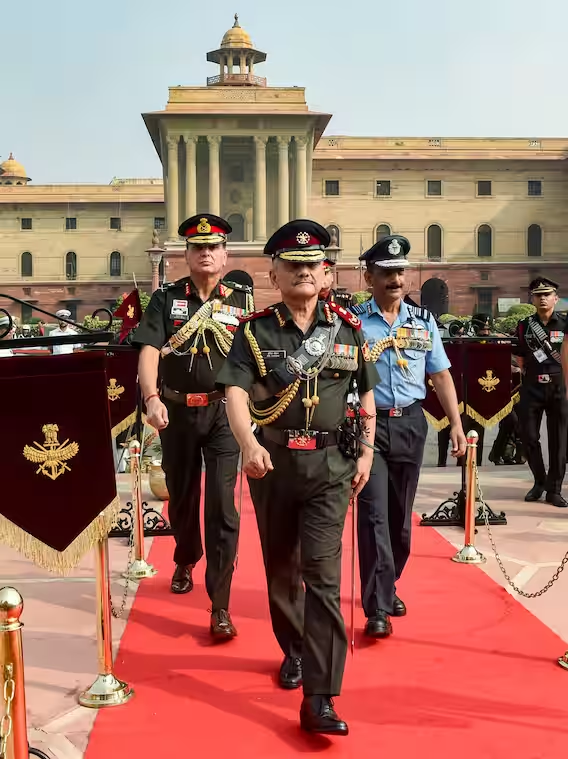
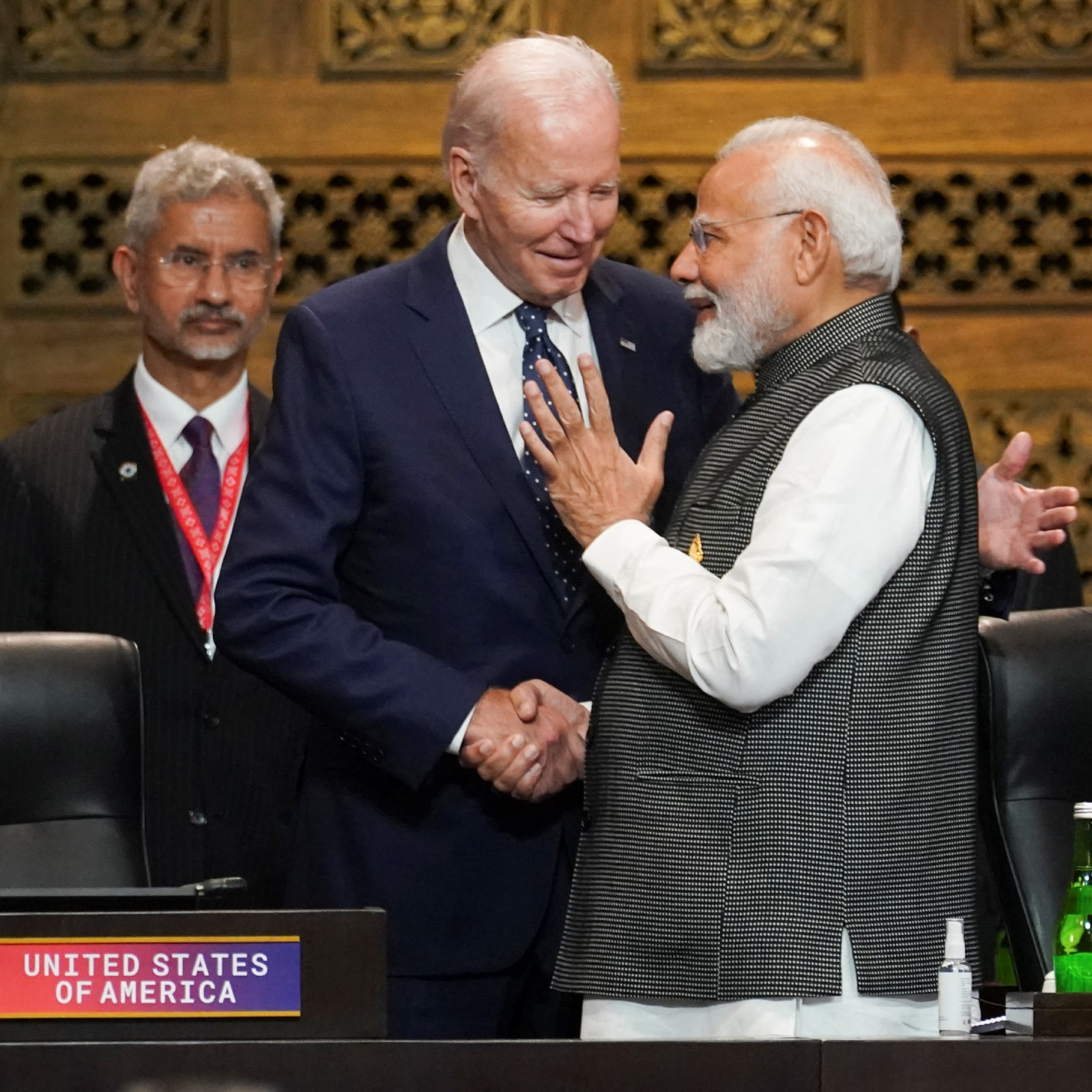
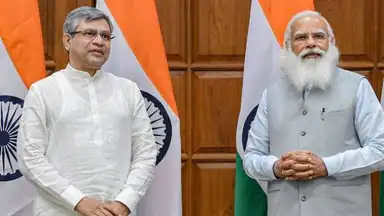
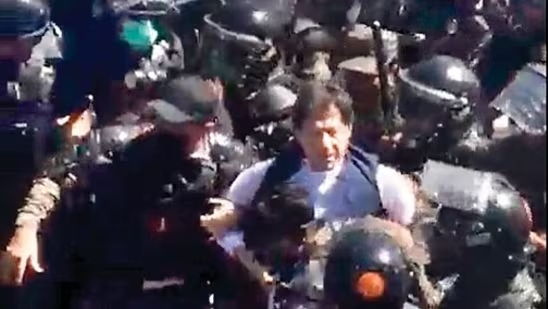


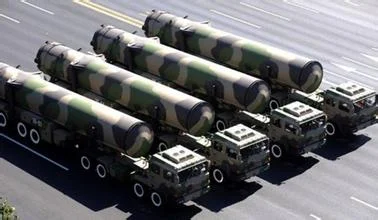


 Security Wise