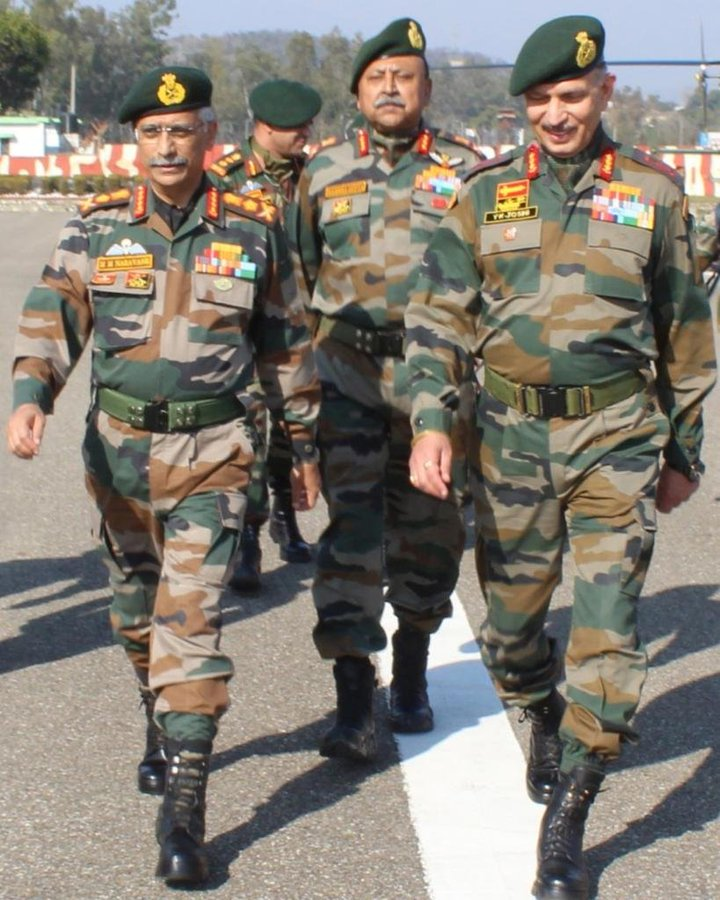
[2020 army chief General MM Naravane & Northern Army commander Lt Gen YK Joshi]
There’s at once much more, and much less, to the quotes from the memoirs — Four Stars of Destiny, of the former army chief, General MM Naravane, carried in a commentary by Sushant Singh, an ex-army officer turned perceptive commentator, published in a recent edition of the magazine, Caravan. Access to this otherwise paywalled piece is available at https://archive.is/20260202071854/https://caravanmagazine.in/security/navarane-memoir-ladakh-crisis. The quoted parts are, apparently, the most controversial portions of the book that has not so far been cleared by the Defence Ministry for public release. If the content of these quotes is the reason why the Modi regime is chary, then it is needlessly apprehensive. Because, in reality, it is more damning of Naravane than it is of Modi and his government.
But what’s the brouhaha about? It has to do with the nature of the government’s directive, specifically, the defence minister Rajnath Singh’s instructions, to Naravane to deal with a situation on the Line of Actual Control (LAC) created by some PLA tanks from its Moldo garrison rumbling uphill towards an Indian position at a higher level in the Kailash Range on 29 August 2020, and the Northern army commander YK Joshi pressing him to allow the firing of his medium guns in response. The drama in Sushant Singh’s narrative refers to Naravane “making frantic calls to the leaders of India’s political and military establishment, including Rajnath Singh, the defence minister; Ajit Doval, the national security advisor; General Bipin Rawat, the chief of defence staff; and S Jaishankar, the minister of external affairs”, asking each of them, in the army chief’s words “What are my orders?”
This is mighty strange, but why were Doval, CDS, and the Minister of External Affairs, Jaishankar, of all people, even on the list that an increasingly frazzled Naravane was contacting to get instructions from? Were these persons in a formally designated heirarchy whom the army chief was, protocol-bound, to call serially for his orders with an imminent clash brewing? And did these people constitute what Sushant Singh calls ” a government committee” put in-charge of developments on the LAC by Prime Minister Narendra Modi? “My position was critical,” writes Naravane finding himself between Joshi “who wanted to open fire with all possible means” and a government committee “which had yet to give me clear-cut executive orders.”
And, if the persons, ostensibly on that “committee”, were called for directions by Naravane in that emergency in 2020, are these same persons still to be called for pol-mil instructions that the current or a future chief of the army staff is/will be expected to get his guidance from should things heat up on the disputed border? To put it plainly, why should the army chief expect an “executive order” from any one other than the Defence Minister? And why should it be tactically detailed? Look up the political directives from US President Franklin Roosevelt to General Eisenhower at the beginning of the American involvement in World War II — when American forces reached North Africa in 1942, and before Normandy landings in 1944, and consider just how undetailed they were. Or Churchill’s guidance to his theatre commanders, from a British politician who was a known authority on military matters. Rajnath Singh, in comparison, is a provincial Hindi Belt politician, like many others in the cabinet, who couldn’t spot a military drone from a hobby drone if his life depended on it.
But the guidance that was issued, and who issued it is the nub of the story. Implicit in Naravane’s account is his dissatisfaction with the Defence Minister’s instructions. Rajnath Singh, albeit after consultations with the PM and others, as the memoir reports, advised Naravane “Jo uchit samjho, woh karo”— do what you think is appropriate. Why was that directive wrong or inadequate, and why are doubts being raised about the Defence Minister as the order issuing authority, and Prime Minister Modi charged with dereliction of duty, and of shirking his responsibility for a decision that Naravane exaggeratedly believed could have started a running war with China? Sushant Singh thinks it was the PM’s call that he didn’t make — a very questionable thesis.
In the event, Naravane decided correctly to have Indian tanks with the lead army unit get into hull down positions, lower their guns and get set to fire downhill at the advancing line of Chinese tanks — actions that stopped the PLA armour in their tracks, ending that particular incident.
This denouement raises several troubling questions. First of all, about what Sushant Singh calls an “existing protocol” — “clear orders not to open fire” till, in Naravane’s words “cleared from the very top.” Why is such a protocol there at all? That’s my peeve — what is so special about the LAC that it has to be treated with kid gloves, and even the smallest troop movements have to be cleared by the China Study Group — that apex group of Mandarin-speaking nay sayers headed by NSA, before its decisions go up the chain to the PM?
But, to return to Naravane’s narrative, isn’t Rajnath’s directive with the PM in the know not “from the very top” then? Why does he, Sushant Singh, and other like-minded people, have a problem with that? And, if as the ex-army chief says, it made for “purely a military decision”, again, what’s wrong with that? Shouldn’t all tactical decisions on the LAC, in any case, be taken at most by the Divisional commander, if not lower commanders? Why bring the corps and theatre commanders even and, more ridiculously, the COAS, into it? The real problem from Naravane’s point of view, it would appear, was that he was “handed a hot potato… [a] carte blanche [to do whatever he thought was best, with] the onus…now totally on” him, and he did not cherish it. It turns out, he did not want to make that decision, have that onus on him!
In that case, what does Naravane, and others who think like him, believe the army chieftaincy is about — endless rounds of meetings in South Block with chai and samosas/biscuits, inspections of army formations and facilities with the requisite pomp and bandobast, making speeches, taking off on the occasional MEA-arranged foreign trip, and similar fun things? Or, for taking hard decisions in crises?
But Naravane dramatises the whole thing — about his sitting “with the map of J & K and Ladakh on one wall, Eastern Command on another”, visualising “the location of each and every unit and formation” on marked and unmarked maps, and about his contemplating various factors, such as the ongoing Covid pandemic, a faltering economy, fractured global supply chains and whether the army and government “Would…be able to ensure a steady supply of spares, etc., ….in case of a long-drawn-out action? Who were our supporters in the global arena, and what about the collusive threat from China and Pakistan?” But, he reassured himself that he had the necessary reserves, and that the army was “ready in all respects” before the Hamlet in him surfaces again: Writes Naravane “but did I really want to start a war?”
Sure, military chiefs are assailed by doubts before a big operation or even small actions but, as history shows, usually these are mostly about the war/ops plan, the assets deployed, the sufficiency of resources to sustain it, and the quality of his commanders implementing it. But, why was he thinking about things that are the preserve of others laterally or higher in the food chain to weigh and evaluate, and which was not his remit? After all, Rajnath had handed him a “carte blanche”.
Last week, at a talk I gave to a Higher Command Course in a military training institution, a student officer, in response to my view that India and its military need to be more aggressive and assertive when it comes to war and warfighting, asked if the military should not be “more responsible” because of the economic straits the country is in, etc., the kind of talk especially from military officers that gets up my nose. Seemingly, Naravane’s type of thinking is the prevailing norm for officers slated for promotion to higher ranks. And I said to this officer what I say here regarding Naravane’s attitude: It is none of the military brass’ damn business to think like politicians or diplomats or economists. Attend on the offensively desirable military outcomes you should be delivering whether any recessive-minded government wants it or not!
Remember how the late great general and commander 17 Mountain Division, Sagat Singh, the man who singly got us the victory in the Bangladesh Liberation War in 1971, handled the PLA with offensive disdain and, disregarding his immediate corps commander GG Bewoor’s directive, and the same protocol and CSG constraints Naravane faced, beat up on the PLA and retained Nathu La Pass for the country in 1967? And how Naravane’s predecessor in office, General K. Sundarji, in his Op Chequerboard, exactly 20 years later, showed resolve to tangle with the PLA that its High Command did not expect, forcing the Chinese to withdraw from their intrusion in Somdurong Chu? Imagine what a Sagat or a Hanut Singh, the great armoured commander, when he took over the same Chhangu-based 17 Div would have done with a carte blanche that Naravane was afraid to exploit.
The PLA is a puffed up paper dragon, deflate it, let local commanders mount continuous offensive tactical actions that may lose a bit of ground here, gain a bit of territory there, to make the LAC a live theatre. The army may be surprised by the dividend such a policy will fetch for its own reputation and by way of politico-strategic gains for the country with respect to its negotiating position. Being a perennial punching bag does not help.


 Security Wise
@BharatKarnad
I’m writing this with some hesitation. I have come across a actual genuine digital copy of Four Stars of Destiny, General naravne’s book whose continued ban without transparent clarification raises serious concerns about free speech and intellectual inquiry in a democracy. I have the pdf and link of the book .Some senior member from congress shared it so that audiences can read the uncensored version. Because the actual hard copy of the book would never be able to make it to bookshops
I do not support piracy, nor do I wish to act irresponsibly. At the same time, the suppression of ideas through indefinite bans feels deeply troubling. I wanted to seek your guidance on whether sharing the link or the pdf of the 448 pager book on this blog channel would be appropriate or not. So that the audiences here can read the book
No, it would be an infringement of copyright and other laws.
Sure even i thought the same.I respect the author and his hardwork in writing the memoirs.
@BharatKarnad
Greetings, Sir.
Thank you for your characteristically forthright and provocative essay on General Naravane’s memoir and the Ladakh crisis.
I had a few questions that your piece raised for me, and I’d be grateful for your thoughts.
1)You describe the PLA as a “puffed-up paper dragon” and advocate continuous local offensive action along the LAC. How do you assess the risk that such a posture could hand escalation dominance to Beijing by allowing it to choose the timing, scale, and narrative of retaliation, especially under nuclear overhang?
2)Do you see General Naravane as an outlier, or as a representative product of India’s current higher command selection and grooming system? If it is the latter, what concrete institutional changes beyond exhortations to be more aggressivewould you propose to produce the kind of commanders you admire?
1) Zero danger of escalation dominance — China does not want a live front to their southwest when Japan, South Korea, US are at the east end.
2) Typical
Whatsapp msg from Air Marshal Harish Masand (Retd), former Adviser, Light Combat Aircraft programme
Feb 9, 8:15 am
Just read your article on Naravane. Were you in Mhow last week for the talk to the HC? On similar lines, I had sent to some folks who asked me to comment on this issue on WhatsApp.
Regards,
Harish
Email from Dr V Siddhartha, former Science Adviser to Defence Minister
Mon, Feb 9 at 1:18 PM
Re: “Last week, at a talk I gave to a Higher Command Course in a military training institution, a student officer, in response to my view that India and its military need to be more aggressive and assertive when it comes to war and warfighting, asked if the military should not be “more responsible” because of the economic straits the country is in, etc., the kind of talk especially from military officers that gets up my nose. Seemingly, Naravane’s type of thinking is the prevailing norm for officers slated for promotion to higher ranks. And I said to this officer what I say here re: Naravane’s attitude: It is none of the military brass’ damn business to think like politicians or diplomats or economists….”
As you know Bharat, today’s officers are exposed much more — through the media, mostly Western — to geo-political events and discourses, and so are much more aware-biased of geo-political amplifications of even local, tactical, MilOps anywhere. So, rather than this admonishment, it would be better if, pedagogically, that amplification is fully acknowledged, BUT include in the elaboration that the loci of such (valid) considerations are not the military commands, but the NSC and its secretariat…. adding that, we (India) are handicapped by wholly inadequate intellectual capabilities to make the needed “what if” assessments as an ongoing scenario-painting activity — dynamically updated by our actual military engagements. The result of such inadequacy is the absurdity of Indian wide-media quotation of this foreign assessment:
https://chpm.ch/wp-content/uploads/Operation-SIndoor-15-January-2026.pdf.
What would have been the media/Congress/Parliament reaction-noise if that Swiss assessment had been adverse?
VS
Wish, Sid, I had the pedagogic skills you assume I have which I don’t. So that part of your well meaning advice is above my competence grade.
But the other thing about official India/military latching on to rinky-dink reports and comments from Western sources to validate their position, is tragic, but unsurprising.
if you are in telegram
Pls share me @Xzgghugbm
Alas, I am not.
Email from Lt Gen Ajay Kumar Singh (Retd), ex-GOC-in-C, Southern Command, and former Lt Governor of Andaman & Nicobar
Mon, Feb 9 at 1:13 PM
Bharat I concur with your analysis. It was in fact a call of the Army Cdr & Chief not the political heirarchy. The China Study Group is to provide politico diplomatic military guideline , not direct military ops in hot situations.
We in the military have developed a culture of always looking over our shoulders during crunch time, many reasons for that, but we keep that for another Day.
Once on a talk at higher comd , I was asked to name the Achilles Heel of the Indian Army? My answer was – there are many but most critical is the operational level leadership.
we must transition from a reactive-defensive posture to a proactive-escalatory framework. In the high-altitude friction of the LAC, the window for tactical dominance closes in minutes, not days.
The Proactive Escalation Model (PEM)
Looks good.
This is mighty strange, but why were Doval, CDS, and the Minister of External Affairs, Jaishankar, of all people, even on the list that an increasingly frazzled Naravane was contacting to get instructions from?
The answer is, and I am sure you know full well, that someone now doesn’t become COAS of the Indian Army unless they are “ji huzoor” types who are accustomed to be risk-averse from their careerist inklings. All of the independent-spirited, gung-ho, cowboy-type military officers are either weeded out or have their upward progression stunted at the Colonel and Brigadier levels. Even the great Sam Manekshaw faced a Court of Inquiry for not adequately deferring to his higher-ups (including to the then RM Menon). But things have worsened since. Brig Surinder Singh’s expose of how the upper tier of generals worked in Kargil (to deflate initiative and then steal glory from others) is revealing enough.
True.
Actually, SHFJM faced inquiry, instigated by VKK Menon, because he allegedly kept a painting hanging of a British/Raj pooh-bah in the main Messroom at the Services Staff College in Wellington, Nilgiris, when in the 1950s he was commandant.
Pity Brig Surinder did not get his due for first alerting the army to the Pakistani infiltration in the Gurez Sector owing to a god awful bunch of commanders up the line.
Sir, can Kargil and Sindoor be interpreted not as crisis responses but as predictable behavior in an enduring security competition — and if this rivalry is structurally permanent, is managing escalation the best India can achieve rather than resolve the conflict for good?
The (asymmetric) Pak action and Indian conventional reaction are always on predictable lines aren’t they? There’s no structural determinism at work here that canot be got around by GOI making an effort to coopt, not the Pakistani politicians, which has been tried before but, as I have argued in my books, by cutting a mutually beneficial deal with the Pakistan Army, which has not been attempted!
Yes, Pak Army can be co-opted if the Indian ‘threat’ is minimised, as I have advocated, by unilaterally (1) removing the forward-deployed Indian nuclear missiles, and (2) rationalising the 3-strike corps posture to a single composite strike corps. This last has happened with the armoured Divisions in I Corps and XXI Corps already moved to the LA, and II Corps remains in tact. None of these moves will hurt India’s security in the least!
What we next need to do is contract to buy all the sugar, cement, truck tyres, etc that Pakistani companies owned by the Pakistan army’s Fauji Foundation, produce! Voila! we’ll have GHQ, Rawalpindi, as a friend! That’s how imaginatively we need to tackle Pakistan, by dealing with the Pakistan Army! It is the Chanakyan way of rendering the adversary amenable! And, for God’s sake, have a cricket detente with T20 and cricket test series! Let Pakistani players join the IPL, Indian Hockey League, kabbadi league, etc. Let there be a free movement of Paki movie, TV, and singing stars. And permit unhindered and open TRADE! Who do you think Pakistanis would rather be strategically pally with? Culturally in sync India, or the inscrutable Chini?
Second point sir, how/can we make China co-opt with us? Using RIC framework, finalising LAC? Doesn’t look that we are getting Aksai Chin or for that matter even PoK back, might as well make them permanent and settled, isn’t it?
China is an eternal enemy.
@BharatKarnad
Professor Karnad, with great respect for your strategic imagination and Chanakyan framing, I remain unconvinced that the Pakistan Army’s hostility is primarily a function of Indian threat posture. Christine Fair’s Fighting to the End presents a deeply researched argument that the Army’s rivalry with India is institutional and ideological, not merely reactive.
Drawing on Pakistani military publications and doctrinal writings, she shows that the Army views itself as the custodian of the Two-Nation Theory and as a revisionist force committed to contesting India regardless of conventional asymmetry.
Even when acknowledging India’s military superiority, it has repeatedly chosen persistent, low-intensity conflict because such confrontation sustains its domestic dominance, budgetary primacy, and political relevance. In that framework, hostility is not simply a response to forward deployments or strike corps posture; it is embedded in institutional identity.
Expanding trade with Fauji-linked enterprises could create economic stakes, but it may also further entrench the Army’s corporate autonomy without necessarily moderating its strategic doctrine. History suggests that Pakistan’s strategy has relied on sub-conventional methods under a nuclear umbrella precisely to offset conventional imbalance.
If India unilaterally reduces visible deterrent posture absent reciprocal doctrinal change, the risk is not large-scale war but calibrated gray-zone pressure. Cultural affinity between Indians and Pakistanis is real and valuable, yet strategic alignment for GHQ is determined less by culture and more by perceived power utility where China continues to provide arms, diplomatic shielding, and balancing leverage.
Engagement and normalization may indeed be desirable goals, but if Fair’s diagnosis is correct, then altering material incentives alone may not transform an institution whose identity has been shaped by sustained rivalry. A calibrated approach that preserves credible deterrence while testing reciprocal economic and cultural openings might therefore be more prudent than front-loaded unilateral contraction.
but i would like to debate with you on this
Yea Christine is an old acquaintance, but don’t take the title of her book literally, for God’s sake! Look at the Pak army’s record in ops!
It definitely seems like a systemic problem. I’m young, and a civilian but interested in army affairs, however, I do not hold them in awe, especially since reports of actual heroism resulting from good decision-making are few and far between.
Looking at the larger picture, the system is bound to rot from within if it is an acquired system, historically speaking. This is especially true for us whose native consciousness and approach to decision making has been replaced by western hierarchies and culture. The lesser that can be said about the contrasting martial ethics the better.
The result is this pathetic, bastardized brainchild of a mongrelized culture propped up by the state using force and glorified by the usage of English words in incoherent ways to appear elitist to the common folk of the nation.
Observing closely, what I see is a deep-seated animosity and an arrogant streak among the army fraternity towards the “dirty natives”, insistence upon foolish rules that were meant to rule upon an oppressed people rather than to serve it.
A few exceptions to this atmosphere remain in the lower ranks and serve as cannon fodder should some crisis emerge, and considering the standard rule of “return on investment”, it’s highly inconvenient to have an intelligent, axe- wielding chief out for owed territory than it is to have a pet dog of a chief who whines and groans every time a laughable adversary like China approaches our very receded borders. Making murals of Akhand Bharat will no more make it a reality than will a muslim’s cry of “No other god than allah” 5 times a day, no matter how sincerely one believes it.
Until action is take, we are a pathetic people with a pathetic nation unworthy of even conquest.
Thanks Bharat Dada for a meaningful and thoughtful Insight on the COAS Narvane’s excerpts from his book.
When is your next book in the offing.
Gautam Koppikar
It has been “in the offing” for long, but should finish it by mid-year! (Cross my fingers!)
Good overall breakdown. However, a sense of impending doom and depression doesn’t escape me.
Are we doomed as a race to limit ourselves to blogposts? Are we doomed as Hindus to view ourselves as sheep surrounded by lions and wolves? Have we resigned to our fate upon the pyre, despite being alive, aware and well-capable of standing our ground?
How long can we continue to watch our nation be buried in plastic waste, construction rubble, and smog? Granted this may not be a platform for this, but perhaps my grievance stems from the persistence of the common thread amidst these problems that ought to keep us up at night; weakness.
Who may we be doing this for ultimately? Ourselves or the world? Retaking lost territory or even defending it against what exactly? I think our basis for defense and self-definition are so drowned and lost under the frankly laughable ideals of the constitution that we, unfortunately, hold so sacred that we never have a simple, straight, and consistent answer for why this land needs defense in the first place.
I am not even talking about the lobby that actively propagates an impotent Gandhian logic. I am talking about general lack of motivation in anyone in the state apparatus to successfully defend against, safeguard, and actively weaponize the abundant resource we have within our land to our disposal.
Naravane is a symptom of a deeper problem. War will likely expose many more elements such as these, so why shy away from it? Are we really afraid of loss of lives in a land that has been historically the most invaded, and yet historically the most successful in repelling relentless and continuous invasions, a fraction of which erased great civilizations many times over?
We need to ponder over these questions. Looking at your bio Mr.Karnad, I am certain you must feel the same way though I cannot tell why we were unable to channelize our faculties effectively.
Regards.
PLA is a puffed up paper dragon🤣🤣.
Yet the strongest military in the whole universe cannot win against it in war games simulations. The same strongest military could not beat up a bunch of goat herders in Afghanistan nor it could defend its reaper drone against the Houthis.
Enough of being a armchair critic Sir.
That the US military in its fighting troops, minus tec support, is no good is a given. What has that got to do with the PLA? And, in any case, it in no way disproves the fact of the paper dragon. Recall that the last time the PLA entered the lists, it was thrashed by Vietnamese irregulars in the Chinese invasion in 1979. So…
US has said officially that China conducted a nuclear test secretly, that too just after Galwan. Does such technology exist sir?
Trump talks, sometimes on the basis of a faulty understanding of technology. China may have conducted “cold” nuclear tests — detonations short of explosions.
“I can reveal that the U.S. government is aware that China has conducted nuclear explosive tests, including preparing for tests with designated yields in the hundreds of tons,” U.S. Under Secretary of State for Arms Control and International Security Thomas DiNanno told a Disarmament Conference in Geneva.
The Chinese military “sought to conceal testing by obfuscating the nuclear explosions because it recognized these tests violate test ban commitments. China has used ‘decoupling’, a method to decrease the effectiveness of seismic monitoring, to hide their activities from the world,” he said.
Above quotes is from a news article sir, shouldn’t India attempt this?
As long as there’s a workable fusion weapon design, cold tests can help upscale the yield.
The general was busy in pooh paah instead of focussing on his core job.Now the armed forces will blame lack of weapons or some general will give emotional statements like we will fight with what we have and push more mindless imports of weapons.This must be the reason why the political bosses prefer diplomacy over military option. Imagine how they will respond if China gives nuclear threats
May be we also need to import generals besides weapons
Hello @BharatKarnad ji,
I would appreciate your perspective on the following report:
https://timesofindia.indiatimes.com/defence/news/indias-fifth-generation-stealth-fighter-jet-will-amca-be-made-by-private-players/articleshow/128109804.cms
As per the report, HAL has been excluded from AMCA race and only private giants are eligible now to participate in the tender process.
You’ve been an advocate of greater private sector involvement for building indigenous defense systems.
Given the ambitious timeline for AMCA, Do you believe these companies will be able to pull this off?
From a standing start by 2040, yes!
Would you pls discuss ,how India is again going for Rafales jets. Is there no option left ?
Plaese look up the most recent and earlier posts on the subject.
hf marut 73 was about to come out and be a back bone of IAF it got sidelined & got dumped. now Tejas seems to be going the same way such stark similarity the same playbook is being rolled out again.
Professor, Does your new book have something on Russia-Ukraine war and its spillover efffects in geo-politics and military planning. The fact that war of attrition has boiled down to economic collapse more than societal collapse as it used to be due to autonomous weapon ystem and somthing on dollar dependence fallacy ?
Yes!
But, there’s a detailed chapter on the Ukraine and Gaza Wars which, I am afraid, may not make it to the final cut!
can we get a Ukraine summary on its 4th year on 24 February, detailing your viewpoint on it and it’s ramifications.
The notable implications in my sight were:
1)wheeled vs tracked APC/tanks
2)Combined usage strategy of tanks and artillery in drone arena and jammed areas
3)war of attrition being changed to economic terms than human bodies as it used to be earlier
4) Infantry having different drone requirements at each tier
Shivam
Prof, pls consider scripting a new piece on two strange and inexplicable visits: (1) Sergio Gor’s visit to Western Command HQ and (2) Bill Gates’ sudden visit to Andhra in the midst of all kinds of scandals and clouds hanging over him and then received there like the Pro-Consul. As for both, is it proof positive that India has been reduced to vassalage status to the hegemonic power of the day?
Gates’ Andhra visit is to seal the data centre deal, I suppose. But Gor’s to Western Command is perplexing — surely there’s nothing Indian mil/intel can tell the US govt they don’t already know about Pakistan. So the briefing by GOCINC is to guage Indian army’s readiness for war/more punitive strikes?
Mr. Karnad you should pen an article on the following comedy. It made India the butt of jokes on the global stage;
https://www.indiatoday.in/india/story/galgotias-university-asked-to-vacate-india-ai-summit-after-china-made-robodog-fiasco-sources-2870105-2026-02-18
Why a separate article? Galgottia U at AI Summit is its own farce
Because it was the responsibility of GOI since the event had the backing of Indian establishment.
There’s a basic rule of vetting all the applicants and the displayed products beforehand.
Isn’t it a failure of Mod establishment?
The excuse bandied about is that there were too many exhibitors for the summit authorities to vet every claim, every product.