
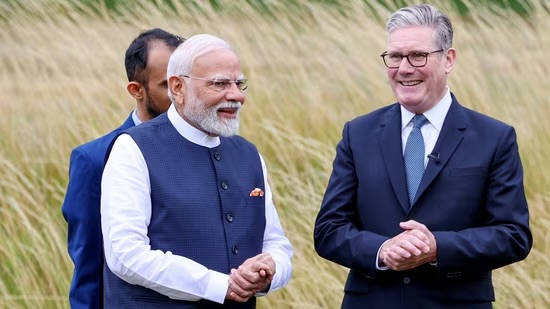
[Modi and UK prime minister Kier Starmer]
When Sir Thomas Roe presented himself in the Mughal Emperor Jehangir’s court at Agra in 1614 as the ambassador of Elizabeth I of England, he did so on the condition he would not observe the rituals of paying obeisance — all the bowing and scraping, to the Badshah. But Roe was an effective enough salesman to have his social transgressions tolerated, because in next to no time he came away with a royal firman permitting the English a trading post in Surat. Apparently, Jehangir didn’t think much about allowing the firangis an economic toehold on the subcontinent. Had he foreseen that small measly presence being parlayed by Britain in time and by strategem into the Raj – the crown jewel of its worldwide empire and the Pax Britannica that followed, he might have had second thoughts. But early 17th century was not exactly Marshall McLuhan’s global village, and inconceivably long distances and a remote kingdom “saat samandar paar” seeking to buy spices, etc. would have been seen as affirming the status of the “Great Moghul”. So Jehangir may be excused his inflated sense of self-importance, and ignorance of geostrategics.
But, what is Prime Minister Narendra Modi’s excuse for gifting India’s sovereignty to Britain 411 years — read that again, four hundred and eleven years — later, this time in the digital realm and, once again, by way —what else— of a trading arrangement? Now it is not spices but sovereignty over source codes and the ever-growing mountains of accumulated and aggregated uniquely Indian government data that foreign countries covet, and the sovereignty over which the Indian government has agreed to surrender to Britain as part of the Comprehensive Economic & Trade Agreement (CETA). So what Modi has sacrificed, in effect, is the country’s digital security and sovereignty.
Seeing the wide, self-satisfied, smile of commerce minister Piyush Goel as he signed CETA even as his British opposite number smirked (or did I imagine that?) like the Cheshire cat in Alice’s Wonderland, whose smile remained even as the feline disappeared, it is plain that neither Goel nor the so-called trade “experts” in his ministry have even a smidgeon of understanding of what “digital sovereignty” is, or comprehend the enormity of what they have so breezily given away. But giveaways, as I have time and again mentioned in my books and other writings, are an Indian government standard. So, what’s new? Goel is a minion of little importance, but he took his tasking orders from the PM. So it is Modi who has to answer for imperiling and compromising the nation’s digital future.
Ironically, around the time Goel was claiming a “gold standard” for CETA and asserting that no sensitive sector was compromised — by which he just meant agriculture, GM foods, Modi in his Varanasi constituency was waxing eloquent about swadeshi and dilating on the global economy, which he said, faced “multiple uncertainties and an atmosphere of instability. In such a scenario”, he declared, “countries across the world are focusing on their own interests”, before exhorting everyone to “remain vigilant about our economic interests.”
Either, Goel has not got the message, or he is doing his master’s bidding. If it is the latter then it suggests that neither Modi, nor anyone else in the vast Government of India, quite has the hang of the digital world, and how the PM’s talk of zealously protecting India’s “economic interests” and his minister’s making India-generated data about everything (every little digital transaction, digitized bank account data and digitized bits of personal information of a billion and 400 million Indians however gathered) a universal commons, as it were, where any country can graze and mine data for its purposes, are contradictory policies. And with Goel & Co. formally conceding access to Indian “government data” and opening up government procurement to the British, will the European Union, the United States, Japan, and whichever other country seeks a free trade agreement be far behind in demanding similar consideration?
Indian government procurement contracts at the central, state, and local levels worth some $750 billion annually are now opened to bidding by foreign companies — a more deleterious development for local industry cannot be imagined, but here we have the Modi regime permitting it! This subject has been dealt with in previous posts.
This post is about the two other issues: First, digital sovereignty, and secondly, the quite astonishing negotiating error of not including major streams of transfer of India’s wealth to America by the Commerce Ministry when negotiating an FTA with the Trump Admin. After all, what is trade but the transfer of wealth from one country to another.
But first, digital sovereignty. It has two components — “source codes” and “digital data”. Source codes refers to the software behind all goods and services. “The most surprising giveaway”, write Smita Purushottam and Parminder Jeet Singh in an op/ed — “What has been missed is India’s digital sovereignty”, The Hindu, Aug 2, that everybody in government ought to read, “is on India’s sovereign right to seek ex-ante access to the source code for foreign digital goods and services, even for those deemed sensitive.” (Ex-ante, is a Latin phrase denoting predictions and forecasts about future events, and with reference to CETA means that India cannot insist on source codes for anything the country may buy from the UK even though software is integral to nearly all products and services.) This, as Purushottam and Parminder point out, is “a 180-degree turn away from [India’s] steadfast stand in the World Trade Organisation”.
The source code issue in defence is exemplified, for instance, Dassault Avions refusing to part with the source codes from the Rafale combat aircraft that the Indian Air Force and navy have bought at enormous expense to the exchequer (at last count exceeding $35 billion). No source codes means India cannot integrate its missiles to this combat platform. Why has the Modi government not insisted on source codes as part and parcel of the multibillion dollar deals? Perhaps, Paris was aware for many years that New Delhi was prepared to cutout the source code issue from its FTAs , as now proven by CETA. Who knows?
Purushottam is a former Indian ambassador to Switzerland and founder of a remarkable little organisation — SITARA (Science, Indigenous Technology, Advanced Research Accelerator), comprising a team of domain expert volunteers in the forefront of pushing indigenous technology to an Indian government and military inclined, at the drop of the proverbial hat, to “buy foreign”. I know of no other diplomat who, in retirement, has done more substantive work in the nationalist cause. And Parminder is arguably the leading expert on digital sovereignty in the country. Their views are known to the government. Both of them should have been an inalienable part of the Commerce Ministry teams negotiating the FTAs, but are not.
Incidentally, the US, recognizing that security, regulatory and law enforcement imperatives require source codes, reversed its stand on source code prohibitions. Washington likewise backtracked on “granting equal and non-discriminatory access” to government data (which in an earlier era represented “government transparency”) to foreign countries in its FTAs. The Modi government, in its wisdom or lack of it, has taken an exactly reverse tack to what America has done even when such modified position grievously hurt the national interest.
But the Modi regime — flowing against the current — reversed itself , for no sensible reason, on the source codes and access to government data issues thereby centrally endangering India’s digital sovereignty and, principally, national security. It has created a new vast vulnerability from what was an extraordinary position of strength — its massive government data bank generated within India that the UK and other foreign countries will now be able to exploit at will. “It is incomprehensible”, write Purushottam and Parminder “why India with intention to become an Artificial Intelligence (AI) super power” would accept in principle that government data “is not a sovereign resource.” Facilitating easy foreign access to this data will, they warn, “erode India’s competitive advantage” in using its own data to create Indian AI products. Such as its own large language models. And further, that foreign states with access could easily weaponise the massive Indian information bank against India.
After all Artificial Intelligence is nothing more than machines discerning patterns in mountains of data — the larger the data pool the better, at phenomenally high compute speeds, to provide options to the decision maker in the corporate world, government, and the military.
Providing further evidence that Goel and his Commerce Ministry babus are a bunch of reckless dunderheads, they agreed to further consultations with the UK government on “free flow of data” and “data localisation” — the two most contested issues in the AI field, and denotes they write, “a dangerous regress and visible vulnerability” with regard to the country’s long held positions. Again, the US as the leader in the AI field along with China, has withdrawn from propagating these issues, even as India heads blindly into digital bondage because, as Purushottam and Parminder also point out, FTA texts will end up defining the global digital order. In this situation India can opt for the Western big-tech-oriented digital architecture or preserve its digital autonomy and sovereignty — it cannot do both at the same time. And once in, and the deeper India is entangled, the more difficult it will be for the country to extricate itself.
As in the foreign and military policy spheres, in the digital area too the Indian government has so far blundered along, keeping its head above water by being “reactive”, with no “clear road map” of where it wants to go. This policy path of not knowing where to go and how to get there is a liability dragging down the country. Per Purushottam and Parminder what is desperately needed is the formulation of “a full-fledged digital security” and “digital industrialization” policy, which alone will enable the government to negotiate from a strong position and to “create the space to become a digital super power” rather than remain a “digital colony”, which is what FTAs like CETA will end up doing.
—————
But, alas, the national interest is hostage to the tender mercies of the generalist diplomats and civil servants running the show, even as Modi believes he is doing so! In the recent past, it obtained for the country the 2008 nuclear civilian cooperation deal negotiated by the generalist joint secretary and now minister, S Jaishankar, that strangled India’s ambitions of becoming a hefty thermonuclear weapons power until such time as the country gets a government with the will and the gumption to resume open-ended high-yield thermonuclear tests in the face of American opposition, and repays China for its nuclear missile arming of Pakistan by nuclear missile arming every country on the Chinese border. And now we have these generalist IAS-wallahs and their ilk screwing things up things fatally for India and complementing Jaishankar’s surrender of the country’s thermonuclear security by surrendering its digital sovereignty as well, all without flinching.
But not content with undermining India digitally they are now ensuring, under Goel and the aegis of the Modi dispensation, that India slips into the status of America’s economic vassal. Or, why else would the instructions go out from the PM’s office to every ministry to make lists where concessions can be made, and products and services can be bought to reduce the trade deficit with the US? The Modi regime behaves like a mangy dog with its tail between its legs when approached by a bigger one making noises.
If with respect to digital security and sovereignty, the Commerce Ministry had better learn from Messrs Purushottam and Parminder and recover the lost ground fast, with respect to the nitty gritty of negotiating with Trump’s trade reps, the country’s interest would have been better served had they heeded Ajay Srivastava’s advice. Srivastava, a 1989 batch trade officer, left the comforts of a sarkari job to start a think tank — Global Trade Research Initiative (GTRI), which is doing yeoman service for the nation. In a Reuters story published by Business Standard, May 26, Srivastava revealed the fundamental flaw in Minister Goel and his Commerce Ministry’s strategy of limiting the negotiations to what Washington desires, just trade where India has a $44 billion surplus, a figure that has got Trump hot under his collar.
But this is only the visible part of the trade imbalance iceberg. What the Indian side has not done, Srivastava reveals, is bringing to the negotiating table the US revenues generated in India for the American education, digital services, financial activities, intellectual property rights payments, Hollywood, Netflix and entertainment industry, royalties, and defence sales sectors, which when added up would turn the tables all the way around, and show a $35-$40 billion US surplus. More than enough for India legitimately to justify imposing higher tariffs on these unaccounted American export sectors and activities the “massive earnings” from which, Srivastava says, “do not show up in the narrow goods trade statistics. When you factor them in…the US…is sitting pretty.”
Srivastava deconstructs the “the non-trade” figures of the US trade surplus with India thus: Indian students payout to American universities in Fiscal 2025 is $35 billion ($25 billion in tuition and $10 billion in living expenses); Tech giants — Google, Meta, Amazon, Microsoft, et al earn from India some $15-20 billion, American Financial Institutions and Consultants earn another $10 -$15 billion, and Global Capability Centers that create and innovate new technologies, services, and products for the American majors take in $10-$15 billion, and IPR payouts in pharmaceuticals, et al amount to $1-$1.5 billion. All this adds up — at the highest end of the revenue scale to some $86.5 billion. (Not sure why in the Reuters story Srivastava pegs this transfer of Indian wealth to only $35-$40 billion when it is more than twice that amount!)
So, how come the geniuses led by Goel in the Commerce Ministry, and other resident economic geniuses in the Government of India (in the PM’s panel of Economic Advisers, for instance) missed such a vast amount of wealth being yearly shuffled off to the US right before their eyes? Talk of being robbed blind. Shouldn’t Modi demote Goel to Animal Husbandry or something lesser and send the generalist babus assisting Goel responsible for this ridiculous situation, packing?
It is a situation where the Modi government is cringy and fearful of the next Trump strike, when the figures show that, far from India being on the defensive — something the Indian government reflexively adopts in any interaction with the US and the West, the Modi regime should be on the offensive in the trade negotiations with the Trump Administration, and talk of raising tariffs on US imports to equalize the transfers of wealth.
But will Modi, even at this late stage, do what’s beneficial for the National Interest and scrap any talk of any more buys to placate Trump, and stand up to Washington or, will he, as is likely, do as he has done repeatedly — cave in to every big power in sight — to the US, China, and whoever else next comes before him?


 Security Wise
If India has revered its long standing WTO position on data sovereignty then this is an onerous development indeed. Never the less. Please correct me, but my reading of the Chapter 12 provisions of CETA are:
Choice of what data to make available is with the governments.
Ref : https://www.commerce.gov.in/international-trade/trade-agreements/india-united-kingdom-comprehensive-economic-and-trade-agreement/
Primeargu@ — 1) it is ex-post (not ex-ante, that’s concerning) & 2) it is the proverbial foot in the door (for God’s sake!)
Thanks. Agree with your point about shoe in the door. Gives a excuse to future babus to start non discriminatory access for all and sundry to GOI data.
West is far better at erecting non trade barrier than us on government contracts also, which is another issue you have raised in past. I fear more of the leverage foreign companies will get on our government servants once billons of dollars worth of contracts are at stake.
On regulatory body for source code though, it can be ex-ante. For instance the agreement can and should be read such that a regulation can require to share source code for inspection and test in case of critical infrastructure, telecom etc to a regulatory body.
Email from Dr v Siddhartha, former Science & Tecnology Adviser to Defence Minister
12:34 pm
4 Aug at 12:34 pm
Re:
“If it is the latter then it suggests that neither Modi, nor anyone else in the vast Government of India, quite has the hang of the digital world, and how the PM’s talk of zealously protecting India’s “economic interests” and his minister’s making India-generated data about everything (every little digital transaction, digitized bank account data and digitized bits of personal information of a billion and 400 million Indians however gathered) a universal commons, as it were, where any country can graze and mine data for its purposes, are contradictory policies. “
This is correct.
VS
This is so reminiscent of the three “foundational agreements” that the Modi govt signed whereby the Indian military core electronics systems were opened up to the US agencies. The Manmohan Singh government to its credit had long resisted the US pressure. Now with a hostile US, look where that has got us.
@BharatKarnad
1)India has been targeted by the United States and the European Union for importing oil from Russia after the commencement of the Ukraine conflict. In fact, India began importing from Russia because traditional supplies were diverted to Europe after the outbreak of the conflict. The United States at that time actively encouraged such imports by India for strengthening global energy markets stability.
2. India’s imports are meant to ensure predictable and affordable energy costs to the Indian consumer. They are a necessity compelled by global market situation. However, it is revealing that the very nations criticizing India are themselves indulging in trade with Russia. Unlike our case, such trade is not even a vital national compulsion.
3. The European Union in 2024 had a bilateral trade of Euro 67.5 billion in goods with Russia. In addition, it had trade in services estimated at Euro 17.2 billion in 2023. This is significantly more than India’s total trade with Russia that year or subsequently. European imports of LNG in 2024, in fact, reached a record 16.5mn tonnes, surpassing the last record of 15.21mn tonnes in 2022.
4. Europe-Russia trade includes not just energy, but also fertilizers, mining products, chemicals, iron and steel and machinery and transport equipment.
5. Where the United States is concerned, it continues to import from Russia uranium hexafluoride for its nuclear industry, palladium for its EV industry, fertilizers as well as chemicals.
6. In this background, the targeting of India is unjustified and unreasonable. Like any major economy, India will take all necessary measures to safeguard its national interests and economic security.
this is what MEA replied back when it was asked about tarrif and oil issues
i mean the fact is our MEA does not know how to deal with china and america but it feels good to see that this time they are hardening there stance
what are your views on this
Dear Sir,
Trump just now imposed total 50 percent tarrif.
What should be India’s answer?
1)Agni 6 test
2)threthen US with BRICS currency
3)RIC military alliance
4)reciprocal tarrif and closing NGO’s related to US
5)ban all future US military equipment buying
@Deepak
should be Agni 6
a genuine long range ICBM
specially for a uncertain and unpredictable future is needed The most
@Nuclear General
without Agni 6 with 12k plus range test US can do nuclear blackmail anyday. Only once they know we have unstoppable missiles which can eliminate their cities they will speak to us with equals like they do with China or Russia. Right now you can see lot of arrogance in Trump abusing India almost daily.
@BharatKarnad
Sir your recommendation to indian government to nuclear missile arm states on Chinese periphery strategy is 200 percent practicable and i agree with your point
but if we look it at from another perspective why can’t the west and US do the same if they are so concerned about the rise of a new superpower China
your views ?
Ask them
@BharartKarnad
Sir may I suggest you write a new blog on Ajit doval’s meeting with putin and supposedly(not confirmed yet) modi’s visit to china
Any comments on article by arun prakash
https://indianexpress.com/article/opinion/columns/80-years-since-hiroshima-in-the-wake-of-operation-sindoor-the-nuclear-conversation-10174415
he talks about same old gaurd escalation dramatics and stuff ,
how do you analyse the escalation in case of op sindoor CDS referencing herman kahn 44 ladder escalation plan ,your comments on herman kahn escalation matrix in context of India-pak
Dear Sir, US bullying has increased under Trump with economic threats, abusing India everyday and supporting Pakistan. Biden administration created east Pakistan again out of Bangladesh, interfered in internal politics of India, tried to harm Indian business in many ways.
Now we can safely say anti India policies of US is bi partisan. So called US India strategic partnership is practically dead but only remain on papers.
We never know when this threat limited to economics will turn to military threat.
Even after agreeing for most of the US goods to be near 0 tarrif big bully Trump not ready for a deal. Trump wants to dump his garbage gmo foods,animal fed dairy and other chemical intensive grown agricultural goods to screw India’s farmers,fishermen, livestock holders and make Indians sick with lot of diseases.
It is time to show this big bully door and align with China and Russia through RIC.
RIC can easily stand against NATO and BRICS can create alternate economy.
We should keep an eye on Chinese buildup and build all deterrents against China not to be under illusion of Hindi Chini bhai bhai like Nehru era mistakes.
Let them earn some money by continue to arm Pakistan . Let us build superior weapons to counter those weapons.
We should get some basic understanding with China(a tactical deal) that we can still fight our unresolved issues later but first bring down the big bully US and create a multi polar world.
What is your opinion on this.
When you accept an inferior position, expect bullying.