
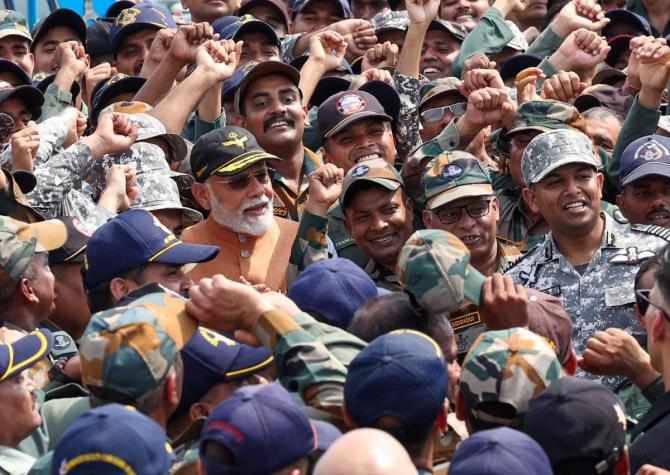
[The PM at the Adampur air base that Pakistan claimed had been destroyed by their missiles]
Rediff.com sent me a slate of questions May 12, 2025 for an email interview. I responded. My original replies reproduced below. A more sanitised version, was published in 2 parts. The first part was published May 13, 2025 — “‘India Missed Opportunity To Take Back Parts Of PoK’ , at https://www.rediff.com/news/interview/operation-sindoor-india-missed-opportunity-to-take-back-parts-of-pok/20250513.htm; and the 2nd part — “China Will Keep Supplying Pakistan Weapons”, at https://www.rediff.com/news/interview/operation-sindoor-china-will-keep-supplying-pakistan-weapons/20250514.htm was published May 14, 2025.
The interview with my original responses:
1) President Trump said a little while ago that ‘We stopped a nuclear conflict. I think it could have been a bad nuclear war. Millions of people could have been killed.’ Were India and Pakistan, in your assessment, truly on the verge of atomic Armageddon last week? Or is it typical Trumpian overstatement?
A: It is the usual Trumpian hyperbole. The nuclear swords were nowhere near being unsheathed as the US President makes out. It is in his interest, however, to vastly exaggerate his role as ‘peacemaker’, considering he has been frustrated in Ukraine and Gaza, so Op Sindoor was a godsent for him.
2) CNN reported that US Vice President Vance, Secretary Rubio and White House Chief of Staff Wiles were alerted by intelligence on Friday that compelled the US to get quickly involved in resolving the India-Pakistan crisis after initially shrugging off any involvement. Apparently, the ‘intelligence’ was about an Indian airstrike coming perilously close to breaching one of Pakistan’s nuclear storage sites. Could we have done so considering both India and Pakistan have a list of each other’s nuclear sites, precisely to avert that dire possibility?
A: Indian missile attack on Chaklala — HQ Strategic Plans Division — Pakistan’s nuclear secretariat, may have been a wakeup call. But the ops cell of SPD is situated underground which the Indian missile could not have, and was not, designed to penetrate. The message sought to be conveyed to Pakistan was the seriousness of India’s intent. Whether its was so accepted is questionable.
3) If this information to the White House came from the Pakistanis, could it have been truthful? Could it have been classic ISI deception designed to alarm the Americans, get them involved in finding a resolution and get them to persuade the Indians to call a cessation of hostilities especially when Pakistan is in no economic condition to continue a long war?
A: Sure, it is quite possible the Indian attack on Chaklala (and also allegedly on targets in the Kirana Hills where there might be some nuclear testing facilities) was exploited by Islamabad to get the Americans to step in to stop the proceedings. But that is not the reason for the American intercession. The fact is the US cannot afford to let Pakistan go under, or to suffer grievous harm because it is at once the most pliable and the most critical ally in Southwestern Asia which it simply cannot do strategically without. It is this fact of international life Messers Modi, Jaishankar and the MEA seem not to appreciate with their futile attempts to try and replace Pakistan with India in America’s strategic calculus. Islamabad knows its value, its indispensability, to the US and the West generally and, therefore, keeps pushing the envelope. In the event, if India ever girds up its loins to militarily wrench important areas of POK from Pakistan, it will have to do so in the face of active American opposition. Understand that!
4) Should India have accepted the offer of a ceasefire when its military objectives were incomplete?
A: No. But then it does not seem the Indian government and the military had any LOC-changing, POK territory-grabbing, objective in mind for Op Sindoor. And a golden opportunity to exercise the option of making a lasting impression on the Pakistan army was lost. More so because Pakistan had opened the doors for Indian actions to grab vital pieces of POK when Islamabad announced it had “suspended” the 1972 Shimla Accord, which legitimised that ceasefire line — the LOC as virtually a boundary. The chance was thus missed to rationalise, i.e., to straighten, the LOC as I had advocated in my ‘Security Wise’ Blog of April 30, by capturing the Haji Pir Bulge at one end, and even Skardu at the other end to link up with the Indian control of the Saltoro Muztagh to the Siachin Glacier.
The short point is, a military operation has to impact an adversary’s thinking and mindset in the manner desired. Had Haji Pir and/or Skardu been taken, the message would have gone out not just to General Asim Munir and his cohort in the Pakistan army but to the Pakistani people that every terrorist incident in India would lead to substantial loss of territory in POK. This would have proved a powerful motivation for GHQ, Rawalpindi, to give up its use of terrorism as a successful tool of asymmetric warfare against India.
5) Do you think India had no option but to accept the ceasefire because the government would not want to displease Mr Trump?
A: Have never understood the tendency of the Indian government, whether under Manmohan Singh and now Narendra Modi, to bend its knees to Washington. It is, by now, a reflex Indian policy. Think of the leverages India has that the government does not use. Its geostrategic location and resources. Without India’s help and assistance the US policy of containing China in the Indian Ocean with India’s position astride it, and in Central Asia with its geographic reach to the north, is null and voided. And what about the “access to the Indian market” economic leverage? No economy, not the American, not the Chinese, can do without selling to India, peddling their wares to Indians. The government scrupulously avoids using it against the US and China, or in the context of the Free Trade Agreements being negotiated left and right. It is hardly a surprise that India, far from getting respect, has a burgeoning reputation for its timidity and for being a sucker.
6) Or was a ceasefire okay with the government and military because 1. We had achieved militarily more than what we set out to especially during days two and three of the conflict, and 2. Because the nightly drone attacks from Pakistan had scared and unnerved the unprepared-for this population in north Indian cities?
A: Of course, the Indian people have no experience of war, are easily rattled, and are jingoistic only upto the point nothing happens in a crisis! If this is a given, surely, the government would have factored this aspect into its calculations before embarking on the punitive drone and missile strike mission. And what great results have been achieved with these hits on Pakistani targets, pray? Indeed, if anything, the damage is so easily repairable, the Pakistani government, army and people are already celebrating the ending of the 3-day “war” as a great win for Pakistan! If anything Sindoor has led to elation in Pakistan as to how well its military handled India.
7) As one of India’s premier national security experts, what is your assessment of Operation Sindoor?
A: Sindoor served as a symbolic gesture more than it achieved a substantive aim. What, after all, was the purpose of the minimal military actions we saw unfolding in realtime? It is not at all clear. Will it prove a deterrent for the Pakistan Inter-Services Intelligence (ISI) from mounting terrorist actions in the future in J&K and elsewhere? Of course not, especially with the restoration, for all intents and purposes, of the status quo ante. So, what was it all about? Sure, as I suggested in my Blog post of May 7, a psychological barrier has been breached with the strikes on the campuses of the Lashkar-e-Tayyaba in Muridke and of the Jaish-e-Mohammad in Bahawalpur. But the effect should not be overstated. Because the Pakistani authorities had vacated both areas of people the day before the Indian missiles struck, suggesting the Pakistan army had intelligence on the incoming Indian attacks. Still, strikes on Pakistan’s Punjabi heartland is a threshold crossed.
8) By striking a wide number of terrorist targets in the first round on Tuesday night and military airfields in consecutive rounds on Wednesday night/Thursday night, did we inflict enough punishment on the ISI and the Pakistan army for the horrific Pahalgam attack?
A: No. Sindoor has caused some deaths and material losses, true. But the destroyed physical facilities can be quickly rebuilt, And youth schooled in little else but Koran in extremist-run madrassahs provide a steady and unending supply of jihadis and mujahideen. So net result: Sindoor will make no difference whatsoever to Pakistan’s attitude to Kashmir or to use of Islamist terrorism.
9) What surprised you most about Operation Sindoor?
A: I was surprised by just how restrained the Indian military effort actually was in contrast to the rhetoric following the Pahalgam massacre on April 22, when Modi talked of “unimaginable consequences”. So were any of the Indian strikes during Sindoor unimaginable? I was astonished, as well, that the government and the military did not prepare for swift and telling actions to oust the Pakistanis, at least, from the Haji Pir Salient that offers the ISI with the main infiltration routes into the Srinagar Valley from south of the Pir Panjal Range. One would have thought the time lag between Pahalgam and Sindoor would be used to get the forces ready for capturing Haji Pir. It was captured by 1 Para in the 1965 War only to be returned at the Tashkant talks in exchange for Chhamb that the Indian army lost. (Except, Chhamb was lost again to the Pakistan army in 1971, this time for good.)
10) Did any aspect of Operation Sindoor disappoint you?
A: Absolutely everything except the symbolic hits on Muridke and Bahawalpur, for the reasons detailed above.
11) Do you believe Marc Rubio’s assertion that India agreed to discuss all issues with Pakistan at a neutral venue? Would External Affairs Minister S Jaishankar and National Security Adviser Ajit Doval, who Rubio interacted with, given the Americans such an assurance? Has the Trump administration restored the hyphen with Pakistan that vexed India’s leaders and diplomats for years?
A: There’s some confusion about what it is the Jaishankar-Ajit Doval duo agreed with the US Secretary of State Marco Rubio on. According to retired dipomats, who may or may not be plugged into the official loop, that “neutral site” was accepted on ambiguous terms. That does not detract from the fact that New Delhi wilted under American pressure. Whatever the truth, the fact that the Modi regime accepted the US as an intermediary establishes a bad precedent that Pakistan will capitalise on in the future both because it formally defines America as an enforcer against India, and because it re-hyphenates India and Pakistan — a giveaway which is a manifest diplomatic disaster. One had hoped that South Asia had left behind the hyphenation phase for good.
12) In a sense, does this conflict redefine war, when adversaries don’t cross their territory, but hurl swarms of drones and missiles at each other? Can such a stratagem be limited in its duration and geographical spread?
A: Yes, in fact, this is medium-term future war in embryo. Weapons with lethality and range will be more important than platforms, like combat aircraft. This future will transition soon to Artificial Intelligence-driven autonomous weapons systems slaved to fused information dissemination systems aided by quantum computing with the ability to surveil and prioritise target sets, in effect, to war solely by machines. Such wars were first imagined by HG Wells in his 1898 book — the War of the Worlds! Except, Wells’ adversary were Martians invading the earth!
13) Do you believe India achieved its objective — of punishing the terrorists and their sponsors — this time more than it did in 2016 (the surgical strikes) and in 2019 (the Balakot air strikes)? Unlike those two military events where evidence was rather inconclusive and sparse, there is enough photographic and video evidence this time to satisfy sceptics.
A: With the hysterical TV, press and social media coverage, where are the skeptics? The few of us, saying “Hang on! Look at the evidence” are drowned out. Not sure what great effect the 2016 response to the Pathankot attack, had. Further, as analysed in my wriings, the 2019 Balakot operation was a sheer failure with the Israeli SPICE 2000 GPS-guided bombs overshooting the target, and a farce even, with the IAF MiG-21 pilot, Abhinandan, captured the next day, returned, and given a gallantry award for getting shot down!
14) Will such forceful military action get the terrorists and their sponsors in the ISI and Pakistan army to end their campaign of murder and mayhem? Or is that highly unlikely given that using terror to hurt India is a long established Pakistan military doctrine and not one the ISI/Pakistani army will renege from no matter what India’s actions? The terrorists may lie low for a while before resuming their sinister campaigns.
A: Pakistan lost nothing in Sindoor for its army to change its mind about the utility of terrorism as an asymmetric weapon to keep the Indian government and military unsettled. Why would they give it up?
15) Prime Minister Modi just declared that future terrorist attacks will be dealt with militarily, like the one we saw last week. This seems like a directive from the Mossad stylesheet. But Israel bombing weakened neighbours is very different from India taking on Pakistan each time — God forbid — terrorists strike in the Kashmir Valley, especially as some Indian defence observers have pointed out there is near parity between the two militaries. Is this new ‘doctrine unrealistic with the possibility of continued and sustained actual military confrontation like we have not seen and the possibility of this going off message in an extremely dangerous way?
A: Please don’t compare Modi’s list to Mossad’s modus operandi, which is nothing as catholic! Israelis never leave anything they start half done.
16) Since the ISI and the Pakistan army won’t call off their beasts, what options does India have to prevent horrific acts of terror like Pahalgam 22/4?
A: If the Indian government won’t use the incidence of Pakistani sponsored terrorism to territorially diminish POK, there is no disincentive whatsoever to ISI to divert from its strategy that has pushed India to the wall.
17) What has been the fallout of Operation Sindoor in Pakistan in your opinion? This entire episode, beginning with the Pahalgam attack, was seen by Pakistan-watchers as a gambit by Asim Munir to shore up his own and the army’s battered-by-Imran Khan image? That the Pakistanis would once again see Munir and the army as the only guardians of national interest, able to protect them, against India. Has that illusion been shattered by India’s deep strikes into Pakistani territory? Why do you think the Pakistan military failed to thwart India’s attacks?
A: Whatever the other fallout, the Pakistani military, surely, would worry about just how porus and ineffective its air defence systems proved in preventing Indian drone and missile salvo firings. Otherwise, the Op Sindoor worked out according to their script!
18) What about the Chinese presence in this 72-hour war? Beyond the anodyne statements asking India and Pakistan to observe restraint, was China a not visible participant in this conflict by transmitting satellite-conveyed observational intelligence to GHQ Rawalpindi and, of course, by pitting Pakistan’s Chinese weapons against India’s Western origin armaments.
A: China visibly gloated — did anybody notice the self-satified smirk on the face of the Chinese government spokesman when he advised retraint? Its client, the Pakistan Air Force, in particular, professionally combined its Swedish Saab Erieye AWACS to spot IAF aircraft as targets in Indian airspace, the small numbers of the Chinese J-10C fighters armed with the apparently deadly Chinese long range PL-15E air-to-air missile (A2A), flying in passive mode until cued to the target by Erieye, and firing on Indian aircraft for very good effect. There was no comparable IAF performance. Indeed, after the first day the Rafale was grounded along with its much touted Meteor A2A missile with the supposedly largest kill-cone of any A2As of some 65 degrees. This grounding suggests a Rafale was shot down by a Pakistani PL-15 over (Bhatinda? in) Indian territory, and why the IAF did not want to risk another such Pakistani hit.
19) What does the almost direct Chinese involvement in the 72-hour war augur for future conflicts with India? Could the Indian Army confront a two front situation in the future, and how could we overcome it?
A: The lesson Beijing would have learned is that there is, cost-benefit wise, no better option than to keep the Pakistan military supplied copiously with its most advanced armaments, certain that in hostilities with India these would be used for maximum effect. And that this, in turn, would burnish the image and reputation of Chinese-built military hardware in the exponentially growing international arms bazaar and increase its arms exports, besides showing up India and its military as not even the equal of Pakistan.
20) Was the rapprochement of October 2024 with the Chinese a mistake? Why did we reach out to the Chinese after four years of asserting how badly the India-China relationship was? What, in your assessment, was the reason for this? Was it the uncertainty of dealing with the Trump administration that led us to this folly?
A: Prime Minister Modi and the external affairs minister Jaishankar should answer this. Sure, in Trump’s world it is good for India to have relations with China as policy leverage. But considering that the status quo ante on the disputed border with China as of 2020 has not been restored and China has made no concessions elewhere, such as in trade and investments and, on the other hand, Trump has time and again succeeded in making Modi look like a chump who can be pressured into doing whatever Washington wants, including buying, as is strongly rumoured, military hardware including the hopelessly bad F-35 “so-called 5th gen” warplane. The fact is whatever the policy the Indian government is pursuing is not working. How much more evidence do they need?
21) 60 years ago, Britain negotiated a ceasefire between India and Pakistan after repeated skirmishes in the Kutch. A couple of months later, India and Pakistan fought a brutal war. Could we see a replay this year, especially with an ambitious and unpredictable general at the helm of Pakistan’s army? Will Pakistan use this pause in battle to rebuild its arsenal with Chinese help and perhaps some part of the billion dollar loan that the IMF had just given Islamabad (who is to know, right?)?
A: Look, it is clear the $1.3 billion IMF loan was the means to influence Islamabad into accepting the termination of Sindoor. There’s another $7.4 billion tranche of credit awaiting clearance. So, GHQ, Rawalpindi, will do nothing until that second lot of money is in their hands before letting the ISI allow the LeT/JeM cadres, now grouped under ‘The Resistance Front’, to once again launch terrorist acts in J&K, and possibly elsewhere in India. If Modi is to be taken at his word, this will mean many more Sindoors, hopefully, with different results!


 Security Wise
whats the crazy fascination with a rafale being shot down? You attack and their air defense or a air to air strike took down a rafale. So? India hit ELEVEN airbases with impunity. Its a clear win. Tom cooper agrees.
https://xxtomcooperxx.substack.com/p/illusions-and-realities-of-cross
https://xxtomcooperxx.substack.com/p/illusions-and-realities-of-cross-b6c
most OSINT guys agree pakistan was beaten to a pulp.
It was sure an incremental improvement over Balakot but will it deter, dissuade Pakistan?
Capturing Haji pir would have cut inflitration route which Pakistan uses after establishing air superiority we should have gone for it or atleast damaged more of their air assets and damaged their airforce you just don’t leave it halfway.We did call out their nuclear bluff though
Tom Cooper has also criticized the way our airforce and militiary leadership conducts war and how our war strategies outdated we arm without any aim unlike Pakistan army which had invested in AWACS.Pakistan knows how to optimise the resources and arm themself in a way that can deter India inspite being 1/8 our economy.There is a lot for Indian military leadership to introspect they just can’t always hide behind insufficient defence budget issue there has to change in our doctrines and way we conduct our war.Our militiary has not come with new age doctrines or warfare we always catching up unlike the west or China which came up cyber warfare, drone warfare,Rocket force .
agreed that the initial strike was poorly planned and SEAD operations were a must. But this is mostly on the govt as it dictates whats on the table and what not and if they told the IAF not to hit the pak military what choice did they have? And as far as deterrence is concerned, read christine fair. Nothing will ever be a deterrent. Theyre ingrained from birth to do this shit. All you as indians can do is secure the borders(a task in itself considering the geography) and hit them everytime a mass causualty event happens. Nothing will deter them. Israel has decimated gaza. You think itll help? Nope. Americas 20 odd year war against terror. Did it help? No. Indias cross border jihadi problem will never go away and theres no magic solution to it. Be a hard state. They kill ten, you kill a thousand. Thats the only deterrent. And a short lived one at that.
I don’t understand why China seems to take pleasure in hurting India. There is no deep-rooted history of enmity like there is between India and Pakistan. Does China really see India as a serious threat? India neither has the intent nor shows much interest in building the capacity to challenge China. Its posture has largely been defensive, unlike Pakistan, which often tries to provoke India.
China’s behavior towards India including its support for a nuclear-armed Pakistan almost feels personal, as if it holds a grudge similar to what it has with the West or Japan. But India is nowhere close to those countries in terms of rivalry or confrontation. Whatever grievances China may have had against India were supposedly settled during the 1962 war. So why does it continue to sustain this hostile policy?
China has far more to gain by maintaining better relations with India through market access, strategic geographical proximity, and India’s talent pool, which it could potentially tap into. Yet, it chooses confrontation over cooperation.
China used to see India as “Western Heaven”; it certainly wouldn’t want it to regain that status, since China sees itself as the world’s only superpower.
Dear Sir, excellent analysis by you. As I commented in earlier post our solution is always easy tactical(more like a pest control) not difficult strategic.
to achieve strategic solution which you are proposing like annexing parts of pok and GB we need to have complete backing of US diplomatically and militarily if China opens another front.
Modi should be prepared to get treated like how Putin got isolated by west.Both west and muslim countries may boycott him for territorial aggression in the name of anti terror operation.
People should be ready for economic hardship,loss of life and property in case war goes on for years like Russia Ukraine war.
govt should solely focus on the war and handling the annexed territory for years which will have effect on economy and other things.
Big results cannot come without big sacrifice.
do you think Indian govt and people are really ready for any of these hardships other than suggesting break pak into 4 parts,capture pok, make balochistan independent etc in tv studio shows and social media posts to achieve bigger goals?
@BharatKarn
professor which book of yours explains this in detail. The importance of pakistan for the american government
This one
“The fact is the US cannot afford to let Pakistan go under, or to suffer grievous harm because it is at once the most pliable and the most critical ally in Southwestern Asia which it simply cannot do strategically without. It is this fact of international life Messers Modi, Jaishankar and the MEA seem not to appreciate with their futile attempts to try and replace Pakistan with India in America’s strategic calculus. Islamabad knows its value, its indispensability, to the US and the West generally and, therefore, keeps pushing the envelope”
and specifically the american help in the nuclear weaponization of pakistan.
I agree with professor and reiterate his words that India should recognize Taiwan and start arming it up later potentially with nuclear weapons technology. After this we will see Beijing being critical in not helping pakistan. We should make china’s neighbors hostile towards it as pakistan is for India. Yes it’s hard but very much doable.
Dr Karnad, I don’t agree with your views that ” both US and China cannot do without exports to the Indian market” as facts on the ground show. China’s total exports to India are just 3.3 percent of China’s overall exports whereas for the US , exports to India are just 1.3 percent of overall American exports. So , no we don’t have any cards on this so-called 1.5 Billion Indian market.
So, why are US and European Cos. eager to replace China with India in the global supply chain, except as a means to keep their hand in, in the Indian market which potentially is huge. And big even by most country standards.
Dr Karnad, I believe most of “China+1” companies have gone to places like Vietnam, Laos, Mexico etc( that is one of the prime reason for Trump tariffs), moreover most of Indian middle classes seemingly in the stagnation mode in the last few years. So even consumption wise we are not as we like to project ourselves. Please go through this one. https://www.google.com/amp/s/m.thewire.in/article/economy/interpreting-indias-middle-income-trap-position-and-its-implications/amp
@bharatkarnad If India is serious about punishing Pak for terrorism, why should it not impose its own sanctions on companies, defence included, who trade or invest in Pakistan. There may be exceptions given to specific companies like GE etc we don’t have alternative to at the moment. This will mean much more than countless dossier to foreign embassies.
https://www.scmp.com/news/china/science/article/3310320/china-reveals-tech-breakthrough-behind-pakistans-hypersonic-strike-india?module=perpetual_scroll_0&pgtype=article
why south china morning post is mentioning Pakistan detroyed a S400 battery in adampur airforce base ..
by western standard south china morning post was authentic before it was taken over by ALIBABA..
dont why they are publishing unverified and propganda report or is it true they destroyed S-400
Because SCMP is China’s paper
Couldn’t agree more with you on “emulating China”. What could be more beneficial for us than the Chinese System, from which everything good flows. Modi has the opportunity to write himself into the history books as someone who changed the paradigm, crossed the Rubicon and ushered in golden age of India.
America wants us to be an ‘Open Society’ ,i.e, ‘Open to American Control’ (OTAC); they want us to be defangued and neutered, and democracy ensures that we remain that way.
https://xcancel.com/MikeBenzCyber/status/1922119136030711987#m
https://xcancel.com/MikeBenzCyber/status/1921308745130209656#m
Email from Dr V Siddhartha, former Science Adviser to Defence Minister
V Siddhartha
Thu, 15 May at 12:11 pm
[In the foreign media] the hyphen in India-Pakistan is in bold.
China’s renaming of Arunachal places is to claim that stopping water flow of Yarlung Tsangpo (on Indus-Pakis behalf) is an “internal matter” of China.
VS
Professor Karnad,
I fully agree with your somewhat pessimistic assessment of Sindoor.
Most of all, I agree with your perception that the Modi team is mistaken in trying to push for greater deference to India over Pakistan, on geo-strategic grounds. Theirs is a futile effort because the choice of Pakistan by the West is based on cultural and religious affinities. Does the Modi team even guess this, with its rather annoying assumption of the mantle of Vishwaguru. The Abrahamic faiths will never give parity to a Hindu nation.
This basic failure was compounded by the lack of clear public messaging and loss of control of the narrative around Sindoor, early on. In an age of hybrid war, this was the weakest part of the Indian attack.
Is the Indian government not fully aware that Pakistani terrorists are a proxy for Anglo-Judaist ambitions in the regions? That India must be contained, no matter what? Are they aware that placing their faith in Israel, the cockpit of Anglo-Judaist empire, while sparring with Pakistan, is like trying to enlist the Medellin cartel in your war on drugs?
I look forward to your assessment and comment to this following news:
https://timesofindia.indiatimes.com/india/us-military-strategist-slams-trump-admin-for-not-blocking-imf-aid-to-pak/articleshow/121196427.cms
Have been saying this over the last 35-odd years and in all my recent writings — Pakistan is nonexpendable to the US
What is the fundamental interest for the US that goads it to “permanent bonding” with Pak in violation of the wise adage that a Nation State has no permanent enemy or foe in the international world excepting its permanent interest? True it is recorded in history that Gilgit served the Americans in the distant past (1959-1960 vintage) as its base to enter the Soviet territory by a spy plane whose pilot Gary Powers was shot down by SA-2 long range sam and captured by the then Soviets. That is passe, what is remaining now? You have not touched this point as I understood in your writings. Could you please give your insight here.
Dear Sir, again IMF bailout package for pak, Trump crypto deal with pak. Trump betrayed India, a reality check for Modi govt.
I think US is no less enemy than China. US always like to interfere in internal affairs of India to create anarchy like situation, reduce growth of India in all fields, strengthen enemies of India like Khalistanis,pak etc to contain growth of India.
Us needs India only to counter counter China and sell Us products.
What are the options now?
Do you think it is better to strengthen BRICS and go for dedollorization to get rid of US dominance rather than getting used by US to contain China?
The comments here are disheartening. Are readers here still under the impression that horizontal (nation v. nation) interaction is definitive? They ignore vertical (supranational v. national) interactions at their peril.
It is not so much China v. India or Pakistan v. India as it is elites acting through segments of each country in their own interests, using national conflict to solidify transnational goals.
Readers here also seem unaware of the religious dimensions of this supranational agenda. Pakistan is a Muslim country of a specific kind, intended as a battering ram against the rise of any power that might threaten the hegemony of the financiers behind the British empire.
It is time we discard the labels and address this reality.
Dear Sir,
Why is the Navy going with Rafaels? If Tejas (N) is already there what’s the logic, from Navy’s perspective, to skip it for the Rafaels?
Further, with the kind of threats that may come to carriers at sea in the future (case in point – look at how a US Navy carrier recently had to make an abrupt turn to avoid an incoming missile from Houthis which apparently toppled a fighter plane)
do we face the same risk for the costly Rafaels in future ?
Thanks !
Had the monies spent on Rafale (M) been invested in the Tejas carrier variant, it would have taken just as long to be on the deck as the Rafale, with its last batch entering IN service 65 months from now!
why you are not politically connected?? …we are your fanboys and fangirls but unless ur not propagating ur views to upper echelon of power circle it is not getting into policy and implementation and please start a YouTube channel so that u can get more visibility…and also it can get some traction in policy circle..
Kumar@ — Thank you for your kind interest. Yes, I have been approached by many in the past few years with your kind of suggestion. But, quite honestly I don’t know how to start a “YouTube channel” or even a podcast. And further, I wish I were 10-15 years younger and had the drive! I am 77 — a healthy 77. Still, that’s too old to start something new, methinks! Perhaps, I am wrong….But I take consolation from the fact that my views still percolate in policy and military circles (or, so I am told).
@BharatKarnad
during this india-pak drama while I was scrolling through twitter I came upon your account on twitter.Sir you joined it in 2011 but stopped posting your articles and writing tweets.Your last post was on 09/05/2023 exactly 2 years ago.
i mean sure a youtube channel demands time and efforts but you should definitely think about twitter you already have thousands of followers with so much less posts.Also twitter has a much larger audiences.
So yeah take it as a suggestion and do give a thought about reposting and writing on twitter again
Yea, OK. Thanks!
So what’s your opinion about the removal of Article 370? In hindsight, has it been a wise decision? What has it achieved other than alienating Kashmiris?
Wasn’t having 10 million Kashmiris on your side worth more than 1,000 F35s and Rafales?
Such a shame that the current ruling elite of Chanakya’s land act in a way diametrically opposed to his principles.
RISAT launch failed again 2nd time in a row? Sabotage by US ?
@Vivek @BharatKarnad
cannot be sure about RISAT but professor tells in a podcast that Americans had turned off the navigation of the Agni 2 missile while we were testing them some 20 years ago and it failed . So might be possible again again i am just speculating
Sure, but this seems like an internal sabotage. Needs a thorough investigation
Dear Sir,
Writing you to seek an answer that is evading me post Op Sindoor. Having followed you for quite some time, I’ve been proponent of revamping India’s Nuclear Doctrine as suggested by you about the NFU & TOT (missiles etc) to anti China countries etc. Especially because we kinda indicate that emulation of the Pak’s doctrine could be somehow helpful to us in deterring China as well.
But after OP Sindoor, wherein some say that we have called off Pak’s Nuclear bluff, do you think that nullifying NFU etc will still result into some considerable gains?, Is there still scope & need to revamp our nuclear doctrine.
Unsure whether my mail will find your attention, but still decided to try. Hope to connect.
Thanking in anticipation. Maj Balaji Suryavanshi, 9421768340, 7478519494.
Suryavanshi@ — a Nuclear doctrine is only a guideline — not a strategy or policy, even less tactics. And it has to be periodically updated. Have suggested First Use ONLY against China. Have long argued that Pakistan’s nulear bluff needs to be called. For the first time, Sindoor called it and, as I predicted, nothing happened. The reason being the exchange ratio — the destruction of 2 Indian cities for the certain extinction of Pakistan as a social organism. That is a bad exchange and the professional Pakistan army knows it.
@BharatKarnad
First use against China?
won’t that be suicidal for us then China will call out our nuclear bluff
No. As I have argued, FU is for the forward deployed N-elements in passive-reactive mode after the PLA has breached our Himalayan defences
Pak Navy is acquiring new AIP submarines from China and are going to build a partial triad with N tipped Babur missiles on submarines. How does that change the dynamics in the subcontinent?
The 8 AIP-ed Hangor-class (ex-Chinese Yuan) and 3 Agosta-Bs will, of course, complicate Indian Navy’s war planning
Sir, I mean if we could finally call off the nuclear bluff of Pak, isn’t it that we adopting first use against china may not be of much deterrence in same way ? Won’t they call off our nuclear bluff? With the ICBMs even if we endanger 1-2 cities of China, their retaliation will be as heavy as ours towards Pak or not i.e almost total destruction of ours ?
Maj Balaji@ — The difference is in credibility. Pak has cried wolf too often and now that its bluff is called it has a problem. India has not adopted a forward deployed nuclear stance I have been advocating, but it will have to soon. Such a stance w/o any hoo-ha would be enough for China, which has its strategic hands full with the US and Russia, to bother particularly about India.
Dear Sir,
Post operation Sindoor, Us is worried about advancement in Indian military capabilities. Soon Trump may prioritize contain India policy over contain China policy.
What is your assessment on this?
Contain India will happen only after China is contained.
Exactly. It’s superb thinking by Churchill and the 1940s imperialists. They had tremendous foresight.
First contain China using India. Once China is subdued, then contain India using Pakistan. Once India is subdued, then contain Pakistan using Afghanistan.
Indians are extremely gullible, especially with the West. They also do not read as many international journals as they should, except for a few of the “top brands.” This ignorance, vanity, and ethnocentrism has come back to bite them.
Donald Trump is a New York liberal who has moved to the center-right over the years. He is close to (married into) Orthodox Jewish circles. He is a show man, TV host, luxury real estate developer and probably an agent of some sort. While he has professed friendship with Modi, he has also professed friendship with practically every other state leader. He has publicly called Modi a stone-cold killer. He has been close to both Islamophobes and Mossad agents as well as anti-Semites and Crusaders. Adding a few jihadists to the mix doesn’t change things.
Modi and most of his followers probably think of him as an “ignorant Yank,” little realising that”ignorant Yanks” are far cannier than Vishvaguru, carry a big stick, while whispering sweet nothings, and are hard-nosed realists and pragmatists in politics.
Indians are foolish in thinking they can partner with the West. It was the British which gave POK to Pakistan to ensure India is cut off from Central Asia and Pakistan has a lifeline to China:
https://en.wikipedia.org/wiki/William_Brown_(British_Army_officer)
@BharatKarnad
Greetings professor karnad I am quite new to your blog channel but I want to ask
1)what are your thoughts on one of the loop holes in the official indian nuclear draft doctrine
where it says that if our intelligence prior to a first launch detects or gets to know that a nuclear attack is 100 percent incoming then we will go first use and preemptive strike
SPD general kidwai in carniege seminar also said that Pakistan has no confidence on india’s NFU and the Indians have managed to find many execptions in their own doctrine.
2)why not have all first strike capabilities including canisterized missiles and still maintain NFU
If you could tell about these two Q
Thank you
Naman@ — What you mention is not part of the gazetted doctrine, but of the practical doctrine followed by the Strategic Forces Command.
It is impractical to canisterise all missiles. NFU is for a targeted to believe or not believe.
@BharatKarnad
I am not just talking about canisterized weapons I mean all communication, surveillance of our enemy forces. Our nuclear forces always being on high alert and all these first strike capabilities
also this is my logic that when a certain policy is declared(NFU) then the mindset of the people in SFC also gets aligned with those policies. And then at the critical moments it is difficult to change it overnight
Can you please tell more about that practical doctrine of SFC. If you are allowed to and if it’s not confidential
That is precisely why, I have advocated FU only versus China — the only adversary that’s likely, albeit the chances are remote, to trip the wire