
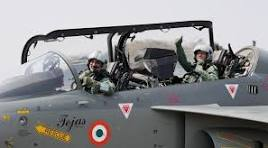
[IAF Chief, ACM AP Singh, taking COAS, Gen. Upendra Dwivedi, up for a Tejas spin]
The 42-squadron strength the IAF has flogged as its desired combat fleet size was originally spun out of the 50 squadron fleet recommended by the Committee chaired by JRD Tata in the wake of the 1962 War — fully 63 years ago, when ordnance was delivered by manned bombers. The 50 became 35 for want of resources before getting jacked up to 42 in the 1980s.
A 2-front wartime deployment plus reserve in the context of the PLAAF and PAF may have been the basis for settling on the 42 number. In reality though, it is just a number that’s gone up and down and up again — a function of the country’s finances, where it has been stuck for the last 35-odd years. But it is treated by the IAF as some kind of divine revelation, not to be trifled with. So, everytime any Chief of the Air Staff opens his mouth, it is to complain, issue dire warnings, about the “capability gap” attributed to the strength of the combat aircraft fleet declining to 30 squadrons, what with the phasing out of all MiG-21s from service by this year end, and the other fast obsolescing aircraft — Jaguars, Mirage 2000s and MiG-29s, that will need, the IAF brass claim, replacing inside of a decade, etc. The all-purpose panacea? 42 squadrons!
Sure enough, the recently elevated Air Chief Marshal AP Singh mouthed the same words. With print and television media faithfully relaying the CAS’ concerns and the talking heads on TV screens and press commentators echoing this oft-repeated nonsense — and this view, as intended, as always got a multiplier boost. The IAF has been very effective in getting what it wants by repeating this “procurement” spiel over the years, and pressuring the government into making ill-advised buys.
It led to the deal for 36 4.5 generation Rafales that Prime Minister Narendra Modi signed for during his April 2015 trip to France despite the by then deposed defence minister Manohar Parrikar’s well known doubts about this aircraft owing to the escalating unit cost, up from Rs 526 crores negotiated during the UPA government’s time, according to the Congress party, to Rs 1,670 crores, or over three-fold increase.
Further, the 36 Rafales in the Indian air orbat have nowhere met the the 70%-75% availability standard agreed on vide the Inter-Governmental Agreement of 23 September 2016, or 27 of the 36 Rafales being available at all times. This standard was demanded of Dassault because the frontline Su-30 MKI has serviceability rates of 55%-60% — the reason why Parrikar, by far the best defence minister the republic has ever had, suggested indigenously producing the Su-30MKI to meet IAF’s needs, and as the only imported component in the future fleet, with the Tejas (1A, 2, AMCA) as the bulk force aircraft. No wonder Parrikar was a bane, and pain in the you know what, for the IAF!
Whatever the Rafale deal has not done for India and the IAF, it did for the French aerospace industry — rescued it from insolvency. I had warned then — read my posts 2012 onwards! — that the initial 36 aircraft would be the wedge for additional 114 Rafales to fill IAF’s requirement of medium role fighter aircraft (MRFA). And also for the 26 Rafale Marine to equip the Indian aircraft carriers. The pitch for the naval version revolved around the commonality of spares and service support with the IAF Rafales. The flyoff of sorts then is pro forma, because now the IAF will argue it already has the servicing infrastructure for Rafale aircraft, and the Service would like very much to be less diversified to ease the logistics nightmare it has all along nursed!
In the event, there will be a “competition” for the MRFA deal — featuring versions of some of the same aircraft that have been in the running in the last 30 years — Lockheed F-21 — a differently designated F-16 Super Viper configuration, the Swedish Gripen, Russian MiG-35/57, and the Boeing Super Hornet F-18, that will be staged mostly for show. Unless…
Unless, the Modi government — like the preceding Congress and BJP regimes, again bends to Washington’s will. Except, Trump now will impose his terms, arm-twist Modi as he did on the tariffs issue getting New Delhi scrambling to accommodate. The question is which aircraft choice will he impose? Who knows why he publicly pushed Modi on the F-35 Lightning. May be he has bought stock in Lockheed! No US President has been so brazen in profiting from his office — it is almost refreshing! But he could go, equally, with the Viper or the Hornet. Whatever, India stands to be struck by Lightning or stung by the Viper/Hornet, and guess what gets hurt? Yep, the indigenous Tejas Mk 1A, Mk 2, and the advanced medium combat aircraft. The country cannot afford to buy yet another lot of foreign aircraft and, at the same time, develop and fly the Indian-designed, home-made Tejas family of fighter aircraft that could be the backbone of the country’s defence industry into the future. It can have one or the other.
Oh, yes, we have all heard IAF Chiefs crying crocodile tears over Tejas and how it is so dear to the service’s heart, how much it is committed to it, etc, etc. But, how, only for the nonce, the option of buying an imported combat aircraft off the shelf and assembling the balance of the requirement in India — preferably by private sector companies, will strenghten the Indian defence industry that, regretfully, cannot be avoided! It is a practised line that has been dutifully voiced by all CASs after PC Lal in the early 1970s. It was Lal who offered this explanation for choosing to kill off the advanced successor — the HF-71/72 to the HF-24 Marut, just so he could buy the British Jaguar. The Marut was created by the legendary World War Two Focke-Wulfe designer of the main Luftwaffe fighter FW109, Dr. Kurt Tank. The HF-71/72 was the product of the uber-talented Dr. Raj Mahindra, who resigned from HAL after IAF chose Jaguar, and with him into oblivion went the last purely Indian designed combat aircraft until the Tejas. The irony was IAF pilots flying the Jaguar vouched for the HF-24 as the better, more stable, low level strike aircraft!
That tragedy is endlessly repeated by the institutionalised shortsightedness of the IAF. The current chief, AP Singh, the former chief test pilot in the Tejas programme, and his successors, may end up doing to the Tejas 1A, 2, AMCA what Lal did to the HF-71, except it will be death by a thousand cuts. Meanwhile, the usual kind of defence minister — a military-wise illiterate, will read from whatever script is given him, and from one end of his mouth praise Tejas and, from the other end of his mouth, talk of meeting the “urgent” need of the IAF with imports. Jai Ho, Atm Nirbhar Bharat!!


 Security Wise
f35 has a “kill switch” and can be disabled by usa any time. Hope indian govt uses its brain while making purchase from USA
Sir this 42 was a number that was demanded decades ago
just 3 days ago saw so many articles that now IAF wants 60 squadrons by 2047 or 2050
Yea, but they have to get to 42 first!
Sir i purchased ur books -“Why India is not a great power(Yet) and “Staggering Forward” and i am enjoying reading those books…its going slow pace but i am enjoying..
when u publish i want that book with ur autograph..waiting for ur next book sir..
The math isn’t too hard to decipher. 42 Squadrons = More Foreign (i.e. Western) Fighter Jets = More Possibility of Humongous Kickbacks, with enough to go around for everyone involved.
Professor, don’t know enough to opine on whether 42 squadrons is enough or not, but the Kaveri engine program continues to languish. Apparently even Russia is playing games as India has not been able to test the latest version on a test bed for over a year! Why not invest in its own test bed? And the investment for a wind tunnel was only recently made! To me it looks like a lack of political will and bureaucratic sabotage! And we have a defence minister who raises his fists and shouts vande Mataram while inaugurating ships, but hides in the background of major defence and security decisions. Complete lack of leadership!
Regarding the role of the IAF, I’m not sure. To me it looks like a grand tamasha- the only thing that will work for India is the Tejas and AMCA programs, and those depend on the Kaveri engine. If there is no indigenous engine, India will be tossed like a lap dog by countries that possess engine technology.
Great Article Dr. Karnad !
How do I meet you sir ? I have interest in Strategic Affairs , geo-politics, etc and hope to discuss these topics with you some day , sir.
Regards
Sir while you keep on grumbling about India acquiring a foreign aircraft, why don’t you give an iota of consideration to the fact that both Tejas Mark 2 and AMCA have been built around F-414 engine and unless India orders F-21 or F-15EX, America will not give the engine to India even at an already jacked up price. Without F-414, Tejas 2 and AMCA are as good as dead programmes.
About 42 squadrons, India does not need 42 squadrons, but 60 squadrons. BJP hasn’t done anything exceptional as far as Defence budget is concerned than what Congress used to do If European countries can raise their budget to 2.5 percent of GDP seeing the existential threat they are facing at the hands of Russia, why can’t India do likewise, keeping in mind that it faces an even graver threat. But you don’t utter a word on that.
Look up my posts over the years relentlessly pushing Kaveri. But, and this is the situation GOI/MOD and IAF got us into, that the alternative was, w/o GE 404/414 grounding Tejas for want of an engine
India should do no competition all over again. Just do a government to government purchase of rafales and call it a day.
@Ajay- Haha how can you be so naive. As Amit keeps posting regularly. Defense Minister of India is completely under the thumbs of Modi/Shah.
As Mr. Karnad posted in this article “owing to the escalating unit cost, up from Rs 526 crores negotiated during the UPA government’s time, according to the Congress party, to Rs 1,670 crores, or over three-fold increase.” It means heavy kickbacks were involved.
@BharatKarnad Can you please give your learned opinion on this https://www.twz.com/air/you-dont-need-a-kill-switch-to-hobble-exported-f-35s in view of US President Donald Trump’s recent offer to Indian Prime Minister Narendra Modi to sell the Lockheed Martin F-35 Lightning II fighter jet to India including mention of the retention of key data rights by Lockheed Martin mentioned in this article?
Is this the case with all US-origin and other foreign-origin military hardwares sold to India so far?
Yup!
@BharatKarnad So, does that mean that the US, UK, Russia, France and Israel which have sold their military hardwares to India can disable it on their own whenever they want?
Possibly.
@BharatKarnad Does this also mean that the US government can disable India’s Tejas fighter jet too whenever it wants because it’s powered by a US General Electric engine?
Diasbler is in the avionics suite, not engine
@BharatKarnad As per this https://nationalinterest.org/blog/buzz/boeing-had-a-rough-2024-the-f-15ex-eagle-ii-could-make-2025-better the Boeing F-15 EX Eagle II fighter jet has a Mission Capable Rate [MCR] of 83.13% compared to the MCR of 67.15% for all variants of the Lockheed Martin F-35 Lightning II manufactured by its competitor, Lockheed Martin.
You have written about availability standard and serviceablity rates in this blog post of yours. They along with the MCR mentioned by me are self-explanatory to me to a certain extent, yet these are used by the armed forces, so there must be a logic for using these different things. Can you please explain to me how they differ from each other?
I’d like to ask if you this MCR were to be taken into account by the Indian Air Force [IAF] now that Boeing’s F-15 Strike Eagle fighter jet is also believed to be participating in the IAF’s tender for fighter jets, will this give an advantage to Boeing because even though the EX Eagle II and Strike Eagle are different variants, it is said that the Boeing F-15 Eagle has never been shot down by an enemy fighter jet and enemy air defence system as per this https://nationalinterest.org/blog/buzz/the-f-15ex-eagle-ii-is-still-moving-forward?
Don’t take brochure performance and serviceability figures seriously.
@BharatKarnad The figures mentioned in the article are from the US Government Accountability Office [GAO] and not from the brochure. Can you please tell me the difference between Mission Capable Rate, Availability Standard and Serviceablity Rates?
Do your own search
@BharatKarnad I did my own search and I couldn’t find the difference between them. Therefore, and since you’ve mentioned availability standard and serviceablity rates in this blog post of yours, please tell me the difference between mission capable rate, availability standard and serviceablity rates.
Look harder! (No more on this.)
” … he could buy the British Jaguar …” –
To my info Nato still maintains Anglo-French Sepecat Jaguars in their inventory. Are there any other fighters which can excel the (old) Jaguar in its terrain-hopping capability on mountains as in the Himalayas? Besides, the Jaguar can be equipped with nuclear bombs and can take-off from very short runways.
Sankar@ — terrain-hopping? Perhaps, you mean terrain-hugging. In the mountains, this is difficult especially if the ranges are close.
The wording could be blurred between “hopping” and “hugging” depending on the fall of the valley from the peak. For gently undulating topography, it is surely the latter whereas for the sharp descent to the valley it could be close to the former. I have seen a video of Jaguar’s demonstration on rough terrain flight where it would appear almost hopping in one or two cases. It is an amazing machine for ground support in mountains.
Have you heard professor, 26 Rafales going to cost 70,000 crores. Plain loot going on there. That’s what happens when you don’t back your projects (develop an engine) and invest sufficiently on time. Had they kept their relationship with Russia intact and built their planes around Russian engines, they would have been having a working aircraft now. Now US will make them chew tea with their noses.
@Gagandeep
As professor said Jai Ho Atm Nirbhar Bharat. They have 7 billion euros for this but not even $1Bn for Kaveri program. That’s not new looting, it has been going in for the past decades in majority of the foreign defense deals
@BharatKarnad
Professor recently declassified JFK files reveal that CIA Had been operating a detention site for interrogation in Delhi. Tons of hearing equipment for listening into PMO and MOD offices.
In one of the podcast too you mentioned that the disk antenna placed on the top of the American embassy in Delhi is pointed at Raisina hills and other government offices.
Can’t our agencies observe all this with this speed these guys will penetrate our nuclear command to someday (god forbid)
Would like to know your opinion on CIA surveillance and intercepting communication of the indian elite and government
US Intel surveillance of GOI/agencies is intrusive and ongoing.
Yes, the so-called “authorised squadron strength” of IAF has always been a mystery to me – and probably to many others not privy to the file notings. I have been unable to see any authentic Govt pronouncement on this subject.
I do recall there were some numbers mentioned in the Rajyadhaksha Committee report , post 1971 war, based on which the Defence Budget was capped at a certain percent of GDP – which was arrived at taking into account the capital acquisitions needed over time. Those were the days of Gnats and MiG 21s in IAF . The only guided missiles IAF possessed were the SAM-2 & SAM -3 Pechora and the K-13 air-air missiles.The so called Force Multipliers ( F-16, Su 30 MKI and Rafale with Precision Guided Munitions ) and Cruise Missiles were yet to arrive on the scene. And I do not know if any re-assessment of Air Force needs has been approved by Govt. taking into account the acquisition of Mirage ( 1986),MiG 27 (1987) , Sukhoi-30 MKIs (1996), Brahmos cruise and other missiles (2010) , Rafale ( 2015) and strike helicopters, PGMs and UAVs ( post Kargil) capabilities and made public .I will be grateful if any of you can point me to available public documents in this regard.
IAF and ultimately the GOI are the best judges on what should be disclosed to the citizens. All that one can say is , if IAF wants public support to fill the “capability gap” and acquire X no of manned strike aircraft in this vastly changed scenario for the period say, 2025-2050, they must disclose to the public what has been approved formally and why. Alternatively, they could make a fresh assessment taking into account new and emerging threats, alternatives ( including ballistic missiles, cruise missiles and UAVs,) Too much to ask?
@BharatKarnad
sir i have always considered your thesis and Argument of Resumption of thermonuclear testing(upto 300-500kt) as quite logical and in India’s interest. But i do not agree with one of your recommendations i.e specifically testing megaton sized weapons
i was reading this report
https://www.aninews.in/news/world/asia/chinas-nuclear-tests-killed-194-lakh-people-due-to-acute-radiation-exposure20210822201901/
China’s 45 nuclear test(atmospheric and underground) including the 3.3 megaton test killed 2 lakh Chinese due to acute radiation and cancer exposure(yeah 2 lakh!!)
now compare that too our underground firecracker tests of pokhran-2 which unfortunately killed some 4,5 dozen people in nearby village of khetolai
no doubt megaton has it’s own pyschological value but at what cost considering the population density of the mainland india
is there any place in india that can absorb a megaton test?
would like to know your opinion?
Deep MT underground test — no radiation.
@BharatKarnad
Sir what was the real reason behind not using the air force during 1962 Himalayan war with China. All these claims of fearing retaliatory strikes on Kolkata makes no sense and reflects pacifist mindset. Then other justifications were that IAF had no experience of high altitude warfare.
Another Reason was that IAF feared that it cannot fight a war of attrition
But what was the main reason behind not using i read from books and articles that PLAAF was not in strong position in comparison to IAF in 1962.Had we shown even 10 percent of the courage that Vietnamese had showed in 1979 the outcomes would have been totally different
I would like to know your thoughts?
Sir, there is big news. President Trump has just announced that Boeing has been awarded the engineering and manufacturing contract for the USAF’s Next Generation Air Dominance (NGAD) fighter, now designated F-47. Lockheed & Martin has been dropped out of the race. Is it plain admission that the F-35 built by Lockheed hasn’t lived up to the expectations technologically and economically ?
Because historically, Lockheed & Martin has helmed all stealth fighters and reconnaissance aircraft programmes so far, be it F-22, F-35, F-117, U-2 Dragon Lady or SR-71 Blackbird. You must be knowing that the last three were built by its world famous and highly secretive Skunk Works advanced projects division. As an aside, I have read the popular book ‘Skunk Works’ by Ben R. Rich and Leo Janos that tells the story of these three aircraft.
And NGAD is supposed to have broadband stealth which I presume to mean that it will not just have invisibility in the X-band but L-band and UHF-band also. So with significant expertise and infrastructure who could have been better placed to make NGAD if not L&M.?
That’s not all. Lockheed Martin was recently dropped from the separate competition to build the U.S. Navy’s F/A-XX next-generation carrier-based stealth fighter also.
Or is it just me that is on a wild goose chase ? Afterall, Lockheed and Martin will make F-35 till 2045, Northrop Grumman will focus on B-21 Raider and now Boeing will build NGAD. So it is just normal wisdom to keep the three US companies in balance, economically solvent and technologically at the cutting edge.
But somehow I smell the fish. L&T might have been punished for the F-35 fiasco.
@BharatKarnad
I was Reading some of the older essays of this channel there i came upon this comment made by you
“Shankaracharya, coming up from the south, saw Hinduism losing ground and famously co-opted most of the Buddhist tenets, including nonviolence and ahimsa) to wean back the masses to the fold. Having had a measure of success and with Ashoka dead, he began, ironically, the violent campaign (including the burning down of the famed library and the rest of the ancient university in Nalanda making, in the process, a bonfire of priceless Buddhist books and scrolls. Driven out of India, Buddhism and Buddhist scholars and monks found refuge in and spread in Southeast Asia, China and the Far East. Thus the vigor, hardness, and aggressive expansiveness of Vedic Hinduism was lost and the people’s energies tamed into impotence. A millennia later, we have the India that we have”
And this one too
“Emperor Ashoka, decimated the entire population of Kalinga in one of the bloodiest holocausts in history, because its ruler showed the temerity to oppose him. Ashoka felt remorse and converted to Buddhism, but only after ensuring there was no challenger left”
Burning down of Nalanda well professor the narrative that has been fed to the majority is that it was one of the Islamic invader the general of Ghurid sultan who Decimated Nalanda library(which you compare to Alexandria of Egypt) and killed Hindu and Buddhist Monks. How did Adi Shankaracharya came into this scene.
Any credible sources or books for this claim professor. I am aware it is in your 2002 book but what led you to this conclusion that it was Shankaracharya and not The Muslim general.
I agree with the Ashoka part but even after Kalinga he never left the use of brute force. The inscription in which he is shown to be guilty for the massacre the very next line he says that “if you forest tribes challenge my hegemony again i will teach you a lesson again” something like that i cannot remember the exact words but clearly a threat. Obviously sir if i have all my enemies finished and rivals decimated i will to become another Gandhi or Buddhist and would go to the mountains to enjoy my remaining life.
Please correct me if i am mistaken on the Shankaracharya part
if you could point out some of the sources the books and authors and historians you read that made you arrive at these conclusions.
thank you
Study the references in my book.
Even William Dalrymple in his latest book ‘The Golden Road’ has attributed the destruction of Nalanda and Buddhist texts and scrolls to Muslim invaders. I recommend this book highly to you @adityamishra. You will come to know how great India is especially in comparison to China. But there was revivalism of Hinduism under Shankracharya and they recovered most of the lost ground to Buddhism.
But don’t believe Hindus have always been holier than thou. Though out of context, but in another book ‘The Anarchy’, William Dalrymple quotes sources to tell that Marathas also used to burn villages, spread plunder and rapine.
There’s evidence to show that the spread of Buddhism is what spooked the high priests of Hinduism, and they sourced it to Nalanda U. And took action. Don’t ask me for the evidence. Look up my footnotes and delve into that literature.
@Gagandeep
thanks i would definitely check out both these books that you recommended
Ya i am aware of that how they sacked Surat .Their expansion had nothing to do with saving Hindus it was all for power , treasure and securing the trade routes.
btw any credible book on emperor Ashoka?
@BharatKarnad
https://fnvaworld.org/indian-machiavelli-urges-confronting-china/
Professor do you have any audio or video recording of your seminar or book launch event at carnegie i am talking about the one in the link above
it is not anywhere on Youtube Would like to hear this one
Usually Carnegie videotapes such book launch discussions and uploads it to its website. For my book, they only uploaded the audio discussion — can’t remember if it was in full, or with some portions redacted!
@BharatKarnad
Sir i was recently reading the bulletin of atomic scientist report on chinese nuclear forces and other Chinese missile brigades in the tibetan area. I Noticed and observed through infographics and maps how smartly the Chinese have already covered majority of the high value targets in India by their SRBM and MRBMs .I mean they don’t need to bring a DF-31,41 ICBM to hit India .A DF-21 deployed in Tibet can pretty much take out Delhi and Populated areas of UP. And it is completely opposite for us our SRBM and MRBM cannot reach that far IRBM and ICBMs(Agni4,5)(And we have them in less number) will be required to reach the most far Chinese target and the Fujian coast the Whealth Producing Centres of China. For India the importance of an SSBN fleet the Arihant’s and S5 will increase only in future.
What solution or counter strategy do you propose here when Chinese have MRBM,SRBM advantages and the flying time from tibet to delhi is also low we won’t get enough time. Would like to know your views.
From day 1, I have been advocating prioritising genuine ICBM — 12,000 kms.
And the government is doing the complete opposite first they went ahead with Prithvi then A-1,2,3
But the Chinese in 1980s developed the DF-5(12000km to reach any American city) with 5 megaton warhead first and then they developed other theatre ballistic missiles like DF-26,21,31
Dear Dr Karnad , Looking at US tariffs of 34 percent against Taiwan and 36 percent tariffs against Vietnam, I guess Mr Trump will be happy to ensure China never needed to invade Taiwan ie his tariffs will probably encourage the Taiwanese to cut a Hong Kong style “one China two systems” type reunification deal with Mr Xi. On additional note, Vietnam will be an additional entity into the Chinese orbit. I would love your views here.