
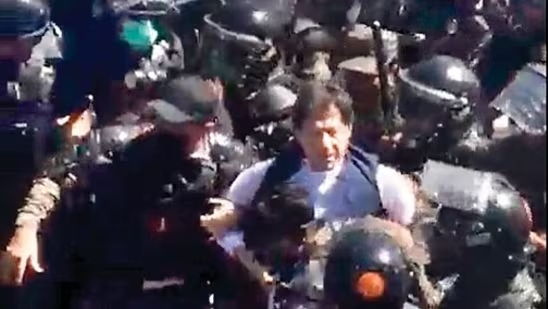
[Imran Khan being hauled off by the paramil Rangers]
Niazi’s are fatal for Pakistan. Lt General AAK ‘Tiger’ Niazi, the Military Governor of East Pakistan, presided over the dissolution of the unitary, if geograpgically ridiculous, state of Pakistan (with two wings a thousand miles apart). “Kaptaan” Imran Khan Niazi, who led Pakistan to cricket 1992 World Cup victory could end up ensuring martial law governments in all but name for the forseeable future with some coalition of non-Pakistan Tehreeq-i-Insaaf (PTI) parties acting as a jamhoori (democratic) front. The army would prefer, however, that Imran Khan retire hurt, accept a comfortable exile in London he knows only too well, and where all politically unwanted and inconvenient Pakistani politicians and ex-dictators find themselves in (to wit, Altaf Hussain of MQM, General Pervez Muharraf, Nawaz Sharif), free to dream, conspire, prepare and plot their political comebacks.
The trouble for Imran was that he had gnawed at the hand that had eased him onto the gaddi and his PTI into government with the enrollment of “electibles” from other parties induced/coerced to join his group, and otherwise propped up his rule. It didn’t expect that Imran’s ambitions transcended their support as he sought to emerge as a node of power independent of the army — drawing the people in millions to him personally and his cause. This was something new for the army because no political creature of theirs had, until Imran came along, shown the gumption to openly turn on his benefactors, collaring GHQ, Rawalpindi, as enemy of state and skewering the army as “fascist” and worse.
The shock and awe in the ranks of Pakistan army Generals was all the more sharp because they had so grossly misassessed Imran despite careful vetting by ISI, and because he seemed to play along for the first couple of years in the manner the army desired. Indeed, when COAS General Qamar Javed Bajwa formally alighted on Imran Niazi as the army’s choice, GHQ had hoped the army’s future and its role as the political puppet master had been secured for at least a decade, if not more.
Their Man in Islamabad looked the part — tall, handsome, of sporting renown with a raffish past as an Oxford Blue, playing cricket for Sussex and, more sensationally, as a tabloid celebrity with an active night life and record of endless squiring and partying with London lovelies, where such things as sniffing cocaine is a minor but cultivated vice. It was a social whirlygig that eventuated in a child (Sita) out of wedlock and a marriage to a Jewish heiress, Jemima Goldsmith. Speaking the King’s English as it should be spoke, looking as dapper in a Blazer as in a Shalwar, Awami shirt and jacket, Imran ticked off all the boxes for GHQ as the person who would be a great showpiece for Pakistan and get the country and the army back into the good books of the US and the West.
After all, the country had had enough with the public blundering and embarrassments inflicted by his predecessor Nawaz Sharif who, when in the White House, by way of an interaction with an amused President Barack Obama, read falteringly from a small piece of paper, a scene repeated in Beijing where he tried to speak what he had memorized and still needed assistance from a lackey to recall the words he had uttered many times before about bilateral relations being “shahad se meetha, Himalaya as ooncha, samandar se gehra” etc. — flowery stuff that flowed past a visibly uncomprehending and uncomfortable Chinese Premier!
But then ISI and GHQ had not reckoned with Imran’s plans for making himself the centre of Pakistani polity and nation, a more enduring fixture in Islamabad than the army thought prudent. He uncorked his idea of a “naya Pakistan” in the general elections and then stirred in the vision of a new “Medina” — an Islamic welfare state of the Prophet’s time solicitous of women, the old and the poor. All this was heady rhetoric, but in real life and in his Banigala estate in the Margalla Hills ringing Islamabad, he couldn’t escape what he was. Imran took himself out of London but couldn’t prevent channeling the natural inner playboy in him. It also didn’t help Imran’s cause with GHQ that he went out of his way to rile Washington with an attitude that suggested a more even Pakistani policy as between the US and Russia-China. All these factors nailed him in his “do or die” struggle with the army.
It was fascinating to see from this side of the Radcliff Line, Imran Niazi in the last months of his upended tenure in office and in the year since poking, provoking prodding, and goading the former Chief of the Army Staff, General Qamar Javed Bajwa, and the army establishment, and wondering when the PM would cross the redline and get his comeuppance. The rift finally occurred in 2018 when COAS General Asif Munir, then a Lieutenant General heading ISI, took a transcript of telephone conversations his agency had recorded — damning stuff indicating the involvement of Imran’s wife, Bushra Bibi, a rich divorcee and his 3rd wife (serially, not in a collective!) to the PM. Usually seen in a full head to toe religious camouflage, the begum was neck deep in major financial hanky panky (possibly relating to the shady real estate tycoon Malik Riaz and the “al Qadir Trust”).
This Bibi is not to be taken lightly though, being credited with turning a husband with a roving eye into apparently a chaste one woman man. That is until ISI, again, leaked to the press some salacious conversations it had electronically evesdropped on — fairly graphic “guftgu” it turned out, with a nubile lass from a well connected family who obviously provided the PM with diversion on careworn days from the presumably strict marital rigamarole of the Bushra. Who knows, it may have encouraged the Bibi to take even more liberties in exploiting her husband’s position and go after the filthy lucre, confident her spouse had lost the moral pretence to wag a finger at her. So, naturally, the prime minister asked for Munir’s removal from ISI, only to have Bajwa turn him down in a nice way, telling him that Munir needed to complete his tenure in that post. That was the turning point in their relations, and culminated in the replacement a year back of the PTI regime with the uneasy coalition of the Muslim League (Nawaz) and Asif Ali Zardari’s Pakistan People’s Party.
Actually, in a way, the Shahbaz interregnum has proved an electoral boon for Imran because the PTI regime’s economic policies had aggravated the economic conditions to such an extent they had begun spiralling into the ditch by the time Shahbaz Sharif took over, and he was stuck carrying the can for the economic downslide and faced the people’s ire. True, this spiral was reinforced with puzzling policies that Finance minister Ishaq Dar pursued, all the while huffing and puffing about how IMF dare not deny Pakistan the dollars, etc and this way made IMF’s recovery program a non-starter. Pressed by IMF, popular subsidies were periodically reduced, the price of petrol/diesel raised, and the cost of grain and other foodstuffs to the common man got on a fast escalator. It accelerated the erosion of the people’s support for the coalition government.
Still IMF was not satisfied. It asked for a longterm plan of action, still bigger cuts in subsidies and imposition of taxes on the wealthy which no government, including Imran’s, had considered doing. So even as the Pakistani economy was plunging with inflation at 30% plus rate, the Pakistani rupee crossing the 300 mark for a US dollar, a provision in the supposed economic recovery plan allowed the rich to continue importing super-expensive cars and monster SUV cruisers at a time when the hard currency reserves had dwinded to less than $3 billion! Skyrocketing prices, industrial shutdowns, jobless youth and no IMF credit nor investment from friendly sources resulted in near zero rate of economic growth and vaulting mass discontent. The scene was set for the May 9 conflagration. And Imran Khan supplied the spark — the incendiary charges and rhetorical jabs against Bajwa, the army, and the “imported government”.
The wild-eyed Pakistani youth who crowded the streets of Lahore, attacked army facilities, may not know who Janice Joplin is, or why that Sixties rock star’s lyrics — “Freedom is just another word for nothing left to lose” that became an anthem for a generation, so resonates with their calls for “azadi”. But Pak GHQ understood rightaway the danger to their corporate interest lurking in PTI’s campaign for change and freedom and how Imran’s rhetoric had fueled it. The army pulled the curtains down, or tried to, on this their latest experiment with PTI. Imran was shown scant respect as he was pummelled into an armoured police van and dumped in a jail until a Court ordered his release. Other PTI leaders were picked up and deliberately mistreated in jails and pressured into resigning from PTI and even politics. A big bunch of them complied. Army then began appying the tourniquet. A medical examination ostensibly revealed traces of cocaine in Imran Niazi’s urine, suggesting the ex-PM had not quite given up on snorting the white stuff. This was done, and his telephonic and other indiscretions leaked to the public with a view to tarring his reputation, to alienating him from his youthful followers. It didn’t work. Far from being disappointed and disgusted with Imran and his begum’s corruptions and other antics, the whole exercise boomeranged. Imran’s manifest mistreatment strengthened instead the popular revulsion against the army and the coalition regime. His trial under Army Act with harsh penalties that the Shahbaz cabinet is pushing but GHQ is dithering over, could exacerbate the situation allround.
The army does not fear Imran as much as it does the masses roused by him and ready to offer battle to the military. This has never happened before but it is what Imran promised. He has become too big a political phenomenon and force, and the danger of a popular blowup/backlash against the army is too real for General Munir and his cohort to ignore. Despite his open threats, he can’t be silenced, and he cannot be herded out of the country or done away with in the manner Zulfiqar Ali Bhtto was in 1979 by his then military nemesis — the Delhi St. Stephens College alum, General Zia ul-Haq — by hanging him. Because a martyred Imran could prove far more dangerous and likely produce a permanent fissure in the society between the army and the people, and that will not bode well for the army. In fact, the Pakistan army is reportedly a house divided — a large officer faction enthused by Imran and upset with Bajwa and now Munir, no longer trusts the top brass to safeguard the army’s interests and, by the by, the country’s.
Imran has powerful leverage — the support of the people which the army will not want to again test on the street. He knows his best card and so does GHQ, and so do the people. All the more reason for the army to ensure that elections are announced but only after Imran is first taken off the stage, disqualified from contesting elections on some charge or the other. This solution suits the trifecta of the army, Shahbaz and PPP.
In fact, General Munir speaking two days ago at the Command & Staff College, Quetta, touched on the army’s basic fear of Imran Niazi’s demagogic leadership. “Those who are making futile efforts to drive a wedge and weaken the unbreakable bond between the people of Pakistan and its armed forces”, the COAS blustered, “will never be able to succeed …Pak Army, being one of the strongest armies of the world, with the blessings of Allah and undaunted support of proud people of Pak, can neither be deterred nor coerced by anyone.” He wasn’t here referring to coercion by India!
Not one to be easily intimidated, Imran mocked the army in return. When is “having a political opposition, holding public meetings, creating awareness among the people and mobilising them for the elections [become] obstacles in the way of democracy?”, he asked before reminding the people that “Democracy ends when there is no opposition.” In a more aggressive vein, one of PTI’s younger leaders referring to the continuing harrassment of party members twittered: “This tyranny will not endure.” With this kind of exchanges, one thing is certain: The political water in the rhetorical kettle will keep boiling, but to what effect?
The curious thing is the army and the three main political parties — PTI, PML(N) and PPP, all desire elections. But other than PTI, the other two parties want Imran Niazi out of the fray because otherwise they stand no chance. There’s a possibility that in return for the easing of pressure on himself and Bushra Bibi, and other concessions, Imran may agree to sit out the elections. But he may insist on nominating someone else from his party and go to the people to get his candidate elected. His choice will doubtless be someone who takes dictation from the newly acclaimed eminence grise in Banigala, but this situation will once again make for a stormy relationship with the army, and the situation would have come a full circle. In the dynastic parties, Nawaz Sharif and Zardari will be pushing their respective progeny, Maryam and Bilawal Bhutto Zardari, to curry favour with GHQ and lead the charge. Except GHQ with these choices may be happier with the known devil — the weak and pliable Shahbaz than the unknown devils but may still side with Maryam, even Bilawal, than with Imran’s select leader of PTI.
Whichever party is permitted to win and whosoever becomes PM, it will be, as in previous elections, with the army’s help. It will mean the GHQ will still be in-charge and yet again operate from behind civilian democratic cover. The next elections in Pakistan will thus reaffirm the settled political system of army rule with a civilian democratic face. This is so because the option of a coup d’etat is now infeasible. Moreover, trying to manage an inherently unmanageable Pakistani state is a risky and cumbersome enterprise and something GHQ would ideally want nothing to do with. Why get saddled with the responsibility for everything going wrong — which is the likely outcome — when a “democratically-elected” government, doing the army’s bidding, can take the flak, face the music?


 Security Wise
Another very interesting article by Dr karnad. Congratulations. It was fascinating to read.
However I believe there is something more to add to what you have been saying.
1. You mention “So, naturally, the prime minister asked for Munir’s removal from ISI, only to have Bajwa turn him down in a nice way, telling him that Munir needed to complete his tenure in that post. ” The fact is that Gen. Bajwa actually did supposedly more pro-Imran Gen. Faiz Hamid. In fact Gen. Munir according to some Pakistani accounts, was removed on a Sunday and that too in a very short notice.
2. The political battle is not only between Imran and the Army. There is actually another significant dimension to the current political turmoil which is the battle for space between the Army and the Pakistani judiciary. It was the Pakistani judiciary that ultimately brought down Gen. Musharaaf , Pakistan’s last military dictator in 2007. Ever since then the army has been trying to dominate the judiciary with little success. The current crisis has magnified multifold since the pro-Munir PDM government has made public many taped private phone conversations between allegedly pro-Imran supreme court judges whom the present government accuse of being pro-Imran. The current government has even made some laws that aim at restricting the authority of the Pakistani judiciary in general. Most Pakistani commentators believe that the Army is using the current PDM government to restrict and curtail the space of the Pakistani judiciary.
“In a more aggressive vein, one of PTI’s younger leaders referring to the continuing harrassment of party members twittered: “This tyranny will not endure.”
Interesting observation is that this comment was made by none other than Omar Ayub Khan who happens to be the grandson of Ayub Khan, the first Pakistani military dictator. It is interesting that he is now the secretary general of the PTI. He made the comment on that basis.
Also another interesting point here is that Ijaz Ul Haq, the son of another military dictator Zia ul Haq and a leader of a small political party in Punjab who recently allied with PTI, is also under tremendous pressure by the Military to renounce ties with the PTI. He has so far resisted this pressure.
Another interesting fact is that Khadija Shah, the granddaughter of another ex-COAS Gen. Asif Janjua, is also currently behind bars for leading the protests that breached the Lahore Corps. Commanders’ home.
This just shows how Imran Khan has been able to divide even the blue blood military families. The Imran Khan phenomenon has completely politicized the Punjabi urban professional and middle classes, particularly the legal and in some cases like the ones mentioned above even the Pakistani military class.
I would love to know your thoughts on this analysis of mine.
In giving the Military State the garb of democracy Pakistan is very much taking the cues from its benefactor; the US. By letting the parties fight on the allotted space with clearly defined boundaries is precisely how the US security state dons the garb of democracy. It’s just that the American operation looks far more sophisticated owing to the business, education, entertainment, tech and media joined at the hip with each other and to the security state. Lacking all the tools of power to influence the polity towards the aims of a security state results in shambles that Pakistani state has found itself. One can not just imitate the American Security State without the tools.
In contrast, Chinese possess all the tools of power and exercise it, albeit crudely. The fear in Washington regarding China doesn’t revolve around how different the Chinese state is but precisely around how very much alike the two states are. From currency manipulation to subsidies and from mercantalism to domestic/foreign influence operations are characteristics of both China and the US. They just do it in different ways.
Greetings Mr. Karnad,
Sir, both the Nawaz-led Muslim League and the Zardari-led Pakistan Peoples Party are battle-hardened and extremely politically adroit players. They know all ins and outs of the corridors of power like the back of their hand. They can flood the streets at a very short notice and, in the case of Nawaz, they have much more bureaucratic penetration than this debauchee Imran Khan, who is nothing more than publicly advertised face of factions within the Establishment.
Nawaz Sharif was prepared to die in jail until the Generals told IK that he should [and would] be sent abroad for proper medical treatment or else we wouldn’t be able to control the reaction, if he breathed his last under our custody.
I can understand our Indian friends’ desire to present IK in their “analyses” as some sort of a out of control, immensely popular, tough politician who has taken on the Pakistani Security Establishment.
This ignorant and amnesiac understanding feeds a particular audience who, as I mentioned in my last comment under your previous article on Pakistan, has been rendered shockingly dumb and superficial by the perpetual dose of nonsense via mass communications. And, hence, if someone were to present a more sober and grownup assessment, he would be dismissed as someone on ISI’s payroll.
Some retired Indian army generals and bureaucrats who have started appearing on YouTube channels appear vacuous and clichéd when they share their takes on Pakistan.
If they of all men are getting ensnared in the frenzy and gibberish spread by various Pakistani YouTubers and media outlets and losing [or willfully surrendering] their critical faculties to retain a $profitable$ place in the “Right” ecosystem, then it augurs disaster and mass intellectual meltdown.
The times are hard here yet manageable.
Regards
@Bharat
Can’t understand the reason for intensive and over the top debate on the crisis happening across the Radcliffe line.Imran khan’s elimination was a forgone conclusion.Carrying out a “revolution” in the 21st century requires unanimous control over those “who control all the guns and eyes”.In Pak, this is the COAS who appoints and controls the corps commanders and DG ISI.Besides, given the vast business empire of GHQ built over decades, there is a vested interest for all three star officers to maintain the current order.Possibility of mutiny by senior officers is therefore, laughable.Hence, challenging the GHQ is nothing but a suicidal endeavor.
What is more significant that ISRO successfully launched NVS-01(second generation) navigation satellite.This satellite will provide encrypted navigation signals to the military as well as civilian consumers.Most importantly, it had an indigenous rubidium atomic clock something which only US,Russia,China have been able to develop.
Professor,
I guess from an Indian point of view, the only interest in Pakistan would be how it impacts Indian security. All the Tamasha happening there evokes hardly any interest. I just hope the Indian security establishment takes advantage of the situation to further sabotage the CPEC, and break the back of Jihadi Islam. Pakistan has become the laughing stock of the world.
@Bharat
Just as I and people like yourself had expected the GE F414 deal appears to be nothing more than a white elephant/An albatross round our necks.
https://www.reuters.com/business/aerospace-defense/us-set-allow-ge-make-engines-india-new-delhis-military-jets-2023-05-31/
The single line “the Indians are pressing for more tech transfer” makes it crystal-clear that this no different from screw-driving stuff that we already know.The US will never ever give anything that is of interest to India which makes any further information ostentatious display of “friendship” as meaningless.The new US ambassador may very well pack his bags and leave with the rest of his CIA retinue.
What is most astounding is that despite The thrust-vectoring Al-31F engine already localized, we have made literally zero effort at trying to improve it on own, tailoring it for the needs of AMCA and Tejas Mk2 and are instead crawling over the west for a engine with lower thrust.This is pure insanity.
In any case,I am certain we can secure ToT of Al-41 engine with Russia by paying a fraction of the price.
@Ayush,
I don’t understand why India should be so peeved when other countries do not part with their top technology. Where is local ingenuity? Look at how Americans developed the nuclear bomb, or stealth aircraft or recently their sixth generation aircraft. They put their minds together and did it themselves or got the best people in the world to do it for them.
Contrast that with what Indians are doing – no good aircraft engine, no powerful ship nuclear reactor, no thorium nuclear reactor (which they have worked for over six decades now), pathetic quality of nuclear weapons, no lithium battery of their own, no most advanced chips (12 nm is best) and the list would likely go on. It’s rocket technology was heavily assisted by the Russians. Even in AI apps, where there are Indians galore, India lags in advanced applications! Only recently have things started to change – but our public defence companies are likely one of the most inefficient around!
China, Germany, France UK – all have developed indigenous tech. Until India learns how to develop its own tech, I’m afraid it will always get the raw end of the deal. No point complaining about other countries on this score. We are talking about global power projection and geopolitics – no country will part with top tech easily.
Salacious article! However, one critical issue not addressed by the media is that if the Pakistani state breaks down due to a combination of a thorough economic meltdown and the subsequent foundering of political cohesion of the state there will result in the large movements of people. Where will they go? Certainly not to China despite the depth of their friendship. Afghanistan? No. Iran? Maybe. India? If hordes of desperate people begin to move eastward when the price of food becomes intolerable in Pakistan what will India, a still largely poor nation, do? There will copious sentiments pouring out of the West pressuring India to accept the refugees. The buck stops in India. It is time for Indians to plan for this contingency.
Completely agree @Gram Massla. No one is talking about this scenario in India. Maybe because Pakistan has a nuclear policy which states that they will use nuclear weapons in case India is known to be involved in breaking up that state (though I don’t think this very credible). But reality is reality. Have to plan for this scenario. Massla Gambhir hai!
LMAO.This scenario WILL NEVER EVER happen.Keeping pak afloat(barely) is one of the most important foreign policy objectives of both china and US , especially the former.China has repudiated billions of dollars of loans, The US and its European lapdogs have generously endowed pak with billions of dollars of cash.The list is long but the point is clear that neither west nor china are going to allow pak to meltdown economically.Pak’s problem is that they are so deep down the gutter that even these generosities are barely enough for a few weeks.Yes, pak has been certainly neutralized for the near-future(at least 5 years).But to conclude that we are finally going to get rid of the parasitic tumor across the Radcliffe line would be naive.
What all armchair analysts in this country miss is that we have won(not being triumphalist here)the 75 year long war of attrition with that rotten carcass of a dead dog.We have endured countless atrocities, hundreds of thousands of casualties but all of our neighbors except china have been neutralized for the time being.While Comparing this decomposing carcass to Nazi Germany is an abject insult to the latter but the fate pak has suffered right now is a miniature form of what the Nazis experienced a 78 years ago.Picking up a decades-long fight with an economy many times their size,military spending in excess of 4% of GDP with ZERO Defense industrial base ,extremely radicalized/uneducated population and infinitesimally inferior demographics and geography was never going to end well.Pakis as a whole, still despise india and it’s majority population(Hindus) with a fanaticism only comparable to the nazi hatred for Slavs and Jews.They fully deserve what they are getting.
@Ayush, one of the problems with Indian strategic thinking is that it accepts historical precepts about how India should behave, I.e., always defensive, always thinking it cannot shape outcomes. For this reason, there is limited to no creative thinking on how to break Chinese influence on Pakistan, which has become a low cost proxy way for China to contain India. All you hear from military leaders and bureaucrats are the sarkari monotones about stuff that’s been going on for decades.
A proactive Indian approach could be to figure out how to permanently break the proxy relationship so that China has no low cost way of containing India. The balkanisation of Pakistan and the crushing of the CPEC, without incurring high costs, is one such way. Covert warfare to accomplish this would be one such idea to accomplish it. Of course, unless one discusses in depth what the pros and cons are of such a strategy, nothing can be done. Sadly, such proactive strategic thinking is lacking in India.
It is time that India starts to think of new ways to break the Pak-China nexus, that does not overly depend on US or Chinese actions. And think about how to break the back of Jihadi Islam in the region. A weak state like Pakistan should not be allowed to delay growth and prosperity in South Asia. It’s high time!
Professor,
Here is a link for Ashley Tellis’ excellent analysis of nuclear policies, weapons, quality of weapons, command structure, delivery systems, deterrence, counter value or counterforce strategies etc. A ‘must read’ for anyone who wants to understand the balance of power between India-Pakistan-China.
Click to access 202207-Tellis_Striking_Asymmetries-final.pdf
He also highlights how the U.S. can support India develop thermonuclear weapons and its SSBN capabilities. I think the U.S. support on TN weapons is probably the lowest cost way for India to perfect these weapons.
For SSBN nuclear propulsion technology, India should really step up its intellectual chops and get something done on its own. I think a large part of lack of progress in India on some of these critical technologies is the lack of ambition, zeal and excellence (at least that’s my hypothesis based on my experience of Indian work ethic, leadership and confidence in achieving goals).